

My Biggest Mistake Was Trusting AI Coaching
The promise sounded perfect: instant feedback, 24/7 availability, consistent methodology, and a fraction of the cost of human coaches. When my biggest mistake was trusting AI coaching happened in early 2025, I wasn't alone. Mid-market leadership teams across North America were experimenting with AI coaching platforms, betting that automation could replace the messy, expensive work of developing leaders. Eighteen months later, the pattern is clear: companies that leaned hardest into AI-only coaching saw engagement scores flatten, manager turnover spike, and strategic execution stall. The tools delivered content, but not transformation.
The Seductive Case for AI Coaching
AI coaching platforms entered corporate learning with compelling pitch decks. They promised to democratize coaching access, eliminate scheduling friction, and deliver personalized development at scale.
The value proposition included:
- Unlimited coaching conversations for a flat subscription fee
- Data-driven insights from thousands of interactions
- No calendar juggling or timezone conflicts
- Consistent methodology across every session
- Integration with Slack, Teams, and learning management systems
For finance teams evaluating leadership coaching budgets, the math looked obvious. Why pay $300-500 per hour for executive coaching when an AI platform costs $50 per user annually?
The answer became clear when managers stopped changing behavior.
What Went Wrong: Four Failure Patterns
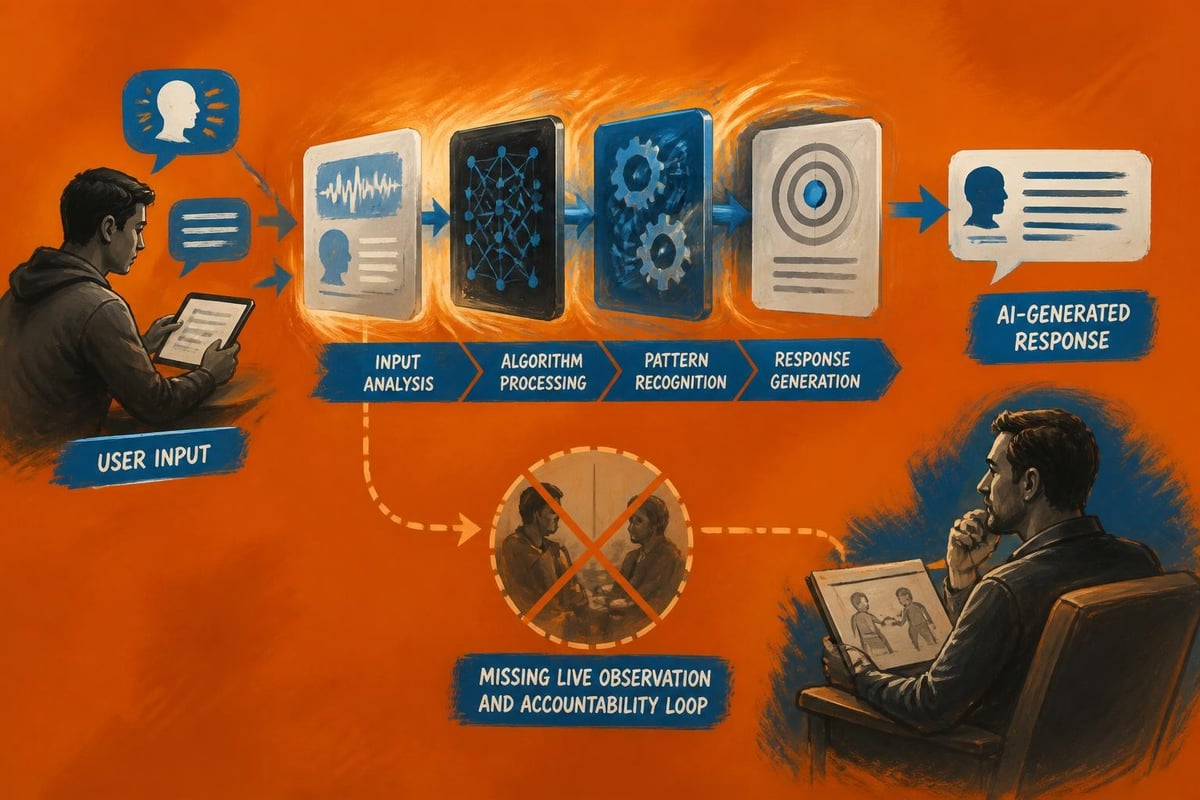
Pattern One: No Accountability Loop
AI coaching tools excel at conversation. They ask good questions, surface frameworks, and generate action plans. What they cannot do is show up in your Monday leadership meeting, watch you fumble a difficult conversation, and coach you through it in real time.
One VP of Sales at a 180-person SaaS company described the gap: "The AI gave me a beautiful conflict resolution framework. But when my top rep threatened to quit during our one-on-one, I froze. No chatbot was there to help me navigate that moment."
Human coaching creates accountability through:
- Live observation in actual business contexts
- Immediate feedback on real interactions
- Follow-up tied to specific commitments
- Relationship capital that makes avoidance harder
Research on ethical challenges in AI coaching highlights accountability gaps as a core limitation, noting that without human oversight, development commitments dissolve into digital noise.
Pattern Two: Context Collapse
AI models trained on aggregated coaching conversations produce generic advice. They lack the pattern recognition that comes from coaching hundreds of leaders in similar industries, stages, and market conditions.
| Human Coach Pattern Recognition | AI Coaching Output |
|---|---|
| "Your competitor just did this; here's how it plays out in 6 months" | "Consider competitive dynamics in your planning" |
| "Three clients hit this exact inflection point; here's the decision tree" | "Leadership transitions require careful stakeholder mapping" |
| "I've seen your industry consolidate; this window closes fast" | "Market timing is important for strategic initiatives" |
The advice isn't wrong. It's just not useful enough to change behavior under pressure.
Pattern Three: No Skin in the Game
Month-to-month human coaching with aligned incentives creates mutual risk. If results don't show, the coach doesn't stay. AI platforms operate on annual contracts with no performance accountability.
When my biggest mistake was trusting AI coaching became obvious, we examined retention data. Companies using AI-only coaching renewed at 34% after year one. Those using human coaches with clear KPI alignment renewed at 78%, because executive coaching tied to business outcomes creates visible progress.
Performance risk alignment matters:
- Coaches who tie fees to engagement scores take ownership
- Month-to-month terms force continuous value delivery
- Shared KPIs create partnership, not vendor relationships
- Incentive structures separate serious coaches from credential collectors
Pattern Four: Ignoring the Hard Stuff
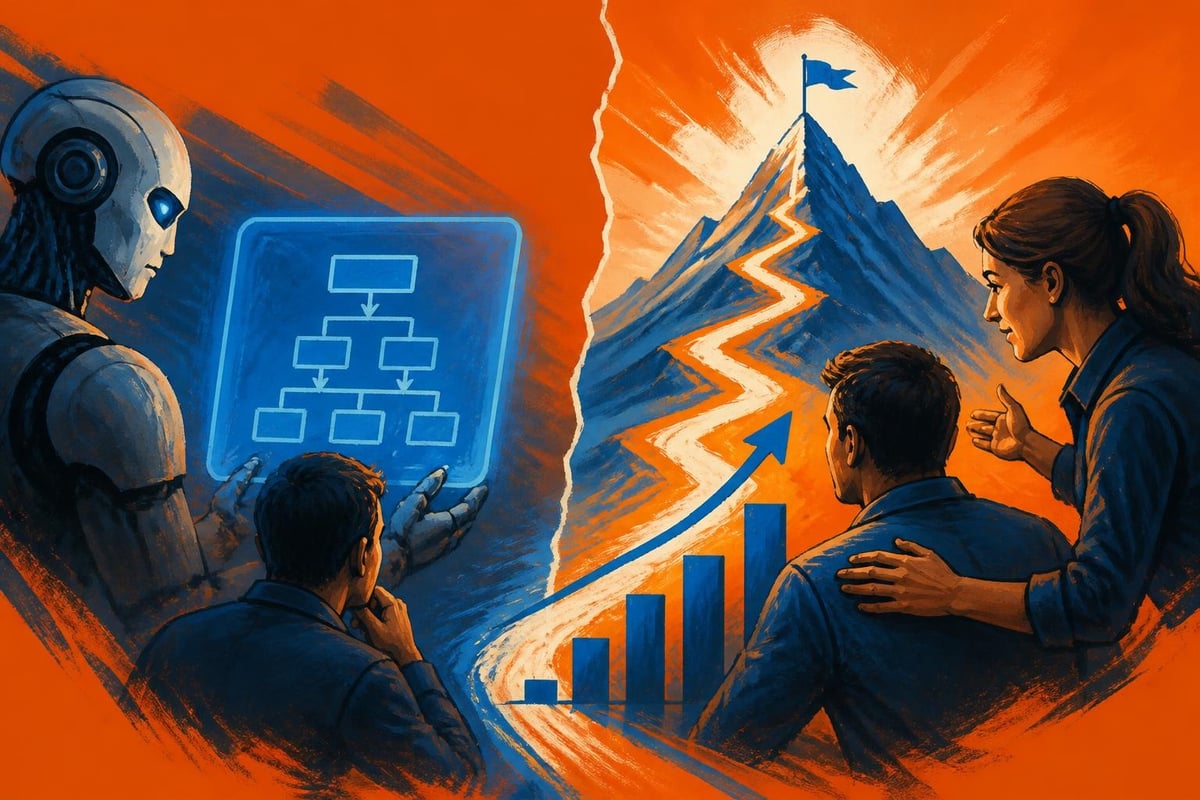
AI coaching avoids difficult truths. It won't tell a founder their leadership style is killing retention. It won't challenge a VP's excuse-making. It won't push back when a manager blames their team for execution failures.
Transformation requires confrontation. Not hostility, but direct challenge grounded in evidence and experience. One CEO reflected: "The AI told me my communication could improve. My coach told me I was avoiding conflict and it was costing me my best people. Guess which conversation changed my behavior?"
Where AI Actually Helps Coaching
The case against AI-only coaching doesn't mean AI has no role. The emerging Coaching 5.0 framework argues for augmentation, not replacement.
Effective AI augmentation includes:
- Pre-session reflection prompts that help clients prepare for coaching conversations
- Post-session action tracking that surfaces commitments and progress
- 360 data aggregation that identifies patterns across feedback sources
- Content libraries that supplement human coaching with frameworks and tools
- Scheduling and admin automation that reduces coordination friction
The AI Coaching Alliance roadmap outlines standards for responsible AI integration, emphasizing human oversight and ethical guardrails.
When business coaches use AI to enhance delivery rather than replace expertise, outcomes improve. The tool handles routine tasks; the human handles judgment, context, and accountability.
The Real Cost of Getting It Wrong
Substituting AI for human coaching doesn't just waste money. It erodes trust in development altogether.
After six months of AI-only coaching, one 220-person manufacturing company saw:
- Manager engagement scores drop 14 points
- Three senior leaders exit for competitors
- Strategic initiative completion fall from 68% to 41%
- Employee perception of leadership development funding as "checking boxes"
The VP of HR summarized: "My biggest mistake was trusting AI coaching to do work that requires human judgment. We thought we were saving money. We were actually destroying credibility."

Recovery took nine months, a complete coaching vendor change, and direct CEO involvement to rebuild manager trust in development investment.
What Buyers Should Demand Instead
The antidote to AI coaching disappointment isn't rejecting technology. It's demanding proof of actual transformation.
Ask potential coaching providers:
- Will you coach live in our meetings, not just in private sessions?
- What KPIs will you tie your work to, and how will we track them?
- What contract terms allow us to exit if results don't show?
- How do you use AI to augment, not replace, your expertise?
- What specific outcomes have you delivered for companies our size and stage?
Credential worship and certification obsession miss the point. The legal and governance implications of treating AI as a third party in coaching relationships highlight that technology cannot substitute for human accountability.
The transformation challenge remains: people change slowly, and behavioral shifts require sustained human pressure, not automated prompts.
FAQ
What is AI coaching and how does it differ from human coaching?
AI coaching uses algorithms and language models to simulate coaching conversations, providing automated feedback and development suggestions. Human coaching involves live interaction, context-specific observation, accountability loops, and real-time adjustment based on client behavior and business outcomes.
Can AI coaching replace human executive coaches?
No. AI coaching lacks the accountability, context recognition, and real-time adaptation required for leadership transformation. Research shows AI works best as an augmentation tool for human coaches, not as a replacement.
What are the main risks of relying solely on AI coaching?
The primary risks include lack of accountability, generic advice that ignores business context, no performance incentive alignment, avoidance of difficult truths, and erosion of trust when development programs fail to deliver real behavioral change.
How can AI effectively support human coaching?
AI can handle pre-session preparation, post-session action tracking, 360 data aggregation, content libraries, and administrative tasks. This allows human coaches to focus on judgment, live observation, accountability, and transformation work.
What should companies look for when evaluating coaching providers?
Demand evidence of measurable outcomes, KPI-aligned engagement, month-to-month terms without long contracts, live coaching in real business contexts, and transparent risk-sharing models. Avoid providers who emphasize credentials over results.
Why did AI coaching fail for mid-market companies?
AI coaching failed because it provided content without transformation. Managers received frameworks but lacked the live accountability, context-specific guidance, and sustained pressure needed to change behavior under real business conditions.
What results should companies expect from effective coaching?
Effective coaching delivers faster decision-making, managers who coach their teams, stronger cross-functional communication, higher engagement and retention scores, and cleaner execution across strategic priorities, all tied to measurable KPIs.
How much does quality executive coaching cost compared to AI platforms?
Human executive coaching typically costs $300-500 per hour or $3,000-8,000 per month for retained engagements. AI platforms cost $50-200 per user annually. However, AI-only approaches often fail to deliver behavior change, making the apparent savings illusory.
What does month-to-month coaching with aligned incentives look like?
Month-to-month coaching means no long-term contracts and the ability to exit if results don't appear. Aligned incentives tie coach compensation to measurable outcomes like engagement scores, retention improvements, or KPI achievement, creating shared risk and mutual accountability.
My biggest mistake was trusting AI coaching taught companies an expensive lesson: transformation requires human accountability, live observation, and sustained pressure that algorithms cannot provide. If you need Noomii Corporate Coaching that delivers measurable leadership development through real-time coaching in your meetings, clear KPI tracking, and month-to-month terms with aligned incentives, connect with providers who roll up their sleeves and share the risk of transformation work.


Leave a Reply
Want to join the discussion?Feel free to contribute!