
Corporate Coaching Programs in South Korea (2026 Guide)
South Korean organizations are investing in leadership development at unprecedented levels, but most corporate coaching programs fail to deliver measurable ROI. The gap between investment and impact stems from misaligned expectations, inadequate coach matching, and programs designed for Western organizational cultures that ignore Korea's unique workplace dynamics. Companies that continue using generic coaching models will waste resources while their competitors build adaptive leadership capabilities that drive actual business outcomes.
The Structural Problem Most HR Leaders Miss
Corporate coaching programs in South Korea face a fundamental challenge that Western frameworks don't address: the collision between hierarchical organizational structures and the need for collaborative, adaptive leadership. Korean companies typically operate with steep power distances and defined seniority systems (inhwa and kibun cultural principles). Yet they're competing in markets demanding rapid innovation and flat decision-making.
The disconnect creates three critical failures:
- Coaches unfamiliar with Korean workplace culture mistake legitimate cultural norms for dysfunction
- Programs designed for individual achievement clash with collective responsibility expectations
- Western coaching models emphasize direct confrontation when Korean professionals require face-saving approaches
A 2025 analysis from the Korea Productivity Center documents this tension, showing that Korean companies increasingly adopt blended learning approaches combining traditional respect hierarchies with modern coaching methods. Organizations that acknowledge this complexity outperform those applying one-size-fits-all solutions.

What Actually Works: Evidence from the Field
Three chaebols and two multinational subsidiaries implemented targeted coaching interventions in 2025 with measurably different outcomes. The successful programs shared four characteristics absent from failed initiatives:
- Coach selection based on Korea-specific sector expertise rather than general executive coaching credentials
- Diagnostic assessments calibrated to Korean workplace behaviors and communication patterns
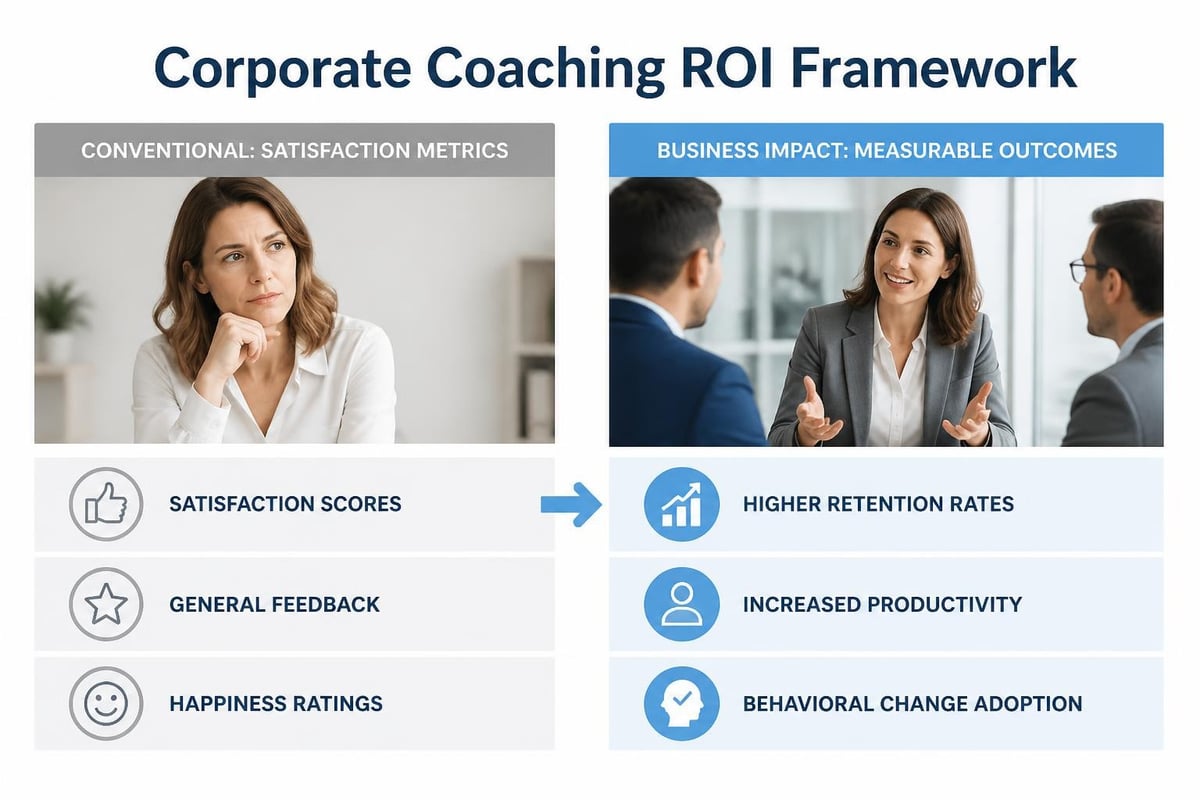
- Metrics tied to business outcomes (retention, promotion velocity, team productivity) instead of satisfaction scores
- Integration with existing HR systems rather than standalone programs
The organizations that treated coaching as isolated from performance management, succession planning, and cultural initiatives saw minimal impact. Those that embedded coaching within broader leadership development frameworks achieved statistically significant improvements in leadership bench strength and engagement scores.
Government Support and Compliance Requirements
Korean government initiatives have expanded corporate training support substantially since 2024. The Ministry of Employment and Labor increased subsidies for enterprise-level coaching and leadership development, particularly for SMEs and technology companies. These flexible training programs allow organizations to customize coaching interventions while maintaining compliance with national workforce development standards.
Key compliance considerations for corporate coaching programs in South Korea include:
- Documentation requirements for government-subsidized training programs
- Alignment with Labor Standards Act provisions regarding employee development
- Data privacy regulations governing assessment tools and coaching records
- Equal opportunity standards ensuring coaching access across organizational levels
Public institutions like the Korea Employment and Labor Educational Institute demonstrate how structured coaching content meets regulatory standards while delivering practical leadership skills. Government agencies require coaching programs that document outcomes, demonstrate fair access, and align with public service mission objectives.
The ROI Calculation Most Programs Ignore
Corporate coaching programs in South Korea typically cost between ₩8 million and ₩25 million per executive annually when properly scoped. Yet most organizations can't answer basic questions about program effectiveness:
| Metric Category | What Gets Measured | What Should Be Measured |
|---|---|---|
| Engagement | Coaching session attendance | Behavioral change adoption rates |
| Performance | Self-reported satisfaction | Objective performance improvements |
| Retention | Program completion rates | High-performer retention vs. control group |
| Culture | Survey sentiment scores | Toxic behavior incident reduction |
| Business Impact | Learning objectives achieved | Revenue per leader, team productivity gains |
The difference between conventional and effective measurement systems determines whether coaching delivers verifiable value or becomes another HR expense without accountability. Organizations that track leading indicators (behavioral adoption, peer feedback, decision quality) can course-correct programs mid-cycle rather than discovering failure after 12 months of investment.
Matching Coaches to Korean Organizational Needs
The coach selection process determines program outcomes more than any other variable. Generic matching based on credentials and availability produces mediocre results. Precision matching based on sector expertise, cultural competency, and specific organizational challenges drives measurable impact.
Critical matching criteria for corporate coaching programs in South Korea:
- Industry background: Manufacturing, technology, financial services, and healthcare organizations face distinct leadership challenges requiring relevant coach experience
- Cultural fluency: Understanding Korean business communication norms, not just language capability
- Intervention expertise: Coaches who've successfully addressed toxic leadership, low engagement, or strategic misalignment in similar contexts
- Assessment literacy: Ability to interpret validated diagnostic tools and translate findings into actionable development plans
Research from Harvard Kennedy School confirms that successful leadership development programs share rigorous participant-program fit as a defining characteristic. Korean organizations amplify this requirement because cultural misalignment creates immediate credibility problems that undermine coaching relationships.
The challenge intensifies when addressing senior executives. C-suite leaders in Korean organizations often view coaching as remedial rather than developmental. Programs succeed when they position coaching as strategic advisory support aligned with business priorities rather than performance correction.
Team-Level Coaching: The Overlooked Opportunity
Most corporate coaching programs in South Korea focus exclusively on individual executive coaching. This misses the larger opportunity: collective team development that addresses systemic dysfunction rather than individual skill gaps.
Korean organizations operate through team structures where individual brilliance matters less than collective execution. Coaching interventions that treat leaders as isolated individuals fail to address the relational dynamics, communication breakdowns, and misaligned incentives that actually constrain performance.
Team coaching approaches that work with intact leadership teams deliver superior results in Korean contexts because they:
- Address actual working relationships rather than hypothetical leadership scenarios
- Surface cross-functional misalignments that individual coaching never reveals
- Build shared accountability for outcomes instead of individual development goals
- Resolve conflicts in real-time within cultural norms around hierarchy and face-saving
Organizations implementing team coaching report faster behavioral change adoption and more sustainable culture shifts compared to individual-only programs.
Scaling Corporate Coaching Across Korean Organizations
Korean conglomerates and multinational subsidiaries operating in Korea face distinct scaling challenges. Programs that work for 10 executives don't automatically work for 100 or 1,000 leaders across multiple business units, regions, and organizational levels.
Scalability requirements include:
- Standardized assessment frameworks that maintain consistency across coaching engagements while allowing customization
- Coach network management ensuring quality control and cultural competency across providers
- Technology infrastructure supporting scheduling, progress tracking, and outcome measurement
- Integration protocols connecting coaching interventions to performance management and succession planning systems
- Cost management maintaining per-leader economics while expanding program reach
Organizations similar to those served by enterprise coaching providers in Japan face comparable challenges around cultural nuance, hierarchical structures, and scaling across diverse business units. The operational discipline required to maintain program quality at scale differentiates professional coaching implementations from ad-hoc initiatives.

The Technology Layer Most Programs Need
Digital coaching platforms and AI-assisted tools have proliferated since 2024, creating both opportunities and risks for corporate coaching programs in South Korea. The right technology enhances human coaching through better matching, progress tracking, and outcome measurement. The wrong technology substitutes algorithms for human judgment and creates compliance risks around data privacy.
Effective technology implementations support:
- Validated assessment delivery and automated scoring with human interpretation
- Coach-client matching algorithms incorporating sector expertise and cultural factors
- Progress dashboards showing behavioral change indicators and business impact metrics
- Confidential note-taking and session documentation meeting Korean privacy standards
- Integration with HRIS systems for seamless program administration
Organizations exploring AI applications in business coaching should maintain clear boundaries between technology-assisted efficiency and the irreplaceable human elements of coaching relationships. Korean professionals particularly value personal connection and trust-building that algorithms can't replicate.
Addressing Toxic Leadership Through Structured Intervention
Korean organizations face growing pressure to address workplace toxicity as younger employees reject traditional acceptance of abusive management practices. Corporate coaching programs designed to remediate toxic leadership behaviors require different approaches than standard executive development.
Effective toxic leadership interventions include:
| Component | Why It Matters | Implementation Approach |
|---|---|---|
| Objective Assessment | Leaders lack self-awareness about impact | 360-degree feedback with behavioral specificity |
| Clear Consequences | Ambiguity enables continued dysfunction | Documented performance standards tied to coaching progress |
| Behavioral Replacement | Criticism without alternatives fails | Specific skill-building in communication and conflict resolution |
| Team Repair | Individual change insufficient when trust destroyed | Facilitated team sessions addressing past harm and rebuilding norms |
| Ongoing Accountability | Short-term compliance reverts without monitoring | Monthly progress reviews with stakeholder feedback |
Organizations that treat toxic leadership as a coaching opportunity without accountability mechanisms waste resources. Those that combine coaching with clear performance expectations and consequences see measurable behavior change. The difference lies in treating coaching as developmental support within a broader performance management framework rather than a substitute for management action.
What CHROs Should Demand from Coaching Vendors
Korean HR leaders evaluating corporate coaching programs should expect vendors to demonstrate specific capabilities beyond generic coaching credentials. The vendor selection process determines whether programs deliver strategic value or become expensive check-the-box initiatives.
Non-negotiable vendor requirements:
- Documented outcomes from similar Korean organizational contexts with verifiable references
- Assessment tools validated for Korean workplace populations with published reliability data
- Coach network with demonstrated Korea-specific expertise, not just international credentials
- Measurement frameworks tracking business impact beyond participant satisfaction
- Compliance capabilities addressing Korean labor law, privacy regulations, and government reporting requirements
- Integration protocols compatible with common Korean HRIS and learning management systems
Vendors unable to provide evidence of these capabilities should be disqualified regardless of brand recognition or pricing. The coaching industry includes many providers offering generic services repackaged as Korea-specific without substantive cultural competency or local expertise.
Questions that reveal vendor capability include requests for specific case examples, coach selection methodology documentation, assessment validation studies, and outcome measurement approaches. Vendors who respond with generalities or deflect to relationship-building lack the operational discipline required for enterprise-scale programs. Understanding executive coaching costs in context helps HR leaders evaluate whether pricing reflects genuine value or market positioning.
Building Internal Coaching Capability
Some Korean organizations are developing internal coaching capabilities rather than relying exclusively on external vendors. This approach works when organizations have sufficient scale, leadership development maturity, and commitment to professional coach training and certification.
Internal coaching programs require:
- Formal coach training meeting International Coach Federation or equivalent standards
- Clear boundaries separating coaching relationships from performance management
- Protected time allocation for coaching activities separate from operational responsibilities
- Supervision and continuing education maintaining coach skill development
- Ethical guidelines addressing conflicts of interest and confidentiality
Organizations building internal capability should maintain external coach networks for senior executives, specialized interventions, and situations where internal coaches face inherent conflicts of interest. The hybrid model combining internal and external resources often delivers optimal cost-effectiveness and program flexibility.
Future Trends Reshaping Corporate Coaching in Korea
Three trends will fundamentally alter corporate coaching programs in South Korea over the next 24 months based on current trajectory and organizational demands:
Trend 1: Shift from Individual to Systems Coaching
Organizations are recognizing that individual leader development without addressing systemic dysfunction produces limited results. Coaching interventions increasingly target leadership systems, team dynamics, and organizational culture rather than isolated skill-building. This systems approach requires coaches with organization development expertise beyond traditional executive coaching backgrounds.
Trend 2: Integration with Succession Planning
Korean companies are embedding coaching within formal succession planning processes rather than treating development as separate from talent decisions. High-potential leaders receive coaching as part of accelerated development paths with clear links to promotion criteria and role transitions. This integration increases coaching program accountability and strategic relevance.
Trend 3: Outcome-Based Vendor Contracting
Progressive organizations are moving away from time-based coaching contracts toward outcome-based agreements where vendor compensation ties partially to measured improvements in leadership effectiveness, retention, or team performance. This shift transfers risk to vendors and forces greater discipline around program design and outcome measurement.
These trends favor providers with sophisticated assessment capabilities, systems thinking expertise, and willingness to accept accountability for measurable results. Vendors selling coaching hours without outcome commitments will face declining market relevance.
Frequently Asked Questions
What is the typical duration of corporate coaching programs in South Korea?
Effective corporate coaching programs in South Korea typically run 6-12 months for individual executive coaching and 9-18 months for comprehensive leadership cohort programs. Shorter engagements rarely produce sustainable behavioral change, while programs exceeding 18 months often indicate poor design or lack of clear objectives. Duration should align with specific development goals and measurable milestones rather than arbitrary timeframes.
How do Korean corporate coaching programs differ from Western approaches?
Korean corporate coaching programs must account for hierarchical organizational structures, collective responsibility norms, and communication styles emphasizing indirect feedback and face-saving. Effective programs adapt Western coaching methodologies to Korean cultural contexts rather than imposing foreign frameworks that ignore workplace realities. Coach selection, assessment interpretation, and intervention design all require Korea-specific expertise for meaningful impact.
What ROI should organizations expect from corporate coaching investments?
Organizations implementing well-designed corporate coaching programs in South Korea typically see 3-5x ROI through improved retention of high-performers, faster leadership development cycles, and measurable productivity gains. However, ROI depends entirely on clear objective-setting, rigorous measurement, and program quality. Generic coaching without targeted interventions and accountability rarely delivers positive returns.
Do government subsidies cover corporate coaching programs?
Korean government programs provide partial subsidies for qualifying corporate training and development initiatives including coaching programs, particularly for SMEs and designated strategic industries. Subsidy availability and requirements vary by program and organizational characteristics. Companies should consult with the Korea Employment and Labor Educational Institute or Ministry of Employment and Labor for current eligibility criteria and application processes.
How should organizations select coaches for Korean executives?
Coach selection should prioritize demonstrated expertise in relevant industries, proven experience with Korean organizational contexts, and specific capabilities addressing identified leadership challenges. Credentials matter less than track record of measurable outcomes in similar situations. Organizations should interview multiple coaches, review case examples, and verify references before engagement. Cultural competency and sector knowledge outweigh generic coaching certification in determining program success.
Corporate coaching programs in South Korea deliver measurable value when designed around cultural context, business priorities, and rigorous outcome measurement rather than generic leadership development frameworks. Organizations that demand evidence-based approaches and vendor accountability will build adaptive leadership capabilities while competitors waste resources on ineffective programs. Noomii Leadership Coaching helps Korean organizations and multinationals operating in Korea implement precision-matched coaching solutions with validated assessments, compliance alignment, and measurable business impact through our global network of certified executive coaches and proprietary matching methodology.



Leave a Reply
Want to join the discussion?Feel free to contribute!