
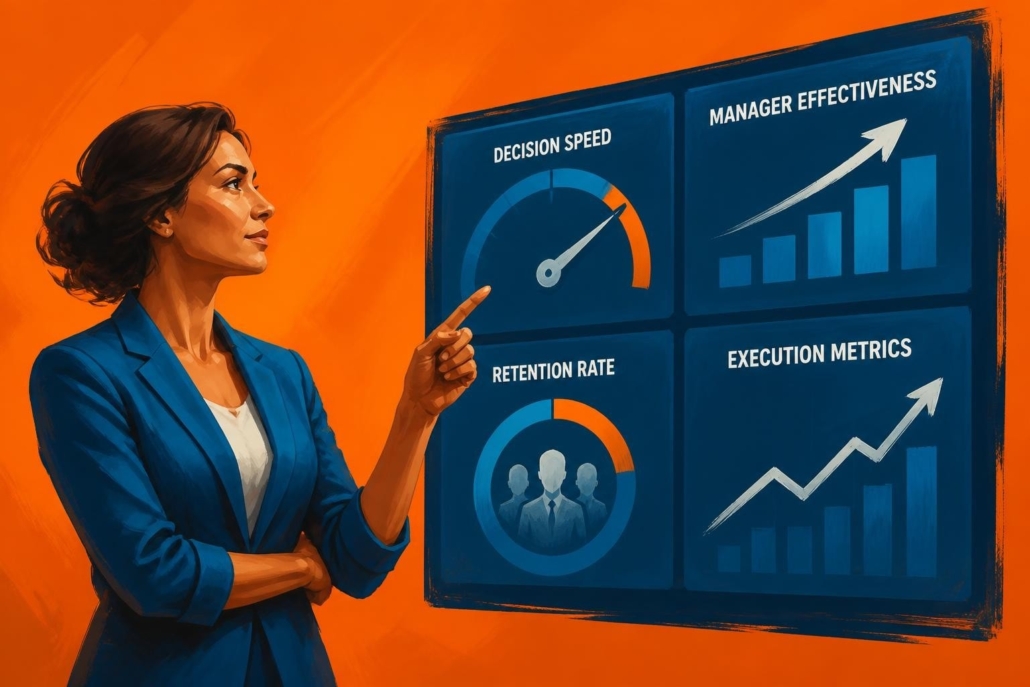
The Truth About Coaching Results (2026 Evidence)
Most coaching engagements end with a thank-you email and vague claims about "transformation." Few companies can point to a specific metric that improved, a behavior that changed, or a business outcome that shifted. The truth about coaching results is uncomfortable: the majority of coaching programs deliver unmeasured, unverifiable, and ultimately forgettable experiences. That's not because coaching doesn't work. It's because most coaching is designed around the coach's comfort zone, not the client's business priorities.
Why Most Coaching Results Remain Invisible
The coaching industry has built an ecosystem that rewards inputs over outcomes. Certifications, hours logged, session counts, and testimonials dominate the conversation. Actual results? Those are harder to pin down.
Here's what commonly passes for "proof" in coaching:
- Participant satisfaction surveys
- Self-reported confidence increases
- Anecdotal stories of breakthroughs
- Before-and-after reflections
None of these are business metrics. None tie to revenue, retention, decision speed, or execution quality. The truth about coaching results is that subjective feedback isn't enough when companies invest serious budget into leadership coaching or manager development.
The Certification Myth and Results Avoidance
Many coaches hide behind credentials. ICF, CCE, PCC designations signal training hours and test scores. They don't signal results. In 15 years of observing the coaching market, I've seen coaches with every certification fail to move the needle, and I've seen uncertified practitioners transform teams because they focused on performance, not process.

Certifications teach methodology. They don't teach you how to diagnose why a sales team misses pipeline targets, why managers avoid tough conversations, or why cross-functional execution stalls. Those skills come from repetition, industry context, and accountability structures that most certification programs never address.
What Actually Drives Measurable Coaching Outcomes
When coaching works, it's because someone tied the engagement to a specific, observable change. Not a feeling. Not a realization. A change.
| Outcome Type | Weak Metric | Strong Metric |
|---|---|---|
| Leadership development | "Increased self-awareness" | Manager retention improved 22% |
| Team coaching | "Better collaboration" | Decision cycle reduced from 3 weeks to 5 days |
| Sales coaching | "More confidence" | Pipeline conversion up 18% quarter-over-quarter |
| Executive coaching | "Clearer vision" | Operating rhythm established, tracked weekly |
The truth about coaching results shows up in scorecards, not surveys. Companies that get value from coaching set clear KPIs upfront, track progress weekly or monthly, and adjust when the needle doesn't move.
Real Case Study: Manager Training Tied to Retention
A 180-person tech services company faced 34% annual turnover in their mid-level managers. Exit interviews revealed unclear expectations, inconsistent feedback, and a lack of coaching from senior leaders.
Problem: High manager turnover drove recruiting costs and destabilized client accounts.
Diagnosis: Managers weren't receiving structured coaching from their own leaders. No feedback cadence. No development conversations.
Solution: Implemented monthly manager coaching sessions focused on three areas: pipeline visibility, one-on-one structure, and difficult conversation frameworks. Senior leaders were coached live during leadership meetings to model real-time feedback.
Result: Manager retention improved to 88% over 12 months. Client NPS increased 11 points. Recruiting costs dropped 40%.
Lesson: Coaching works when it's embedded in operating rhythm, not treated as a side program. When leaders coach visibly and consistently, the behavior cascades.
The ROI Problem: Why Coaching Avoids Numbers
Most coaches resist tying their work to financial outcomes. The reasons range from "coaching is holistic" to "you can't measure transformation." But the truth about coaching results is simpler: if you can't measure it, you can't improve it, and you probably shouldn't pay for it.
Common excuses for avoiding ROI:
- "Coaching addresses soft skills, which are hard to quantify."
- "Results take years to materialize."
- "Too many variables affect business outcomes."
All three are defensible in theory. All three are often cover for ineffective coaching. Soft skills drive hard outcomes. If communication improves, meeting efficiency should improve. If decision-making sharpens, project timelines should tighten. If managers learn to coach, retention should stabilize.
When executive coaching packages avoid ROI discussions, it's usually because the coach doesn't know how to connect behavior change to business metrics. That's a skill gap, not a measurement problem.

Proprietary Framework: The Four-Layer Coaching Accountability Model
Effective coaching stacks accountability across four layers:
- Behavioral KPIs: What specific actions will the coachee take weekly? (e.g., complete three feedback conversations, review pipeline every Monday, run one leadership team retrospective)
- Team Metrics: What team-level outcomes should improve? (e.g., sprint completion rate, one-on-one frequency, forecast accuracy)
- Business Metrics: What company-level numbers should shift? (e.g., revenue per employee, voluntary turnover, sales cycle length)
- Operating Rhythm: How is progress reviewed, adjusted, and reinforced? (e.g., weekly check-ins, monthly scorecard reviews, quarterly recalibration)
This model forces clarity. If a coaching engagement can't identify metrics at all four layers, it's likely a feel-good exercise.
What Buyers Miss When Evaluating Coaching
Mid-market companies and Fortune 500 divisions often hire coaching the same way they hire consultants: based on credentials, proposals, and references. But coaching isn't consulting. Results don't come from slide decks. They come from sustained behavior change under pressure.
What to ask before hiring a coach:
- What specific metrics will we track monthly?
- How do you coach during live meetings versus behind closed doors?
- What happens if we don't see progress in 90 days?
- Can you show examples of KPIs that improved with past clients?
- Are you willing to tie fees to outcomes?
Most coaches stumble on the last question. Outcome-based pricing is rare because most coaches don't trust their own impact enough to share risk. The truth about coaching results is that confidence in outcomes should lead to skin in the game.
The AI Coaching Disruption Nobody's Talking About
AI coaching tools are flooding the market in 2026. Platforms promise 24/7 availability, instant feedback, and fraction-of-the-cost pricing. Some are useful for reflection prompts and skill drills. None replace a coach who diagnoses real team dysfunction, facilitates hard conversations, or holds leaders accountable when execution falters.
The real risk isn't AI replacing coaches. It's AI exposing coaches who never delivered measurable value in the first place. If your coaching can be replicated by AI for business coaching, it was probably shallow to begin with.
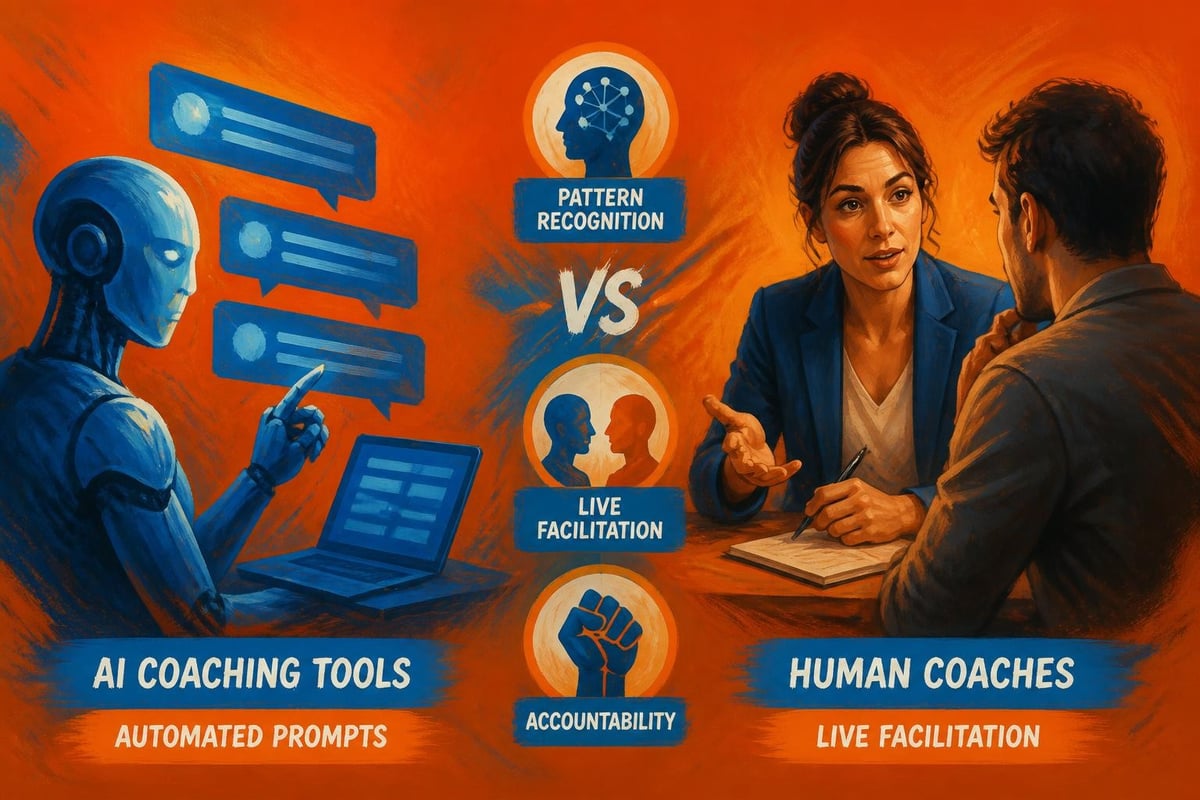
| Factor | AI Coaching Tools | Human Coaches (Results-Focused) |
|---|---|---|
| Availability | 24/7, instant | Scheduled, limited |
| Cost | $50-$500/month | $3,000-$15,000/month |
| Customization | Template-driven | Context-specific |
| Accountability | Self-reported | Externally enforced |
| Live facilitation | None | High-stakes meetings, real-time |
| Business integration | Low | High when embedded |
AI tools work for individual reflection. Human coaches work for organizational change. Choose based on the problem you're solving.
FAQ
Q: What is the average ROI of executive coaching?
A: Studies claim 5x to 7x ROI, but most are based on self-reported data. Real ROI depends on tying coaching to specific KPIs like retention, decision speed, or revenue per employee.
Q: How long does it take to see coaching results?
A: Behavioral change can appear in 4-6 weeks. Team-level metrics typically shift in 90 days. Business outcomes may take 6-12 months depending on the engagement.
Q: Can you measure soft skills coaching outcomes?
A: Yes. Soft skills drive hard outcomes. Better communication reduces meeting time. Stronger feedback improves retention. Clearer delegation speeds execution.
Q: What's the difference between coaching and consulting?
A: Consulting delivers recommendations. Coaching builds capability. Consulting solves the problem for you. Coaching equips you to solve it yourself.
Q: Why do most coaching programs fail to deliver results?
A: They lack clear KPIs, accountability structures, and integration into operating rhythm. Coaching treated as a side program rarely sticks.
Q: Should coaching be tied to bonuses or promotions?
A: No. Coaching should be voluntary and psychologically safe. But the outcomes of coaching (better performance, leadership capability) naturally influence career progression.
Q: How do you evaluate a coach before hiring?
A: Ask for case studies with specific metrics. Request references you can call. Test their diagnostic skills in a trial session. Avoid coaches who won't discuss ROI.
Q: Is certification necessary for effective coaching?
A: No. Certification signals training, not results. Look for coaches with industry experience, proven outcomes, and willingness to tie fees to performance.
Q: Can coaching work remotely or does it require in-person sessions?
A: Both work. Remote coaching is efficient for one-on-ones. In-person coaching is valuable for team facilitation and high-stakes leadership sessions. Hybrid models are most common in 2026.
The truth about coaching results is that most programs avoid measurement, hide behind credentials, and deliver unmeasured experiences. Real coaching ties to KPIs, integrates into your operating rhythm, and improves metrics you already track. If you're ready for practical corporate coaching that delivers measurable outcomes in leadership development, manager training, and team performance, explore how Noomii works month-to-month with no long contracts and clear accountability from day one.



Leave a Reply
Want to join the discussion?Feel free to contribute!