

Can Coaching Really Work? Evidence, Myths, and ROI
The question "can coaching really work" surfaces whenever organizations face budget reviews, leadership gaps, or failed vendor relationships. The honest answer is yes, coaching works-but only under specific conditions that most buyers and coaches ignore. The industry has spent decades confusing certification worship with capability, theory with practice, and activity with outcomes. Understanding what separates effective coaching from expensive theater requires looking at evidence, not marketing claims.
What the Research Actually Shows About Coaching Effectiveness
Multiple meta-analyses confirm that coaching delivers measurable outcomes when properly designed and executed. The Vrije Universiteit Amsterdam study analyzed individual-level outcomes in organizational contexts, finding significant positive effects on performance, well-being, and goal-directed self-regulation. These weren't marginal improvements-they represented meaningful changes in how people led, decided, and executed.
Key findings from coaching effectiveness research include:
- Improved work performance and productivity
- Enhanced communication and relationship quality
- Stronger goal achievement and self-regulation
- Increased confidence and reduced impostor syndrome
- Better instructional practice in educational settings
The Institute of Coaching outlines benefits ranging from increased self-confidence to improved work performance, but context matters enormously. Coaching tied to specific business outcomes outperforms coaching focused on abstract personal development. The difference lies in design, not intention.
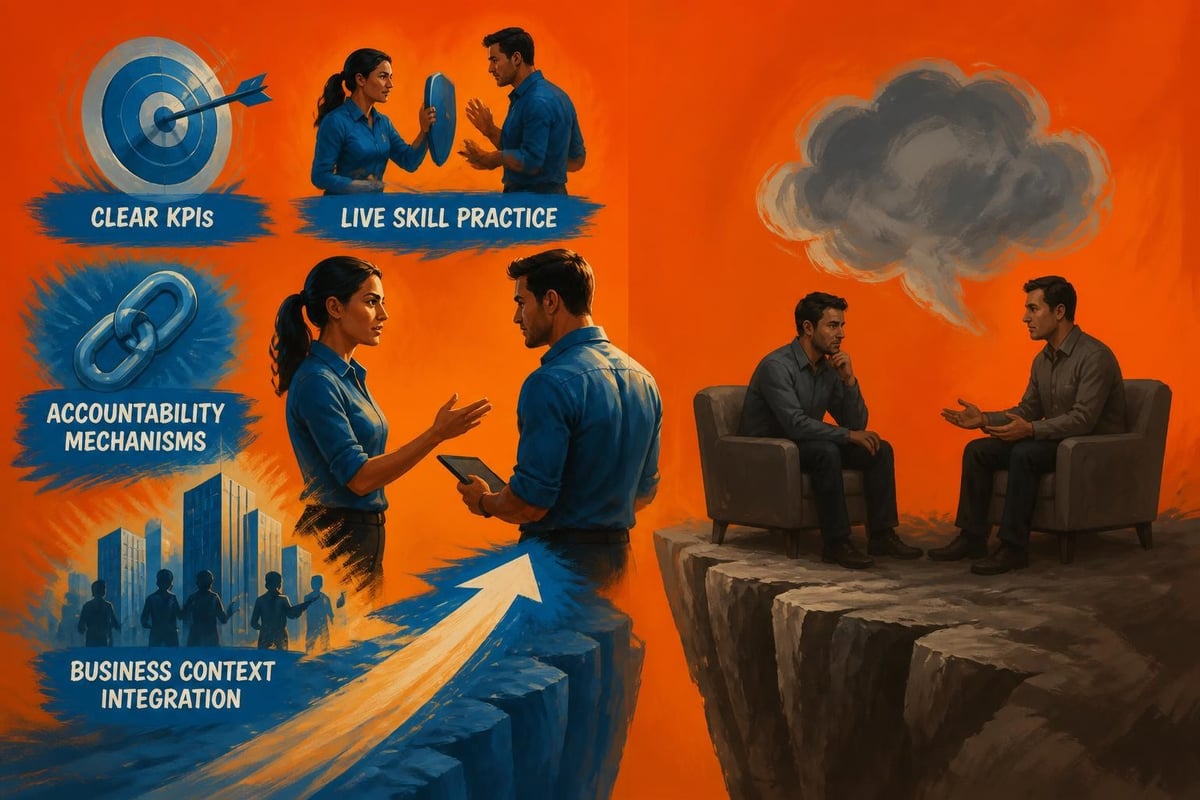
What buyers miss: most studies measure self-reported satisfaction or perception changes, not business metrics. When leadership coaching connects to decision speed, retention rates, or revenue per manager, the ROI becomes visible and defensible. When it focuses on feelings without tying to performance, value evaporates.
Why Most Coaching Fails Despite Good Intentions
The coaching industry's dirty secret is that credential accumulation rarely predicts client results. Organizations spend millions on certified coaches who deliver thoughtful conversations that change nothing measurable. The failure pattern is consistent: coaching happens in isolation from real work, avoids accountability, and prioritizes coach comfort over client transformation.
Common Failure Modes in Corporate Coaching
| Failure Pattern | Why It Happens | Business Impact |
|---|---|---|
| Conversation without application | Coach stays in theory, avoids live practice | Insights never become skills |
| Monthly check-ins only | Too slow for behavior change | Momentum dies between sessions |
| No KPI connection | Coaching exists separate from business goals | Can't prove value or adjust approach |
| Credential worship | Buyers select based on certificates, not results | Wrong coach for actual needs |
Can coaching really work when divorced from real business challenges? Experience says no. The most effective coaching we've observed happens inside actual meetings, tied to specific KPIs, with progress measured weekly or biweekly. Coaches who avoid this level of engagement typically lack the expertise to add value in live business contexts.
Organizations often choose coaches based on impressive LinkedIn profiles featuring multiple certifications and association memberships. What they should examine: track record with similar companies, willingness to tie compensation to outcomes, and ability to coach live in meetings rather than theoretical discussions in private sessions. Business coaches who deliver results focus on application, not credentials.
The Conditions That Make Coaching Actually Work
Evidence and experience point to six critical conditions that determine whether coaching delivers business results or just consumes budget. These aren't theoretical-they're observable patterns from thousands of engagements across industries.
Conditions for coaching effectiveness:
- Clear KPI alignment – Coaching ties directly to measurable business outcomes like decision speed, retention rates, or sales conversion
- Live skill practice – Coaches work inside real meetings and situations, not just private reflection sessions
- Frequent accountability – Weekly or biweekly touchpoints maintain momentum and allow rapid adjustment
- Manager involvement – Leaders participate rather than delegating development to external coaches alone
- Context expertise – Coaches understand the industry, business model, and organizational dynamics
- Outcome-based economics – Some portion of engagement tied to results, creating aligned incentives
The question "can coaching really work" transforms into "what conditions exist to ensure coaching works" when buyers focus on design rather than hope. Recent research on coaching effectiveness highlights unexpected benefits like combating executive isolation, but these emerge from well-structured engagements, not random coach selection.

Consider two scenarios: Company A hires a credentialed coach for monthly one-on-one conversations with executives. Company B brings in coaches who attend leadership meetings, track decision implementation, measure manager coaching skills weekly, and tie part of their fee to retention improvements. Both involve "coaching," but only one typically delivers measurable business results.
The Role of AI and Digital Tools in Modern Coaching
The integration of technology raises new questions about coaching effectiveness. While AI tools can augment coaching practices, they work best as supplements to human accountability and expertise, not replacements. AI excels at pattern recognition, feedback delivery, and skill practice between sessions. It fails at reading complex group dynamics, challenging comfortable narratives, or making judgment calls in ambiguous situations.
Smart organizations use digital tools to extend coaching between sessions while maintaining human expertise for live intervention. For team building and engagement, platforms like Innobook offer practical team activities and experiences that complement coaching work by creating shared experiences and breaking down silos through events ranging from escape rooms to adventure activities designed for corporate groups.
Measuring Coaching Impact Beyond Satisfaction Scores
The gap between coaching activity and business impact widens when measurement stops at participant satisfaction. Happy coaching clients don't necessarily become more effective leaders. Organizations serious about coaching ROI track leading and lagging indicators tied to business performance.
Meaningful coaching metrics:
- Decision speed (time from issue identification to action)
- Manager coaching adoption (percentage regularly using coaching skills)
- Employee engagement scores within coached leaders' teams
- Retention rates for high performers under coached managers
- Revenue or productivity per coached leader
- Cross-functional collaboration quality
Can coaching really work if you can't measure the impact? Technically yes, but you'll never know or be able to improve the approach. The discipline of measurement forces coaches and organizations to define success upfront, track progress honestly, and adjust when approaches fail. Coaches who resist measurement typically lack confidence in their ability to move meaningful metrics.
What Buyers Should Look for in Coaching Engagements
After observing hundreds of coaching engagements, patterns emerge in what separates effective from ineffective partnerships. Smart buyers examine factors beyond credentials, personality fit, and marketing polish.
Critical evaluation criteria:
- Track record in similar contexts – Ask for specific outcomes with comparable companies, not general testimonials
- Willingness to tie economics to results – Coaches confident in their impact accept some performance-based compensation
- Live participation capability – Can they coach effectively inside real meetings and high-stakes situations?
- Business acumen depth – Do they understand your business model, competitive dynamics, and operational realities?
- Rapid iteration approach – Weekly progress review and adjustment versus monthly check-ins
- Manager development focus – Building internal coaching capability rather than creating dependency
The networking and relationship building that happens in effective coaching relationships can be strengthened through modern tools. Digital business cards from Spreadly enable coached leaders to maintain connections, share updated contact information instantly, and track professional network growth-a practical complement to relationship-focused coaching work.

Organizations also benefit from ensuring their teams maintain energy and health during intensive development periods. Services like FrugtCompagniet, which deliver fresh fruit and healthy snacks to Danish offices, support the physical wellbeing that enables sustained coaching engagement and behavioral change.
The Contrarian Truth About Coaching Credentials
The coaching industry has created a credential mill that benefits certifying organizations more than clients. While basic training provides useful frameworks, the obsession with acronyms after names often signals inexperience masked by certificate collection. Can coaching really work when the coach spent more time accumulating credentials than delivering client results?
The most effective coaches typically have deep expertise in specific domains-sales, operations, leadership transitions, team dynamics-earned through years of practice, not weekend workshops. They view credentials as optional professional development, not primary value propositions. When evaluating coaches, examine what they've built, fixed, or transformed, not what certificates they've collected.
This doesn't mean all certifications lack value. Specific technical training in assessment tools, facilitation methods, or psychological frameworks can enhance coaching quality. The problem emerges when credentials substitute for expertise, when buyers select based on alphabet soup after names rather than demonstrated results in relevant contexts.
FAQ: Can Coaching Really Work for Your Organization?
How long does it take for coaching to show measurable business results?
Well-designed coaching with clear KPIs typically shows early indicators within 4-6 weeks and meaningful business impact within 3-4 months. Engagements requiring longer suggest misaligned design, inadequate frequency, or wrong coach-client fit.
What's the difference between coaching that works and coaching that wastes money?
Effective coaching ties directly to business KPIs, happens frequently (weekly or biweekly), includes live skill practice in real situations, and creates accountability for both coach and participant. Ineffective coaching consists of monthly conversations disconnected from business outcomes with no measurement or accountability.
Do coaching credentials actually predict coaching effectiveness?
Credentials indicate training completion but don't reliably predict client results. Track record in similar business contexts, willingness to measure outcomes, and demonstrated expertise matter more than certification alphabet soup. Focus on what coaches have built or fixed, not what certificates they've collected.
How can we measure coaching ROI beyond participant satisfaction?
Track business metrics directly influenced by coached leaders: decision speed, team engagement scores, retention rates for high performers, revenue or productivity per leader, quality of cross-functional collaboration, and adoption of coaching skills by managers. Leading indicators show progress; lagging indicators confirm business impact.
Should coaching happen monthly or more frequently?
Behavior change requires frequency. Weekly or biweekly sessions maintain momentum, allow rapid adjustment, and embed new skills before old patterns reassert. Monthly sessions work for maintenance, not transformation. If budget limits frequency, shorter more frequent touchpoints outperform longer monthly sessions.
Can AI tools replace human coaches for leadership development?
AI excels at pattern recognition, skill practice, feedback delivery, and extending coaching between human sessions. It fails at reading complex group dynamics, challenging comfortable narratives in real-time, and making judgment calls in ambiguous high-stakes situations. Best approach: AI augments human coaching, doesn't replace it.
What makes coaching work for mid-market companies versus Fortune 500 enterprises?
Mid-market organizations (25-500 employees) need pragmatic, fast-moving approaches with visible progress and flexible terms. They can't absorb long contracts or theoretical frameworks. Fortune 500 divisions often have similar needs despite enterprise resources. Both benefit from coaching tied to clear KPIs with month-to-month accountability rather than rigid programs.
How do we avoid hiring coaches who talk well but deliver little?
Require specific outcome examples from similar business contexts. Ask about their measurement approach and willingness to tie some compensation to results. Request participation in real meetings early to assess live capability. Avoid long contracts until value is proven. Watch for credential worship and theory-heavy language without practical application focus.
What's the biggest mistake organizations make when buying coaching services?
Selecting based on impressive credentials, polished presentations, and personality fit rather than track record with similar challenges, willingness to be measured on outcomes, and capability to coach live in real business situations. The second biggest mistake: long contracts before proving value through actual results.
Can coaching really work? Yes, when designed around business outcomes, measured against clear KPIs, and delivered through live practice rather than theoretical conversations. The difference between effective coaching and expensive theater lies in execution design, not coach credentials. If you need practical corporate coaching that delivers measurable results for mid-market companies or Fortune 500 divisions, Noomii offers month-to-month engagements tied to visible outcomes like faster decisions, stronger manager capability, and cleaner execution across priorities.



Leave a Reply
Want to join the discussion?Feel free to contribute!