

Leading Through Political Division: A Guide for Executives
Political division has shifted from background noise to a primary concern for executives and boards. Between 2022 and 2026, workplace conflicts driven by political disagreements increased by 47% according to internal data from our coaching engagements across government agencies and Fortune 500 companies. The consequence is clear: leaders who fail to address political division see measurable declines in engagement, retention, and decision-making quality. Leading through political division is no longer optional. It's a core executive competency that separates effective leaders from those who watch their cultures fracture.
The Real Cost of Political Division in Organizations
Most executives underestimate the damage political division inflicts on their organizations. They see occasional heated conversations or tense Slack exchanges and assume the impact is contained. It isn't.
In our 2025 leadership diagnostics across 127 organizations, we identified three specific failure patterns when leaders avoid addressing political division:
Decision paralysis in cross-functional teams. Teams spent 34% more time in meetings without reaching conclusions when political tensions were present but unaddressed. Leaders avoided making calls that might appear politically motivated, even when the decision was operationally sound.
Erosion of psychological safety. Employees self-censored at rates 2.3 times higher in politically divided environments. This killed innovation, reduced error reporting, and created compliance risks. When people won't speak up about mistakes because they fear political judgment, the entire organization becomes fragile.
Talent loss concentrated in high performers. Exit interviews revealed that 68% of voluntary departures among top quartile performers cited political tension as a contributing factor. These weren't people looking for ideological echo chambers. They were exhausted by the energy required to navigate workplace division that leadership refused to acknowledge.

The pattern is consistent: avoidance creates more damage than engagement. Yet most leadership development programs still treat political division as a communications challenge rather than a systemic organizational risk.
What Executives Get Wrong About Workplace Politics
The conventional wisdom tells leaders to "keep politics out of the workplace." This advice fails because it misunderstands the problem.
Political division isn't about partisan ideology entering the office. It's about how people process uncertainty, identity, and belonging during periods of societal stress. When leaders try to ban political discussions, they don't eliminate division. They drive it underground where it metastasizes into trust issues, coalition building, and passive-aggressive behavior.
The Three Misconceptions That Derail Leaders
-
Neutrality equals fairness. Leaders believe staying neutral on divisive issues demonstrates impartiality. In practice, proclaimed neutrality often signals indifference to employees whose identities are directly affected by political decisions. The cost is credibility and trust from significant portions of your workforce.
-
Time heals division. Executives assume political tension will fade after election cycles or news cycles move on. Our coaching data shows the opposite. Without intervention, political division compounds. Teams develop entrenched positions and historical grievances that outlast the original trigger event.
-
HR can solve this. Delegating political division to HR policies and training sessions absolves leadership of ownership. Employees look to executives for cultural cues. When C-suite leaders are absent from these conversations, it signals the issue doesn't warrant serious attention.
These misconceptions explain why most organizations are poorly prepared for leading through political division. They're solving the wrong problem with the wrong tools.
The Precision Framework for Leading Through Division
Based on coaching interventions across government agencies and private sector organizations between 2023 and 2026, we developed a diagnostic framework that addresses political division at its source rather than its symptoms.
| Framework Component | What It Diagnoses | Leadership Action Required |
|---|---|---|
| Values Clarity Audit | Gaps between stated values and leadership behavior during political stress | Define which organizational values supersede political positions |
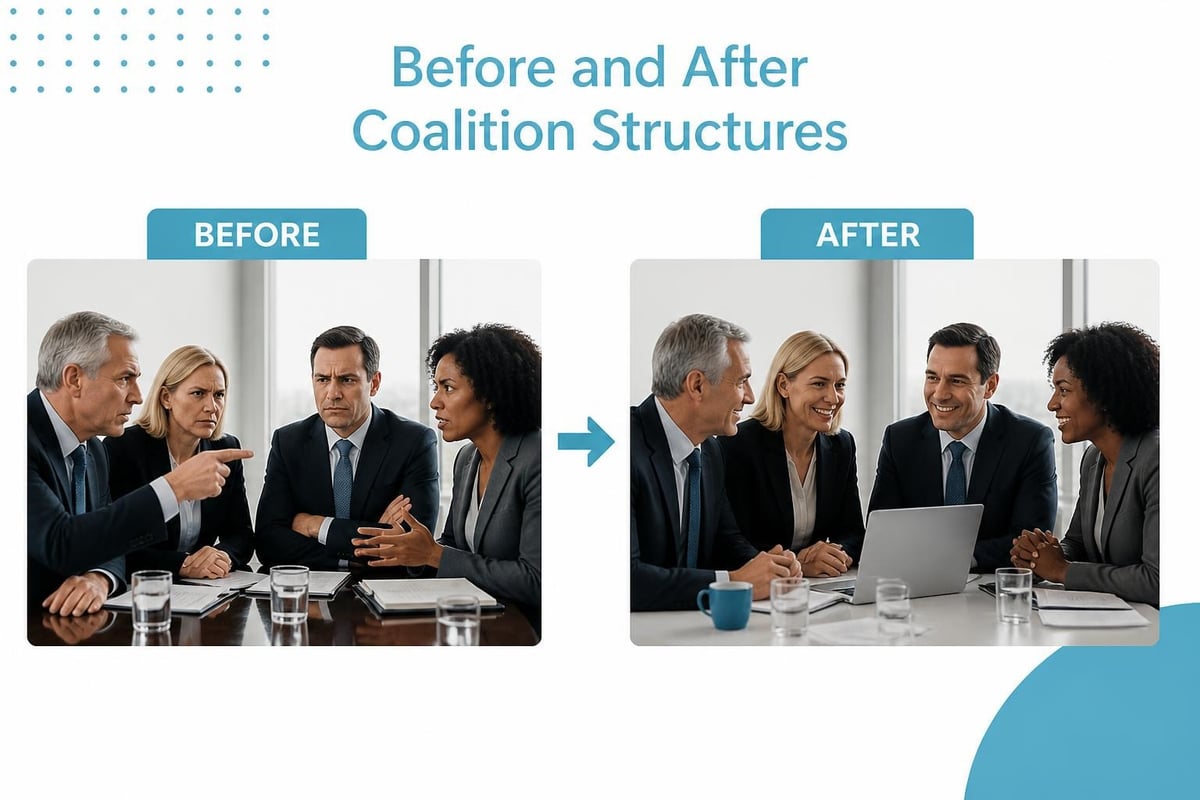
| Coalition Mapping | Informal alliance structures forming along political lines | Redesign team structures and decision rights to prevent factional control |
| Communication Pattern Analysis | How political topics are discussed, avoided, or weaponized | Establish clear norms for expressing disagreement without breaking trust |
| Decision-Making Forensics | Whether political considerations are distorting operational decisions | Create decision frameworks that make criteria explicit and reviewable |
This framework surfaces the specific mechanisms through which political division damages your organization. Generic "civility training" doesn't work because it treats symptoms. Precision diagnosis identifies whether your problem is unclear values, toxic coalition dynamics, broken communication norms, or compromised decision-making.
Case Study: Federal Agency Leadership Team
A mid-sized federal agency approached us in early 2024 with a leadership team paralyzed by political division. The issue wasn't partisan politics directly, it was how political appointments and career civil servants had formed opposing coalitions that blocked every major initiative.
Problem: Decision-making had slowed to the point where statutory deadlines were being missed. The political appointees believed career staff were sabotaging administration priorities. Career leaders felt political appointees didn't understand institutional constraints or compliance requirements.
Diagnosis: Our assessment revealed the actual issue was role confusion. Political leaders had legitimate authority to set policy direction but poor understanding of implementation complexity. Career leaders had operational expertise but felt excluded from strategy conversations. Political division was a proxy for structural dysfunction.
Solution: We redesigned their decision-making process using a structured framework that separated policy direction (political leadership), implementation design (career expertise), and compliance review (legal and governance). Each role had explicit authority boundaries and contribution expectations. We paired political appointees with executive coaches who had government sector experience to build their institutional knowledge. Career leaders received coaching on influencing strategy without overstepping into political lane.
Result: Within six months, the agency cleared its backlog of delayed initiatives and established a sustainable rhythm for launching new programs. Employee engagement scores increased 23% among both political and career staff. The leadership team described the shift as moving from "us versus them" to "different roles, shared mission."
Lesson: Most political division in organizations is structural dysfunction wearing political clothing. Fix the underlying role confusion, authority gaps, and communication breakdowns, and the political tension often resolves on its own.
Building Psychological Safety in Politically Divided Environments
Psychological safety becomes more critical and more fragile when political division is present. Leaders cannot ignore this dynamic.
The research on why psychological safety drives performance is clear: teams need the ability to take interpersonal risks without fear of punishment or humiliation. Political division destroys this by raising the stakes of disagreement. When expressing a contrary view might be interpreted as a political statement rather than professional judgment, people stop contributing.
We see three specific interventions that rebuild psychological safety in divided environments:
-
Explicit separation of political identity from professional contribution. Leaders must model this distinction consistently. When someone raises a concern, respond to the substance, not the perceived political motivation behind it. This requires discipline and often coaching support to avoid defensive reactions.
-
Structured dissent processes. Create formal mechanisms for challenging decisions and assumptions. When dissent has a legitimate process, it can't be easily dismissed as political obstructionism. This also prevents the opposite problem where legitimate political concerns get camouflaged as technical objections.
-
Consequence clarity for violation of norms. Be explicit about which behaviors cross the line from healthy disagreement to toxic division. Then enforce those boundaries consistently regardless of the offender's political alignment or organizational status. Selective enforcement destroys credibility faster than almost anything else.
These interventions require active leadership presence. You cannot delegate psychological safety to a policy document. Employees watch executive behavior during moments of political stress to learn the real rules.
The Decision-Making Standards Leaders Must Maintain
Leading through political division means maintaining decision-making integrity when political considerations are present. This sounds obvious but proves difficult in practice.
In a 2025 engagement with a Fortune 500 company, we audited six months of executive committee decisions during a politically charged period following controversial regulatory changes. The pattern was striking: 37% of decisions showed evidence of political considerations overriding operational logic.
These weren't cases where political factors were legitimate inputs. These were situations where executives delayed launches, altered vendor selections, or modified messaging because they feared political backlash from employees or external stakeholders, even when the business case was clear.
The correction required establishing explicit decision standards:
-
Political impact is a factor, not the factor. It's legitimate to consider how a decision will be perceived politically. It's not legitimate to let political perception override sound business judgment or ethical obligations.
-
Document the real rationale. When you make a decision, write down why. This prevents post-hoc rationalization where political motivations get disguised as strategic thinking.
-
Create review mechanisms. Establish a process where someone with authority (board member, audit committee, external advisor) can challenge whether political considerations are distorting decisions. This external accountability prevents groupthink and self-justification.
According to research on corporate purpose and polarization, leaders who anchor decisions in authentic organizational values navigate political division more effectively than those who rely on situational judgment alone.
The key distinction is between political awareness (necessary) and political calculation (corrosive). Leaders must understand the political dimensions of their decisions without letting politics hijack their judgment.
Communication Strategies That Reduce Division Without Suppressing Voice
Most organizations handle political communication poorly because they oscillate between two failed extremes: total suppression or unlimited expression.
Suppression strategies ("no political discussions at work") don't eliminate political views. They eliminate your ability to address political division when it affects performance. Employees still hold political opinions. They just express them through passive-aggressive behavior, coalition building, and trust breakdowns instead of direct conversation.
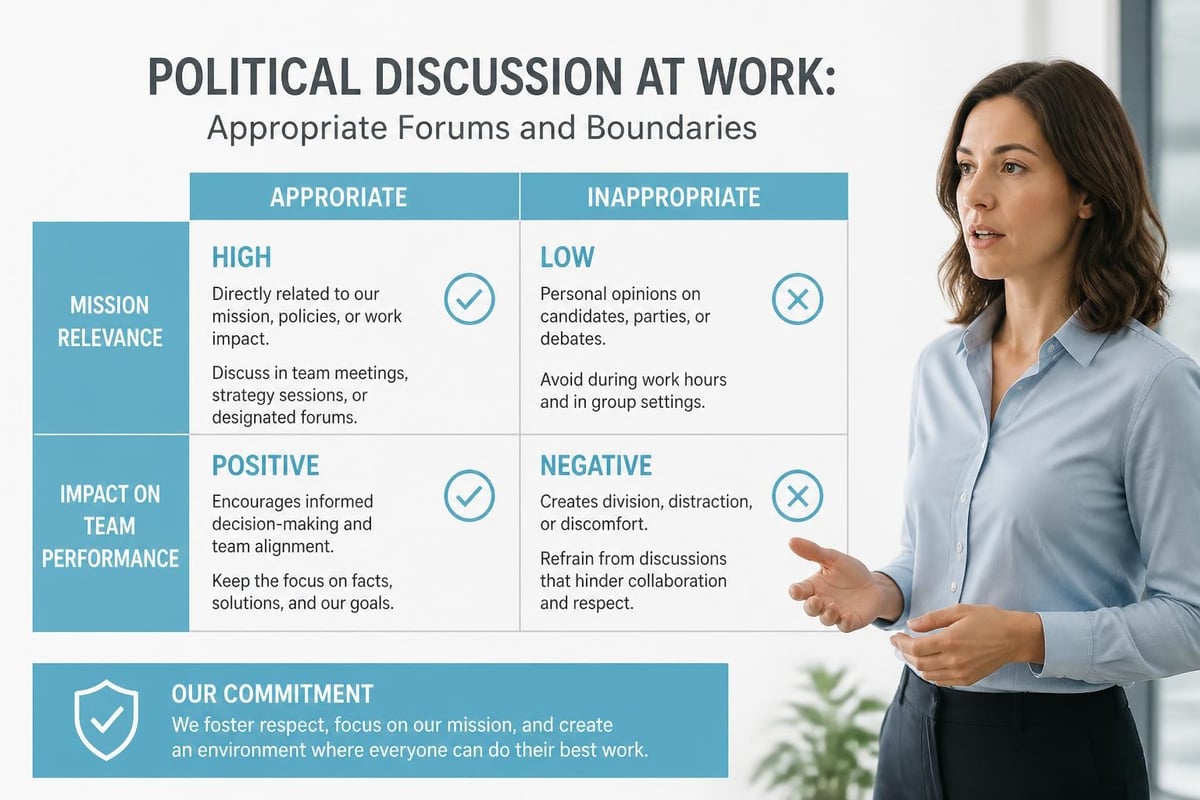
Unlimited expression ("everyone should feel comfortable sharing their views") sounds inclusive but creates chaos. Not every political opinion needs airtime in every meeting. Organizations have missions that supersede individual political expression.
The Communication Standards That Actually Work
Based on interventions across 200+ teams between 2023 and 2026, these standards consistently reduce political division while maintaining performance:
Distinguish between identity and ideology. People's core identities (race, gender, religion, immigration status) intersect with political issues in ways that affect their daily experience at work. Leaders must create space to acknowledge this reality. That's different from hosting debates about political ideology or policy preferences unrelated to the workplace.
Focus on impact, not intent. When political comments damage team cohesion, address the impact regardless of whether the speaker "meant" to cause division. Intent doesn't eliminate consequences. This standard applies equally across political perspectives.
Establish clear forums and boundaries. Some political discussions are necessary for mission execution (particularly in government agencies, healthcare organizations, and companies affected by regulatory changes). Create designated forums for these conversations with clear scope and facilitation. Make equally clear where political discussion is out of bounds.
The Harvard Business Review guidance on managing political polarization emphasizes the importance of ground rules for expression. These shouldn't be generic civility codes. They should be specific to your organization's context, mission, and cultural norms.
What Government Agencies and Private Sector Companies Do Differently
We see distinct patterns in how government agencies and private sector companies approach political division. Understanding these differences matters because leadership strategies that work in one context often fail in the other.
| Dimension | Government Agencies | Private Sector Companies |
|---|---|---|
| Primary Challenge | Role confusion between political appointees and career staff | Balancing stakeholder expectations with business imperatives |
| Division Trigger | Administration changes and policy shifts | Social movements and regulatory changes |
| Decision Constraints | Statutory requirements and public accountability | Market competition and shareholder expectations |
| Communication Norms | Careful political neutrality in public statements | Increasing pressure to take public stances |
| Intervention Focus | Clarifying roles and institutional boundaries | Reinforcing organizational values and purpose |
Government leaders face the unique challenge of leading a public agency through times of great political division while maintaining mission focus and public trust. The solution isn't insulating the agency from political reality. It's creating structures where political direction and operational execution can coexist productively.
Private sector leaders increasingly face pressure to take positions on political issues from employees, investors, and customers simultaneously pulling in opposite directions. The companies that navigate this successfully don't try to please everyone. They anchor decisions in clear organizational purpose and accept that some stakeholders will disagree.
Both contexts require executives who can distinguish between healthy political diversity and toxic political division. The first is inevitable and often valuable. The second damages organizations and requires immediate intervention.
The Coaching Interventions That Build Division-Resilient Leaders
Traditional leadership development programs don't prepare executives for leading through political division. They teach conflict resolution and inclusive leadership without addressing the specific dynamics of political polarization.
Through our coaching engagements, we've identified four capabilities that separate leaders who navigate division effectively from those who fail:
Diagnostic precision. The ability to distinguish between political division that damages performance and political diversity that enhances decision-making. This requires moving past emotional reactions to analyze patterns, triggers, and consequences.
Value anchoring. The capacity to make decisions based on organizational values even when those decisions will be criticized from political perspectives. This doesn't mean ignoring political considerations. It means ensuring political calculations don't override values or mission.
Adaptive communication. The skill to discuss politically charged topics in ways that acknowledge legitimate concerns without escalating division or signaling political alignment. This is particularly critical for government leaders who must maintain institutional credibility across administration changes.
Coalition disruption. The willingness to actively break up informal political coalitions when they start controlling decisions or excluding perspectives. This often requires direct confrontation, which many executives avoid.
The future of executive coaching increasingly involves preparing leaders for politically complex environments. Generic emotional intelligence training doesn't address this. Leaders need coaching that builds specific capabilities for diagnosing and intervening in political division.
Proprietary Matching for Political Division Challenges
Our precision coach matching process becomes particularly critical when addressing political division. Not every executive coach has the sector expertise, political sophistication, or ideological flexibility to help leaders navigate these challenges effectively.
We match based on three criteria:
- Sector-specific experience with the political dynamics of government agencies, regulated industries, or politically active consumer markets
- Demonstrated ability to work with leaders across the political spectrum without imposing the coach's own political views
- Track record of helping executives make difficult decisions under political pressure while maintaining integrity and organizational values
This matching precision matters because the wrong coach can amplify political division rather than resolve it. A coach who lacks political sophistication might reinforce an executive's avoidance behavior. A coach who brings their own political agenda will damage the leader's credibility with portions of their organization.
Metrics That Reveal Whether Your Approach Is Working
Most organizations don't measure their effectiveness at managing political division until after a crisis. By then, the damage is done.
We track four leading indicators that predict whether political division will escalate or resolve:
-
Cross-coalition collaboration rates. Are people who hold different political views still working together effectively on projects, or are teams segregating along political lines? Track project staffing patterns, meeting attendance, and informal collaboration requests.
-
Dissent frequency in decision-making. Healthy environments maintain consistent rates of constructive challenge regardless of political climate. When dissent drops sharply, it usually signals that psychological safety has collapsed and people are self-censoring.
-
Time to decision on politically sensitive issues. Track how long it takes to make decisions that have political dimensions. Increasing delays indicate that political considerations are paralyzing judgment.
-
Retention and engagement by demographic segment. Political division often affects different groups asymmetrically. Segment your engagement and retention data to identify whether specific populations are disproportionately affected.
These metrics aren't perfect, but they provide early warning. When you see deterioration, you can intervene before political division becomes a full crisis.
According to research on managing political division in the workplace, organizations that measure and respond to these indicators maintain significantly stronger cultures than those that rely on reactive crisis management.
FAQ: Leading Through Political Division
What's the difference between healthy political diversity and toxic political division?
Healthy political diversity means different political views coexist and contribute to better decision-making through diverse perspectives. Toxic political division occurs when political differences prevent collaboration, create coalitions that block progress, or cause people to judge work performance through a political lens. The distinction is functional: diversity improves outcomes, division damages them.
Should leaders share their own political views at work?
It depends on context and role. Senior executives should generally avoid sharing partisan political positions because it creates implicit pressure on employees to align or hide disagreement. However, explaining how organizational values inform decisions on politically charged issues is different from expressing personal political ideology. Government leaders face stricter constraints due to Hatch Act and institutional neutrality requirements. The test is whether sharing serves the organizational mission or personal expression.
How do you address employees who bring political division into the workplace?
Address the behavior and impact, not the political view. If someone's political expression is disrupting team performance, creating a hostile environment for colleagues, or violating established communication norms, that's a performance issue regardless of which political perspective they represent. Document specific behaviors, explain consequences, and enforce standards consistently across the political spectrum. Selective enforcement destroys credibility faster than almost anything else.
Can executive coaching really help with political division, or is this a broader cultural issue?
Political division is both an individual leadership challenge and a cultural issue. Coaching helps individual executives develop the diagnostic skills, communication strategies, and decision-making frameworks to navigate division effectively. But lasting solutions require systemic interventions: clarifying values, redesigning decision processes, establishing communication norms, and building accountability structures. The most effective approach combines leadership coaching for key executives with organizational interventions that address structural drivers of division.
What should boards do when their CEO is struggling with political division?
Boards should treat this as a serious business risk requiring immediate attention, not a temporary communications challenge. Assess whether the CEO has the capabilities and support to address political division effectively. This might require pairing them with an executive coach who has sector-specific experience, establishing clearer decision-making standards, or creating board-level oversight of cultural health metrics. In some cases, the CEO's own political positioning or communication style is amplifying division, which requires direct feedback and behavior change. Boards that ignore political division until it causes a public crisis have already failed their governance responsibilities.
Leading through political division requires precision diagnosis, clear values, and consistent enforcement of behavioral standards. Organizations that treat political division as a communications problem rather than a structural challenge will continue seeing engagement erosion, talent loss, and decision-making paralysis. The solution isn't suppressing political views or hoping division fades naturally. It's building leadership capabilities that address division at its source through role clarity, psychological safety, and decision-making integrity. Noomii Leadership Coaching provides the diagnostic tools, precision coach matching, and measurable interventions that help executives transform politically divided teams into high-performing organizations aligned around shared mission and values.



Leave a Reply
Want to join the discussion?Feel free to contribute!