

What Executives Are Missing About Retention in 2026
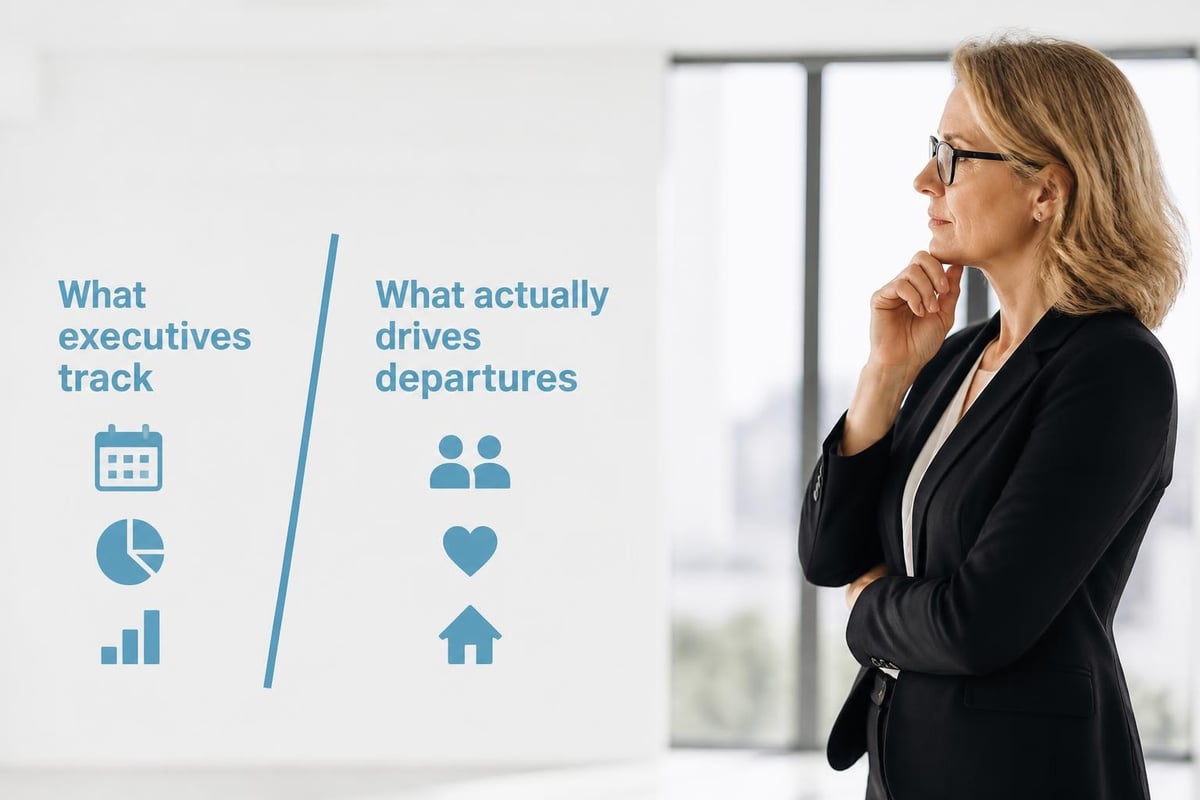
Most executives track retention rates but miss the story behind the numbers. The real retention crisis isn't about headcount stability or tenure averages. It's about misreading what drives people to stay, misdiagnosing why high performers leave, and missing the leadership behaviors that silently erode commitment. In 2026, the cost of this blind spot runs into millions for most organizations, and the pattern repeats because executives are measuring the wrong things.
The Perception Gap Is Wider Than You Think
What executives are missing about retention starts with a fundamental disconnect between leadership perception and workforce reality. Recent data shows leaders consistently overestimate actual employee engagement and loyalty by significant margins. CEOs report confidence in their retention strategies while exit interviews reveal systemic issues invisible to the C-suite.
Here's what this looks like in practice. A Fortune 500 client came to us reporting 12% annual turnover among mid-level managers, which they considered acceptable. Their CHRO pointed to competitive compensation and annual engagement surveys showing 78% satisfaction. But when we conducted individual leadership assessments and confidential interviews, we found something different.
The Diagnosis Most Leaders Miss
The real issue wasn't compensation or benefits. It was manager quality at the director level. Three specific directors created toxic decision-making environments, undermined autonomy, and blocked career progression for high performers. These three leaders directly influenced 34% of the departures over 18 months. The exit interviews captured generic responses about "career opportunities elsewhere" because employees don't typically name their direct manager as the problem when HR is conducting the interview.
This pattern repeats across sectors. The employee retention problem most leaders are missing often centers on flexibility, recognition, and measuring commitment beyond surface-level retention rates.
Problem: High performer turnover among mid-level managers
Diagnosis: Toxic leadership patterns at the director level creating exit conditions
Solution: Targeted coaching intervention for three directors plus succession planning
Result: 19% reduction in manager turnover within 12 months, estimated $2.3M savings in replacement costs
Lesson: Retention metrics hide more than they reveal without behavioral diagnostics
Why Traditional Retention Strategies Fail
Most retention programs treat symptoms, not causes. The standard playbook includes:
- Compensation benchmarking and adjustments
- Expanded benefits packages
- Annual engagement surveys
- Generic professional development programs
- Stay interviews conducted too late
None of these address what actually drives departures in 2026. The fundamental issue is that executives design retention strategies based on aggregated data that obscures individual leadership failures, team-level dysfunction, and the specific moments when top performers mentally check out.
Consider the common misconceptions employers have about their employees. Leaders underestimate the importance of recognition, trust, and daily manager interactions while overinvesting in programs that sound good in board presentations but change nothing about the actual employee experience.
The Manager Variable Nobody Wants to Address
What executives are missing about retention is that manager quality is the single highest-impact variable, yet it receives the least direct intervention. Organizations will spend $50,000 per employee on recruiting, onboarding, and training while avoiding the $15,000 coaching engagement that would fix the manager driving the turnover.
| Retention Investment | Typical Annual Budget | Impact on Actual Turnover |
|---|---|---|
| Compensation adjustments | $500K – $2M | Moderate (addresses 15-20% of departures) |
| Benefits expansion | $300K – $1M | Low (addresses 5-10% of departures) |
| Generic training programs | $200K – $800K | Minimal (addresses <5% of departures) |
| Manager coaching interventions | $50K – $200K | High (addresses 40-60% of departures) |
The math is clear, but budgets don't reflect it. Why? Because addressing manager quality requires executives to admit that their promotion decisions, leadership development approach, and performance management systems are failing. It's easier to add another benefit than to confront a senior director about toxic behavior patterns.
We worked with a government agency facing 28% annual turnover in a critical technical division. The agency had invested in competitive salary bands, flexible work arrangements, and career development pathways. Turnover continued. Our diagnostic revealed that two senior managers consistently violated psychological safety principles, publicly criticized team members, and created fear-based cultures where raising concerns was career suicide.
Problem: Persistent high turnover despite competitive compensation and benefits
Diagnosis: Two senior managers creating psychologically unsafe environments
Solution: Executive coaching for both managers with clear behavioral benchmarks and accountability measures
Result: Turnover dropped to 9% within 18 months in that division
Lesson: You cannot compensate your way out of toxic leadership

The Flexibility Trap
In 2026, flexibility has become a checkbox item rather than a retention driver because executives misunderstand what flexibility actually means to employees. Offering remote work while maintaining surveillance software and requiring constant availability isn't flexibility. It's remote micromanagement.
What executives are missing about retention regarding flexibility is the autonomy dimension. Employees don't just want location flexibility. They want decision-making autonomy, schedule control, and trust that they can manage their work without constant oversight. The organizations retaining top talent are those that measure outputs rather than activity, trust professionals to manage their time, and remove unnecessary approval layers.
A manufacturing client came to us frustrated that their "generous" hybrid policy wasn't improving retention among engineers. When we examined the actual work environment, we found:
- Required office attendance on arbitrary days that disrupted deep work
- Manager expectations for instant Slack responses during "core hours"
- Three-layer approval processes for routine technical decisions
- Weekly status meetings that could have been asynchronous updates
The policy said "flexible." The culture said "we don't trust you." We restructured their approach around outcome-based accountability, eliminated unnecessary approvals, and coached managers on building trust through autonomy. Engineer retention improved by 23% over the following year.
Recognition Versus Appreciation: A Critical Distinction
Most executives believe they recognize employees adequately. They point to annual awards, bonuses for high performers, and public acknowledgments at company meetings. What they miss is the difference between recognition (acknowledging results) and appreciation (valuing the person).
Employees leave organizations where they feel like interchangeable resources, even when they're being "recognized" for their output. Myths about employee retention often center on the assumption that compensation and formal recognition programs address the appreciation gap. They don't.
What Actually Drives Commitment
Through hundreds of leadership coaching engagements, we've identified specific behaviors that differentiate managers who retain top talent from those who don't:
- Regular acknowledgment of effort, not just results – Recognizing the difficulty of the work, not just the outcome
- Investment in individual development goals – Even when those goals don't directly serve current business needs
- Soliciting input and acting on it – Not just asking for feedback but demonstrating it changed decisions
- Advocacy during resource allocation – Fighting for team needs in budget and staffing conversations
- Transparent communication about constraints – Explaining the "why" behind difficult decisions
These behaviors can't be programmed into an HR system or delivered through annual reviews. They require leadership capability development at the individual manager level, which is why coaching demand is growing among organizations serious about retention.
The Employee-Customer Retention Link
What executives are missing about retention extends beyond internal workforce stability. There's a direct correlation between employee engagement and customer retention that most leaders overlook. High employee turnover doesn't just create recruiting costs. It degrades customer relationships, institutional knowledge, and service quality in ways that show up in customer churn rates 6-12 months later.
We worked with a financial services firm experiencing simultaneous employee and client departures. Their initial diagnosis focused on market competition and pricing pressure. Our analysis revealed something different: relationship continuity mattered more than they realized.
When key client-facing employees left, they took institutional knowledge about client preferences, historical context, and trust-based relationships with them. New employees, even highly skilled ones, couldn't replicate that context. Clients experienced this as service degradation, leading to higher churn rates in accounts that had experienced employee transitions.
Problem: Elevated client churn correlated with employee departures
Diagnosis: Loss of relationship continuity and institutional knowledge
Solution: Retention-focused coaching for client-facing team managers plus knowledge transfer protocols
Result: Client retention improved by 14% as employee stability increased
Lesson: Employee retention is a customer retention strategy

Predictive Analytics and the AI Advantage
The most sophisticated organizations in 2026 are using machine learning techniques to predict employee turnover and design targeted interventions before departure decisions crystallize. This isn't about surveillance. It's about pattern recognition that identifies at-risk employees based on behavioral signals: decreased collaboration, reduced contribution in meetings, withdrawal from development opportunities, and changes in work patterns.
What executives are missing about retention is the opportunity to intervene proactively rather than reactively. Exit interviews happen after the decision is final. Predictive analytics identify the warning signs 60-90 days earlier, when intervention can still change the outcome.
However, most organizations deploying these tools make a critical mistake: they use the data for monitoring rather than manager development. The right approach is equipping managers with insights and coaching them on effective conversations, not creating surveillance systems that further erode trust.
Building Retention Capabilities, Not Just Programs
The organizations winning the retention battle in 2026 aren't those with the best benefits packages. They're the ones investing in manager capability development as a core retention strategy. This means:
- Evidence-based leadership diagnostics that identify specific behavioral gaps
- Precision matching between managers and coaches with relevant expertise
- Targeted intervention plans addressing documented retention-killing behaviors
- Measurable accountability through defined KPIs and cultural health indicators
- Integration with broader talent development and succession planning
The future of executive coaching recognizes that retention isn't an HR problem. It's a leadership capability problem that requires systematic development at every management level.
The ROI Executives Ignore
Most executives can cite recruiting costs, but few accurately calculate the full cost of turnover. Beyond replacement expenses, consider:
| Cost Category | Typical Impact | Often Measured? |
|---|---|---|
| Direct replacement costs | $50K – $150K per role | Yes |
| Lost productivity during vacancy | 20-30% of annual output | Rarely |
| New hire ramp time | 6-12 months to full productivity | Sometimes |
| Team morale impact | Decreased engagement and productivity | No |
| Institutional knowledge loss | Irreplaceable in some cases | No |
| Customer relationship disruption | Measurable churn increase | Rarely connected |
When you account for all costs, losing a senior manager typically represents $300K-$500K in total organizational impact. A $15,000 coaching engagement that prevents that departure represents a 20:1 ROI. Yet most organizations spend more on exit interviews than on retention-focused coaching.
What Actually Works: Evidence From the Field
After working with hundreds of organizations on retention challenges, certain patterns consistently separate those who solve the problem from those who don't:
Stop doing:
- Treating retention as an HR metric rather than a leadership accountability
- Implementing generic "best practices" without diagnosing your specific issues
- Measuring satisfaction instead of commitment and engagement drivers
- Waiting for exit interviews to gather insight on why people leave
- Avoiding difficult conversations with managers who drive turnover
Start doing:
- Conducting behavioral diagnostics at the manager and team level
- Investing in targeted coaching for retention-critical leadership roles
- Measuring and acting on early warning indicators before decisions finalize
- Creating accountability for retention at the individual manager level
- Connecting retention outcomes to leadership effectiveness evaluations
Retention strategies that actually work emphasize manager quality, intentional relationship-building, and addressing the specific drivers of turnover within your organization rather than copying what worked somewhere else.
The Contrarian Truth About Retention
Here's what most executives don't want to hear: high retention isn't always the right goal. Some turnover is healthy and necessary. The problem is that most organizations lose the people they want to keep while retaining underperformers who should have been managed out years ago.
What executives are missing about retention is the quality dimension. The question isn't "What's our retention rate?" It's "Are we retaining our highest performers and losing our lowest contributors, or the reverse?" Many organizations inadvertently create cultures where high performers leave because mediocrity is tolerated, difficult conversations are avoided, and political skill matters more than results.
We worked with a technology firm celebrating 94% retention while struggling with declining innovation and market share. Their high retention rate masked a different problem: they'd retained 94% of their workforce but lost 60% of their highest performers over three years. The remaining employees were those who valued stability over growth, avoided risk, and resisted change. The organization was stable but dying.
Problem: High overall retention masking high-performer departures
Diagnosis: Culture rewarding tenure and stability over performance and innovation
Solution: Leadership coaching focused on performance management, difficult conversations, and creating conditions where high performers thrive
Result: Overall retention dropped to 88% but high-performer retention increased to 91%
Lesson: Retention rate without context is a vanity metric
Frequently Asked Questions
What are the biggest mistakes executives make with retention strategies?
Executives typically make three critical errors: treating retention as an HR program rather than a leadership capability issue, measuring satisfaction instead of the specific drivers of commitment, and investing in generic solutions without diagnosing their particular retention challenges. The most costly mistake is avoiding direct intervention with managers who drive turnover because addressing individual leadership failures is uncomfortable.
How much does manager quality actually impact retention rates?
Research and our field experience consistently show that manager quality is the single highest-impact variable in retention, directly influencing 40-60% of voluntary departures. Employees don't leave companies; they leave managers. Organizations that invest in targeted coaching for managers see 15-25% improvements in retention within 12-18 months, far exceeding the impact of compensation adjustments or benefits expansion.
What early warning signs indicate retention problems before employees resign?
The most reliable indicators include decreased participation in meetings and collaborative work, reduced engagement with development opportunities, changes in work patterns or schedule flexibility requests, withdrawal from informal team interactions, and increased focus on narrowly defined job responsibilities rather than broader contribution. These behavioral changes typically appear 60-90 days before resignation decisions finalize.
How do you measure the ROI of retention-focused coaching?
Calculate the full cost of turnover including direct replacement expenses ($50K-$150K), lost productivity during vacancy and ramp time (equivalent to 6-12 months of output), team morale impact, institutional knowledge loss, and customer relationship disruption. For senior roles, total impact typically reaches $300K-$500K per departure. A coaching engagement costing $15K-$25K that prevents one such departure represents a 12:1 to 20:1 ROI, easily measured through reduced turnover rates in coached leaders' teams.
What's the difference between retention programs and retention capabilities?
Retention programs are one-time initiatives or benefits (flexible work policies, professional development budgets, recognition awards) that may address symptoms but don't build organizational capacity to retain talent over time. Retention capabilities are embedded leadership skills and systems (manager coaching, behavioral diagnostics, early intervention protocols, accountability measures) that create sustained improvement. Programs deliver temporary results; capabilities deliver lasting change.
The retention crisis most executives face isn't about market competition or generational differences. It's about misdiagnosing the problem, measuring the wrong indicators, and avoiding the leadership capability gaps that actually drive departures. When you address manager quality through targeted coaching, build early intervention systems, and create real accountability for retention outcomes, the numbers change dramatically. Noomii Leadership Coaching helps organizations solve retention challenges through evidence-based diagnostics, precision coach matching, and measurable leadership development that targets the specific behaviors driving turnover in your organization.



Leave a Reply
Want to join the discussion?Feel free to contribute!