
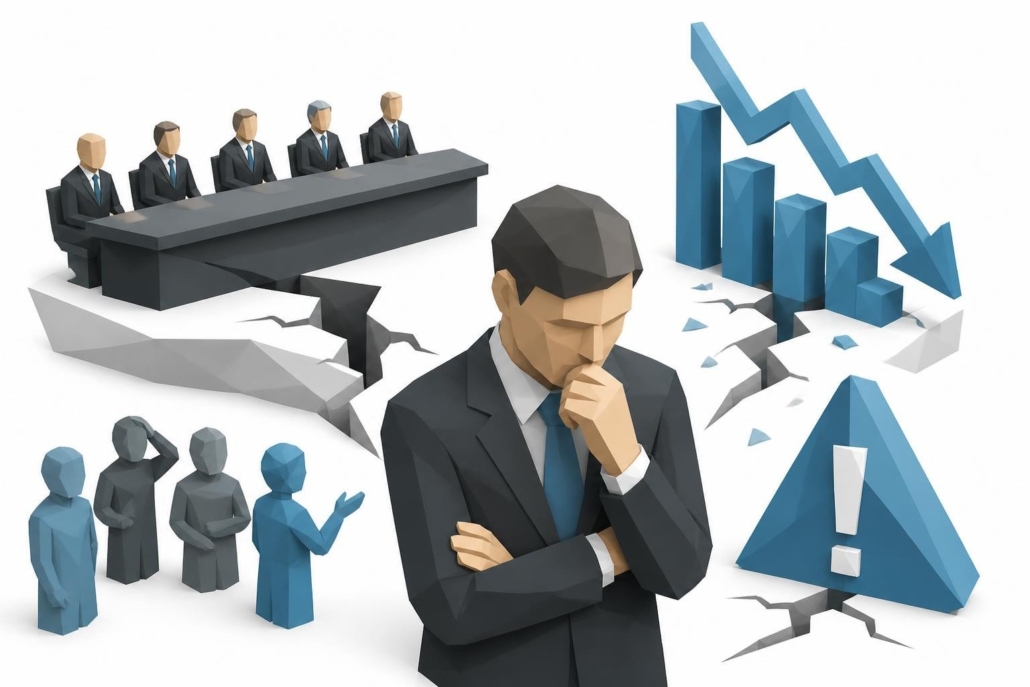
The Leadership Failures Behind Corporate Scandals
Every scandal follows a pattern. Boards miss warning signs. Executives prioritize appearance over substance. Internal controls get bypassed. The leadership failures behind corporate scandals rarely emerge overnight. They accumulate through small compromises, ignored red flags, and a culture that rewards short-term performance while punishing dissent. By the time regulators or journalists expose the problem, thousands of employees, investors, and customers have already absorbed the damage.
The Real Cause Gets Misdiagnosed
Most post-scandal analyses blame individual bad actors. The board removes the CEO. The company issues a statement about renewed values. Shareholders file lawsuits. This response addresses symptoms while missing the structural problem.
Research shows that focusing exclusively on toxic leaders obscures systemic factors that enable misconduct in the first place. When organizations frame scandals as individual moral failures, they avoid examining compensation structures, governance gaps, and cultural norms that made the behavior rational from the perpetrator’s perspective.
Why Boards Miss What’s Obvious in Hindsight
Directors receive sanitized information. Management controls the agenda. Meetings focus on backward-looking financial reports rather than forward-looking risks. The leadership failures behind corporate scandals often trace back to boards that never asked uncomfortable questions.
Consider these common governance breakdowns:
- No independent channels for employee concerns that bypass management filtering
- Compensation metrics that reward quarterly results over sustainable performance
- Director expertise gaps in critical areas like technology, cybersecurity, or regulatory compliance
- Meeting cadences too infrequent to provide real-time oversight during fast-moving crises
- Excessive deference to charismatic CEOs who discourage challenge and debate
Examination of significant board failures reveals a pattern: directors knew something felt wrong but lacked the information, independence, or courage to act before irreversible damage occurred.

The Cultural Factors You Can Measure
Culture drives behavior when no one is watching. The leadership failures behind corporate scandals emerge from specific, identifiable cultural characteristics that executives can diagnose and address before crisis hits.
A systematic review of institutional failures identifies three cultural patterns present in nearly every major scandal:
- Performance pressure without ethical guardrails. Employees receive clear targets but ambiguous guidance on acceptable methods.
- Silence mechanisms that suppress dissent. Whistleblowers face retaliation. Contrary opinions get labeled as “not being team players.”
- Symbolic compliance instead of substantive controls. The organization has policies, training, and compliance departments but no real accountability when violations occur.
The Diagnostic Most Organizations Skip
Smart CHROs measure cultural health before regulators force the issue. Psychological safety assessments reveal whether employees feel safe reporting concerns, admitting mistakes, or challenging leaders. Low scores predict future scandals more accurately than financial audits.
| Cultural Indicator | Healthy Organization | Scandal-Prone Organization |
|---|---|---|
| Error Reporting | Increases year over year | Decreases as pressure rises |
| Anonymous Hotline Usage | Steady, with visible responses | Rare, with no visible action |
| Exit Interview Honesty | Specific, actionable feedback | Generic, safe responses |
| 360 Review Candor | Direct critique of senior leaders | Consistently positive regardless of performance |
Organizations that track these indicators quarterly catch problems while they’re still fixable. Those that rely solely on compliance metrics discover issues when prosecutors arrive.
What Happens When Executives Optimize for Appearance
The leadership failures behind corporate scandals accelerate when executives manage perception instead of reality. This manifests in predictable ways:
Earnings manipulation starts small. A one-time adjustment to meet analyst expectations becomes a quarterly routine. The CFO knows it’s wrong but rationalizes that next quarter’s actual performance will justify this quarter’s reported numbers. It never does.
Risk transfer replaces risk management. Executives move problematic activities to subsidiaries, contractors, or offshore entities. The problems don’t disappear, they just become someone else’s responsibility until they become everyone’s crisis.
Metrics replace judgment. Leaders create scorecards that measure everything except what matters. Call centers optimize average handle time while customer satisfaction collapses. Sales teams hit revenue targets through practices that guarantee future cancellations and lawsuits.
The Greed Factor Nobody Wants to Discuss
Academic research on corporate failures and greed documents how compensation structures create rational incentives for irrational risks. When executives hold stock options that expire within 18 months, a strategy that boosts short-term share price while creating long-term liabilities becomes financially logical for the individual even as it destroys enterprise value.
This isn’t about individual morality. It’s about institutional design. Organizations that separate decision rights from consequence absorption create predictable disasters.

The Recovery Patterns That Actually Work
Organizations that successfully rebuild after scandal follow a different playbook than those that simply rebrand and hope. The leadership failures behind corporate scandals require leadership solutions, not just legal settlements.
Immediate actions that signal real change:
- Replace the entire executive team implicated in the scandal, not just the CEO. Half-measures communicate that the organization hasn’t learned.
- Bring in external investigators who report directly to the board, not management. Internal reviews lack credibility.
- Publish findings without legal sanitization. Stakeholders can distinguish corporate speak from genuine accountability.
- Revise compensation to include clawback provisions triggered by ethical violations, not just financial restatements.
- Install independent compliance functions that report to the board, with budgets management cannot cut.
The Coaching Intervention Organizations Overlook
Most recovery plans focus on systems and controls. Few address the leadership behaviors that enabled the original failure. Performance coaching for remaining executives, when properly structured, changes the decision-making patterns that created vulnerability in the first place.
Effective coaching interventions after scandal include:
- Decision audits that examine how leaders gathered information, weighed alternatives, and reached conclusions in past situations
- Stakeholder mapping exercises that force executives to consider consequences beyond their immediate teams
- Ethical dilemma simulations that practice navigating gray areas before real stakes emerge
- Feedback loops from frontline employees about whether executive behavior has actually changed
Organizations that invest in leadership development as part of scandal recovery reduce recurrence rates. Those that rely solely on compliance training repeat the cycle.
Why Prevention Fails in Most Organizations
The leadership failures behind corporate scandals persist because prevention programs address the wrong problems. Consider the standard approach:
Companies create ethics hotlines that employees don’t trust. They distribute codes of conduct that nobody reads. They require annual compliance training that everyone clicks through without absorbing.
These initiatives check boxes. They don’t change behavior.
What Works Instead
Prevention succeeds when organizations build systems that make ethical behavior easier than unethical shortcuts. This requires:
Reducing pressure to choose between ethics and results. When sales quotas require borderline tactics to achieve, most salespeople choose tactics. The solution isn’t better training on values, it’s quota structures aligned with sustainable growth.
Creating decision-making transparency. Recording who approved what creates accountability that policies cannot. When executives know their reasoning will undergo future scrutiny, judgment improves.
Rewarding those who spot problems early. Organizations that promote internal whistleblowers and credit them with saving the company send clear messages about desired behavior. Those that quietly pay settlements while maintaining silence teach the opposite lesson.
Analysis of lessons from leadership scandals shows that organizations with strong prevention cultures don’t rely on individual virtue. They design systems where doing the right thing serves self-interest.
| Prevention Approach | Why It Fails | What Works Instead |
|---|---|---|
| Annual ethics training | One-time event, easily forgotten | Ethical decision exercises in every leadership meeting |
| Values posters | No connection to consequences | Promotion criteria that explicitly weight integrity |
| Hotline reporting | Anonymous with no visible follow-up | Named concerns with public (anonymized) resolution updates |
| Compliance department | Separate from operations | Compliance embedded in operating committees |

The Board’s Actual Job During Crisis
When scandal breaks, directors face a choice. They can protect their reputations by claiming ignorance, or they can demonstrate the oversight they should have provided earlier.
The leadership failures behind corporate scandals often include board failures before, during, and after the crisis becomes public. Directors who understand their fiduciary duty take specific actions:
Immediate crisis response:
- Retain independent legal counsel separate from management’s attorneys
- Establish a special committee with full investigatory authority
- Suspend executive bonuses and equity vesting pending investigation results
- Communicate directly with regulators rather than through management filters
- Review and potentially replace the audit committee if financial misconduct occurred
The Questions Directors Should Have Asked Earlier
Effective boards don’t wait for crisis. They create regular forums for difficult questions:
- “What would cause our customers to lose trust in us overnight?”
- “Which of our current practices would look indefensible on the front page of the Wall Street Journal?”
- “What concerns have employees raised that we’ve dismissed as operational details?”
- “How would we know if our executives were hiding problems from us?”
- “What metrics might encourage unethical shortcuts?”
Boards that ask these questions quarterly rarely face scandals. Those that focus exclusively on financial performance and strategy create blind spots that eventually materialize as crisis.
Resources on dramatic board failures demonstrate how directors who avoided uncomfortable questions paid with their reputations when avoidable crises emerged.
The Warning Signs CHROs Notice First
Human resources leaders spot the leadership failures behind corporate scandals before they reach the boardroom. They see resignation patterns, hear exit interview themes, and track employee survey trends that forecast trouble.
Smart CHROs escalate these signals:
Talent flight from specific divisions or leaders. When high performers consistently leave particular parts of the organization, it signals leadership or ethical problems worth investigating.
Increasing legal claims and settlements. Harassment complaints, discrimination charges, and employment disputes cluster around problematic cultures and leaders.
Survey score divergence. When engagement scores for particular teams fall while company averages hold steady, the data points to localized leadership failures that metastasize if ignored.
Declining internal mobility. Employees who refuse transfers to certain divisions signal reputation problems that leaders above haven’t acknowledged.
The Fix That Requires Courage
CHROs who want to prevent scandal must be willing to lose their jobs. They escalate concerns about powerful executives knowing it might cost them their careers. They refuse to implement policies they know create ethical hazards even when the CEO pressures them.
Organizations serious about prevention give CHROs protected status similar to general counsel. Their compensation doesn’t depend on pleasing operating executives. They report to the board on people matters without management filtering.
Leadership coaching programs provide CHROs with frameworks for having difficult conversations with executives about behavior patterns that create risk. Coaching also helps executives receive feedback without becoming defensive, a critical skill most senior leaders never develop.
The Role of Modern Leadership Development
The leadership failures behind corporate scandals reveal a development gap. Most executive education focuses on strategy, finance, and operations. Few programs rigorously develop ethical judgment, stakeholder awareness, or the ability to make sound decisions under pressure.
Organizations investing in prevention build leadership capabilities that reduce scandal risk:
Scenario-based learning where executives practice responding to ethical dilemmas with real consequences for poor judgment. Online courses don’t develop this skill. Realistic simulations with feedback do.
Cross-functional rotations that force leaders to understand how their decisions impact other stakeholders. CFOs who have never run operations make different tradeoffs than those who have managed people.
Regular coaching focused on decision quality, not just results. Examining how leaders reached conclusions helps identify blind spots before they create disasters. Executive coaching that includes decision audits catches faulty reasoning patterns early.
Mandatory “pre-mortem” exercises before major decisions where teams imagine how the initiative could fail spectacularly and work backward to identify risks. This technique surfaces concerns that optimistic groupthink suppresses.
The Transformation After a Close Call
Some organizations learn from near-misses without experiencing full scandal. A regulator issues a warning letter. An internal audit uncovers a practice that could have become catastrophic. A journalist starts asking questions that signal bigger problems.
The leadership failures behind corporate scandals become leadership opportunities when executives treat close calls as inflection points rather than bullets dodged.
Actions that demonstrate actual learning:
- Commission an independent review of what went wrong and why existing controls failed
- Publicly acknowledge the issue and explain corrective actions
- Revise decision-making processes to prevent recurrence
- Reward those who surfaced the problem rather than punishing messengers
- Track leading indicators that would signal similar risks emerging elsewhere
Organizations that treat near-misses seriously develop institutional memory. Those that quietly fix the immediate problem and move on repeat variations of the same failure pattern until the consequences become unavoidable.
Contemporary analysis of modern leadership failures emphasizes that recovery requires not just new policies but fundamentally different leadership mindsets prioritizing long-term institutional health over short-term individual gain.
Frequently Asked Questions
What are the most common early warning signs that leadership failures could lead to corporate scandal?
Employee exodus from specific divisions, increasing legal settlements, divergence between corporate values statements and actual decisions, executives who punish dissent, and compensation structures that reward short-term results regardless of methods used. CHROs and board members who track these indicators can intervene before problems become public crises.
How can boards effectively oversee management without micromanaging operations?
Boards should focus on key risk indicators, maintain independent information channels from employees, require management to present alternative scenarios rather than single recommendations, rotate committee assignments to prevent capture, and ask “what could go wrong” questions in every session. Effective oversight examines decision quality and risk awareness, not operational details.
What role does leadership coaching play in preventing corporate scandals?
Coaching helps executives develop judgment under pressure, recognize their blind spots, understand stakeholder impacts beyond immediate results, and create decision-making processes that surface risks early. Organizations that invest in coaching for behavioral change, not just skill development, reduce the leadership failures behind corporate scandals by addressing root causes rather than symptoms.
Why do compliance training programs fail to prevent scandals?
Standard compliance programs focus on rules rather than judgment, create one-time checkbox exercises rather than ongoing capability building, lack consequences for violations, and exist separately from operations rather than embedded in decision processes. Prevention requires system redesign that makes ethical behavior rational and unethical behavior difficult, not just annual training modules.
How should organizations rebuild leadership credibility after a scandal?
Replace implicated executives entirely, conduct transparent investigations with published findings, revise compensation to include ethical performance metrics and clawback provisions, create independent reporting channels that bypass management, demonstrate changed behavior through consistent decisions over time, and invest in leadership development that addresses the capabilities that failed. Credibility returns through sustained evidence, not statements.
The leadership failures behind corporate scandals stem from identifiable patterns: boards that don’t ask hard questions, executives who optimize for appearance, cultures that punish dissent, and systems that reward short-term results over sustainable performance. Organizations that diagnose these patterns early and address root causes through leadership development, system redesign, and cultural transformation prevent the crises that destroy enterprise value and careers. Noomii Leadership Coaching helps organizations identify leadership gaps, match executives with specialized coaches who address behavioral patterns that create risk, and build the judgment capabilities that prevent governance failures before they become public scandals.



Leave a Reply
Want to join the discussion?Feel free to contribute!