

The Hidden Cost of Toxic Executives (2026 Data)
Most boards discover the hidden cost of toxic executives only after the damage becomes impossible to ignore. By the time HR escalates concerns, high performers have already started interviewing elsewhere, legal is tracking unusual complaints, and operating metrics show unexplained deterioration. The C-suite executive everyone knows is the problem remains untouched because no one wants to admit the hire was a mistake or that the promoted insider turned destructive. Meanwhile, the organization hemorrhages value in ways that never appear on a balance sheet until it's too late.
The Real Price Tag Nobody Calculates
The hidden cost of toxic executives extends far beyond salary and severance. Research tracking the financial and operational impacts of hiring unsuitable executives shows that mid-sized companies face strategic risks that cascade through every layer of the organization. In 2026, we're seeing boards finally quantify what they've long suspected: one toxic executive can erase millions in enterprise value before anyone acts.
From direct observations across government agencies and Fortune 500 companies, the damage breaks down into five measurable categories:
Direct Financial Drain
- Severance packages averaging 12 to 18 months of total compensation
- Legal fees from wrongful termination claims, discrimination lawsuits, or regulatory investigations
- Recruitment costs to replace the executive plus opportunity cost during search periods
- Consulting fees to repair damage or conduct post-departure audits
Momentum Loss
Strategic initiatives stall or fail entirely when toxic executives are involved. A healthcare organization we assessed in early 2026 discovered that three major projects remained 40% incomplete two years after launch because the COO created competing priorities, withheld resources from rivals, and blamed teams for his strategic confusion.
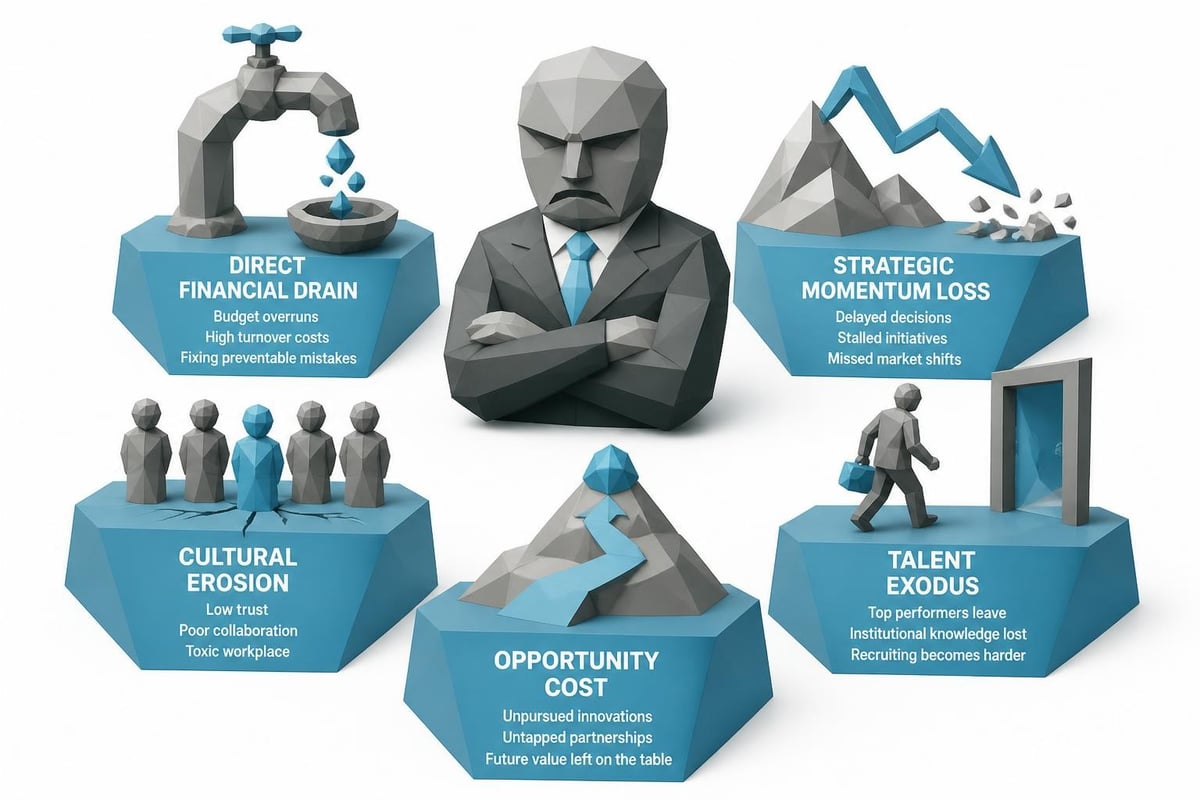
Cultural Erosion
The toxicity spreads. Teams adopt survival behaviors, hoard information, avoid collaboration, and stop taking intelligent risks. Cultural erosion and talent drain accelerate as employees recognize that leadership either can't see the problem or won't address it.
Talent Exodus
High performers leave first. They have options. A technology company we worked with in Q4 2025 lost seven senior directors in four months, all reporting to the same VP. Exit interview data revealed identical themes: favoritism, public criticism, unclear expectations, and retaliation against those who questioned decisions.
Opportunity Cost
What doesn't get built matters as much as what gets damaged. While organizations manage toxic executive fallout, competitors capture market share, innovate faster, and attract the talent you're losing.
What Makes Executive Toxicity Different
Toxic executives operate differently than difficult middle managers. They have positional power, board relationships, revenue responsibility, and often a track record that earned them the role. This creates organizational paralysis.
The Protection Mechanisms
Boards and CEOs hesitate to act because toxic executives frequently deliver short-term results. They hit quarterly targets while destroying the team that delivered them. They win clients while creating legal liability. They project confidence in board meetings while HR documents hostile workplace complaints.
From our 2026 leadership assessments, we've identified the most common protection mechanisms:
| Protection Mechanism | Why It Works | Organizational Cost |
|---|---|---|
| Results Shield | "They're hitting numbers" | Unsustainable performance built on fear |
| Founder/Insider Status | "They built this division" | Untouchable perception blocks feedback |
| Specialized Expertise | "Nobody else understands this market" | Overestimated irreplaceability |
| Board Relationship | "They report directly to the board" | CEO lacks removal authority |
| External Reputation | "Industry leader, award winner" | Public image vs. internal reality gap |
The Diagnostic Blind Spots
Most organizations lack the frameworks to diagnose executive toxicity before it becomes crisis level. Traditional performance reviews measure outcomes, not leadership behavior. 360 assessments get gamed or ignored when executives view feedback as optional.
The early warning signals appear in unexpected data:
- Turnover clustering: Multiple departures from the same division within 90 days
- Compliance anomalies: Increased HR complaints, legal holds, or policy exceptions
- Meeting patterns: Executives excluded from cross-functional initiatives or strategic planning
- Communication gaps: Information flow breaks down between the executive's team and the rest of the organization
- Vendor feedback: External partners report unusual demands, ethical concerns, or communication issues
The Intervention vs. Termination Decision
Here's what most boards miss: intervention and development over immediate termination often delivers better outcomes, especially when the executive has critical institutional knowledge or client relationships. The question isn't whether to act, but how to act with precision.
When Intervention Works
We've documented successful turnarounds in approximately 40% of toxic executive cases when three conditions exist:
- Self-awareness capacity: The executive can recognize their impact when confronted with specific evidence
- Behavioral flexibility: They demonstrate ability to modify communication style, decision-making approach, or leadership behaviors
- Organizational patience: The board commits to a structured 90-to-180-day intervention with clear milestones
A financial services company engaged our team after their CFO created a pattern of public criticism and exclusionary decision-making. The diagnostic revealed high analytical capability combined with low emotional intelligence and zero awareness of impact. The intervention plan included:
- Weekly executive coaching focused on stakeholder management and communication patterns
- Monthly 360 pulse surveys tracking specific behavioral changes
- Clearly defined success metrics tied to team engagement and cross-functional collaboration
- Board oversight with predetermined decision points
Six months later, engagement scores in finance improved by 34 points, voluntary turnover dropped to normal levels, and the CFO maintained performance while fundamentally changing how they led.

When Immediate Removal Is Required
Some situations demand immediate action regardless of cost. Legal exposure, ethics violations, harassment patterns, or fraud leave no room for development plans. But even then, the hidden cost of toxic executives continues through organizational trauma, knowledge loss, and relationship damage.
The removal process itself requires careful orchestration:
- Legal review: Document everything, engage employment counsel, prepare for litigation
- Communication strategy: Internal and external messaging that maintains confidentiality while addressing team concerns
- Transition planning: Interim leadership, client notification, project handoffs
- Cultural repair: Acknowledge the impact, rebuild psychological safety in the workplace, and reset norms
- Prevention analysis: Understand what hiring, promotion, or oversight failures allowed the situation to develop
The Prevention Framework That Actually Works
The best solution to the hidden cost of toxic executives is not hiring or promoting them in the first place. That requires changing how organizations assess executive capability.
Evidence-Based Leadership Diagnostics
Stop relying on interviews, references, and gut feel. Validated assessment tools identify behavioral patterns, decision-making tendencies, interpersonal dynamics, and stress responses that predict executive toxicity.
Our 2026 diagnostic framework combines:
- Behavioral assessments: Identify traits associated with toxic leadership (narcissism, lack of empathy, need for control, inability to accept feedback)
- Stakeholder interviews: Structured conversations with direct reports, peers, and board members using consistent evaluation criteria
- Performance pattern analysis: Review how candidates achieved results in previous roles (sustainable vs. extractive approaches)
- Situational simulations: Observe how executives handle conflict, ambiguity, feedback, and collaboration in controlled scenarios
The Hiring Process Red Flags
These warning signs predict future toxicity with surprising accuracy:
- Consistently blaming others for failures or departed team members
- Inability to name specific developmental areas or coaching they've received
- Dismissive comments about HR, compliance, or organizational processes
- Taking disproportionate credit for team achievements
- Reluctance to provide direct report references or explain team turnover
- Rigid thinking about "their way" of doing things
What Works: The Turnaround Methodology
Organizations that successfully address toxic executives without destroying value follow a structured approach. This isn't theory. It's documented across our client engagements in government, healthcare, technology, and financial services sectors.
Phase One: Diagnostic Precision (Weeks 1-3)
Skip the generic 360 assessment. Deploy targeted diagnostics that measure:
- Impact quantification: Calculate actual costs across the five damage categories
- Behavior inventory: Document specific incidents, patterns, and organizational effects
- Capability assessment: Determine if the executive has the capacity to change
- Stakeholder mapping: Identify who's protecting them, who's suffering, and who has influence
- Risk analysis: Legal exposure, client relationships, competitive intelligence, succession options
Phase Two: Intervention Design (Weeks 4-6)
Create a customized plan that addresses root causes, not symptoms. Generic leadership development fails because it doesn't target the specific toxic behaviors destroying value.
Effective intervention plans include:
| Intervention Component | Purpose | Success Indicator |
|---|---|---|
| Executive coaching | Address underlying drivers of toxic behavior | Demonstrated self-awareness in weekly sessions |
| Behavioral contracts | Create accountability for specific changes | Zero policy violations for 90 consecutive days |
| Stakeholder repair | Rebuild damaged relationships | Improved peer feedback scores |
| Team engagement work | Restore psychological safety | Direct report survey improvements |
| Board oversight | Maintain pressure and support | Monthly progress reviews with clear metrics |
The toxic leader transformation process requires expert coaching paired with organizational accountability. Neither works alone.

Phase Three: Measurement and Decision Points (Months 2-6)
Define exactly what success looks like and when you'll make stay-or-go decisions. Vague commitments to "give it time" waste resources and extend damage.
Track these leading indicators:
- Team engagement scores from direct reports (monthly pulse surveys)
- Peer collaboration metrics (participation in cross-functional work, meeting inclusion, information sharing)
- HR complaint trends (new issues, pattern changes, severity)
- Client or stakeholder feedback (especially from those who previously raised concerns)
- 360 assessment progress on identified behavioral targets
Set predetermined decision points at 90 days and 180 days. If metrics don't improve or regress, make the leadership change. If progress is clear and sustained, continue with ongoing coaching and monitoring.
The Board's Role in Prevention and Response
Boards create the conditions for executive toxicity through poor governance, inadequate oversight, and accountability failures. The same boards then struggle to address what they enabled.
Governance Changes That Prevent Toxicity
Based on our work with boards in 2026, these governance practices reduce executive toxicity risk:
- Anonymous upward feedback channels: Create safe mechanisms for teams to report executive behavior without career risk
- Culture metrics in board reporting: Track engagement, turnover, and inclusion data alongside financial performance
- Leadership behavior standards: Define and enforce expectations for how executives lead, not just what they deliver
- Regular executive assessments: Conduct behavioral diagnostics every 18 to 24 months, not just during crises
- Succession readiness: Maintain viable alternatives so no executive becomes irreplaceable
When Boards Get It Wrong
The most expensive board failure is knowing about toxic executive behavior and choosing inaction. This happens when boards prioritize short-term results over long-term organizational health or when personal relationships cloud judgment.
A manufacturing company board we advised in late 2025 ignored 18 months of HR escalations about their COO because revenue grew 23% during his tenure. When he finally departed (following a discrimination lawsuit that settled for $2.8 million), the post-mortem revealed:
- 31 employees had left his division, costing approximately $4.1 million in turnover and replacement
- Two strategic partnerships failed due to his interpersonal conflicts
- Product development timeline extended by nine months because teams avoided collaboration
- Legal had flagged compliance risks the board never reviewed
Total documented cost: $11.7 million. The actual cost was higher when accounting for opportunity cost and reputation damage.
FAQ: Addressing Toxic Executives
How long should organizations give toxic executives to change behavior?
Ninety days is sufficient to see meaningful progress if the executive has change capacity. Leadership coaching with clear behavioral targets should produce measurable improvements in team engagement, peer relationships, and documented incidents within this timeframe. If no progress appears by day 90, continuation is unlikely to succeed. Extension to 180 days is warranted only when early progress is clear but additional development is needed to sustain changes.
What's the average cost of removing a toxic C-suite executive?
Direct costs range from $800,000 to $3.2 million for severance, legal fees, and replacement recruiting. Indirect costs including lost momentum, cultural damage, talent exodus, and opportunity cost typically run 3 to 5 times the direct expenses. For organizations with $50 million to $500 million in revenue, total documented costs average $4.7 million per toxic executive removal based on 2026 client data.
Can toxic executives successfully change their leadership approach?
Yes, in approximately 40% of cases when three conditions exist: the executive demonstrates self-awareness capacity, shows behavioral flexibility, and the organization commits to structured intervention with accountability. Success requires expert coaching, clear metrics, regular measurement, and board oversight. Generic leadership development or unsupported "second chances" fail consistently.
Should boards prioritize results or leadership behavior when evaluating executives?
Both matter, but sustainable results require effective leadership behavior. Executives who deliver short-term outcomes while creating toxic environments generate results that cannot be sustained and costs that exceed the value created. Organizations that tolerate toxic high performers signal that behavior doesn't matter, which accelerates cultural erosion and increases the hidden cost of toxic executives across the entire leadership team.
What's the most overlooked early warning sign of executive toxicity?
Turnover clustering within a specific division or team reporting to one executive. When three or more departures occur within 90 days from the same organizational unit, especially among high performers, executive behavior is the probable cause. Most organizations track overall turnover but miss these localized patterns until the damage is severe. HR should flag clustering patterns immediately for diagnostic review.
The hidden cost of toxic executives remains one of the most preventable sources of value destruction in organizations today. Boards that implement evidence-based diagnostics, respond quickly to warning signals, and invest in structured intervention or decisive removal protect both organizational health and enterprise value. The Noomii Corporate Leadership Program helps organizations identify toxic leadership patterns, design precision interventions, and strengthen executive decision-making through tailored coaching solutions that deliver measurable results.



Leave a Reply
Want to join the discussion?Feel free to contribute!