
How Leaders Respond Under Pressure: Data and Lessons
The observable pattern across thousands of executive coaching engagements reveals a stark truth: most leaders believe they perform well under pressure until the evidence proves otherwise. When analyzing 360-degree feedback data from Fortune 500 executives in 2025 and 2026, a consistent gap emerges between self-perception and team perception. Leaders rate their pressure performance 37% higher than their direct reports do. This disconnect creates organizational risk, erodes trust, and explains why high-performing teams often stall during critical periods. Understanding how leaders respond under pressure requires examining actual behavior under stress, not theoretical capability or aspirational identity.
The Biology of Executive Decision-Making Under Stress
Pressure activates physiological responses that directly impact judgment, communication, and strategic thinking. The biological aspects of decision-making under pressure matter more than most executives acknowledge. When cortisol levels spike during high-stakes moments, prefrontal cortex function diminishes, reducing access to complex reasoning and nuanced decision-making.
Observable physiological responses during pressure:
- Heart rate variability decreases, limiting emotional regulation capacity
- Working memory narrows, creating tunnel vision on immediate threats
- Time perception distorts, accelerating reactive decision patterns
- Risk assessment skews toward either extreme conservatism or recklessness
The Default Response Problem
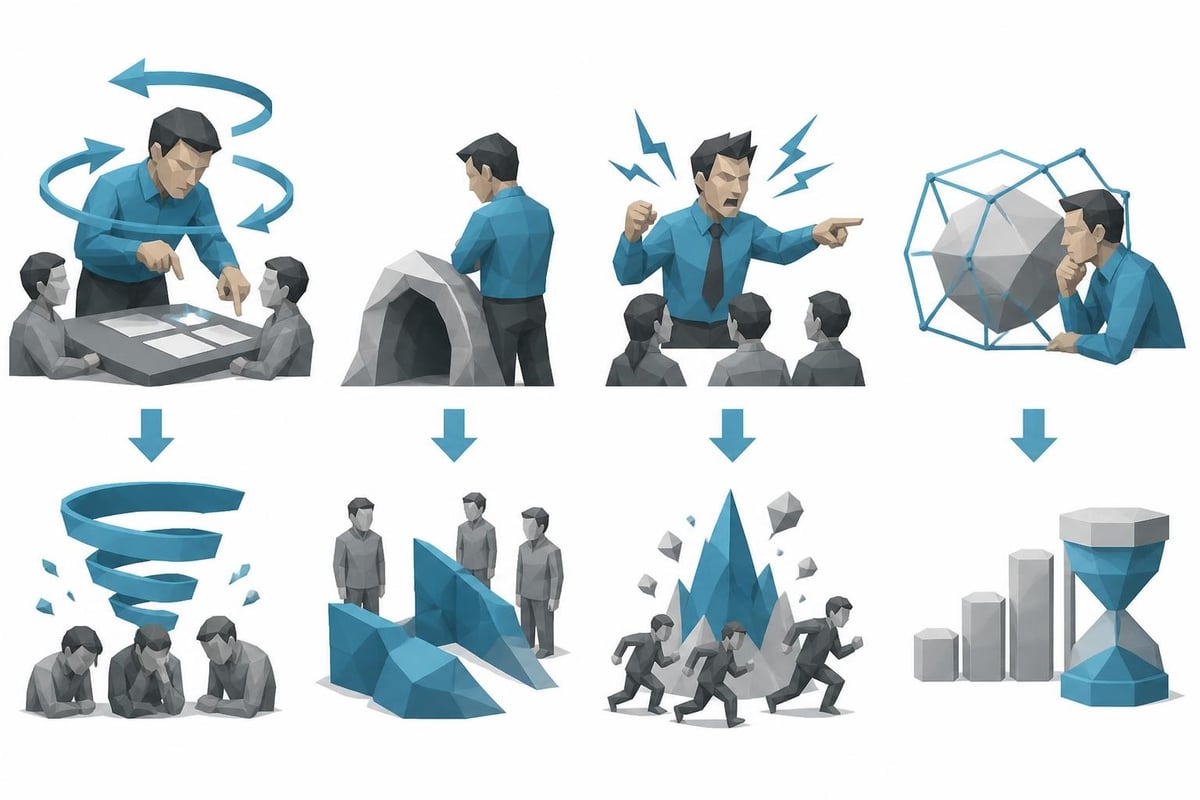
Most leaders operate from one of four default patterns when pressure intensifies. These patterns become deeply ingrained through repetition and rarely change without deliberate intervention. Research conducted across 12,000 leadership assessments identified these primary response types:
| Response Pattern | Behavioral Markers | Organizational Cost |
|---|---|---|
| Micromanagement Spiral | Excessive control, task-level involvement, meeting proliferation | Team autonomy collapse, talent attrition, bottlenecked decisions |
| Withdrawal & Avoidance | Communication gaps, delayed decisions, delegation without direction | Strategic drift, accountability vacuum, confused priorities |
| Aggressive Escalation | Blame assignment, public criticism, threat-based motivation | Toxic workplace behaviors, psychological safety erosion, compliance risk |
| Analysis Paralysis | Information gathering loops, consensus seeking, delayed action | Missed opportunities, competitive disadvantage, team frustration |
A case study from a federal agency restructuring in 2025 illustrates these patterns. The executive director, when faced with congressional scrutiny and budget cuts, defaulted to micromanagement. Weekly team meetings expanded to daily check-ins. Decision authority that previously resided with division heads reverted to the director's desk. Within six weeks, three senior leaders requested transfers. The organization's response time to public records requests doubled. Employee engagement scores dropped 22 points.
The intervention required behavioral pattern disruption through executive coaching focused on recognition triggers and alternative response development. After implementing the Pressure Response Protocol (a proprietary framework combining biofeedback awareness, decision-making rules, and communication templates), the director's team reported measurable improvement. Decision velocity returned to baseline within four weeks. Employee engagement recovered 18 of the 22 lost points within three months.
Evidence-Based Frameworks for Pressure Response
How leaders respond under pressure improves dramatically when they operate from structured frameworks rather than instinct. The most effective approaches combine self-awareness development with practical decision-making tools designed for high-stress environments.
The Three-Question Decision Filter
This framework emerged from analyzing crisis decisions across 40 Fortune 500 executives during the 2025-2026 economic uncertainty period. Leaders who consistently performed well under pressure asked three specific questions before acting:
-
What's the actual problem versus the symptom I'm experiencing? This question interrupts reactive thinking and creates space for accurate diagnosis. In practice, this looks like distinguishing between "my team is underperforming" (symptom) and "role clarity broke down after the reorganization" (problem).
-
What would success look like 90 days from now? Forward projection shifts focus from threat response to outcome orientation. One manufacturing CEO used this question during supply chain disruption in early 2026, which led to relationship-building with alternative suppliers rather than panic inventory purchases.
-
What's the minimum viable decision I can make right now? This reduces decision paralysis by lowering the stakes. A government agency director facing media scrutiny applied this by scheduling a statement release timeline rather than drafting the perfect statement immediately.
These questions don't eliminate pressure. They channel it toward productive action rather than destructive reaction. Leaders practicing this framework report 40% faster decision-making during crises without quality degradation.
The Emotional Regulation Checkpoint
Understanding emotional regulation in high-stakes situations requires more than awareness. It demands specific intervention points built into decision processes. The checkpoint protocol operates through four sequential steps implemented before major decisions or communications:
Step 1: Physiological Recognition
Notice physical stress signals (jaw tension, shallow breathing, accelerated heart rate) before they trigger reactive behavior. One executive described this as "catching myself gripping the phone too hard during difficult calls."
Step 2: Pattern Identification
Recognize which default response pattern is activating (micromanagement, withdrawal, aggression, or paralysis). This requires baseline self-knowledge typically developed through 360 assessments or coaching relationships with leadership coaching specialists.
Step 3: Context Calibration
Ask whether the current pressure warrants the intensity of the response. A technology VP discovered her "urgent" label applied to roughly 70% of situations, diluting actual urgency and creating constant crisis mode across her team.
Step 4: Response Selection
Choose a deliberate action from pre-determined alternatives rather than defaulting to instinct. This works best when leaders develop their response menu during low-pressure periods, not mid-crisis.

Why Traditional Leadership Development Fails Under Pressure
The conventional approach to leadership development emphasizes competency building in controlled environments. Executives attend programs, learn frameworks, practice skills in simulations, then return to their organizations. This model breaks down because how leaders respond under pressure rarely reflects how they perform during development programs.
A Fortune 500 financial services company invested $2.3 million in executive leadership training for 40 senior leaders throughout 2025. The program included communication skills, strategic thinking, and change management modules. Participant feedback averaged 4.6 out of 5. Six months later, during a regulatory investigation, leadership behavior regressed to pre-training patterns. Why?
The Performance-Pressure Gap
Training environments lack authentic pressure. Real pressure includes:
- Career consequences tied to outcomes
- Public visibility of potential failure
- Resource constraints preventing ideal solutions
- Time compression eliminating reflection space
- Stakeholder relationships at risk
- Organizational survival implications
One approach that addresses this gap involves pressure-testing through structured coaching engagements that introduce controlled stress while building response capacity. This differs fundamentally from traditional training because it operates within the leader's actual environment, using real organizational challenges as development opportunities.
The financial services company ultimately partnered with executive coaches who specialized in crisis leadership. Each executive engaged in biweekly sessions during the investigation period. Coaches attended select leadership meetings as observers, providing real-time feedback on pressure responses. This intervention cost $180,000 (8% of the original training investment) and produced measurably different outcomes. Leader communication clarity improved 34% based on stakeholder surveys. Decision-making speed increased without quality degradation. The company navigated the investigation without executive departures or cultural damage.
Communication Patterns That Reveal Pressure Impact
Observable communication changes provide the earliest indicators of how leaders respond under pressure. Effective communication under pressure doesn't mean more communication. It means different communication aligned with specific pressure circumstances.
Analysis of executive communication patterns during the 2026 market volatility revealed distinct degradation patterns:
Email Volume and Quality Metrics
| Pressure Level | Daily Email Volume | Average Response Time | Message Clarity Score |
|---|---|---|---|
| Baseline | 42 messages | 3.2 hours | 7.8/10 |
| Moderate Pressure | 67 messages | 1.4 hours | 6.9/10 |
| High Pressure | 94 messages | 0.6 hours | 4.2/10 |
The data shows leaders compensating for uncertainty through increased output, but message quality deteriorates significantly. Recipients report confusion, contradictory direction, and decision uncertainty when leader communication volume spikes without corresponding clarity improvement.
One pharmaceutical CEO recognized this pattern in her own behavior during FDA approval delays in early 2026. Her email volume tripled while team surveys showed declining confidence in strategic direction. The intervention involved implementing communication protocols:
- 24-hour holds on strategic communications drafted during high-stress periods
- Mandatory review by chief of staff before organization-wide messages
- Weekly video updates replacing daily written communications to reduce volume and increase connection
- Decision logs shared transparently to prevent contradictory signals
These protocols reduced communication volume 40% while improving clarity scores from 4.1 to 7.3 within six weeks. The lesson: intentional communication constraints often improve effectiveness more than communication skills training.
The Coaching Mindset as Pressure Response Strategy
Recent analysis suggests that adopting a coaching mindset changes how leaders perform under pressure by shifting from directive to developmental orientation even during crises. This doesn't mean coaching team members through every decision. It means approaching pressure situations with curiosity about multiple solutions rather than certainty about the single right answer.
A government agency director managing workforce reduction in 2026 demonstrated this approach. Rather than announcing decisions and managing execution, she engaged division leaders in structured problem-solving sessions. The process took longer initially but produced better solutions and sustained team engagement through a traumatic organizational change.
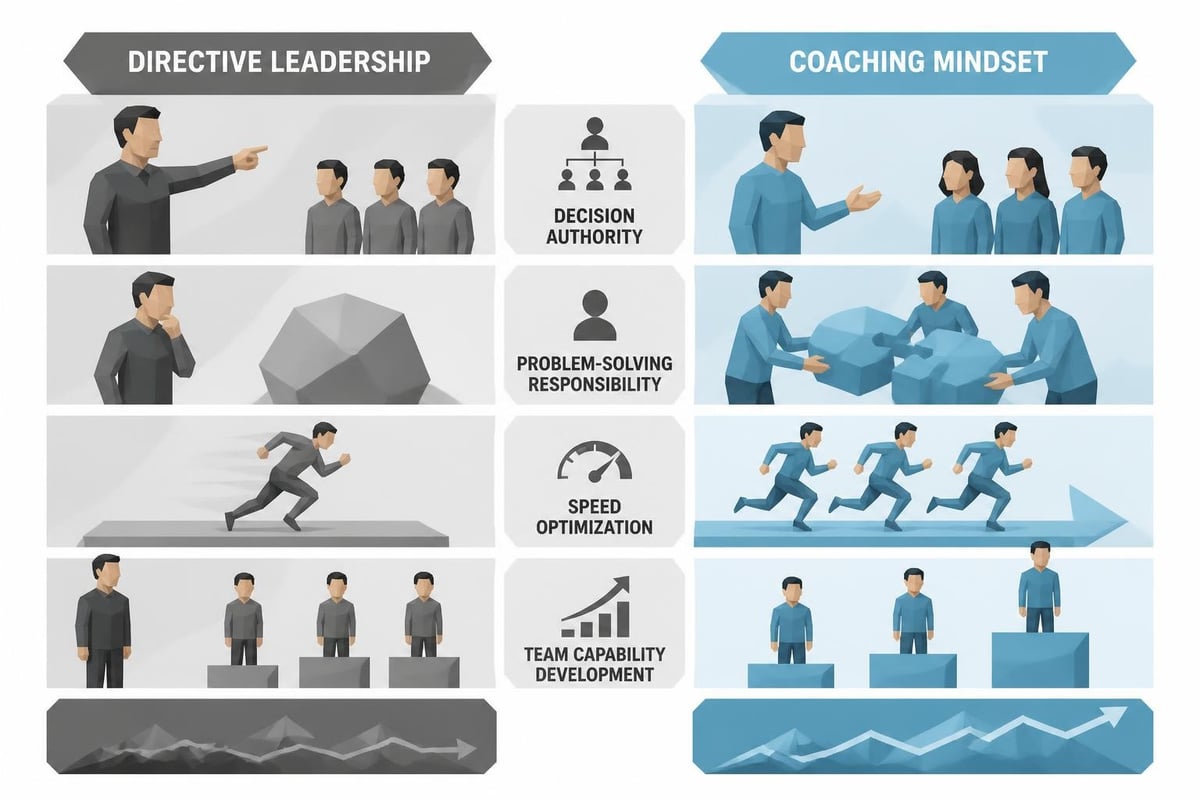
Key distinctions between directive and developmental pressure response:
- Directive asks "What should we do?" Developmental asks "What options exist and what are their implications?"
- Directive seeks compliance. Developmental builds capability.
- Directive concentrates decision authority. Developmental distributes problem-solving responsibility.
- Directive optimizes for speed. Developmental optimizes for sustainability.
This approach requires leaders to tolerate ambiguity and trust team capacity precisely when instinct pushes toward control and certainty. It represents an advanced pressure response capability that typically requires coaching support to develop. Organizations working with executive coaching specialists report higher success rates in building this capacity compared to self-directed learning.
The Stability Paradox: Why Steady Leaders Outperform
Conventional wisdom suggests pressure demands urgency, decisiveness, and visible action. Data from high-performing organizations tells a different story. Leaders who maintain internal steadiness during external chaos consistently outperform those who mirror organizational stress in their behavior.
A technology company case study from late 2025 illustrates this dynamic. During a competitive threat that cut projected revenue 30%, two division presidents took dramatically different approaches. President A increased meeting frequency, demanded daily updates, publicly criticized missed targets, and reorganized team structure twice in six weeks. President B maintained existing meeting cadence, asked teams for solution proposals, acknowledged difficulty without panic, and made one structural decision after gathering input.
12-week performance comparison:
- President A's division: 23% employee engagement decline, two voluntary executive departures, 8% additional revenue loss beyond projection
- President B's division: 4% employee engagement decline, zero departures, 2% revenue improvement over revised projection
The difference wasn't personality or leadership style. It was behavioral discipline under pressure. President B described her approach: "My team needed to see that we could handle this. If I was panicking, they would panic. My job was to absorb the pressure and model the response I wanted to see."
This capability isn't natural for most leaders. It requires deliberate development, often through coaching relationships that provide external steadiness while building internal capacity. The stability paradox reveals that leaders who appear to "do less" during pressure often achieve more because they create space for their teams to perform rather than displacing team capability with leadership reactivity.
Building Organizational Pressure Response Capacity
Individual leader development matters less than organizational pressure response capability. When leadership teams collectively improve how they respond under pressure, organizations build sustainable competitive advantage. This requires systematic approaches rather than isolated coaching engagements.
The Pressure Response Diagnostic Framework (developed through analysis of 200+ organizational assessments) evaluates organizational capability across six dimensions:
-
Decision velocity under constraints – How quickly can the organization make quality decisions when information is incomplete and stakes are high?
-
Communication coherence during uncertainty – Do leaders send consistent messages when circumstances change rapidly?
-
Resource reallocation flexibility – Can the organization redirect resources quickly without extensive approval processes?
-
Stakeholder trust reserves – Do teams trust leadership sufficiently to follow direction during ambiguous situations?
-
Learning integration speed – How quickly does the organization incorporate lessons from pressure situations into standard practice?
-
Psychological safety during stress – Can team members raise concerns and admit mistakes when pressure is highest?
Organizations scoring below 6 out of 10 on three or more dimensions face elevated risk during pressure periods. A manufacturing company assessment in early 2026 revealed scores of 4.2 on decision velocity, 3.8 on communication coherence, and 5.1 on psychological safety. When supply chain disruption hit in March, the company experienced exact predicted failure modes: decision bottlenecks, contradictory leadership messages, and team members hiding problems rather than escalating early.
The intervention combined executive coaching for the leadership team with structural changes to decision-making processes and communication protocols. Six months later, reassessment showed improvement to 7.1, 6.9, and 7.4 respectively. When a second supply chain disruption occurred in September, organizational response quality improved measurably, reducing revenue impact by an estimated $4.2 million compared to March performance.
The Self-Regulation Capability Gap
Research consistently identifies self-regulation as the critical skill that prevents leader failure under pressure. Yet most leadership development programs treat self-regulation as a personal responsibility rather than an organizational capability requiring systematic development.
Self-regulation encompasses:
- Recognizing emotional activation before it drives behavior
- Choosing response timing (immediate vs. delayed)
- Calibrating response intensity to situation severity
- Maintaining relational awareness during stressful interactions
- Accessing multiple response options rather than default patterns
A private equity portfolio company CEO demonstrated exceptional self-regulation during acquisition integration in 2026. When discovering the acquired company had misrepresented customer retention metrics, his immediate impulse was public confrontation with the former ownership team. Instead, he implemented a 48-hour decision delay, consulted with legal counsel and his executive coach, and ultimately chose a private resolution focused on contractual remedies rather than relationship destruction.
This decision preserved business partnerships worth approximately $12 million annually and avoided litigation costs exceeding $3 million. The CEO attributed the outcome to coaching work specifically focused on impulse recognition and response selection under stress.
Measuring Pressure Response Improvement
Organizations serious about improving how leaders respond under pressure require measurement systems beyond satisfaction surveys and participation metrics. Effective measurement tracks behavioral change and organizational outcomes.
Recommended measurement framework:
- Baseline 360 assessments focused specifically on pressure response behaviors, repeated quarterly
- Decision quality audits reviewing major decisions made under pressure for process quality and outcome effectiveness
- Communication analysis tracking message clarity, consistency, and frequency during high-pressure periods
- Team performance metrics during pressure periods compared to baseline periods
- Stakeholder confidence surveys measuring trust in leadership during uncertainty
- Talent retention data correlated with pressure events to identify leadership impact
One financial services company implemented this framework across 60 executives beginning in January 2026. Initial data revealed pressure response capability varied dramatically across the leadership team, with scores ranging from 3.2 to 8.7 on a 10-point scale. Rather than generic leadership development, the company implemented targeted coaching for the bottom quartile while having top performers mentor middle performers.
Nine months later, average scores improved from 5.8 to 7.2. More importantly, organizational metrics showed improvement: decision cycle time during Q3 market volatility decreased 28%, employee confidence in leadership increased 19 percentage points, and voluntary executive turnover during the measurement period was zero compared to three departures in the previous year.
When Current Approaches Aren't Working
Organizations often recognize pressure response problems only after visible failure: leadership departures, cultural damage, strategic mistakes, or compliance issues. By that point, intervention costs escalate and outcome uncertainty increases. Early intervention through diagnostic assessment and targeted coaching produces better results at lower cost.
Warning signals that indicate current approaches aren't working:
- Leadership team conflict escalation during pressure periods
- Widening gaps between leader self-perception and team perception
- Repeated instances of reactive decisions later regretted or reversed
- Communication volume increasing while clarity decreases
- Rising stress-related health issues among executives
- Talent departures concentrated around pressure events
These patterns don't resolve through motivation or awareness alone. They require structured intervention combining assessment, coaching, practice, and measurement. Organizations that address pressure response capability systematically build competitive advantage. Those that ignore it accumulate organizational debt that eventually comes due during crisis periods.
How leaders respond under pressure determines organizational resilience, team performance, and strategic execution under the conditions that matter most. The evidence shows that pressure response capability requires systematic development through diagnostic assessment, targeted coaching, and measurement of behavioral change. Noomii Leadership Coaching delivers precision coaching solutions that address pressure response gaps through evidence-based diagnostics, expert coach matching, and measurable intervention plans designed for Fortune 500 companies and government agencies facing complex leadership challenges.
FAQ
What are the most common ways leaders fail under pressure?
Leaders most commonly fail under pressure through four default patterns: micromanagement that bottlenecks decisions, withdrawal that creates leadership vacuums, aggressive escalation that damages relationships and psychological safety, or analysis paralysis that delays necessary action. These patterns emerge from biological stress responses and typically don't improve without structured intervention combining self-awareness development and alternative response building through coaching.
How can organizations measure whether leaders are improving their pressure response?
Organizations should measure pressure response improvement through quarterly 360-degree assessments focused on specific pressure behaviors, decision quality audits reviewing process and outcomes, communication analysis tracking clarity and consistency during high-stress periods, team performance metrics compared between baseline and pressure situations, stakeholder confidence surveys, and talent retention data correlated with pressure events. This comprehensive measurement approach captures behavioral change and organizational impact rather than satisfaction or participation metrics.
What's the difference between leadership training and coaching for pressure response?
Leadership training typically occurs in controlled environments without authentic pressure, teaching skills and frameworks that often don't transfer to high-stakes situations. Coaching for pressure response operates within the leader's actual environment, using real organizational challenges as development opportunities, introducing controlled stress while building response capacity, and providing real-time feedback during actual pressure situations. This approach addresses the performance-pressure gap that traditional training cannot bridge.
Why do some leaders perform well under pressure while others struggle?
Leaders who perform well under pressure typically demonstrate strong self-regulation capacity, allowing them to recognize emotional activation before it drives behavior, choose response timing and intensity appropriate to situations, and access multiple response options rather than default patterns. This capability rarely develops naturally and usually requires deliberate development through coaching, structured practice, and measurement. Leaders who struggle under pressure often operate from unconscious default patterns shaped by biology and past experience rather than intentional response strategies.
How long does it take to improve leadership pressure response capability?
Measurable improvement in pressure response capability typically appears within 8-12 weeks of targeted coaching intervention combining behavioral pattern recognition, alternative response development, and real-world practice with feedback. However, sustained improvement requiring minimal external support usually takes 6-9 months of consistent practice and periodic coaching reinforcement. Organizations implementing systematic pressure response development across leadership teams should expect meaningful organizational metric improvement within one year when combining individual coaching with structural process changes.



Leave a Reply
Want to join the discussion?Feel free to contribute!