

Leadership Failures Driving Turnover: The Real Cost
The pattern repeats itself across industries, geographies, and company sizes. High performers submit resignation letters. Exit interviews reveal frustration with management. HR scrambles to backfill critical roles. Yet when boards and senior executives examine the root cause, they consistently underestimate how leadership failures driving turnover create cascading organizational damage that extends far beyond immediate replacement costs. In 2026, with labor markets tightening and talent acquisition costs reaching historic highs, the price of ignoring leadership inadequacy has become unsustainable.
The Financial Reality Most Executives Miss
When organizations calculate turnover costs, they typically focus on recruitment expenses, onboarding time, and temporary productivity loss. This accounting misses the substantial hidden costs that leadership failures driving turnover generate across the enterprise.
Consider the actual financial impact based on patterns we observe in leadership diagnostics:
| Cost Category | Visible Calculation | Hidden Multiplier |
|---|---|---|
| Replacement hiring | $50,000-$150,000 per role | Knowledge transfer failure adds 30-40% |
| Productivity gap | 3-6 months to full performance | Team disruption extends timeline 50% |
| Customer impact | Occasional service lapses | Relationship damage persists 12-18 months |
| Cultural erosion | Not typically measured | Reduces engagement scores 15-25% |
The numbers tell only part of the story. When a senior director leaves due to leadership failures that drive good employees away, their departure often triggers a secondary exodus. We've seen this cascade effect repeatedly: one executive resignation leads to three manager departures within six months, each taking institutional knowledge, client relationships, and team cohesion with them.
The real multiplier effect occurs in organizational memory loss. When experienced employees leave, they take decision context, relationship capital, and process understanding that cannot be documented in transition notes. New hires spend months reconstructing knowledge that walked out the door.

Five Leadership Patterns That Trigger Immediate Flight Risk
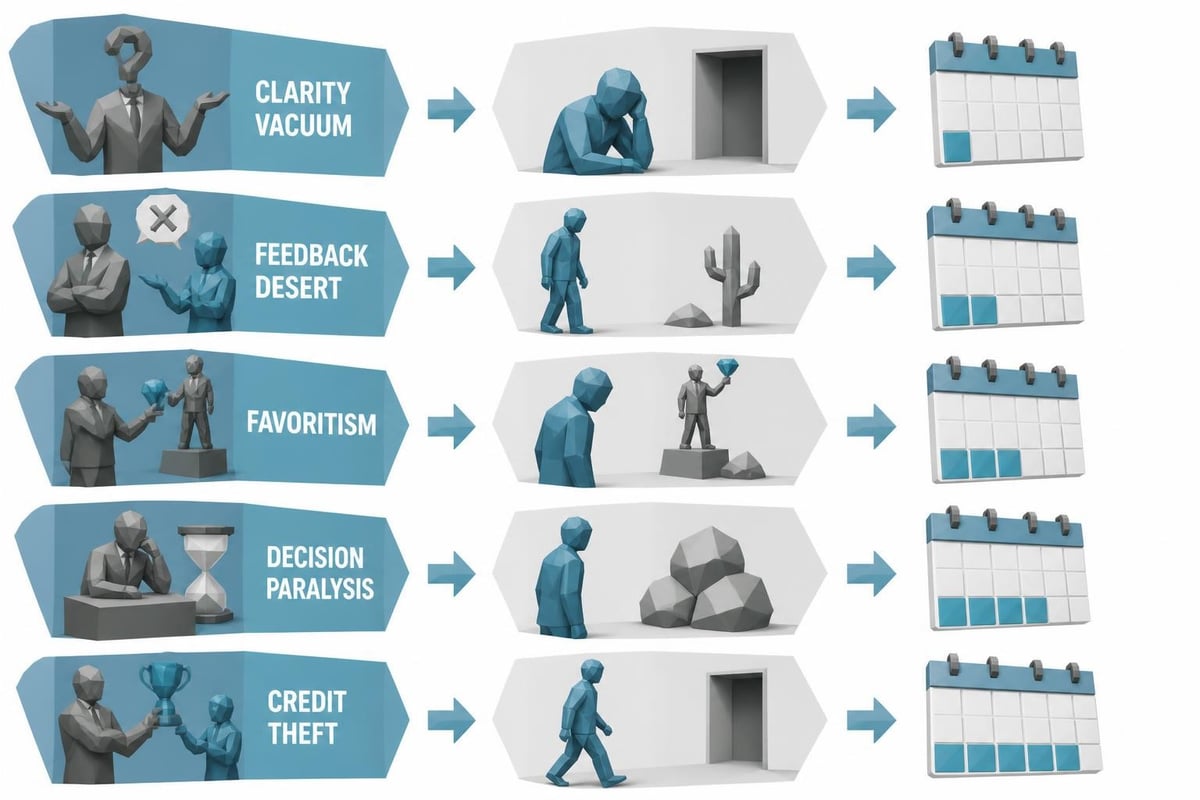
Through comprehensive leadership assessments across Fortune 500 companies and government agencies, specific behavioral patterns consistently predict employee departures within 90-180 days. These aren't theoretical leadership principles. They're observable, measurable failures that create documented attrition.
The Clarity Vacuum
Leaders who cannot articulate clear expectations, decision criteria, or strategic priorities create organizational chaos that high performers refuse to tolerate. In one recent diagnostic of a technology division experiencing 40% annual turnover, we identified that 73% of departing employees cited "unclear direction" as their primary frustration.
The mechanism is straightforward. Talented professionals need to understand:
- What success looks like in measurable terms
- How their work connects to organizational objectives
- Which initiatives take priority when resources conflict
- What authority they have to make decisions
When leaders provide ambiguity instead of clarity, top performers leave for environments where their impact is visible and valued.
The Feedback Desert
Absence of meaningful feedback ranks among the top three leadership failures driving turnover across every sector we analyze. This isn't about annual performance reviews. It's about the complete absence of regular, specific, actionable input on performance, progress, and development.
We observe two distinct failure modes:
- Radio silence: Leaders provide no feedback until problems become critical
- Generic praise: Vague "good job" comments that offer no developmental value
Both approaches signal to employees that their growth matters less than immediate task completion. High performers particularly resent this pattern because they actively seek development opportunities and view stagnant skill development as career regression.
The organizations that successfully retain top talent implement structured feedback cadences with specific behavioral observations, impact analysis, and developmental recommendations. The contrast between feedback-rich and feedback-poor cultures shows up immediately in retention metrics.
The Favoritism Trap
Nothing destroys team cohesion faster than visible preferential treatment based on personal relationships rather than performance contribution. When leaders consistently give choice assignments, flexibility, recognition, or developmental opportunities to a select inner circle, they create a two-tier culture that drives merit-based professionals to exit.
The pattern manifests in several ways:
- Assignment distribution that favors specific individuals regardless of capability
- Inconsistent application of policies, deadlines, or quality standards
- Access to leadership time and mentorship distributed by relationship rather than potential
- Recognition and rewards that don't correlate with measurable outcomes
In government agencies particularly, this favoritism creates compliance risks and morale collapse. We've diagnosed situations where entire teams submitted transfer requests after watching less qualified colleagues receive promotions based purely on social proximity to decision-makers.
The Trust Equation Nobody Calculates
Organizations invest substantial resources in engagement surveys, culture initiatives, and retention programs while overlooking the fundamental variable that determines whether employees stay or leave: do they trust their direct leader's judgment, integrity, and commitment to their success? Understanding when leadership fails requires examining this trust equation with precision.
Trust isn't built through team-building exercises or inspirational speeches. It develops through consistent demonstration of three specific capabilities:
Competent decision-making under pressure. Employees evaluate whether their leader makes sound judgments when stakes are high, information is incomplete, and political pressure is intense. Leaders who consistently make reactive, politically motivated, or analysis-free decisions destroy trust rapidly. Every poor decision becomes evidence that leadership lacks the capability to navigate complexity.
Transparent communication about reality. Sugarcoating problems, withholding critical information, or contradicting observable facts creates cynicism that no amount of positivity can overcome. We've seen entire divisions lose confidence in leadership after watching executives deny obvious problems that frontline employees deal with daily. The credibility gap becomes irreversible.
Genuine investment in team success. Employees assess whether their leader actively removes obstacles, advocates for resources, develops their capabilities, and celebrates their contributions. Leaders who take credit for team wins while deflecting blame for losses create resentment that manifests in departure decisions.
When we conduct leadership diagnostics for organizations experiencing unexplained attrition, trust erosion appears as the common thread across departing employee cohorts. They don't leave because of compensation, benefits, or workload. They leave because they've concluded their leader lacks the judgment, honesty, or commitment to support their success.
Decision Paralysis as Organizational Poison
While dramatic leadership failures grab attention, one of the most insidious patterns involves leaders who simply cannot make decisions with appropriate speed and conviction. This paralysis creates organizational gridlock that frustrates execution-oriented professionals to the point of resignation.
The typical progression looks like this:
- Initiative proposed with clear business case and implementation plan
- Analysis requested to validate assumptions and quantify risks
- Additional analysis requested when initial findings are inconclusive
- Stakeholder input solicited to build consensus and reduce political risk
- External benchmarking conducted to see what competitors are doing
- Committee formed to evaluate options and develop recommendations
- Decision deferred pending further analysis or more favorable conditions
By the time this cycle completes, the original opportunity has evaporated, the team has lost momentum, and high performers have updated their resumes. Research on executive failure rates confirms that inability to make timely decisions ranks among the top predictors of leadership ineffectiveness.
Decision paralysis particularly damages organizations in rapidly changing environments where competitive advantage goes to companies that can execute quickly on incomplete information. When employees watch leaders endlessly deliberate while competitors move forward, they recognize they're in the wrong organization.
The pattern we observe in diagnostics: leaders who demand 90% certainty before committing to decisions create cultures where initiative dies and talented people leave for environments that value calculated risk-taking over risk avoidance.
What High-Quality Leadership Diagnostics Reveal
Generic employee surveys miss the specific leadership behaviors that trigger departures. Comprehensive diagnostics using validated assessment tools identify the precise gaps between current leadership capability and what the organization requires to retain top talent.
Effective diagnostics examine three distinct layers:
Individual Leader Behavioral Patterns
Assessment of specific observable behaviors across critical dimensions: decision quality, communication clarity, feedback delivery, delegation effectiveness, conflict resolution, strategic thinking, and team development. These aren't subjective ratings. They're structured evaluations that identify specific capability gaps with developmental precision.
The value emerges in specificity. Instead of "needs to improve communication," diagnostics reveal "provides insufficient context when delegating complex assignments, leading to rework and frustration." That precision enables targeted intervention.
Team Dynamic Impact
Analysis of how individual leadership behaviors create team-level consequences: psychological safety at work, collaboration effectiveness, innovation frequency, conflict patterns, and performance variability. This layer connects leadership actions to measurable team outcomes.
We frequently discover that leaders rate themselves positively on dimensions where their teams report significant problems. This perception gap itself becomes a diagnostic finding that explains retention challenges.
Organizational System Effects
Examination of how leadership patterns at scale create enterprise-level consequences: cultural coherence, talent mobility, succession readiness, change capacity, and strategic execution effectiveness. This systemic view identifies whether leadership failures represent isolated issues or organizational patterns.
| Diagnostic Layer | Assessment Focus | Turnover Connection |
|---|---|---|
| Individual behaviors | Specific capability gaps | Direct report flight risk |
| Team dynamics | Collective effectiveness | Team cohesion and performance |
| System effects | Cultural and strategic impact | Enterprise retention patterns |
Organizations that conduct this three-layer diagnostic work gain visibility into exactly which leadership failures driving turnover require immediate intervention versus long-term development investment.
The Intervention Framework That Actually Works
Once diagnostics identify specific leadership failures, the question becomes: what intervention approach produces measurable improvement in retention-critical behaviors? Generic leadership training fails because it doesn't address individual behavioral patterns with sufficient precision.
The intervention framework that generates documented results combines four elements:
Targeted behavioral change plans based on diagnostic findings, not generic development programs. If a leader's primary failure involves providing unclear expectations, the intervention focuses specifically on expectation-setting frameworks, communication protocols, and accountability structures. Broad-based training on "leadership excellence" doesn't move the needle.
Expert coaching matched to specific developmental needs. A leader struggling with decision paralysis requires different coaching expertise than one dealing with team conflict or strategic communication. Precision matching between leader needs and coach capabilities determines intervention effectiveness.
Structured accountability mechanisms that ensure behavioral change translates to observable team impact. Development plans without measurement systems rarely produce lasting change. Effective interventions establish clear behavioral targets, create feedback loops with direct reports, and track improvement against baseline metrics.
Organizational support that removes structural barriers to leadership effectiveness. Sometimes the problem isn't individual capability but system design that prevents good leadership. Intervention plans that ignore organizational constraints fail regardless of individual commitment.
We've seen this framework reverse retention crises within 90-120 days when implemented with diagnostic precision. The key is matching intervention intensity to problem severity and leadership level.

The Executive Blind Spots That Perpetuate Problems
When organizations experience persistent turnover despite retention initiatives, the root cause often traces to specific blind spots at the executive level. Senior leaders systematically underestimate certain failure patterns while overvaluing others.
Blind spot one: Confusing activity with impact. Executives see leaders attending meetings, sending emails, and completing projects. They miss that those same leaders provide no meaningful feedback, create unclear priorities, and make politically motivated decisions. Activity metrics obscure leadership effectiveness.
Blind spot two: Overweighting technical expertise. Organizations promote strong individual contributors into leadership roles, then express surprise when technical brilliance doesn't translate to leadership capability. The skills that make someone an exceptional engineer, analyst, or sales professional have minimal overlap with the capabilities required to lead teams effectively.
Blind spot three: Tolerating acceptable mediocrity. Executives accept leadership performance that doesn't create obvious crises while missing the steady talent drain it produces. The leader who isn't dramatically failing but also isn't developing people, making sound decisions, or building high-performing teams creates slow organizational degradation that shows up in retention data before executive awareness.
Blind spot four: Misdiagnosing turnover causes. When good people leave, executives default to compensation explanations or inevitable market dynamics rather than examining leadership quality. This attribution error prevents addressing actual problems. Organizations facing high turnover rates should examine leadership effectiveness before assuming external factors drive departures.
The pattern we observe: executive teams that systematically audit leadership quality against retention outcomes identify problems earlier and intervene more effectively than those that react to turnover crises after talent has already departed.
Measuring What Actually Matters
Organizations that successfully reduce leadership failures driving turnover implement measurement systems that track leading indicators rather than lagging outcomes. Waiting for turnover data means responding to problems months after they became visible to employees.
Effective measurement tracks five categories:
- Team health indicators: Engagement scores, psychological safety assessments, collaboration effectiveness ratings, and innovation frequency measured at team level rather than organizational aggregate
- Leadership behavior frequency: Observable actions like feedback delivery, decision speed, clarity of communication, and recognition consistency tracked through structured observation
- Development velocity: Skill growth, stretch assignment completion, and capability expansion measured for team members under specific leaders
- Early warning signals: Transfer requests, reduction in discretionary effort, decline in idea generation, and changes in communication patterns
- Retention risk scoring: Predictive models that identify flight risk based on tenure, performance level, development trajectory, and leadership quality exposure
Organizations that establish these measurement systems gain 6-12 month visibility into retention problems before resignations occur. That lead time enables intervention while employees remain engaged rather than after they've mentally checked out.
The measurement approach that works: combine quantitative metrics with qualitative insight from structured conversations, skip-level meetings, and pulse assessments that capture real-time sentiment rather than annual survey snapshots.
The Compliance and Governance Dimension
In government agencies and heavily regulated industries, leadership failures driving turnover create risks that extend beyond talent loss into compliance exposure and governance challenges. Poor leadership decisions can trigger regulatory violations, create liability exposure, and damage public trust.
The connection between leadership quality and compliance risk appears in three patterns:
Leaders under pressure make expedient decisions that violate established protocols, creating audit findings and enforcement actions. We've seen situations where leadership shortcuts to meet deadlines produced compliance failures that resulted in investigations, penalties, and mandatory remediation.
Toxic leadership environments suppress reporting of problems, ethical concerns, and potential violations. When employees fear retaliation or dismissal for raising issues, compliance systems fail regardless of how well-designed they are on paper. The signs of leadership failure often appear first in reduced willingness to escalate concerns.
Leadership failures that drive away experienced employees create knowledge gaps in compliance-critical processes. When institutional memory walks out the door, organizations lose understanding of why certain controls exist and how to implement them effectively.
Governance structures must therefore evaluate leadership effectiveness not just through performance metrics but through compliance track records, employee reporting patterns, and audit findings. Boards that ignore leadership quality while focusing exclusively on financial results miss substantial risk exposure.
Building Leadership Capability at Scale
Organizations with distributed operations face a distinct challenge: how do you address leadership failures driving turnover when you have hundreds of managers across multiple geographies, business units, and functional areas? The scalability question determines whether leadership development remains an executive privilege or becomes an enterprise capability.
Scalable approaches require three elements:
Standardized diagnostic frameworks that assess leadership capability consistently across the organization. Custom assessment for each leader isn't feasible at scale. Organizations need validated tools that identify capability gaps with precision while remaining cost-effective to deploy broadly.
Distributed coaching networks that provide expert development support without requiring all coaching to flow through central resources. Organizations that maintain networks of specialized executive coaches can match leader needs with coach expertise efficiently while maintaining quality standards.
Technology-enabled tracking systems that monitor development progress, measure behavioral change, and correlate leadership improvement with retention outcomes across the enterprise. Manual tracking fails beyond approximately 50 leaders. Scale requires platforms that automate measurement while maintaining insight quality.
The organizations that successfully build leadership capability at scale treat it as a systematic process rather than an artisanal craft. They establish clear standards for leadership effectiveness, measure current capability against those standards, deploy targeted interventions, and track improvement over time.
The ROI Calculation That Justifies Investment
CHROs and CFOs rightly demand ROI justification for leadership development investments. The calculation becomes compelling when you quantify the full cost of leadership failures driving turnover against intervention expense.
Standard calculation approach:
Cost of turnover per departed employee:
- Replacement hiring: $75,000 average
- Productivity loss during vacancy: $45,000
- Onboarding and training: $25,000
- Team disruption and knowledge loss: $35,000
- Customer impact and relationship damage: $20,000
Total per departure: $200,000
Annual turnover cost for 100-person division with 25% attrition:
- 25 departures × $200,000 = $5,000,000 annual cost
Leadership development investment to reduce turnover 40%:
- Comprehensive diagnostics: $150,000
- Targeted coaching for 15 at-risk leaders: $450,000
- System implementation and tracking: $100,000
Total investment: $700,000
Expected benefit from 40% turnover reduction:
- Prevented departures: 10 employees
- Cost savings: $2,000,000
Net ROI: 186% in year one
This calculation uses conservative estimates. Organizations with specialized talent, complex roles, or critical customer relationships often see 3-5x multipliers on base turnover costs. The ROI case strengthens when you factor in the broader costs of poor leadership including cultural damage and strategic execution failure.
What Actually Changes Behavior
The limitation of most leadership development initiatives: they treat behavioral change as an information problem rather than a habit formation challenge. Leaders who fail aren't missing knowledge about effective leadership. They're struggling to consistently demonstrate productive behaviors under pressure.
Behavioral change requires four conditions:
Clear specification of target behaviors. Vague goals like "improve communication" don't drive change. Specific targets like "provide written context and success criteria for all delegated assignments within 24 hours" create actionable standards.
Immediate feedback on performance gaps. Monthly coaching conversations don't provide sufficient feedback frequency to reshape ingrained patterns. Effective behavior change involves daily or weekly feedback cycles that catch deviations quickly.
Deliberate practice in realistic scenarios. Reading about delegation doesn't build delegation skill. Leaders need structured opportunities to practice target behaviors, receive critique, and refine approach before high-stakes application.
Environmental support for new patterns. Individual commitment fails when organizational systems reward old behaviors. Behavioral change requires aligned incentives, accountability structures, and cultural norms.
The organizations that successfully address leadership failures driving turnover understand this behavioral change reality. They design interventions around habit formation principles rather than awareness-building workshops.
Frequently Asked Questions
What are the most common leadership failures that cause employee turnover?
The five most common patterns we observe in leadership diagnostics are: providing unclear expectations and priorities, failing to deliver meaningful feedback and development support, demonstrating favoritism rather than merit-based decision-making, exhibiting decision paralysis that blocks progress, and taking credit for team success while deflecting accountability for failures. Each pattern directly correlates with measurable increases in voluntary departure rates.
How quickly can leadership coaching reduce turnover rates?
Organizations implementing targeted coaching interventions based on comprehensive diagnostics typically observe measurable retention improvement within 90-120 days. Early indicators like engagement scores and transfer request frequency show positive movement within 30-45 days. Full cultural shift and sustained turnover reduction requires 6-12 months of consistent leadership behavior change supported by organizational accountability systems.
What's the difference between regular employee surveys and leadership diagnostics?
Employee engagement surveys measure satisfaction and morale at organizational aggregate levels. Leadership diagnostics assess specific behavioral capabilities of individual leaders using validated tools that identify precise developmental gaps. Diagnostics examine decision quality, communication effectiveness, feedback delivery, delegation skill, conflict resolution, and team development with sufficient granularity to enable targeted intervention. Surveys tell you that problems exist; diagnostics tell you exactly which leadership behaviors need to change.
Should we replace underperforming leaders or invest in coaching?
This depends on three factors: severity of leadership failure, willingness to change, and organizational impact timeline. Leaders demonstrating toxic behaviors, ethical violations, or complete inability to perform core functions require immediate removal. Leaders with specific capability gaps who recognize problems and commit to development often achieve significant improvement through targeted coaching. The diagnostic assessment should include change readiness evaluation that informs this decision.
How do we measure leadership development ROI?
Calculate baseline turnover costs including replacement hiring, productivity loss, knowledge transfer failure, and team disruption. Implement leadership interventions and track changes in voluntary departure rates, particularly among high performers. Measure intermediate indicators like engagement scores, team effectiveness ratings, and development velocity. Compare prevented turnover costs against intervention investment. Organizations typically see 150-300% first-year ROI when interventions successfully reduce turnover by 30-50%.
Leadership failures driving turnover create organizational damage that extends far beyond immediate replacement costs into cultural erosion, knowledge loss, and competitive disadvantage. The pattern is reversible when organizations diagnose specific leadership gaps with precision and deploy targeted interventions that change behavior rather than just raise awareness. Noomii Leadership Coaching helps organizations solve complex leadership challenges through evidence-based diagnostics, precision coach matching, and measurable intervention plans that align individual development with institutional retention goals.



Leave a Reply
Want to join the discussion?Feel free to contribute!