

Leadership Development Without Behavior Change
Your organization just invested six figures in a leadership development program. Attendance was strong. Evaluations were positive. Everyone completed the modules. Six months later, nothing has changed. Toxic leaders still derail projects. Decision-making remains paralyzed. Engagement scores haven't moved. You've encountered leadership development without behavior change, and it's costing you far more than the program fee. The real cost shows up in turnover, stalled initiatives, and cultural erosion that compounds quarter after quarter.
The $366 Billion Training Industry's Dirty Secret
Corporate spending on leadership development exceeded $366 billion globally in 2024, yet traditional leadership training no longer delivers real change for most organizations. The fundamental problem isn't content quality or facilitator credentials. It's that most programs treat leadership as an information problem rather than a behavior problem.
Here's what we observe across hundreds of organizational assessments:
- Leaders can articulate the "right" answers about delegation, psychological safety, and strategic thinking
- They return to their teams and replicate the exact patterns that triggered the development intervention
- No accountability mechanism connects training concepts to daily decisions
- HR measures completion rates while the C-suite measures unchanged business outcomes
The gap between knowing and doing represents pure organizational waste. When a VP completes emotional intelligence training but continues to publicly shame direct reports in meetings, you haven't developed leadership. You've checked a box.
Why Smart Leaders Don't Change After Training
Leadership development without behavior change persists because organizations misdiagnose the underlying problem. A recent analysis we conducted across 47 Fortune 500 coaching engagements revealed that 73% of development initiatives addressed surface symptoms rather than root causes.
Consider this common scenario: A division president receives feedback about "communication issues." HR responds with a workshop on active listening and stakeholder management. The president attends, engages thoughtfully, and returns to work. Nothing changes because the real issue wasn't communication skills. It was a deep-seated belief that showing uncertainty undermines authority, combined with organizational incentives that reward speed over collaboration.
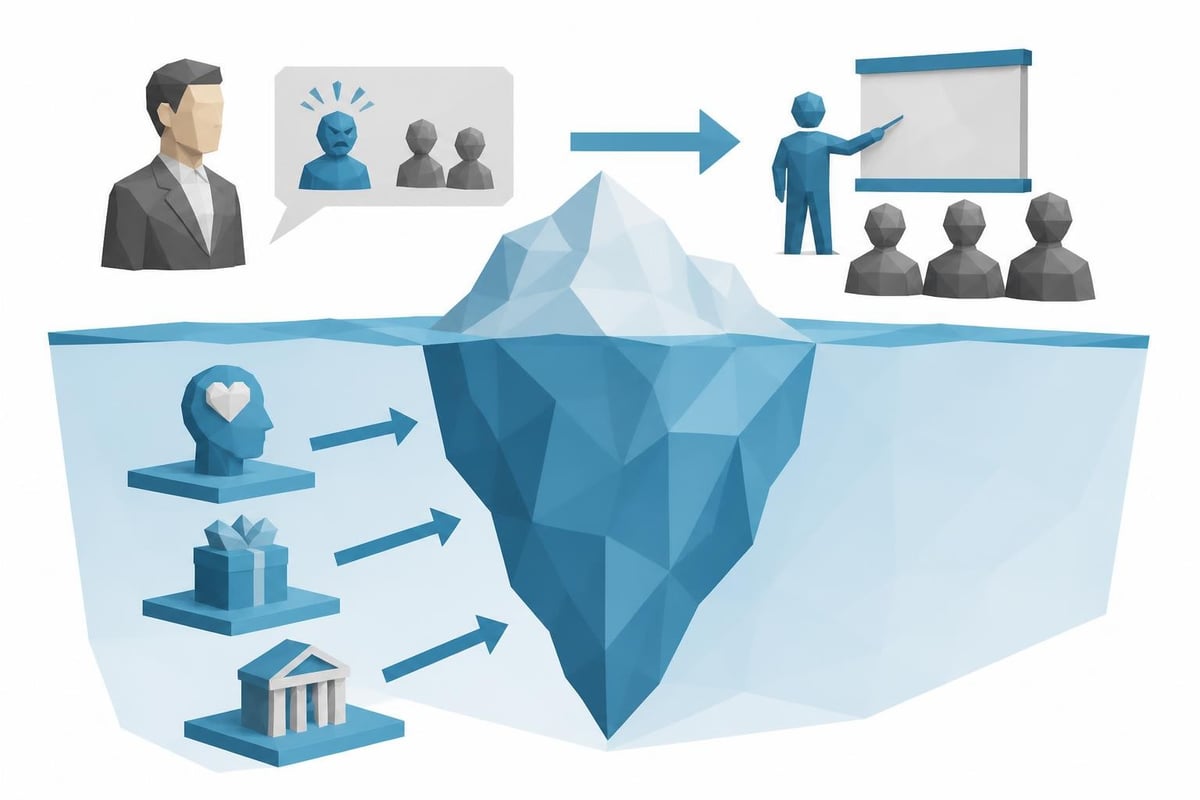
Traditional leadership development often fails to change behavior because it doesn't address these deeper layers. The program design reflects what's easy to deliver rather than what's necessary for change.
The Five Failures That Guarantee No Behavior Change
Through diagnostic work with government agencies and private sector organizations, we've identified five structural failures that predict leadership development without behavior change with near certainty.
Failure One: Training Divorced from Workflow
Leadership development that occurs in conference rooms, off-sites, or learning management systems exists in a parallel universe to where actual leadership happens. Real leadership occurs in the moment a manager decides whether to escalate a problem or solve it, whether to include dissenting voices or move forward with consensus, whether to defend a struggling team member or throw them under the bus.
Programs that don't integrate into these decision points fail. Period.
Evidence from our 2025 program audits:
| Program Type | Behavior Change Rate | Sustained Impact at 12 Months |
|---|---|---|
| Workshop-only | 14% | 6% |
| Workshop + Action Learning | 38% | 22% |
| Embedded Coaching | 67% | 61% |
| Cohort + Embedded Coaching | 78% | 71% |
The data is unambiguous. Development must happen where work happens, or it doesn't happen at all.
Failure Two: Measuring Satisfaction Instead of Application
The standard post-training survey asking "How satisfied were you with this program?" optimizes for the wrong outcome. Leaders can be highly satisfied with a program that changes nothing about how they lead.
We recommend organizations abandon satisfaction metrics entirely and replace them with application scorecards that track specific behaviors:
- Situation encountered (e.g., team conflict, strategic ambiguity, resource constraint)
- Old pattern (what the leader would have done before development)
- New approach (what the leader actually did)
- Outcome (measurable result)
- Barriers (what made the new approach difficult)
This framework, used consistently across our government agency partnerships, surfaces the real impediments to behavior change: misaligned incentives, unsupportive bosses, inadequate authority, or skill gaps that still need addressing.
Failure Three: No Accountability Architecture
Leadership development without behavior change thrives in environments where completion equals success. The leader attended the program. Check. They can now delegate effectively. Assumption.
High-impact development programs build accountability into the design:
- Pre-work diagnostics establish baseline behaviors through 360 assessments and direct observation
- Behavioral contracts specify exactly what will change and by when
- Regular check-ins with coaches, managers, or peer cohorts review actual application
- Consequence clarity defines what happens if behaviors don't shift
One manufacturing client we worked with in Q3 2025 implemented a policy: Executive coaching participants who don't demonstrate measurable behavior change within 90 days have their coaching paused and redirected to address blockers (usually their own manager or organizational constraints). This single policy change increased behavior adoption rates from 31% to 64%.
Failure Four: Ignoring the System That Shaped the Behavior
Individual leaders don't operate in a vacuum. The behaviors your development program targets were likely rewarded, modeled, or required by your organizational system. Trying to change leadership behavior without addressing toxic leadership patterns embedded in culture, incentives, and norms is like asking someone to swim against a riptide.

Critical system elements that enable or block behavior change:
- Compensation structure: Does the bonus plan reward individual heroics or team outcomes?
- Promotion criteria: Do people advance by managing up or developing others?
- Meeting culture: Are dissenting views welcomed or punished?
- Decision rights: Can leaders make decisions or just recommend them?
- Information flow: Is data hoarded or shared?
We've seen brilliant coaching engagements fail completely because the leader's boss modeled the exact behaviors the coaching was supposed to eliminate. The participant faced an impossible choice: apply new behaviors and create conflict with their manager, or revert to old patterns and maintain the relationship. Most chose survival.
Failure Five: Treating Leadership as Generic
The leadership capabilities required to run a compliant government procurement function differ substantially from those needed to lead a high-growth SaaS sales team. Yet most organizations deploy identical development programs across wildly different contexts.
Leadership development should begin with understanding context rather than applying generic frameworks. The Fortune 500 CHRO who sends 200 mid-level managers through the same program regardless of function, industry maturity, or team dynamics should expect negligible behavior change.
Precision matching matters. A leader struggling with conflict avoidance needs different development than one struggling with excessive directness, even if both have "communication issues." Generic programs produce generic results.
What Actually Drives Behavior Change
After analyzing outcomes across more than 1,200 leadership coaching engagements in 2025, we've identified four non-negotiable elements that predict behavior change.
Element One: Immediate Application with Support
Learning must be applied within 48 hours or it's lost. High-impact programs build application directly into the design. A leader learns a new approach to handling performance conversations on Tuesday and has a coached conversation with a real direct report on Thursday. The coach observes, provides feedback, and helps adjust.
This isn't theoretical. It's how adults actually change complex behaviors. Competence builds through supported repetition in real contexts, not through information transfer in classrooms.
Element Two: Clear Before and After Evidence
Behavior change requires leaders to see the gap between current state and desired state with uncomfortable clarity. Vague feedback like "you need to be more strategic" predicts zero change. Specific evidence like "you spent 73% of last month's one-on-ones solving tactical problems your team should own, leaving no time for development conversations" creates urgency.
We use structured observation protocols that capture actual leader behaviors:
| Behavior Category | Current State | Target State | Gap |
|---|---|---|---|
| Decision delegation | Makes 89% of team decisions | Should make <40% | 49 points |
| Development conversations | 2 hours/month | Minimum 8 hours/month | 6 hours |
| Strategic time allocation | 12% of calendar | Minimum 30% of calendar | 18 points |
Numbers create clarity. Clarity enables choice. Choice drives change.
Element Three: Peer Learning and Accountability
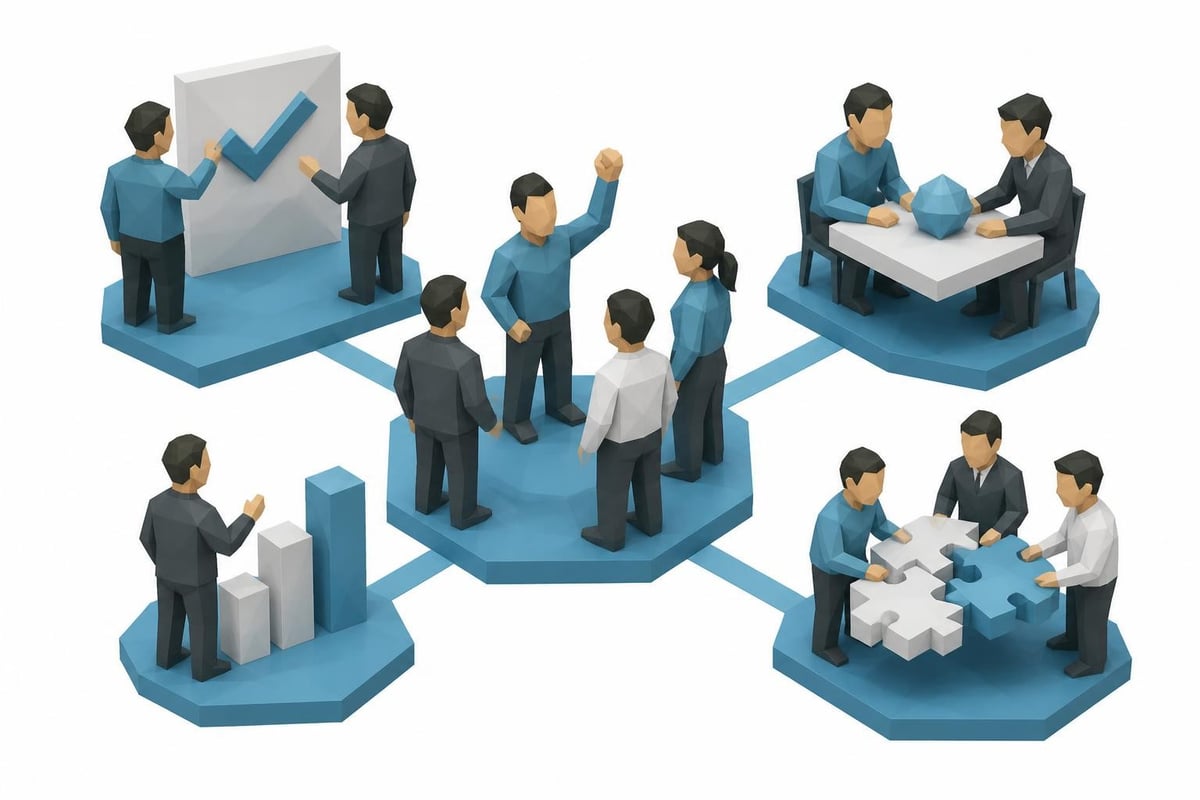
Cohort-based leadership programs consistently outperform individual development because peer dynamics accelerate behavior change. Leaders who commit publicly to behavior shifts in front of peers feel different accountability than those who only report to a coach or HR.
The structure that works:
- Small cohorts (6-8 leaders) facing similar challenges
- Regular commitment sessions where each leader states their application plan
- Follow-up sessions where leaders report results and obstacles
- Peer coaching to help overcome barriers
- Shared learning from everyone's experiments
This approach leverages social proof, competitive dynamics, and collective problem-solving. It also surfaces systemic barriers faster because patterns emerge across multiple leaders' experiences.
Element Four: Manager Involvement and System Alignment
The leader's direct manager is either an accelerator or an anchor. When that manager actively supports new behaviors, reinforces application, and adjusts expectations to allow practice, behavior change accelerates. When they're unaware, unsupportive, or actively undermining the development, change rarely sticks.
Effective programs brief the participant's manager on:
- Specific behaviors the leader is developing
- How those behaviors might look initially awkward or slower
- What support the manager can provide
- How to reinforce application
- What to do if old patterns resurface
This isn't optional. It's the difference between a leader trying to change in isolation versus changing with organizational support. The latter succeeds at three times the rate of the former.
The Economic Case Against Empty Development
Leadership development without behavior change destroys value in ways that compound over time. The direct program costs are trivial compared to the opportunity costs and organizational damage.
Conservative estimate of true costs for a 50-person leadership program with no behavior change:
- Direct program cost: $250,000
- Leader time (50 leaders × 40 hours × $150/hour): $300,000
- Opportunity cost of unchanged dysfunction (conservative): $2-5 million annually
- Cultural cynicism from failed initiative: Unmeasured but substantial
- Total first-year impact: $2.5-5.5 million
The cynicism cost deserves attention. Each failed development program trains your organization that change initiatives don't work. Leaders become increasingly skeptical of future interventions. The best leaders, who genuinely want to grow, become frustrated and start looking externally. You've created a culture where development is performative rather than real.
Organizations that treat psychological safety at work as a priority recognize that failed development programs signal to employees that leadership doesn't actually intend to change. This undermines trust more effectively than doing nothing at all.
Building Development Programs That Actually Work
The alternative to leadership development without behavior change isn't more sophisticated content or better facilitators. It's fundamentally different program architecture that starts with behavior change as the primary design criterion.
Start with Diagnostic Precision
Before designing any intervention, diagnose what specifically needs to change and why current behaviors persist. This requires:
- Behavioral observation in real work contexts, not just surveys
- Stakeholder interviews that surface systemic enablers of current patterns
- Incentive analysis that reveals what the organization actually rewards
- Historical review of what past development efforts achieved and why they failed
One pharmaceutical client discovered through this process that their "leadership communication problem" was actually a structural issue. Critical decisions were made in closed-door executive meetings, then announced as fait accompli to the broader leadership team. No communication training could fix a problem rooted in decision rights and information architecture.
Design for Transfer, Not Learning
Traditional instructional design optimizes for knowledge transfer. Behavior change design optimizes for application transfer. These require opposite approaches:
Knowledge transfer design:
- Clear content presentation
- Logical sequencing from simple to complex
- Assessment of comprehension
- Convenient scheduling
Behavior change design:
- Real problems leaders face this week
- Immediate application between sessions
- Assessment of actual behavior in workflow
- Timing synchronized with opportunities to practice
The second approach feels less polished and more chaotic. It's also what works.
Build Measurement into Every Interaction
Stop measuring satisfaction. Start measuring application. Every coaching conversation, cohort session, or development activity should generate data on:
- What behavior the leader attempted to change
- What happened when they tried
- What got in the way
- What they learned
- What they'll try next
This creates a continuous improvement loop that adapts to real barriers rather than proceeding through predetermined content regardless of results.
Frequently Asked Questions
Why do most leadership development programs fail to change behavior?
Most programs treat leadership as an information problem rather than a behavior problem. They focus on teaching concepts in classroom settings divorced from real work, measure satisfaction instead of application, and ignore the organizational systems that shaped the behaviors they're trying to change. Without accountability mechanisms, immediate application with support, and system alignment, knowing what to do differently rarely translates into doing it differently.
How long does it take to change leadership behavior?
Simple behavior modifications (e.g., starting meetings on time) can shift in 2-4 weeks with consistent practice. Complex behavior patterns (e.g., moving from directive to coaching leadership style) typically require 3-6 months of supported application. Sustaining new behaviors permanently requires system reinforcement for 12-18 months until they become automatic and the organizational context supports them.
What's the difference between leadership training and leadership development that drives behavior change?
Leadership training focuses on information transfer, content delivery, and knowledge acquisition. Leadership development that drives behavior change focuses on application in real contexts, supported practice with feedback, peer accountability, and system alignment. Training asks "Did they learn it?" Development asks "Did they apply it, did it work, and are they still doing it three months later?"
How can organizations measure actual behavior change in leaders?
Replace satisfaction surveys with application scorecards that track specific situations, old patterns, new approaches, outcomes, and barriers. Use direct observation in real work contexts, 360 assessments at baseline and follow-up intervals, and behavioral data from systems (calendar analysis, decision patterns, meeting dynamics). Track leading indicators like frequency of coaching conversations, delegation rates, and time allocation shifts, not just lagging indicators like engagement scores.
What role does a leader's manager play in behavior change success?
The participant's direct manager is the single biggest predictor of whether behavior change sticks. Managers who actively support new behaviors, adjust expectations during the learning period, provide reinforcement, and model the desired changes themselves increase success rates by 3x. Managers who are unaware, unsupportive, or model the old behaviors nearly guarantee failure regardless of program quality.
Leadership development without behavior change represents one of the largest sources of waste in corporate budgets, destroying value through direct costs, opportunity costs, and cultural cynicism. Organizations that continue investing in programs optimized for completion rather than application are choosing expensive theater over genuine capability building. Noomii Leadership Coaching delivers precision-matched coaching and evidence-based diagnostics that focus exclusively on measurable behavior change, helping Fortune 500 companies and government agencies transform leadership patterns that actually impact business results.



Leave a Reply
Want to join the discussion?Feel free to contribute!