

What Boeing Reveals About Accountability in Leadership
The Boeing 737 MAX crisis didn't happen because of a single engineering flaw. It happened because accountability at every level of the organization broke down, and no one stopped it. What Boeing reveals about accountability is uncomfortable for most executives: formal governance structures mean nothing when leadership lacks the judgment, courage, and clarity to use them. Between 2018 and 2024, Boeing's leadership choices cost 346 lives, billions in settlements, criminal charges, and a reputation that may never fully recover. For CHROs and board members watching from other industries, the lesson is not that Boeing was uniquely corrupt. The lesson is that Boeing's accountability failures are predictable, diagnosable, and preventable, but only if leadership teams are willing to see what's actually broken.
The Governance Theater That Failed
Boeing maintained robust corporate governance documentation that looked impressive on paper. The company had board committees, ethics policies, compliance frameworks, and all the standard apparatus of modern corporate oversight. Yet when the MCAS system was designed with a single point of failure and minimal pilot training requirements, none of these structures stopped it.
The gap between governance documentation and governance reality is where accountability dies. Boards meet, review presentations, ask polite questions, and approve recommendations without the technical depth or operational insight to challenge management effectively. This isn't incompetence. It's structural blindness created by leadership teams that confuse process compliance with actual accountability.
Why Boards Miss What Matters
Three dynamics explain why Boeing's board failed to catch critical safety decisions:
- Information asymmetry between management and directors became a shield rather than a problem to solve
- Expertise gaps in complex technical domains went unaddressed because directors relied on management summaries
- Cultural deference to executive judgment prevented difficult questions about tradeoffs between speed and safety
When Boeing’s board faced crisis-level scrutiny in 2024, the fundamental question wasn't about individual director qualifications. It was whether the entire board structure was capable of exercising independent judgment on matters that required deep operational and technical knowledge.
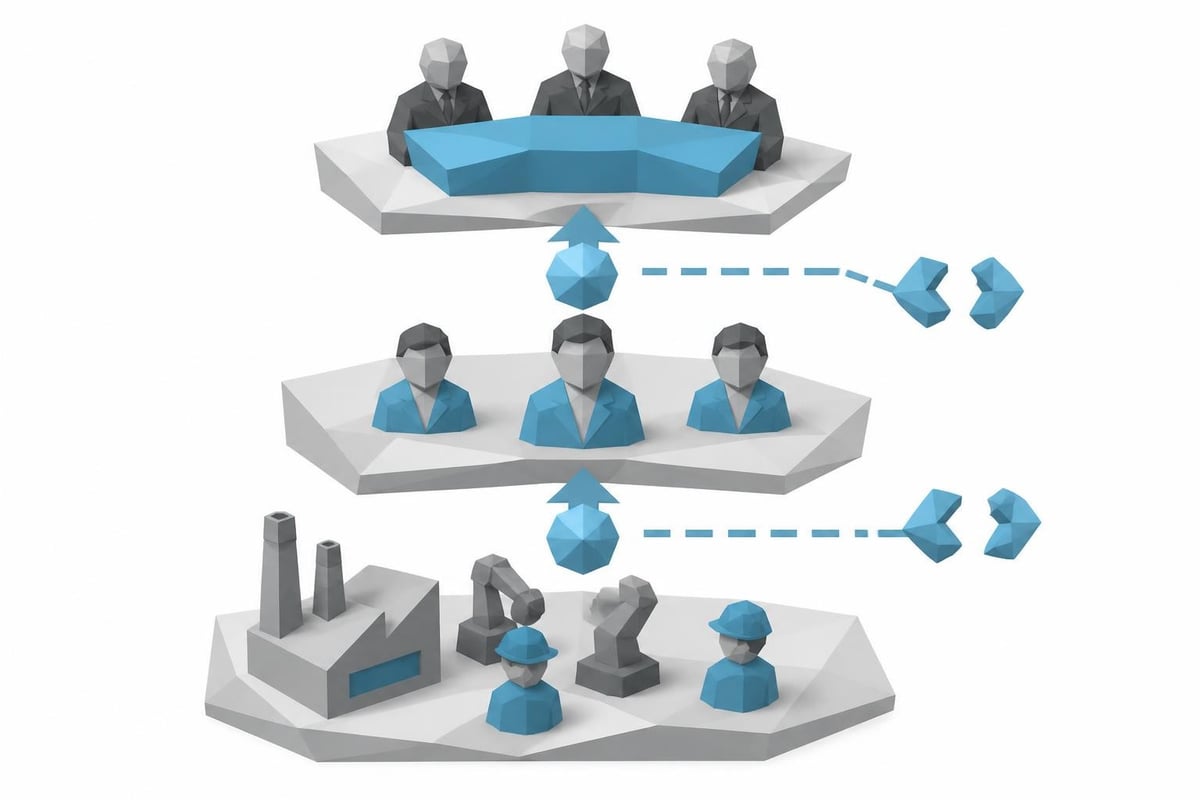
Most Fortune 500 boards face the same challenge Boeing did. Directors bring financial, legal, and strategic expertise, but lack the domain-specific knowledge to evaluate operational risks in engineering, software development, or manufacturing quality. The solution isn't adding more engineers to boards. It's creating accountability mechanisms that surface ground-level risks before they become board-level crises.
The Cultural Rot Beneath the Surface
What Boeing reveals about accountability goes deeper than board dynamics. The company's merger with McDonnell Douglas in 1997 fundamentally shifted its culture from engineering excellence to financial optimization. This wasn't a secret. Engineers, pilots, and industry observers noted the change in priorities for years before the MAX crashes.
Boeing’s culture became impossible to ignore after internal communications revealed how leadership dismissed safety concerns, pressured engineers to meet unrealistic timelines, and prioritized schedule over everything else. These weren't rogue actors. This was sanctioned behavior, modeled from the top and reinforced through promotion decisions, budget allocations, and executive communications.
The Accountability Markers Leaders Ignore
Cultural accountability breaks down in observable, measurable ways long before catastrophic failures:
| Accountability Indicator | What It Looks Like | What Boeing Showed |
|---|---|---|
| Dissent tolerance | Concerns raised without retaliation | Engineers silenced, concerns dismissed |
| Cross-functional transparency | Information flows freely across silos | Safety data hidden from pilots and regulators |
| Decision traceability | Clear ownership of choices and outcomes | Diffused responsibility, no single point of accountability |
| Learning systems | Near-misses drive process improvements | Warnings ignored, patterns dismissed |
These indicators are leading, not lagging. They predict governance failures before financial or safety disasters materialize. Yet most executive teams don't measure them, don't discuss them in leadership meetings, and don't tie them to compensation or promotion decisions.
In 2023, working with a Fortune 500 manufacturer facing product quality issues, we diagnosed similar patterns. Engineers reported feeling pressured to approve designs they had concerns about. Quality metrics were gamed to meet executive dashboards. The leadership coaching interventions focused not on communication skills or emotional intelligence, but on rebuilding decision rights, escalation paths, and consequence systems that made accountability real rather than rhetorical.
The SEC's Verdict on Leadership Communication
In April 2026, the SEC took action against Boeing for misleading statements about the 737 MAX, finding that leadership communications to investors obscured known safety issues and misrepresented the company's response to regulatory concerns. This wasn't a case of technical disclosure violations. This was leadership choosing what truths to tell and what risks to hide.
What Boeing reveals about accountability in executive communications is that leaders who lack internal accountability mechanisms will inevitably lack external transparency. The same culture that prevented engineers from escalating safety concerns prevented executives from disclosing material risks to shareholders and regulators.
The Communication Accountability Framework
Effective leadership communication requires three interlocking elements:
- Truth-seeking processes that surface uncomfortable realities before external communications are drafted
- Independent verification of claims made to boards, regulators, and investors
- Consequence systems that penalize leaders who obscure, minimize, or misrepresent known risks
Boeing had none of these in functional form. Communications were managed for narrative control, not accuracy. When the MAX crisis deepened, leadership's instinct was to minimize, deflect, and delay rather than acknowledge the scope of failures.
This pattern repeats across industries. Theranos, Wells Fargo, Volkswagen, and countless other governance failures share this characteristic: leaders who controlled information flows to protect themselves rather than inform stakeholders. The accountability failure isn't in the crisis response. It's in the years of decisions that made dishonest communications seem rational or necessary.

The Software Engineering Lessons No One Applied
The MCAS system's design flaws were extensively documented in technical analyses that revealed basic software engineering failures: single sensor dependency, inadequate redundancy, insufficient testing, and poor human-factors design. These weren't cutting-edge AI safety problems or novel technical challenges. These were fundamental mistakes that undergraduate computer science programs teach students to avoid.
What Boeing reveals about accountability in complex technical systems is that leadership competence matters more than organizational size or resources. Boeing had world-class engineers, sophisticated development processes, and decades of aviation safety experience. What it lacked was leadership willing to enforce engineering discipline when it conflicted with schedule or cost targets.
A Promise Theory analysis of the MCAS failures demonstrated how accountability broke down across organizational boundaries. Software engineers made assumptions about pilot training. Training developers assumed pilots would receive detailed MCAS documentation. Airline customers assumed Boeing's safety claims were verified. Each party kept their promises to their immediate stakeholders while the system-level accountability failed completely.
Accountability in Complex Technical Decisions
Leaders overseeing technical organizations must establish clear decision rights and verification mechanisms:
- Technical veto authority for designated engineers on safety-critical systems
- Independent testing and validation separate from development teams
- Assumption documentation that makes implicit dependencies explicit across teams
- Failure mode analysis required before deployment, not after incidents
These aren't theoretical best practices. These are operational requirements that distinguish organizations with genuine technical accountability from those with accountability theater. Boeing's leadership chose not to enforce them, and the predictable result was systematic engineering failures that safety processes should have caught.
What Boards Should Demand Starting Now
The Boeing crisis provides a clear accountability audit framework for any board overseeing operational complexity, technical risk, or safety-critical systems. Directors who want to avoid Boeing's failures need to ask different questions and demand different evidence.
Stop accepting summary presentations. Require direct access to subject matter experts, unfiltered incident reports, and dissenting analyses. If management resists, that's diagnostic information about accountability culture.
Map decision rights explicitly. Who has authority to stop a product launch, halt production, or escalate a safety concern? What happens when they exercise that authority? If the answer is unclear or uncomfortable, accountability is already broken.
Measure accountability indicators. Track how often concerns are raised, how quickly they're investigated, and how transparently results are communicated. These are leading indicators of governance health that most boards ignore until crisis forces attention.
| Board Accountability Practice | Traditional Approach | High-Accountability Approach |
|---|---|---|
| Risk reporting | Quarterly summaries from management | Real-time access to incident databases and trend analysis |
| Expert input | Presentations filtered through executives | Direct sessions with engineers, quality leads, frontline managers |
| Decision validation | Rely on management recommendations | Independent technical reviews for high-stakes choices |
| Cultural assessment | Annual employee surveys | Continuous monitoring of dissent, escalation, and learning patterns |
These changes require board members who have the time, expertise, and independence to engage deeply with operational realities. That may mean smaller boards, different director qualifications, or significantly higher compensation for genuinely demanding oversight work.

The CHRO's Role in Accountability Architecture
HR leaders bear significant responsibility for accountability failures because they design the systems that shape leadership behavior. Compensation structures, promotion criteria, performance evaluations, and consequence mechanisms either reinforce accountability or undermine it.
At Boeing, HR systems rewarded executives for meeting financial targets and delivery schedules while providing weak consequences for safety lapses or cultural toxicity. This wasn't an oversight. This was an explicit choice about what behaviors to incentivize and what risks to tolerate.
What Boeing reveals about accountability for CHROs is that technical competence and operational judgment must become core leadership requirements, not optional add-ons to financial or strategic skills. The leadership development programs that matter aren't about communication techniques or executive presence. They're about building judgment, cultivating dissent tolerance, and establishing consequence systems that make accountability real.
The Accountability Systems CHROs Must Build
Effective accountability architecture includes specific, measurable components:
- Consequence clarity where leaders know exactly what happens when they miss risks, silence concerns, or prioritize wrong metrics
- Promotion criteria that weight operational judgment and cultural stewardship as heavily as financial performance
- Escalation protection ensuring employees who raise concerns face no retaliation and receive transparent follow-up
- Learning mandates requiring leaders to document lessons from near-misses and process breakdowns
In 2024, we worked with a government agency facing leadership credibility issues after several high-profile operational failures. The diagnosis revealed that HR systems rewarded political skill and relationship management while providing no consequences for poor operational judgment or risk blindness. The intervention focused on redesigning performance frameworks, establishing technical advisory councils with veto authority, and creating transparent decision logs that made accountability traceable.
The Precision Required for Accountability That Works
Generic accountability commitments mean nothing. "We value transparency" or "We maintain high ethical standards" are the language of organizations that don't actually know how to operationalize accountability. What Boeing reveals about accountability is that precision matters more than principles.
Accountability systems must specify exactly who decides, who verifies, who escalates, and what happens when failures occur. This requires leadership teams willing to document decision rights, map information flows, establish verification mechanisms, and enforce consequences consistently.
The Noomii approach to leadership accountability starts with diagnostic precision. We assess actual decision patterns, information flow realities, and consequence system effectiveness rather than accepting stated policies or aspirational values. Then we match leaders with coaches who have direct operational experience in high-accountability environments: former regulators, technical executives, military leaders, and operators who understand the difference between governance theater and governance that works.
Frequently Asked Questions
What specific accountability failures led to Boeing's 737 MAX crisis?
Boeing's accountability failures spanned multiple levels: engineering teams lacked authority to stop unsafe designs, middle management prioritized schedule over safety concerns, executives misrepresented risks to regulators and customers, and the board failed to exercise independent technical oversight. The MCAS system's single-point-of-failure design, inadequate pilot training, and rushed certification all reflected systematic accountability breakdowns where no individual or group could effectively prevent known risks from becoming disasters.
How can boards improve accountability for complex technical decisions?
Boards must move beyond summary presentations to direct engagement with subject matter experts, unfiltered incident data, and dissenting analyses. This requires establishing independent technical advisory councils, mapping explicit decision rights for safety-critical choices, measuring leading indicators like dissent frequency and escalation patterns, and ensuring directors have sufficient time and expertise to engage with operational complexity rather than simply ratifying management recommendations.
What role do HR leaders play in building organizational accountability?
CHROs design the systems that shape leadership behavior through compensation structures, promotion criteria, performance frameworks, and consequence mechanisms. Effective accountability requires HR leaders to weight operational judgment and cultural stewardship as heavily as financial performance, establish clear escalation protections, create transparent decision logs, and enforce consistent consequences when leaders miss risks or silence concerns rather than treating accountability as a values statement.
How do you diagnose accountability gaps before they become crises?
Leading indicators of accountability failure include low dissent frequency, slow escalation of concerns, information silos between functions, unclear decision ownership, weak learning systems after near-misses, and consequences that don't match stated priorities. Effective diagnosis requires analyzing actual decision patterns and information flows rather than reviewing policy documents, then comparing leadership behaviors to stated accountability commitments to identify gaps between rhetoric and reality.
What makes leadership coaching effective for improving accountability?
Coaching improves accountability when it focuses on building specific capabilities: judgment in complex technical decisions, tolerance for dissent and bad news, discipline in following verification processes, and courage to enforce consequences. Generic coaching on communication or emotional intelligence rarely addresses the root causes of accountability failures. Effective coaching matches leaders with coaches who have direct operational experience in high-accountability environments and can diagnose behavioral patterns that undermine genuine oversight.
Boeing's accountability failures weren't unique, but they were predictable and preventable for leadership teams willing to diagnose what's actually broken rather than maintain governance theater. The Noomii Corporate Leadership Program helps organizations build the diagnostic precision, targeted interventions, and measurable accountability systems that prevent culture and oversight from drifting into crisis, matching executives with coaches who understand the difference between compliance documentation and leadership that works.



Leave a Reply
Want to join the discussion?Feel free to contribute!