

Why Certified Coaches Still Struggle in 2026
You earned the credential. Completed the coursework. Passed the assessments. Yet your calendar remains half-empty, and your corporate clients choose competitors with less impressive letters after their names. Understanding why certified coaches still struggle requires looking beyond the certification myth to examine what actually drives coaching success in 2026. The uncomfortable truth is that credentials signal training completion, not market readiness, client acquisition ability, or business acumen.
The Certification Paradox: Training Without Business Skills
Certification programs teach coaching competencies but rarely address the business fundamentals required to sustain a practice. Most coaches exit programs equipped with frameworks and conversation techniques yet completely unprepared for prospecting, pricing, or positioning their services.
The typical certification gap includes:
- No instruction on client acquisition strategies
- Limited guidance on pricing models or package structure
- Minimal training in articulating value to corporate buyers
- Zero emphasis on financial management or cash flow
- Absence of marketing fundamentals or positioning strategy
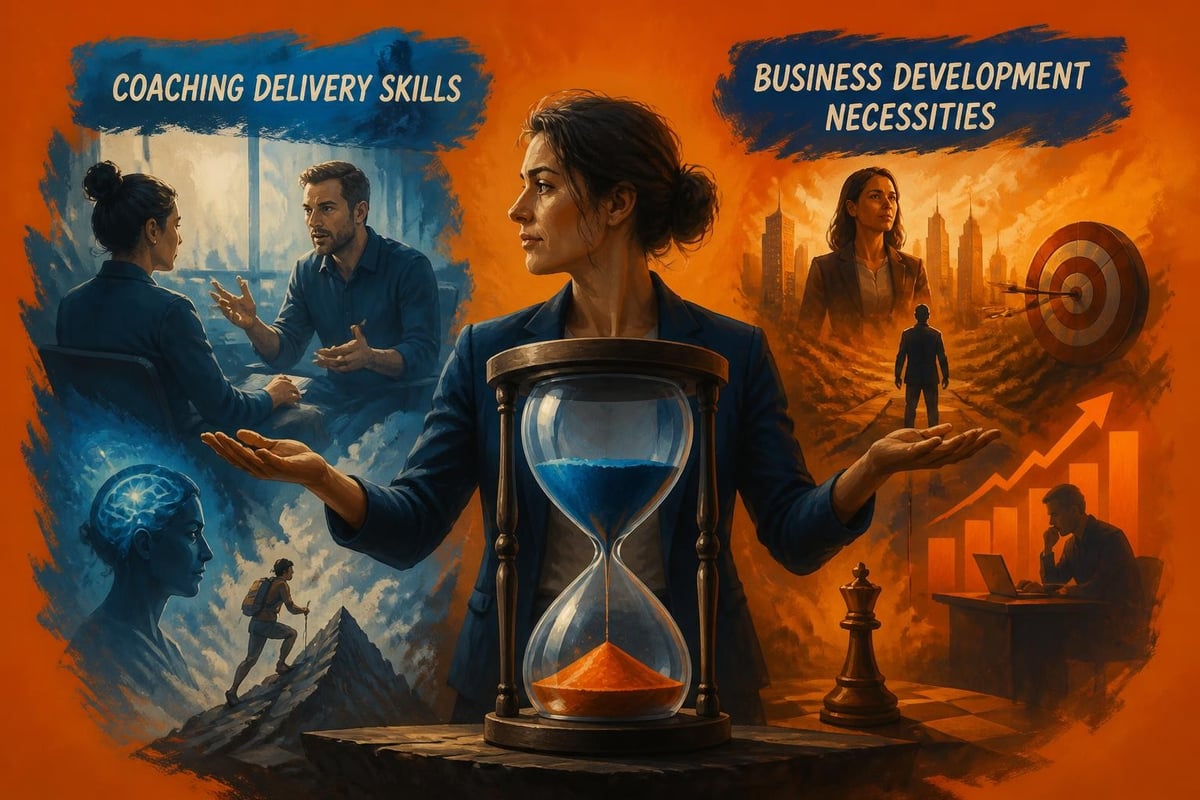
This explains why many certified coaches struggle to scale despite possessing legitimate skills. The certification addressed coaching delivery but ignored the commercial engine required to find paying clients consistently.
Market Saturation Creates Invisible Coaches
The coaching industry added over 23,000 newly certified practitioners in 2025 alone. This saturation means your certification no longer differentiates you, it simply qualifies you to enter an increasingly crowded market where client discoverability determines success more than coaching ability.

Corporate buyers face decision paralysis when evaluating coaches. Everyone claims transformation, leadership development, and breakthrough results. Without clear differentiation beyond certification level, buyers default to referrals, existing relationships, or platforms that pre-vet coaches against business outcomes.
What Corporate Buyers Actually Evaluate
Certification signals baseline competence. Corporate decision-makers evaluate entirely different criteria when selecting coaches for their teams:
| Buyer Priority | Why It Matters | What Coaches Miss |
|---|---|---|
| Measurable outcomes | Budget justification requires ROI | Focusing on process over results |
| Industry context | Generic coaching misses business nuances | Emphasizing universal frameworks |
| Implementation speed | Leaders need quick wins | Lengthy discovery and assessment phases |
| Scalability | One coach can't serve 200 managers | Selling individual sessions only |
The certification prepared you to conduct coaching conversations. It didn't prepare you to speak the language of P&L impact, employee retention costs, or revenue per employee, which is what corporate buyers care about when evaluating performance coaches.
The Revenue Plateau: Why Growth Stalls
After initial momentum from referrals and personal networks, many certified coaches hit a revenue ceiling between $60,000 and $90,000 annually. This plateau occurs because the strategies that generated first clients don't scale to build a sustainable business.
Common plateau triggers include:
- Trading time for money exclusively with no leveraged offerings
- Relying on word-of-mouth without systematic lead generation
- Underpricing services due to imposter syndrome or market ignorance
- Avoiding niching to keep options open, resulting in generic positioning
- Neglecting professional visibility beyond immediate network
Forbes identifies market differentiation challenges as a critical barrier. When your marketing mirrors every other certified coach, buyers see commoditized services and shop on price or convenience rather than unique value.
The Experience vs. Credential Debate
Why certified coaches still struggle becomes obvious when examining what actually builds trust with sophisticated buyers. A coach with 15 years of operational leadership experience and no certification often wins corporate contracts over newly certified coaches with impressive credentials but limited business context.
Experience signals that outweigh certification:
- Direct P&L responsibility in similar industries
- Track record of building or scaling teams
- Specific expertise in the client's business challenges
- Demonstrated results with measurable outcomes
- Understanding of organizational dynamics and politics
This reality frustrates coaches who invested significant time and money in certification programs. The market values applicable experience and proven results over training completion certificates.

Implementation Gaps That Certifications Don't Address
Certification teaches coaching methodology. It doesn't address the implementation challenges that determine whether coaching creates lasting change or becomes another failed corporate initiative.
Corporate coaching fails when:
- Coaching remains disconnected from business KPIs and strategic priorities
- Sessions focus on feelings and awareness without behavioral change
- No accountability structure exists beyond coaching conversations
- Leadership doesn't model or reinforce coached behaviors
- Results aren't measured against baseline performance metrics
Effective corporate coaches embed themselves in business operations. They understand psychological safety at work, connect coaching to retention and engagement data, and tie progress to quarterly OKRs. Certification programs rarely teach this operational integration.
The Marketing and Positioning Problem
Most certified coaches fail at marketing because they market their process rather than client outcomes. Buyers don't care about your ICF certification level or your preferred framework. They care whether you can help their managers have difficult conversations, improve team performance, or reduce voluntary turnover.
Many running a coaching business face challenges including client acquisition and unclear service positioning. The coaches who thrive in 2026 position themselves around specific business outcomes in defined markets rather than broad coaching capabilities.
Effective positioning answers:
- What specific business problem do you solve?
- For which type of organization or leader?
- What measurable outcomes can clients expect?
- Why should they choose you over alternatives?
- What proof validates your claims?
Generic language like "I help leaders reach their potential" communicates nothing distinctive. Specific positioning like "I help mid-market manufacturing companies reduce frontline manager turnover by 30% through operational coaching and KPI accountability" differentiates immediately.
Building a Coaching Business Versus Coaching Well
The final reason why certified coaches still struggle centers on role confusion. Coaching ability represents only 30% of what determines business success. The remaining 70% involves sales, marketing, operations, financial management, and strategic positioning.
| Business Function | Time Required | Covered in Certification? |
|---|---|---|
| Service delivery (coaching) | 30% | Yes, extensively |
| Sales and client acquisition | 25% | No |
| Marketing and positioning | 20% | No |
| Operations and administration | 15% | No |
| Financial management | 10% | No |
Successful coaches either develop business capabilities or partner with organizations that provide client flow, like Noomii, which connects qualified coaches with corporate clients actively seeking specific expertise.
Moving Beyond the Certification Ceiling
Breaking through requires accepting that certification was the entry point, not the destination. Coaches who build sustainable practices in 2026 focus on outcomes, specialize in solving specific problems, and develop business acumen alongside coaching skills. They recognize that corporate buyers evaluate coaches based on relevant experience, measurable results, and business fluency rather than certification pedigree.
Frequently Asked Questions
Why do certified coaches struggle to find clients?
Certification teaches coaching skills but not client acquisition, marketing, or business development. Most coaches lack systematic lead generation strategies and rely on referrals that eventually dry up without a sustainable client pipeline.
Does coaching certification guarantee business success?
No. Certification validates coaching competency but doesn't address business fundamentals, marketing, positioning, or the commercial skills required to build a sustainable practice. Many certified coaches plateau financially despite strong coaching abilities.
What should coaches focus on besides certification?
Coaches should develop niche expertise, create measurable outcome frameworks, build systematic marketing, master consultative sales, and understand the business context of their target clients. Business acumen often matters more than additional certifications.
How do corporate buyers evaluate coaches?
Corporate buyers prioritize measurable outcomes, industry experience, implementation capability, and ROI over certification level. They evaluate whether coaches understand their business challenges and can demonstrate relevant results with similar organizations.
Why do experienced professionals outcompete certified coaches?
Experienced practitioners bring business credibility, industry knowledge, and practical insights that resonate with corporate buyers. They speak the language of business outcomes rather than coaching processes, making them more attractive to decision-makers.
What causes coaches to plateau at $60,000-90,000 annually?
Revenue plateaus occur when coaches rely exclusively on trading time for money, lack systematic client acquisition, underprice services, avoid specialization, and fail to create leveraged or scalable offerings beyond one-to-one coaching.
Should I get additional coaching certifications?
Additional certifications rarely solve business development challenges. Focus instead on building marketing systems, developing niche expertise, creating outcome measurement frameworks, and improving commercial skills that drive client acquisition.
How can coaches differentiate in a saturated market?
Differentiation comes from specialized expertise, proven results in specific industries, proprietary frameworks, measurable outcomes, and clear positioning around business problems rather than coaching methodologies. Specificity beats generalization.
What business skills do certified coaches typically lack?
Most coaches lack training in sales, marketing, financial management, pricing strategy, service packaging, client acquisition systems, and business operations. Certification programs focus on coaching delivery rather than practice management.
Credentials open doors, but results keep them open. The coaches who thrive understand that certification represents the beginning of professional development, not the culmination. If your organization needs coaching that prioritizes measurable business outcomes over credential worship, Noomii connects you with experienced practitioners who tie coaching directly to KPIs, embed themselves in your operations, and deliver results you can track quarterly. We work month-to-month because retention should depend on visible progress, not long-term contracts.



Leave a Reply
Want to join the discussion?Feel free to contribute!