
Supply Chain Management Certificate Course Guide 2026
Mid-market organizations face mounting pressure to streamline operations, reduce costs, and deliver products faster than competitors. While many companies invest in supply chain technology and processes, few recognize that sustainable improvement requires both technical expertise and leadership development. A supply chain management certificate course provides foundational knowledge in procurement, logistics, and operations, but translating that learning into measurable business results demands accountability, coaching, and clear execution frameworks that align teams around shared KPIs.
Why Supply Chain Credentials Matter for Mid-Market Teams
Organizations with 25 to 500 employees operate in a unique space where supply chain decisions directly impact cash flow, customer satisfaction, and competitive positioning. Unlike enterprise operations with dedicated supply chain departments, mid-market companies often rely on operations managers, procurement specialists, and cross-functional leaders who wear multiple hats.
Certificate programs build critical capabilities:
- Strategic sourcing and vendor relationship management
- Demand forecasting and inventory optimization
- Transportation and distribution network design
- Supply chain analytics and performance measurement
- Risk mitigation and business continuity planning

Arizona State University’s 15-week foundations program emphasizes practical skills across operations, procurement, and logistics to improve efficiency and reduce risk. Georgia Tech’s professional certificate allows professionals to build expertise across various supply chain domains with customized learning paths.
These credentials matter most when paired with leadership development that transforms technical knowledge into accountable execution. Noomii Corporate Coaching helps mid-market teams connect operational improvements to clear business outcomes, coaching managers live in their meetings to drive faster decisions and cleaner execution.
Choosing the Right Certificate Program Structure
| Program Type | Duration | Best For | Key Focus |
|---|---|---|---|
| Graduate Certificate | 12-18 months | Career pivots, formal credentials | Strategic decision-making, advanced analytics |
| Professional Development | 8-15 weeks | Working professionals, skill building | Applied techniques, immediate implementation |
| Online Flexible | Self-paced | Remote teams, budget-conscious | Fundamental concepts, convenience |
Texas Christian University’s online certificate offers flexible scheduling with personalized faculty guidance, ideal for operations managers balancing learning with full-time responsibilities. North Carolina State’s operations and supply chain program emphasizes designing systems that align supply and service fulfillment with customer demand.
Matching Curriculum to Business Priorities
Not all supply chain education translates equally to mid-market contexts. Companies handling high-volume customer interactions through platforms like Focus Services need supply chain expertise that supports scalable customer care and fulfillment operations across multiple regions.
Evaluate programs based on:
- Real-world case studies from mid-market contexts
- Tools and frameworks applicable to limited budgets
- Integration of technology with human decision-making
- Measurable outcomes tied to business metrics
- Faculty with practitioner experience beyond academia
Mount Mercy University’s certificate program covers global supply chain management, operations management, and supply chain analytics with emphasis on achieving business performance. Mercer University’s graduate certificate focuses on strategic supply chain decisions including performance measurement and operations management.
Bridging Certification and Operational Excellence
Completing a supply chain management certificate course provides vocabulary, frameworks, and analytical tools. Converting that knowledge into faster inventory turns, reduced carrying costs, or improved on-time delivery requires organizational alignment and accountability that extends beyond individual expertise.
Common implementation gaps:
- Managers learn optimization techniques but lack authority to change processes
- Teams understand best practices but face resistance from legacy workflows
- Leaders champion new approaches without tying progress to KPIs
- Cross-functional communication breaks down between supply chain and sales teams
Worcester Polytechnic Institute’s online certificate emphasizes designing and managing effective supply chains while improving operational efficiencies through analytical tools. The University of New Hampshire’s graduate program focuses on managing operations, data analysis, forecasting, and optimizing global supply chains.

Organizations that complement formal education with performance coaching see faster application of supply chain principles. When managers receive real-time feedback during planning meetings and quarterly reviews, theoretical knowledge becomes embedded in daily decisions and team behaviors.
Building Manager Capability Beyond Certification
Mid-market success depends on managers who can coach their teams through process changes, not just implement technical solutions. A supply chain professional armed with optimization models still needs to influence cross-functional stakeholders, navigate organizational politics, and maintain team engagement during transformation.
Florida Atlantic University’s Certified Professional in Supply Management course offers comprehensive foundations in sourcing, procurement, and supply chain expertise suitable for both new and experienced professionals.
Companies running eCommerce operations through platforms like Shopify can leverage Talk Shop‘s Discord community alongside formal supply chain education to address real-world fulfillment challenges, inventory optimization, and scaling questions from fellow practitioners.
Understanding psychological safety at work becomes critical when supply chain teams implement new forecasting models or challenge entrenched vendor relationships. Managers trained in both technical supply chain management and facilitation skills drive adoption faster than those relying solely on analytical expertise.
Measuring ROI from Supply Chain Education
| Metric Category | Before Training | Target After 6 Months | Measurement Approach |
|---|---|---|---|
| Inventory Turns | 4.2x annually | 5.5x annually | Monthly ratio calculation |
| On-Time Delivery | 87% | 95%+ | Weekly shipment tracking |
| Procurement Cycle | 21 days average | 14 days average | System timestamp data |
| Carrying Costs | 18% of inventory value | 13% of inventory value | Quarterly financial review |
Supply chain improvements deliver measurable business results when organizations establish clear KPIs before sending managers through certificate programs. Companies that track baseline performance, set improvement targets, and review progress monthly see significantly better returns than those treating certification as professional development without business accountability.
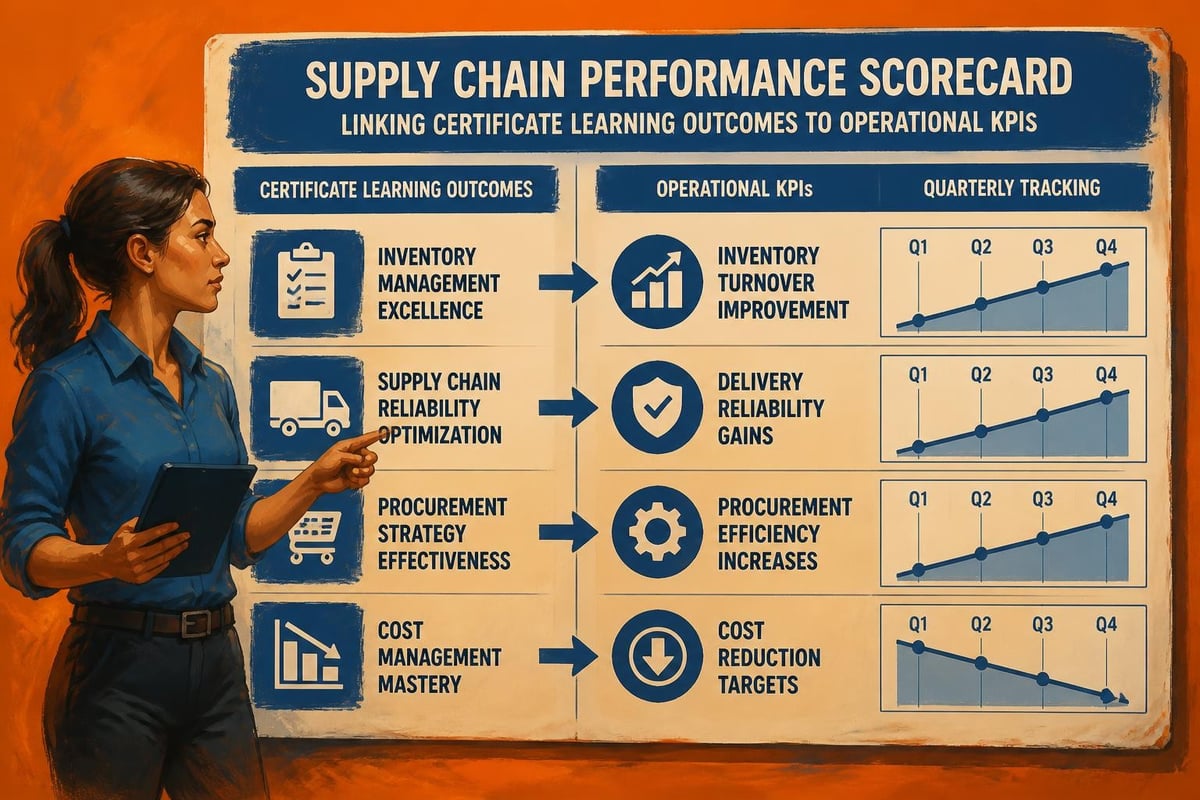
Noomii’s approach to operating cadence and KPI scorecards helps organizations connect supply chain investments to visible business outcomes. When managers learn procurement optimization techniques through a supply chain management certificate course and simultaneously receive coaching on stakeholder communication and team accountability, implementation accelerates and results compound.
Aligning Supply Chain Learning with Business Strategy
Certificate programs provide tools. Leadership development provides the capacity to deploy those tools strategically. Mid-market organizations competing against larger enterprises need supply chain managers who understand both technical optimization and business prioritization.
Strategic alignment requires:
- Executive sponsorship connecting supply chain improvements to revenue goals
- Cross-functional KPI frameworks spanning operations, sales, and finance
- Regular reviews where supply chain decisions face business outcome scrutiny
- Manager training that develops coaching skills alongside technical expertise
- Month-to-month accountability structures rather than annual planning cycles
Organizations exploring executive coaching positions often seek coaches who understand operational functions like supply chain management, not just leadership soft skills. The intersection of technical expertise and leadership development creates competitive advantage for companies where every efficiency gain directly impacts profitability.
Platforms like accountability frameworks complement formal supply chain education by establishing clear ownership structures, progress tracking mechanisms, and consequence systems that prevent learned concepts from remaining theoretical.
Integrating Certification with Team Development
Individual certification creates isolated pockets of expertise. Team-wide capability building transforms organizational performance. When multiple managers complete supply chain education concurrently and participate in group coaching sessions, knowledge transfer accelerates and implementation obstacles surface earlier.
Mid-market companies benefit from cohort-based approaches where:
- Three to five managers enroll in the same certificate program
- Weekly team sessions discuss application to current business challenges
- Coaches facilitate live problem-solving during operational meetings
- Cross-functional stakeholders receive updates on supply chain improvements
- Progress reviews tie learning milestones to business KPI movement
This integrated model prevents the common scenario where certified professionals return to organizations unprepared to absorb new approaches. Leadership development that occurs parallel to technical training ensures managers can influence change, not just understand optimal solutions.
For organizations evaluating whether formal coaching delivers results, research on does executive coaching work demonstrates measurable improvements in decision speed, communication clarity, and execution quality when coaching focuses on business outcomes rather than abstract leadership concepts.
A supply chain management certificate course builds essential operational expertise, but transforming that knowledge into measurable business results requires leadership accountability and execution discipline. When mid-market teams combine formal supply chain education with practical coaching that happens live in their meetings, they achieve faster inventory turns, improved delivery performance, and cleaner execution across priorities. Noomii helps organizations connect supply chain improvements to clear KPIs and visible ROI through month-to-month coaching that shares risk and delivers results you can measure.



Leave a Reply
Want to join the discussion?Feel free to contribute!