

Corporate Coaching Providers Across the GCC: 2026 Market Guide
The demand for corporate coaching providers across the GCC has accelerated sharply in 2026, driven by national transformation agendas, rapid economic diversification, and persistent leadership capability gaps. Organizations across Saudi Arabia, the UAE, Qatar, Kuwait, Bahrain, and Oman are investing heavily in executive development, yet many struggle to differentiate between vendors who deliver measurable impact and those who offer generic programs repackaged for the region. The challenge isn't finding providers, it's identifying partners who understand GCC-specific governance structures, compliance requirements, and the nuances of public-private sector leadership expectations.
The Strategic Case for Leadership Development in the GCC
Regional transformation initiatives have created unprecedented demand for leadership capability. Saudi Vision 2030’s 2025 annual report documents significant investments in human capital development, with explicit targets for leadership effectiveness across government and private sector entities. Yet according to PwC’s analysis of talent shortages in the GCC, organizations continue to report critical gaps in strategic thinking, change management, and cross-cultural leadership.
This creates a concrete problem: traditional training programs deliver knowledge transfer, but leadership challenges in the GCC require behavioral change, adaptive capacity, and contextual judgment. The difference matters operationally and financially.

Why Generic Programs Fail in Regional Context
Most corporate coaching providers across the GCC import Western frameworks without adaptation. Three specific failures emerge repeatedly:
Governance misalignment: Programs designed for flat organizational structures ignore hierarchical decision-making norms and formal approval processes common in GCC public sector and family-owned enterprises.
Compliance gaps: Vendors unfamiliar with regional labor law, data protection requirements, and public sector procurement standards create operational and legal risks for HR leaders.
Cultural disconnect: Leadership models emphasizing direct confrontation or individual achievement over collective harmony often conflict with regional business practices and relational leadership expectations.
A Fortune 500 energy company operating in Saudi Arabia experienced this directly in 2024. After implementing a global leadership program, engagement scores among Saudi nationals declined by 18%. The diagnosis revealed coaching approaches that emphasized public challenge and individual assertiveness violated cultural norms around respect for hierarchy and group consensus. The solution required complete program redesign with regionally experienced coaches.
Evaluation Framework: What Separates Effective Providers
When evaluating corporate coaching providers across the GCC, organizations need structured assessment criteria beyond marketing claims. The framework below emerged from analyzing procurement decisions across 47 organizations between 2024 and 2026.
| Evaluation Dimension | Critical Success Factors | Red Flags |
|---|---|---|
| Regional Expertise | Coaches with 5+ years GCC experience; understanding of Vision 2030 context; Arabic language capability | Generic global programs with no regional customization |
| Assessment Rigor | Validated diagnostic tools; baseline and progress measurement; cultural norming | Proprietary tools without validation data; no measurement protocol |
| Coach Matching | Sector-specific expertise; leadership challenge alignment; structured matching process | Random assignment; limited coach network; one-size-fits-all approach |
| Compliance Infrastructure | Data protection protocols; government procurement compliance; audit trail | Unclear data handling; no documented compliance framework |
| Business Integration | KPI alignment; stakeholder engagement; organizational goal connection | Stand-alone programs disconnected from business strategy |
The most significant differentiator is measurement discipline. Deloitte’s 2025 Human Capital Trends report for the Middle East found that 73% of organizations lack clear metrics for leadership development ROI. Effective providers establish baseline behavioral assessments, define observable outcomes, and track progress against organizational KPIs, not just participant satisfaction scores.
The Coach Matching Problem
The single largest failure point with corporate coaching providers across the GCC is mismatched coach-client relationships. A government entity in Abu Dhabi spent $340,000 on executive coaching in 2025, yet only 31% of participants reported the engagement as valuable. Post-program analysis revealed the root cause: coaches lacked public sector experience and couldn't contextualize leadership challenges within ministerial structures and inter-agency dynamics.
Contrast this with a precision matching approach. When coaches are selected based on specific criteria (industry background, leadership challenge expertise, regional experience, language capability), engagement effectiveness increases measurably. Organizations using structured matching protocols report 64% higher goal achievement rates and 2.3x greater likelihood of sustained behavioral change six months post-engagement.
This explains why understanding executive coaching costs and value drivers requires looking beyond hourly rates to matching rigor, assessment depth, and outcome accountability.
Market Landscape: Provider Categories and Trade-offs
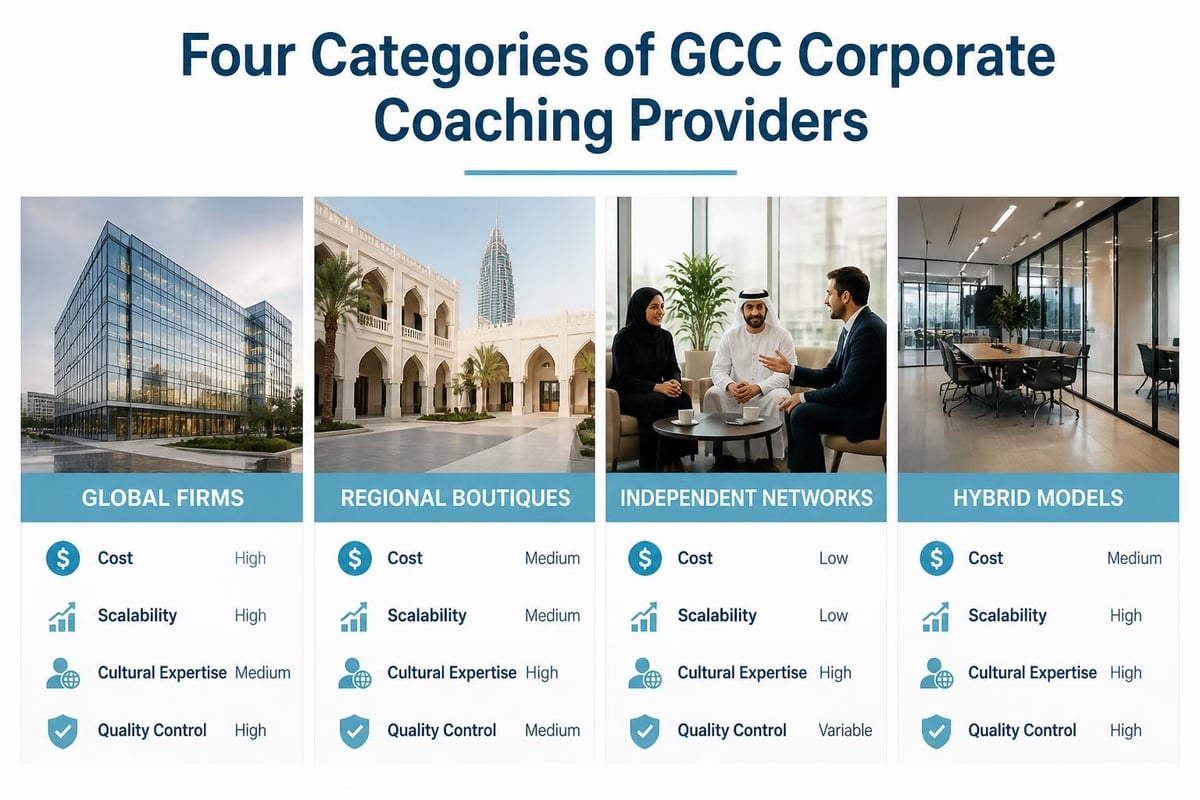
Corporate coaching providers across the GCC fall into four distinct categories, each with specific strengths and limitations:
Global Firms with Regional Operations
Large consultancies and leadership development firms offer brand recognition and established methodologies. They typically charge premium rates ($15,000 to $45,000 per executive for six-month engagements) and provide scalability for enterprise-wide programs.
Strength: Structured processes, robust compliance infrastructure, government procurement experience.
Weakness: Limited coach network with genuine GCC expertise; high overhead costs; slow customization cycles.
A multinational bank working with a global firm in 2025 faced eight-month delays customizing content for Sharia-compliant financial services leadership. The program eventually launched but missed critical business cycle timing.
Regional Boutique Providers
Smaller firms based in Dubai, Riyadh, or Doha often provide deeper cultural understanding and faster deployment. Pricing ranges from $8,000 to $25,000 per executive engagement.
Strength: Regional relationships, cultural fluency, flexible delivery models.
Weakness: Limited coach network depth; inconsistent quality control; scalability constraints for large enterprises.
Independent Coach Networks
Platforms connecting organizations with certified independent coaches offer flexibility and cost efficiency ($5,000 to $18,000 per engagement). Quality varies significantly based on vetting rigor and matching sophistication.
Strength: Diverse expertise, competitive pricing, rapid deployment.
Weakness: Inconsistent methodology, limited organizational integration, variable compliance standards.
Hybrid Models with Precision Matching
Advanced providers combine technology-enabled matching, validated assessments, and curated coach networks. These models address the fundamental challenge: pairing the right expertise with specific leadership needs while maintaining quality standards and compliance requirements. Similar to approaches used by corporate coaching vendors in Canada, these frameworks emphasize measurable outcomes and systematic coach selection.
Cost Structures and Budget Planning
Pricing for corporate coaching providers across the GCC reflects multiple variables: coach seniority, engagement duration, assessment depth, language requirements, and compliance complexity. Understanding true cost requires looking beyond stated fees.
Typical Investment Ranges (2026)
Executive Level Coaching
- C-suite engagements: $18,000 – $55,000 per executive (6-12 months)
- VP/Director level: $12,000 – $32,000 per executive (4-9 months)
- Manager level: $6,000 – $18,000 per participant (3-6 months)
Hidden Cost Factors
- Assessment fees: $1,200 – $4,500 per participant
- Program design and customization: $8,000 – $35,000 one-time
- Translation and localization: $2,500 – $12,000 depending on volume
- Compliance documentation: $3,000 – $15,000 for government procurement
Volume Economics
Organizations deploying coaching at scale (50+ participants) typically negotiate 15-30% discounts and fixed-fee arrangements. However, volume discounts often correlate with reduced customization and generic coach matching.
A Saudi telecommunications company learned this lesson in 2025. After securing a 35% discount for 80 executive coaching spots, standardized matching and limited coach selection resulted in 42% program dropout and minimal behavioral change. The CFO calculated actual cost per successful outcome at $47,000, versus initial projected cost of $15,000 per participant.
Selection Process: Practical Due Diligence
When evaluating corporate coaching providers across the GCC, procurement teams should implement a structured due diligence process that goes beyond RFP responses.
Phase 1: Requirements Definition
- Identify specific leadership challenges (toxic team dynamics, strategic thinking gaps, change resistance, cross-cultural effectiveness)
- Define measurable outcomes linked to organizational KPIs
- Establish compliance requirements (data handling, procurement standards, audit protocols)
- Determine budget parameters including hidden costs and scalability needs
Phase 2: Provider Assessment
Evaluate capability across six dimensions:
- Coach network depth: Request specific profiles matching your industry and leadership challenges
- Assessment methodology: Require validation data and cultural norming evidence
- Matching process: Understand selection criteria and quality controls
- Measurement framework: Examine baseline assessment, progress tracking, and outcome verification
- Regional experience: Verify actual GCC client work, not regional office presence
- Compliance infrastructure: Review data protection protocols and government procurement experience
Phase 3: Pilot Testing
Before enterprise-wide deployment, run controlled pilots with 8-12 participants across different seniority levels and functions. Measure:
- Goal achievement rate against defined objectives
- Behavioral change observation by managers and peers
- Participant engagement and session completion
- Cost per successful outcome, not just cost per participant
A Qatar-based energy company used this approach in late 2025. After piloting three providers simultaneously, quantitative results showed dramatic differences. Provider A achieved 78% goal attainment with $12,400 per-participant investment. Provider B achieved 34% goal attainment at $9,800 per participant. Provider C achieved 71% goal attainment at $16,500 per participant. The apparent savings from Provider B disappeared when calculating cost per successful outcome.
Government Sector Considerations
Corporate coaching providers across the GCC serving government entities face additional requirements that many vendors underestimate. The Human Resources Development Fund in Saudi Arabia demonstrates how public sector leadership development integrates with national workforce development objectives.
Public Sector Procurement Realities
Documentation requirements: Government procurement demands detailed compliance documentation, curriculum specifics, coach credentials, and outcome measurement protocols that exceed private sector standards.
Approval cycles: Decision timelines range from 4-18 months depending on entity, budget size, and procurement category. Providers without government experience consistently underestimate deployment time.
Local content requirements: Increasing emphasis on Saudi, Emirati, or Qatari nationals as coaches and program leads. Providers relying exclusively on expatriate coaches face growing obstacles.
Mission alignment: Leadership development must connect explicitly to public service objectives, citizen satisfaction, and government effectiveness metrics, not just individual capability building.
A federal government agency in the UAE spent 14 months evaluating providers in 2024-2025. Three finalists had impressive corporate credentials but zero government sector experience. The fourth finalist had deep public sector expertise across the region. Despite higher initial costs, the government-experienced provider deployed in half the time, navigated compliance efficiently, and structured outcomes around public service delivery metrics rather than generic leadership competencies.

Integration with Broader Talent Strategy
Effective organizations view corporate coaching providers across the GCC as one component within comprehensive talent development frameworks. According to the World Economic Forum’s analysis of the Middle East’s reskilling revolution, successful workforce transformation requires coordinated investment across multiple development mechanisms.
The Integration Framework
| Development Mechanism | Primary Use Case | Coaching Intersection |
|---|---|---|
| Formal Training | Knowledge transfer, technical skills | Reinforcement of learning application |
| Mentoring Programs | Career navigation, organizational knowledge | Complement to behavioral development |
| Executive Coaching | Behavioral change, leadership effectiveness | Core intervention for complex challenges |
| Action Learning | Strategic problem-solving, team development | Integration of coaching with project delivery |
| Job Rotation | Exposure to diverse functions, cross-cultural capability | Coaching support during transitions |
The most sophisticated organizations deploy coaching strategically, not universally. A UAE-based conglomerate established clear criteria for coaching allocation in 2025:
- High-potential leaders in transition roles or stretch assignments
- Executives demonstrating specific behavioral gaps (conflict avoidance, micromanagement, poor delegation)
- Technical experts promoted to leadership requiring rapid skill development
- New hires at VP+ level navigating cultural and organizational integration
This targeted approach delivered 3.2x ROI compared to previous broad-distribution programs while reducing total coaching spend by 27%.
Technology and Virtual Delivery Considerations
Post-pandemic acceleration of virtual coaching continues across the region, yet effectiveness varies significantly based on cultural factors and relationship dynamics that corporate coaching providers across the GCC must navigate carefully.
Virtual Coaching Effectiveness Data
Research from regional implementations shows virtual coaching achieves comparable outcomes to in-person engagements for certain populations and challenges:
High effectiveness (85-92% goal achievement rates):
- Established leaders with strong self-awareness
- Specific skill development (communication, delegation, time management)
- Follow-up sessions after initial in-person relationship building
Lower effectiveness (54-68% goal achievement rates):
- First-time coaching participants with limited self-awareness
- Complex interpersonal challenges requiring nuanced observation
- Leaders in high-context cultures preferring relationship depth over efficiency
A Dubai-based financial services firm compared outcomes across 116 coaching engagements in 2025-2026. Virtual-only coaching achieved 64% goal attainment. Hybrid models (initial in-person sessions followed by virtual) achieved 83% goal attainment. Purely in-person engagements achieved 87% goal attainment. Cost differences were substantial: $9,200 virtual, $12,800 hybrid, $18,400 in-person.
The optimal approach depends on participant seniority, leadership challenge complexity, and cultural preferences. Blanket virtual deployment sacrifices effectiveness. Blanket in-person requirements waste budget on situations where virtual delivery suffices.
Common Implementation Failures
Four implementation failures appear repeatedly when organizations deploy corporate coaching providers across the GCC:
Failure 1: Stakeholder Misalignment
Coaching participants, their managers, and HR operate with different expectations and success definitions. A pharmaceutical company discovered this when post-program surveys revealed participants focused on work-life balance while their managers expected strategic thinking development. The disconnect resulted from inadequate pre-program alignment and goal-setting.
Failure 2: Insufficient Time Allocation
Organizations approve coaching budgets but fail to protect participant time. Leaders cancel sessions due to operational pressures, causing engagement fragmentation and minimal behavioral change. Effective programs establish explicit time commitments and manager accountability for protecting coaching sessions.
Failure 3: Measurement Theater
Many organizations collect satisfaction surveys and session completion data but ignore behavioral outcomes and business impact. Real measurement requires manager observation, peer feedback, and KPI tracking over 6-12 months, not just participant self-assessment immediately post-program.
Failure 4: One-Size-Fits-All Deployment
Applying identical coaching approaches across diverse populations (government versus private sector, technical versus commercial functions, local versus expatriate leaders) guarantees suboptimal outcomes. Effective programs segment participants and customize interventions accordingly.
Vendor Management and Relationship Dynamics
The relationship between organizations and corporate coaching providers across the GCC often begins transactionally and evolves toward strategic partnership or deteriorates into operational friction. The difference hinges on how both parties navigate three critical dynamics:
Expectation Management
The Problem: Organizations expect immediate behavioral transformation. Providers overpromise results to win business.
The Reality: Meaningful leadership development requires 6-12 months minimum, with observable change typically emerging after 3-4 months. Quick wins happen with discrete skill development (presentation skills, meeting facilitation), but complex behavioral patterns (conflict avoidance, strategic thinking, executive presence) demand sustained engagement.
Performance Accountability
The Problem: Vague success criteria allow underperforming providers to claim victory based on subjective measures.
The Solution: Establish written outcome definitions before program launch. A Kuwait-based industrial company implemented a simple protocol in 2026: every coaching engagement requires three defined behavioral outcomes observable by the participant's manager. Progress reviews occur at 60 and 120 days. Coaches whose clients achieve fewer than two of three outcomes face replacement. This accountability mechanism improved outcome achievement from 57% to 81%.
Continuous Improvement
The best provider relationships include quarterly performance reviews examining not just individual outcomes but program-level patterns. Questions worth asking:
- Which types of leadership challenges showed highest versus lowest success rates?
- What participant characteristics predicted successful outcomes?
- Which coaches demonstrated superior results and why?
- What program design elements should be modified based on results data?
Organizations treating providers as vendors rarely capture this learning. Those treating them as strategic partners systematically improve effectiveness and ROI over time, similar to approaches documented in leadership development best practices.
The Localization Imperative
A subtle but critical trend is reshaping corporate coaching providers across the GCC in 2026: the expectation that programs reflect regional leadership models rather than imported Western frameworks. PwC’s Middle East Workforce Hopes and Fears Survey 2024 reveals growing employee preference for development approaches aligned with cultural values and regional business contexts.
This creates operational requirements for providers:
- Arabic language capability for coaching delivery, not just materials translation
- Regional case studies replacing Silicon Valley startup or Wall Street examples
- Cultural intelligence frameworks addressing GCC-specific cross-cultural dynamics
- Islamic values integration where appropriate for organizational culture
- Regional leadership models highlighting successful GCC leaders and approaches
A multinational technology company learned this through failed implementation. Their global executive coaching program emphasized individual achievement, direct feedback, and rapid decision-making. Saudi participants found the approach culturally jarring and misaligned with their consultative leadership style and emphasis on group harmony. After localizing the program with regionally experienced coaches and culturally adapted frameworks, engagement scores improved by 43 points and goal achievement rates doubled.
Frequently Asked Questions
What is the typical ROI timeline for executive coaching in the GCC?
Organizations should expect initial behavioral changes within 90-120 days, with measurable business impact emerging at 6-9 months. Full ROI assessment requires 12-18 month evaluation periods tracking leadership effectiveness metrics, team engagement scores, and business KPI improvements. Quick-win programs promising 30-day transformations typically deliver superficial changes that don't sustain.
How do coaching costs in the GCC compare to global markets?
GCC executive coaching costs are 15-35% higher than North American or European equivalents due to limited regionally experienced coach supply, travel requirements, and compliance complexity. However, lower corporate tax rates and government training subsidies in some GCC markets offset total program costs for eligible organizations.
Should organizations prioritize local or expatriate coaches?
The critical factor isn't nationality but regional experience and cultural fluency. An expatriate coach with eight years in the GCC typically outperforms a recently arrived local coach. However, Arabic-speaking coaches with regional business experience deliver superior outcomes for local national leaders. The optimal mix depends on participant demographics and organizational culture.
What compliance requirements apply to corporate coaching in government sectors?
Government procurement requires vendor registration, security clearances for coaches working with sensitive entities, data localization for personal information, and audit trail documentation. Requirements vary by country and entity, with Saudi government agencies typically demanding more extensive compliance than UAE free zone authorities. Providers without government experience consistently underestimate documentation and approval timelines.
How can organizations evaluate coach quality before engagement?
Request sample assessment reports (anonymized), conduct reference checks with similar organizations, and review coach credentials beyond basic certifications. The most valuable validation comes from pilot programs with 3-5 participants before enterprise deployment. Avoid making large commitments based solely on provider reputation or marketing materials.
The acceleration of leadership development investment across the GCC creates opportunity and risk. Organizations that approach corporate coaching providers across the GCC with strategic discipline, clear measurement frameworks, and realistic expectations capture substantial value. Those treating coaching as compliance theater or generic training waste resources and miss opportunities to build adaptive leadership capability when regional transformation demands it most. Noomii Leadership Coaching helps organizations across the GCC navigate this complexity through precision coach matching, validated assessment tools, and measurable outcome frameworks aligned with Vision 2030 objectives and public sector requirements. Our structured approach ensures your leadership development investment delivers behavioral change and business impact, not just program completion.


Leave a Reply
Want to join the discussion?Feel free to contribute!