
Leadership Development for Telecom Operators: A Practical Guide
Leadership development for telecom operators works when it targets the specific transitions that break telecom careers: technical expert to people leader, functional head to enterprise executive, and incumbent operator to platform competitor. Generic management curricula miss all three. The programs that change behavior start with diagnostics, pair each leader with a coach who knows the sector, and report results against retention, performance and engagement metrics that the CFO already trusts.
This guide is written for HR, L&D and People leaders who own leadership quality and succession at mid-market and large operators. It covers why telecom leadership is structurally different, a framework for building a program, where programs fail, and how to measure what you get.
Why telecom operators need a different approach to leadership development
Telecom operators need a distinct approach because their leaders manage capital-intensive infrastructure, regulated markets and fast product cycles at the same time, and most were promoted for engineering or commercial excellence rather than for leading people.
The scale of the shift is hard to overstate. According to the GSMA Mobile Economy 2025 report, 305 operators in 121 markets had launched commercial 5G services by December 2024, and global 5G connections passed 2 billion by the end of that year. The same report estimates that mobile technologies and services generated about 5.8% of global GDP. Operators sit at the center of that value, and their leaders are asked to run it with organizations designed for a different era.
Three structural pressures shape the leadership challenge:
- Technology cadence outruns org design. Moving from non-standalone to standalone 5G, cloud-native cores and network automation changes who owns decisions. GSMA reports 60 operators were offering commercial 5G on standalone networks as of December 2024. Each of those migrations redistributes authority between network, IT and product teams.
- Regulatory and compliance exposure. Spectrum obligations, data protection and lawful intercept rules mean leadership failures carry legal weight, not just cultural cost.
- Dual identity. Operators are both utilities with reliability obligations and consumer brands competing on experience. Leaders must switch between a risk-averse operations mindset and a commercial one, often in the same week.
The practical implication for a CHRO: a leadership curriculum copied from a retail bank or software company will teach concepts your leaders cannot apply on Monday morning.
The leadership gaps that show up most often in telecom
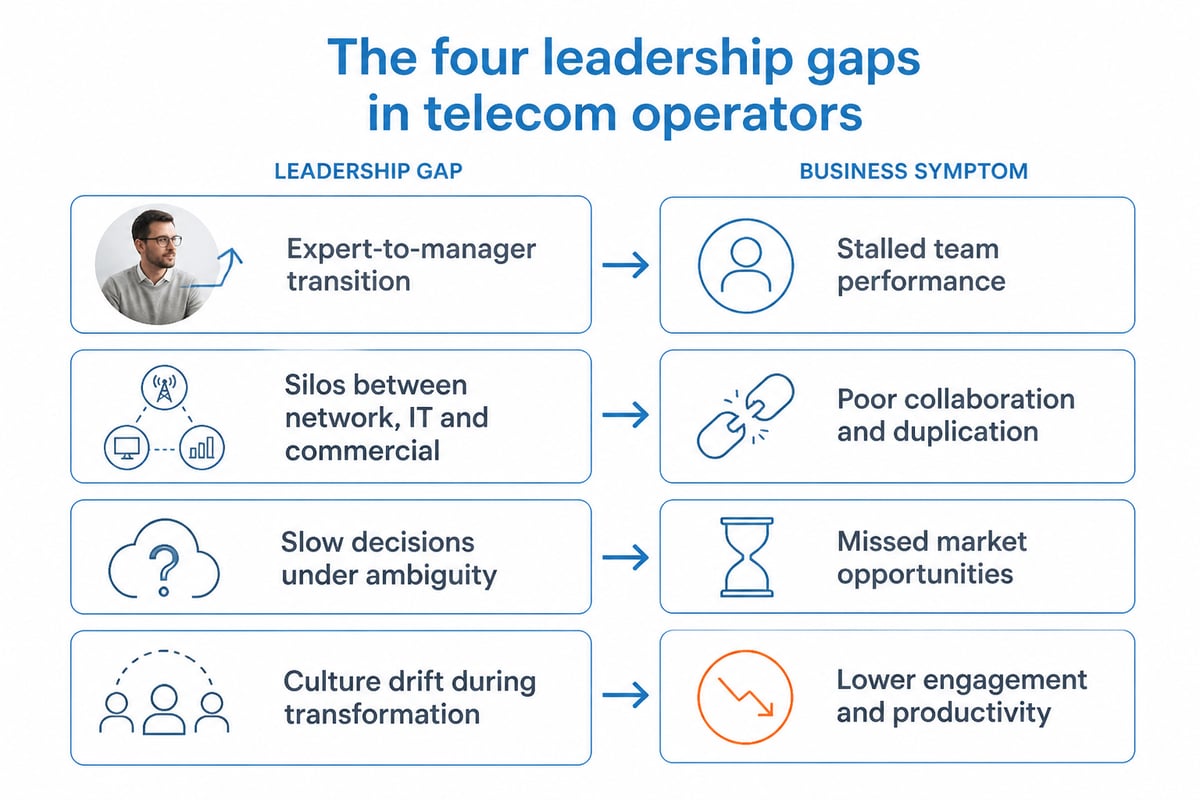
The most common gaps are in the expert-to-manager transition, cross-functional ownership and decision speed, and they tend to persist because promotion systems reward technical depth.
The expert-to-manager cliff
Network engineers, RAN specialists, pricing analysts and enterprise sales leaders are promoted because they are excellent at the work. Then they inherit a team and are measured on something else. Many keep doing the job themselves, which overloads the leader and under-develops the team.
Silos between network, IT and commercial
A 5G enterprise offer touches network slicing, billing, security, sales engineering and legal. When no leader owns the outcome end to end, decisions stall in committee. The skill gap is not technical. It is the ability to convene peers without authority and drive a decision.
Decision-making under ambiguity
Capex allocation, vendor selection and network sunset decisions involve long horizons and incomplete data. Leaders who default to consensus or escalation slow the business. Leaders who decide fast without stakeholder alignment create rework.
Culture drift during transformation
Restructurings, outsourcing of network operations and integration after mergers strain trust. Toxic or avoidant leadership patterns often surface here first, and they are expensive to ignore. Noomii's conversation on how organizations handle toxic leadership is a useful reference for People teams building an intervention playbook.
A diagnostic-first framework for leadership development in telecom
A diagnostic-first framework works in five stages: diagnose, match, design, deliver and measure, and the order matters because most programs fail by skipping straight to delivery.
I call this the D-M-D-D-M sequence for shorthand, and it reflects how evidence-based coaching programs are typically structured.
- Diagnose. Establish a baseline for each participating leader and for the team around them. A 360 survey surfaces behavioral patterns that self-assessment hides. Noomii provides a free 360 leadership survey for every participant, which gives HR a consistent dataset from day one.
- Match. Pair each leader with a coach who understands their function, level, industry and goals. A coach who has never seen a network operations center will struggle to coach a head of network operations on shift handover culture.
- Design. Build a development plan tied to a business problem, not a competency list. "Reduce escalations from regional engineering to the CTO office by changing how directors make calls" is a plan. "Improve strategic thinking" is not.
- Deliver. Coaching, stretch assignments and peer forums run in parallel. Coaching converts insight into changed habits between sessions, which is where behavior change actually happens.
- Measure. Track against agreed KPIs at defined intervals and report to the sponsor.
Why matching deserves more weight than content
Most L&D budgets overspend on content and underspend on fit. In my observation of how leadership programs succeed or stall, the coach-leader relationship is the strongest controllable variable. That is why Noomii's coaches are sourced, interviewed and hand-matched to each leader's needs, and why no payment is due until the coach selection and development plan are approved. For a People leader, that approval gate lowers the risk of committing budget to a poor fit.
Contrarian view: stop training your whole management layer
Most operators should concentrate leadership investment on a small number of high-leverage roles rather than rolling a standard program across every manager.
The conventional approach is broad: train all people managers on the same curriculum so nobody is left out. It looks equitable and is easy to defend. It also dilutes spend and produces completion certificates instead of changed behavior.
A sharper approach identifies the roles where leadership quality moves business outcomes most:
- Directors of network operations and field services, where one leader's culture affects uptime, safety and attrition across hundreds of technicians.
- Heads of enterprise and wholesale sales, where deal ownership and cross-functional negotiation determine margin.
- Transformation and program leaders, who carry 5G, cloud and automation change without formal authority over most of the people they need.
- Successors to the top 30 to 50 roles, where a failed appointment costs the most.
Broad foundational training still has a place for new managers. But if you have to choose where to put coaching hours, put them where a leadership failure would be felt in the P&L. The Leadership Development Programs from Noomii are built for this kind of targeted design: customized, measurable plans for each leader, developed with your HR, L&D or People team and aligned to business strategy, with pilot programs available so you can test the approach on a small cohort first.
Hypothetical example: what documented behavior change could look like
Documented outcomes from Noomii engagements show what a well-run program can deliver, and two cases are relevant to operators facing complex, multi-country organizations.
Fortune 500 global electronics manufacturer
Hypothetical example: leaders spread across multiple regions need consistent development, but local delivery risks uneven quality.
- Diagnosis: The need was coordinated support across geographies, not a single curriculum delivered remotely.
- Solution: Coordinated multi-coach delivery across 5 countries.
- Result: A sponsor could re-commission repeat coaching engagements if impact is documented.
- Lesson: Re-commissioning is a stronger proof point than satisfaction scores. If sponsors buy again, the evidence was credible to them.
Fortune 1000 international therapeutics company
- Problem: Leaders were stuck in task execution rather than owning problems.
- Diagnosis: The gap was a mindset and accountability shift, not a skills shortage.
- Solution: Targeted coaching focused on ownership behaviors.
- Result: Leaders could move from task execution to problem ownership.
- Lesson: The task-to-ownership shift is the same one telecom operators need from engineering and operations managers. For a related sector view, see Noomii's guidance on leadership development for pharmaceutical companies, another regulated, technically driven industry.
Coaching outcomes should be validated against your own baseline in a pilot, since results vary by organization and cohort.
Choosing a delivery model: coaching, workshops or internal academy
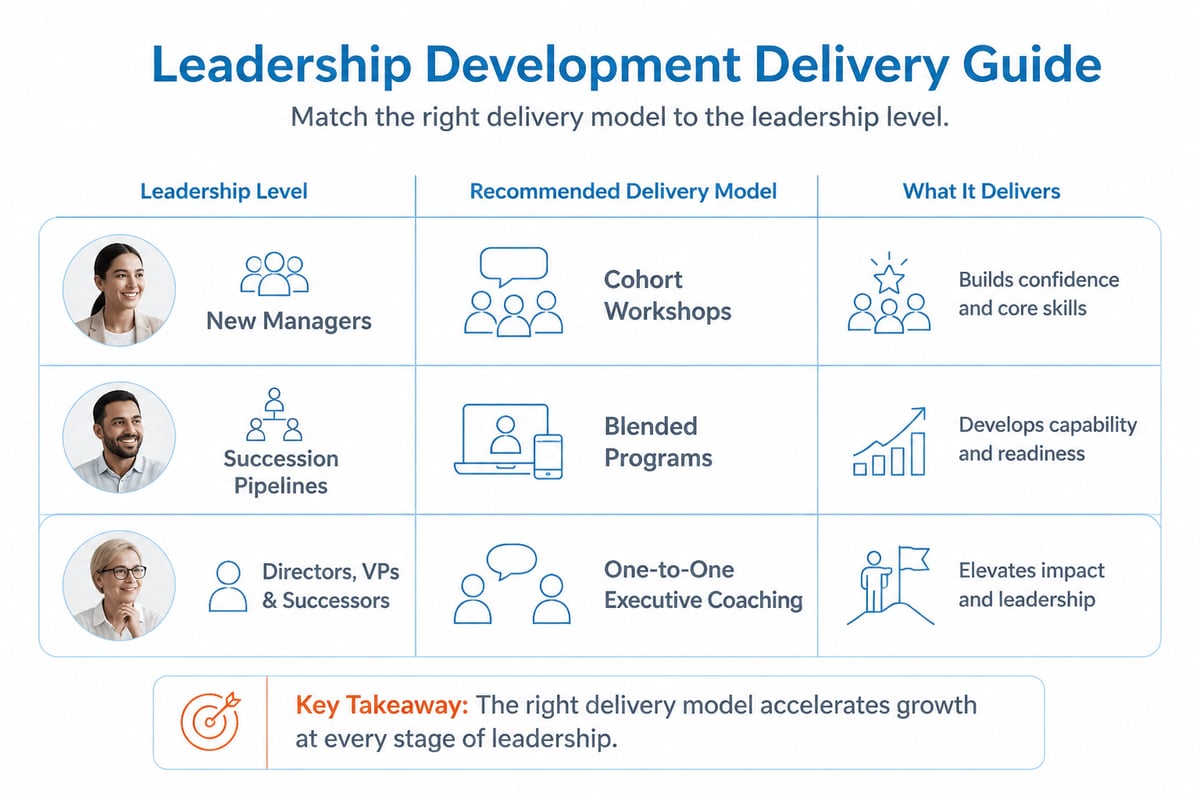
The right delivery model depends on what you are trying to change, and for senior and high-stakes roles, one-to-one coaching outperforms classroom formats on behavior change.
| Approach | Best for | Strength | Limitation |
|---|---|---|---|
| One-to-one executive coaching | Directors, VPs, successors | Personalized, tied to real decisions | Higher cost per head |
| Cohort workshops | New managers, shared vocabulary | Efficient, builds peer networks | Weak transfer to daily behavior alone |
| Internal academy | Technical and compliance content | Controlled, scalable | Limited external perspective |
| Blended program | Succession pipelines | Combines insight, practice and reinforcement | Needs coordination and a clear sponsor |
Most mature operators land on a blend: an internal academy for shared fundamentals, plus external coaching for the roles that matter most. The failure mode is treating workshops as a substitute for coaching and then wondering why behavior has not changed. Noomii has written directly on this problem in its piece on leadership development without behavior change.
Aligning leadership development with network and commercial strategy
Leadership development earns its budget when each leader's plan is tied to a specific strategic initiative, so the development work and the business work are the same work.
Start from the operator's strategic agenda and work backward to the leadership behaviors it requires. A few examples of the translation:
- Standalone 5G and network slicing: requires leaders who can negotiate priorities across network, IT and product, and who can make trade-off calls without waiting for committee consensus.
- Enterprise and B2B growth: requires commercial leaders who co-own delivery with engineering rather than handing off after signature.
- Cost and efficiency programs: require leaders who can hold difficult conversations about role changes while protecting engagement in the teams that remain.
- Regional expansion or integration: requires leaders who can build trust across cultures, which is where coordinated multi-coach delivery across countries becomes practical.
For operators in Europe, the regional picture adds context. GSMA's Europe-focused Mobile Economy report covers regional connectivity, the 5G outlook and the sector's economic contribution, and it is a useful input when you brief leadership teams on the market they are steering through.
One practical note for governance: telecom operators run under regulatory and audit scrutiny, and leadership programs should be documented to match. Noomii's approach includes compliance and governance alignment so that development initiatives meet organizational, regulatory and ethical standards. Where your facilities teams manage statutory equipment checks, a resource like Workplace Inspection Services Ltd, an independent UK engineering inspection company covering LOLER, PUWER, PSSR and COSHH/LEV requirements, offers a useful reference for the operational compliance side that leaders in field and site operations are accountable for.
How to measure the return on leadership development
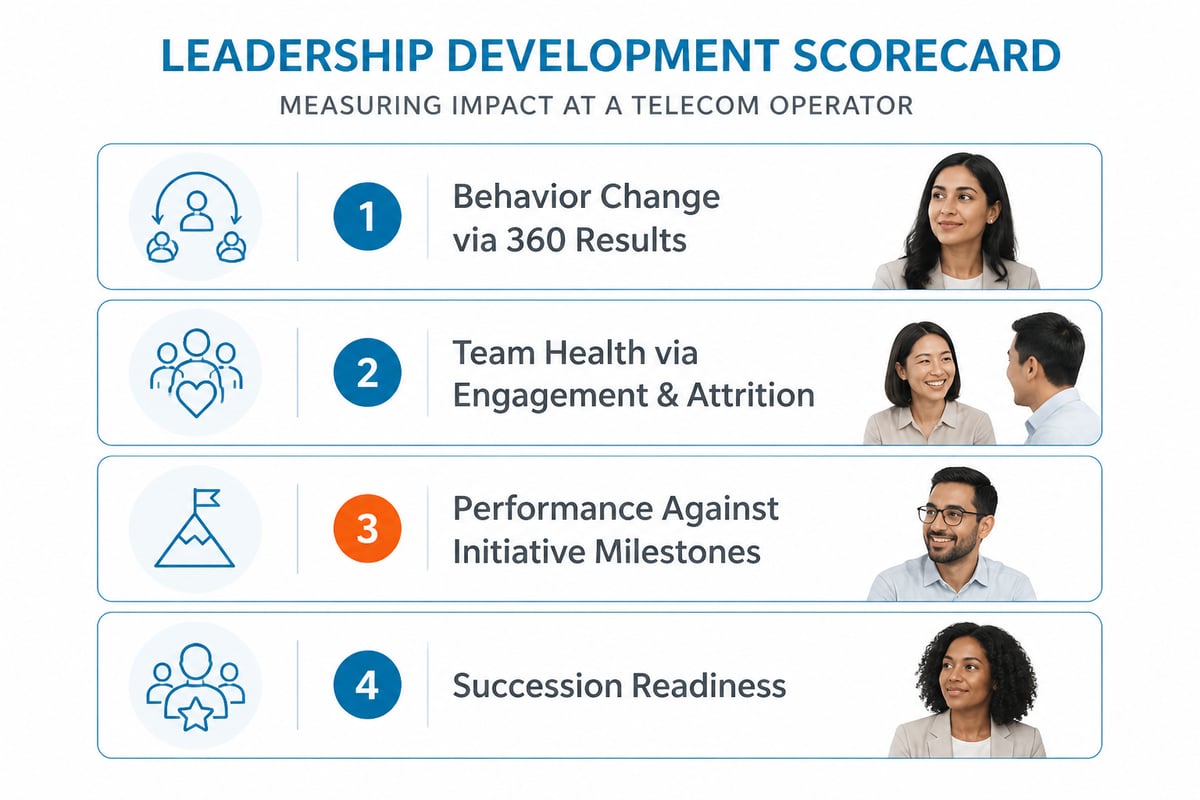
Measure leadership development by connecting individual behavior change to business indicators your executive team already tracks, and agree the metrics before the first coaching session.
A workable scorecard has four layers:
- Behavior. Change in 360 results between baseline and follow-up, focused on the two or three behaviors in each leader's plan.
- Team health. Engagement, regretted attrition and internal mobility within each leader's team.
- Performance. Delivery against the initiative the leader is accountable for, such as project milestones, escalation volume or deal conversion.
- Succession. Readiness ratings for successors and the share of senior vacancies filled internally.
Noomii provides quarterly ROI reports tied to retention, performance and leadership KPIs, which gives sponsors a regular cadence rather than a single end-of-program review.
A caution for People leaders: attribution is imperfect. Leadership is one of several factors behind attrition or performance. Treat the data as directional evidence, compare coached leaders against a sensible baseline, and be transparent about what you can and cannot claim. Overstating ROI is the fastest way to lose credibility with a CFO.
For deeper reading on structuring the program itself, Noomii's overview of a leadership development program and its page on corporate leadership development cover design considerations in more detail.
A 90-day plan to get started
A 90-day pilot is the lowest-risk way to test leadership development for a telecom operator, and it produces enough data to justify scaling or stopping.
- Days 1 to 15: Scope. Choose 8 to 15 leaders in high-leverage roles. Name an executive sponsor and agree the business problems each leader's plan will address.
- Days 15 to 30: Diagnose and match. Run 360 surveys, review the results with each leader, and approve coach matches and development plans.
- Days 30 to 75: Deliver. Coaching sessions, one stretch assignment per leader and a monthly sponsor check-in.
- Days 75 to 90: Measure and decide. Compare against baseline, collect sponsor feedback and decide whether to expand, adjust or stop.
Keep the pilot honest. Define in advance what result would justify scaling, and what would not.
Frequently asked questions
What is leadership development for telecom operators?
It is a structured effort to build the leadership capability telecom operators need to run networks, regulated operations and commercial growth at once. It typically combines diagnostics such as 360 surveys, one-to-one coaching, stretch assignments and measurement tied to retention, performance and succession.
Why is telecom leadership development different from other industries?
Operators combine capital-intensive infrastructure, regulatory obligations and fast technology change, and most leaders are promoted for technical or commercial expertise. The main transitions to address are expert to people leader and functional head to enterprise executive.
Who should be prioritized for development?
Prioritize roles where leadership quality most affects outcomes: network operations and field services directors, enterprise and wholesale sales heads, transformation leaders and successors to the top senior roles. Broad training can still support new managers.
How long before leadership development shows results?
Behavior change can be observed within a single engagement cycle, and a 90-day pilot gives early directional data. Business outcomes such as retention and succession readiness take longer, which is why quarterly reporting is useful.
How do you measure ROI?
Link behavior change from 360 results to team engagement, regretted attrition, delivery performance and internal succession rates. Agree metrics before starting and compare against a baseline, while being clear that leadership is one of several factors.
Should coaching replace workshops?
For senior and high-stakes roles, coaching tends to convert insight into changed habits more reliably. Workshops remain useful for shared vocabulary and new managers. Most operators benefit from a blend.
Start this week by naming one executive sponsor and listing the 10 roles where a leadership failure would hurt your network or commercial results most, because that list becomes your pilot cohort. From there, a partner who can run the 360 baseline, hand-match sector-aware coaches and report quarterly against your KPIs saves months of design work, and Noomii's Leadership Development Programs are built around exactly that sequence. If you want to scope a pilot for your operator, Book a Free Strategy Call with Noomii Leadership Coaching and we will map the roles, metrics and timeline together.


Leave a Reply
Want to join the discussion?Feel free to contribute!