
Leadership Development Across Sub-Saharan Africa: Guide
Leadership development across Sub-Saharan Africa works best when it is built around local operating conditions, measured against business outcomes, and delivered through a mix of fellowships, coaching and on-the-job stretch roles rather than classroom training alone. The region offers abundant ambition and a young talent base, but the infrastructure that converts potential into executive-ready leaders is uneven. For HR, L&D and People leaders, the task is to build a system that fits each market instead of exporting one template across 40-plus countries.
This guide covers the context you are operating in, the formats that exist, a framework for designing your program, how to measure it, and where most programs fail.
What Makes Leadership Development in Sub-Saharan Africa Different
Leadership development in Sub-Saharan Africa differs from mature markets because the pipeline is shaped by a young workforce, fragmented national education systems, and organizations that often grow faster than their management bench.
Four conditions matter most for people leaders:
- A thin middle layer. Many companies have capable frontline talent and ambitious executives but too few experienced managers between them. Promotion often happens before a first-time manager has been taught the basics of delegation or performance conversations.
- Multi-country complexity. A regional head may oversee teams in Nigeria, Kenya, Ghana and South Africa, each with different labor norms, languages, regulatory environments and expectations of authority.
- Uneven institutional support. Formal skills systems are being rebuilt. The African Union's Decade of Accelerated Action for the Transformation of Education and Skills Development in Africa runs from 2025 to 2034, according to UNESCO. That is a long runway, and employers cannot wait for it to produce a ready supply of leaders.
- Talent mobility. Strong leaders are recruited by multinationals, regional competitors and overseas employers. Development without a retention logic simply trains people for someone else.
The practical implication is that your program has to build capability faster than the surrounding ecosystem will, and it has to give leaders a reason to stay while it does.
The Main Formats: What Exists and What Each One Does
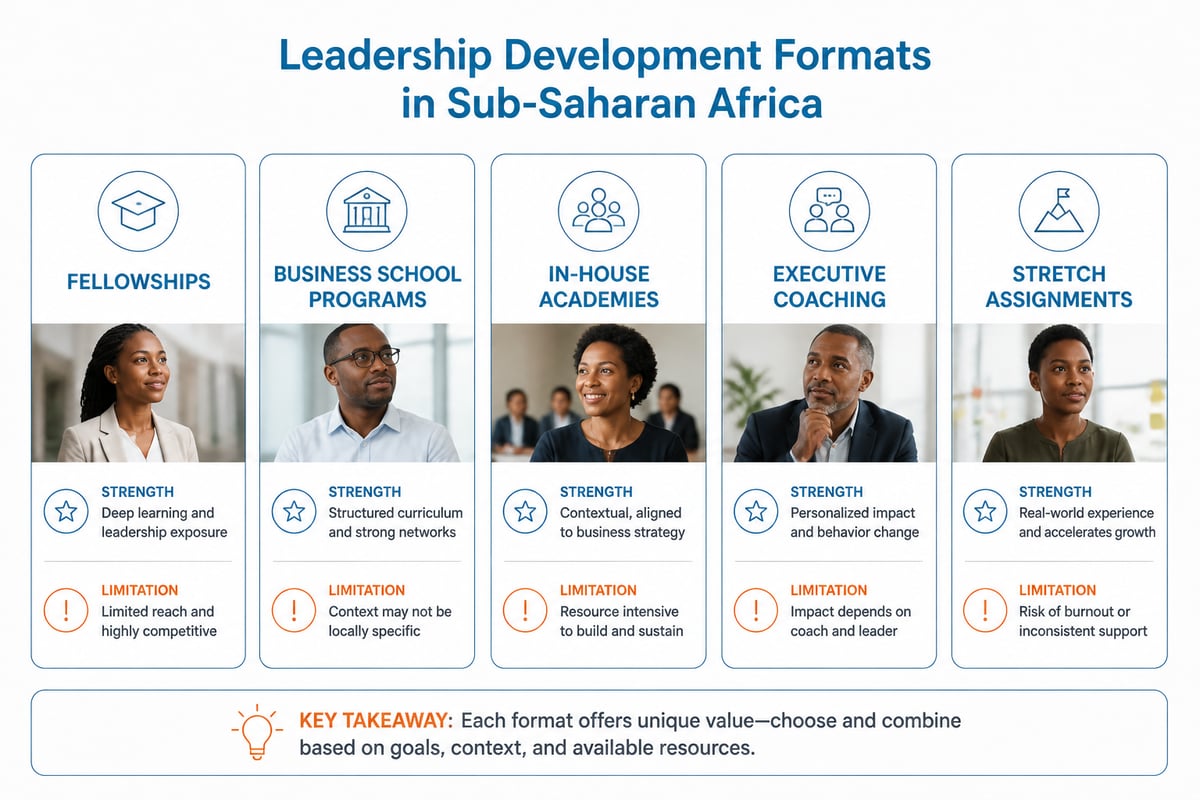
The main formats for leadership development across Sub-Saharan Africa are fellowships, business school programs, in-house academies, executive coaching and structured stretch assignments, and each solves a different problem.
Fellowship and network programs, including regional leadership centers and public service fellowships, are strong at building cross-border networks and exposing emerging leaders to peers. They are typically open to individuals by application, which means your company does not control who attends or what gets applied back at work.
| Format | Best at | Main limitation |
|---|---|---|
| Fellowships and regional networks | Peer networks, exposure, credibility | Individual selection, little link to your business goals |
| University and business school programs | Frameworks, strategic and financial literacy | Knowledge transfer often outpaces behavior change |
| In-house academies | Consistent language, culture, scale | Quality depends on internal facilitator capability |
| Executive and leadership coaching | Behavior change, individual gaps, confidential issues | Needs rigorous matching and clear goals to deliver value |
| Stretch assignments and rotations | Real decision-making under pressure | Needs sponsorship, or leaders are set up to fail |
No single format is sufficient. The strongest programs pair a knowledge input with a behavior-change mechanism and a real assignment, so that what leaders learn gets tested in their actual role within weeks.
A Five-Step Framework for Designing the Program
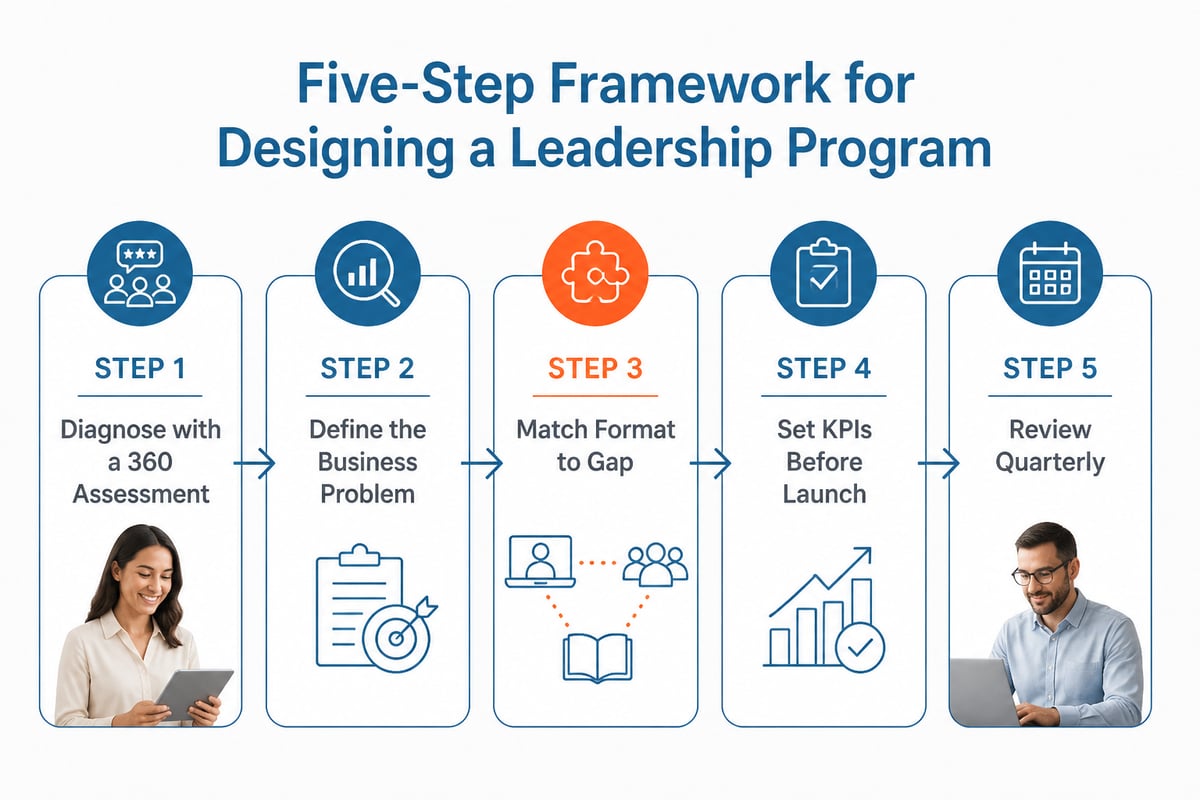
A reliable design sequence for leadership development across Sub-Saharan Africa moves from diagnosis to measurement in five steps, and skipping the first one is the most common reason programs underperform.
This is the sequence I recommend HR and L&D teams use. Treat it as a working framework, not a theory: each step produces a deliverable your executive sponsor can review.
- Diagnose before you design. Run a baseline of leadership strengths and gaps across your target population. A validated 360 assessment, which gathers input from managers, peers and direct reports, shows behavioral patterns that self-reports hide. Noomii provides a free 360 leadership survey for every participant, which gives a starting point for individual plans and a population-level view.
- Define the business problem in plain terms. "Improve leadership" is not a goal. "Reduce regretted attrition among country managers" or "move team leads from task execution to problem ownership" is. Pick two or three.
- Match the format to the gap. A skills gap suggests structured learning. A behavior gap, such as conflict avoidance or unclear accountability, calls for coaching. A readiness gap calls for stretch roles with sponsorship.
- Set the KPIs before launch. Agree which retention, performance, engagement and promotion-readiness indicators will be tracked, and who owns the data.
- Review quarterly and adjust. Programs that run for a year without a checkpoint tend to drift from the original business problem.
Why Coaching Often Outperforms Classroom Learning in This Region
Coaching often outperforms classroom learning for senior and mid-level leaders because it addresses the specific, context-dependent challenges that a generic curriculum cannot, and it does so privately.
Consider the conditions leaders in the region manage. A country director may be balancing a global head office's reporting demands against local team expectations. A newly promoted manager may be supervising people who were recently peers, in a culture where challenging a senior colleague carries real social cost. These situations are specific, and the useful response depends on the person, the sector and the market.
Hand-matched coaching addresses this because the coach is selected for function, level, industry and goals rather than assigned from a pool. Noomii’s coaches are sourced, interviewed and matched to each leader's needs, and you do not pay until the coach selection and development plan are approved. For a regional program, that removes the risk of committing budget to a poor match.
The caution is that coaching without structure becomes a pleasant conversation with no business effect. The same discipline applies as above: a development plan tied to the diagnostic, quarterly reviews, and defined indicators. For a deeper look at why training often fails to change what leaders do, see this analysis of leadership development without behavior change.
Case Evidence: What Measurable Results Look Like
Measurable results from leadership coaching show up as observable behavior change, repeat commissioning by the buyer, and shifts in how leaders own problems, and Noomii's documented engagements illustrate each one.
Two engagements Noomii has described, presented here in the Problem, Diagnosis, Solution, Result, Lesson format:
Fortune 500 global electronics manufacturer
- Problem: Leaders operating across multiple countries needed consistent development that did not depend on one location or one coach.
- Diagnosis: The gap was coordination. Individual coaching existed in pockets, but nothing connected it to shared leadership goals.
- Solution: Coordinated multi-coach delivery across 5 countries, with each leader matched to a coach by function, level and goals.
- Result: The organization re-commissioned coaching engagements because of the documented impact.
- Lesson: Global consistency comes from coordination and measurement, not from using one coach everywhere.
Fortune 1000 international therapeutics company
- Problem: Leaders were strong at executing tasks but did not take ownership of the problems behind them.
- Diagnosis: The behavior gap was about accountability, not technical skill.
- Solution: Targeted coaching built around problem ownership.
- Result: Leaders moved from task execution to problem ownership.
- Lesson: Name the specific behavior you want to see change, then coach to it.
Across Noomii engagements, leaders have shown observable behavior change, coaching effectiveness has been rated 8-9 out of 10 across goal alignment, support and accountability, and senior leaders have rated coach professionalism 10 out of 10. These are Noomii's own reported figures, and they are a reasonable benchmark to request from any provider you evaluate.
Contrarian View: Stop Treating Africa as One Market
Treating leadership development across Sub-Saharan Africa as a single regional program is the most common design mistake, and it leads to content that fits nowhere well.
The conventional approach is to build one flagship curriculum, run it in one hub city, and call it regional. It is efficient on paper. In practice, a Lagos-based sales leader and a Nairobi-based operations leader face different regulatory pressure, different talent competition and different team dynamics. A curriculum pitched at the average serves neither.
A better pattern separates what should be common from what should be local:
- Common: the leadership competency model, the diagnostic instrument, the KPIs and the reporting cadence.
- Local: the coach, the case material, the language of delivery, and the stretch assignment.
This keeps the benchmarking value of a regional program while respecting how leadership actually plays out in each market. If you are weighing regional providers, Noomii's overview of leadership development vendors in Kenya shows what to look for in a single-market evaluation.

Tying Development to Policy Shifts and Talent Supply
Corporate programs should track national and continental skills policy because it signals where the talent supply is heading and where employers will have to fill gaps themselves.
UNESCO's overview of the second continental report on learning and skills development, produced with UNICEF and the African Union, discusses progress, gaps and approaches to make skills development more responsive to economic and social needs. For a People leader, the useful reading is this: public systems are working to align skills with labor-market demand, but the leadership and management layer is rarely the first priority. That layer is where employers have the most control and the most to gain.
Two implications follow. First, do not assume that graduates arrive with management capability; plan for a first-manager transition program as a standard offer. Second, build partnerships with local institutions where it helps with recruitment, but keep the leadership pipeline itself in your own hands.
For organizations that want a structured design with your HR and L&D team, Noomii’s Leadership Development Programs offer customized, measurable plans for each leader aligned with business strategy, with pilot programs available.
How to Measure Leadership Development So the Board Believes It
Measurement that persuades a board links leadership development to retention, performance and leadership indicators, reported on a fixed rhythm, with a baseline established before anything starts.
Use a short list of indicators and hold to it:
- Retention: regretted attrition among program participants versus a comparison group.
- Performance: team-level results tied to the business problem you defined in step two.
- Leadership behavior: change in 360 scores on the two or three behaviors targeted.
- Pipeline readiness: the share of critical roles with a ready-now or ready-in-one-year successor.
- Engagement: direct-report engagement for participating leaders.
Noomii delivers quarterly ROI reports tied to retention, performance and leadership KPIs, which gives HR a ready format for board updates. Whatever provider you use, insist on the same structure. A related resource on leadership improvement planning can help you turn diagnostic findings into individual commitments.
One discipline matters more than any tool: write down the baseline in month zero. Programs that lack a baseline can describe activity but cannot prove change, and that is the first thing a finance committee will notice.
Common Failure Points and How to Avoid Them
Most failures in leadership development across Sub-Saharan Africa come from a short list of avoidable design errors rather than from lack of budget or effort.
- Selecting participants by seniority rather than by role criticality. Start from the roles that most affect results and succession risk.
- No sponsor above the participant. Without a senior sponsor who reviews progress, leaders return from development to an unchanged job.
- Ignoring toxic behavior. Fast-growing organizations sometimes tolerate high performers who damage team trust. Noomii's discussion of why organizations tolerate toxic leadership is worth reading if this applies to you.
- Counting attendance as impact. Hours of training and satisfaction scores describe delivery, not change.
- Launching without a succession link. Development should feed named succession slots, or it becomes a perk.
Hypothetical example: a regional company promotes strong salespeople to country manager without structured support, and the transition is left to chance. Without a diagnostic, a matched coach or a sponsor, gaps tend to surface late. The lesson is that the promotion moment, not the training event, is when support matters most.
Frequently Asked Questions
What is the best way to start leadership development across Sub-Saharan Africa?
Start with a baseline diagnostic of the leaders you most need to develop, define two or three business problems the program must solve, and pilot with a small cohort before scaling. A pilot lets you test coach matching, content fit and measurement in one or two markets first.
Should leadership programs be regional or country-specific?
Use a hybrid. Keep the competency model, diagnostic and KPIs common so you can benchmark across countries, and localize coaches, case material and stretch assignments to each market.
How long does it take to see results?
Observable behavior change can appear within the first few months of a well-structured engagement, but retention and performance effects take longer to show. Set quarterly checkpoints so progress is visible before the full cycle ends.
Is coaching or training better for new managers?
New managers usually benefit from both. Short structured training covers fundamentals such as delegation and feedback, while coaching helps them apply those skills in their actual team situation.
How do we choose a coach for a leader in a different country?
Match on function, level, industry and goals, not only on geography. Ask the provider how coaches are sourced and interviewed, and confirm there is no payment until you approve the coach selection and development plan.
How do we prove ROI to the board?
Establish a baseline before launch, track retention, performance and leadership KPIs on a quarterly cadence, and compare participants against a reasonable reference group. Quarterly reports make the case in a format finance leaders recognize.
This week, list the five roles in your region that would hurt most to leave empty and write down who is ready to step into each one, because that gap list is the starting brief for any program. With that in hand, Noomii can run a free 360 leadership survey for each participant, match each leader with a coach, and report results quarterly through its Leadership Development Programs. If you want help turning that gap list into a measurable plan, Book a Free Strategy Call with Noomii Leadership Coaching and we will map the next step with you.


Leave a Reply
Want to join the discussion?Feel free to contribute!