
Leadership Development Providers in Thailand: A Guide for Employers
Leadership development providers in Thailand fall into five groups: universities and business schools, local training houses, regional consulting firms, global training brands, and coaching networks that pair leaders with individual coaches. The right choice depends less on brand than on whether the provider can show behavior change in your leaders, so evaluate every option against that standard before comparing price or curriculum.
This guide is written for HR, L&D and People leaders at mid-market and large companies who own leadership quality and succession. It covers how the Thai market is structured, a selection framework you can apply, what to ask in a vendor review, and how to prove the investment worked.
How Is the Thai Leadership Development Market Structured?
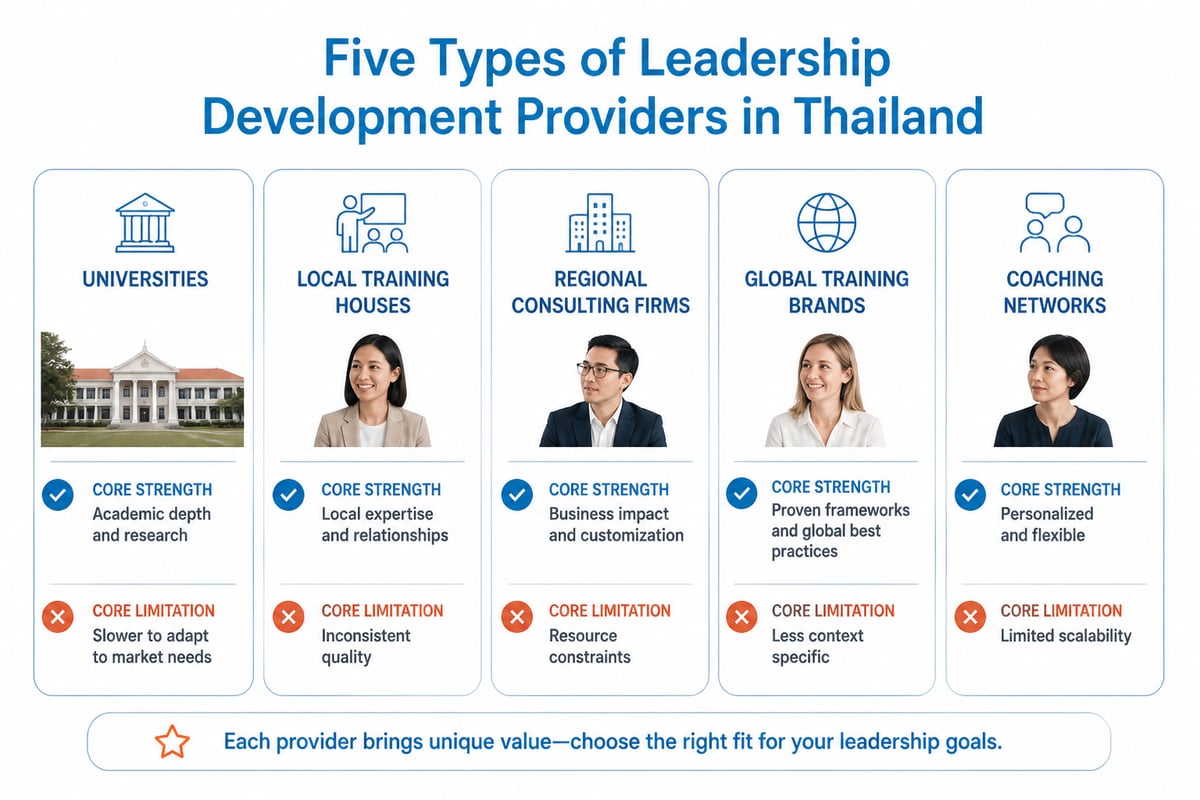
The Thai market splits into five provider types, each with a distinct strength and a distinct blind spot.
| Provider type | Typical strength | Typical limitation |
|---|---|---|
| Universities and business schools | Academic credibility, executive education brand, alumni networks | Cohort calendars, limited personalization |
| Local Thai training houses | Thai-language delivery, cultural fluency, lower cost per seat | Uneven quality, thin measurement |
| Regional consulting firms | Organizational diagnostics, change programs, senior facilitators | Higher fees, partner-heavy delivery |
| Global training brands | Standardized content across countries, licensed assessments | Content adapted late to local context |
| Coaching networks | One-to-one work tied to individual goals, flexible across locations | Quality depends on matching, not the brand name |
Public sector investment shows how much capability building is underway. The Department of Skill Development reported training and assessing skill standards for tens of thousands of workers through skill-development networks during 2023 to 2024, according to the Thailand Ministry of Labour. A separate 2025 government initiative targeted a large number of people across many provinces, per THAILAND.GO.TH.
Those programs build technical and digital skills at the workforce level. Leadership capability, the layer that determines whether those workers are well managed, is largely left to employers. That gap is where your provider decision matters.
Most directories of Bangkok training firms rank by headcount or revenue. Size tells you almost nothing about whether a provider can change how your plant manager runs a shift or how your regional director handles conflict.
What Should Leaders in Thailand Actually Be Developed For?
Leadership development in Thailand should target the specific gaps in your leadership pipeline, and the local data suggests those gaps are less about trust and more about candor and decision ownership.
The 2025 PwC Thailand Hopes and Fears Survey of Thai workers found trust in managers and top management is relatively high in Thailand compared with global levels. The same survey found Thai employees are more open with their direct managers than employees globally.
Read that carefully. Thai employees report relatively high trust and openness toward managers. A leader who sees those numbers might conclude the leadership pipeline is healthy. That conclusion is risky. Survey-reported openness measures how employees feel about their manager, not whether the manager is making hard calls, giving direct performance feedback or challenging upward. In hierarchical organizations, goodwill toward a manager can coexist with avoided conflict and slow decisions.
Three development priorities tend to follow from that pattern:
- Feedback with consequences. Managers who are well liked but avoid difficult performance conversations.
- Problem ownership. Leaders who execute tasks well but wait for direction instead of owning outcomes.
- Cross-border leadership. Thai leaders managing regional teams, or foreign leaders managing Thai teams, who need to adapt without losing directness.
Hypothetical example: a manufacturing group with a strong engagement score discovers through a 360 assessment that its plant leaders rarely escalate quality problems early. The engagement data looked healthy; the behavioral data showed the gap. Provider selection should start from that kind of diagnostic, not from a course catalog.
How Do You Choose Among Leadership Development Providers in Thailand?
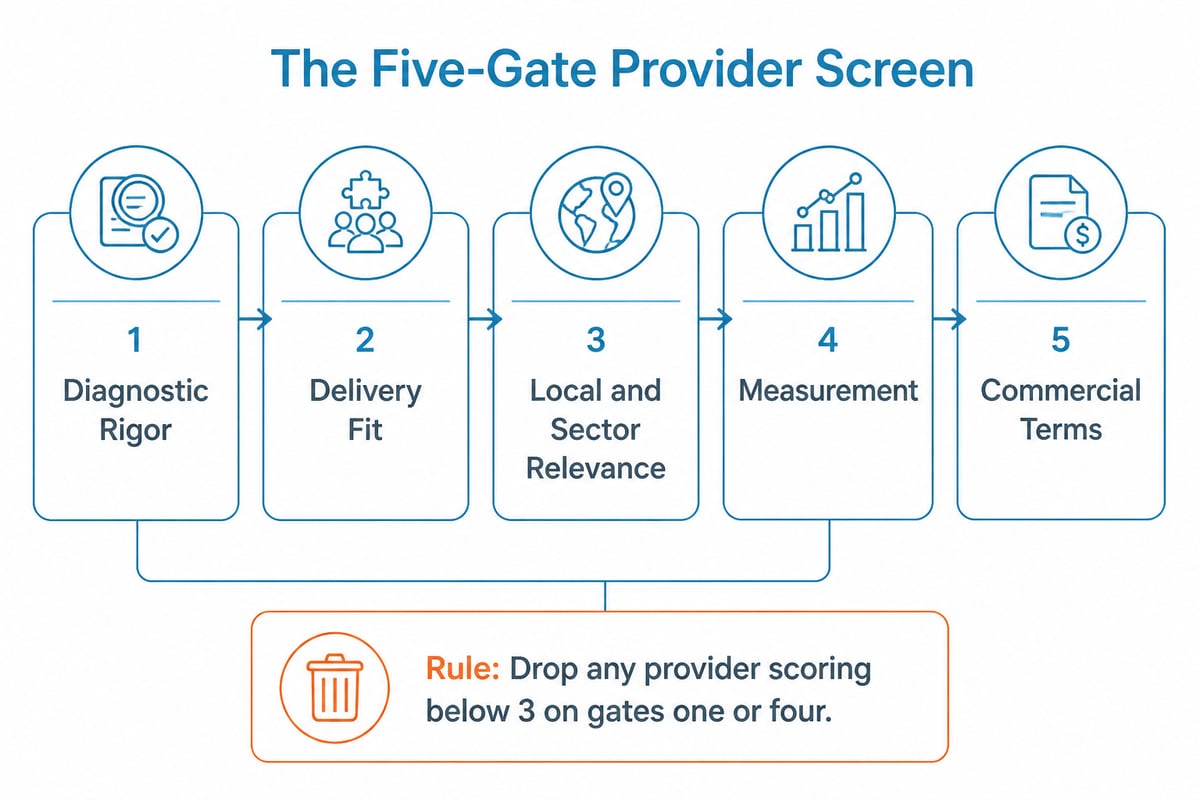
Choose by testing each provider against five criteria, in this order: diagnostic rigor, delivery fit, local and sector relevance, measurement, and commercial terms.
I use a simple scoring approach, the Five-Gate Provider Screen, because most selection processes over-weight the first meeting and under-weight the evidence. Score each gate from 1 to 5 and drop any provider that scores below 3 on gate one or gate four.
- Diagnostic rigor. Does the provider assess your leaders before proposing a program? Validated 360 or behavioral assessments should come first. A proposal that arrives before any diagnostic is a sales document, not a development plan.
- Delivery fit. Classroom cohorts suit foundational skills for first-time managers. One-to-one coaching suits senior leaders with specific behavioral targets. Blended models suit large populations. Match format to the problem.
- Local and sector relevance. Ask who will actually deliver, not who will pitch. Request biographies of the facilitators or coaches and look for experience in your industry and in Thai or regional business contexts.
- Measurement. Ask what gets reported, how often, and against which KPIs. Attendance and satisfaction scores are not outcomes.
- Commercial terms. Look for pilot options, clear exit points and payment tied to milestones rather than large upfront commitments.
Format matters more than brand
A well-known classroom brand delivered to a senior team with divergent problems produces a pleasant offsite and little change. A coaching engagement delivered to a hundred first-line supervisors without a shared framework produces inconsistency. Neither fails because the provider is poor. Both fail because the format did not match the population.
Where Do Coaching Networks Fit Alongside Classroom Training?
Coaching networks fit where leaders need individualized behavior change, especially at director level and above, and where a company operates across several countries and cannot standardize on one local trainer.
Classroom programs and coaching solve different problems. Training transfers knowledge and creates a shared vocabulary. Coaching applies that vocabulary to a specific leader's habits, in the context of that leader's real decisions. Employers who treat them as substitutes tend to overspend on one and underinvest in the other.
Noomii Leadership Coaching operates as a coaching network. Its coaches are hand-matched to each leader by function, level, industry and goals, and they are sourced, interviewed and matched to each leader's needs, with no payment until the coach selection and development plan are approved. Every participant receives a free 360 leadership survey, which gives the HR team baseline data before the first session. For employers with leaders in several countries, Noomii coordinates multi-coach delivery across global teams, including a documented engagement across five countries.
For employers who want a structured program rather than ad hoc coaching, Leadership Development Programs are designed with your HR, L&D or People team and aligned to business strategy, with pilot programs available. Noomii is not the right fit for individuals seeking personal life coaching or for small teams wanting fixed-price packaged coaching, so if either describes your situation, a local training house or a university short course is the more sensible route.
What Do Documented Results Look Like?
Credible results name the starting problem, the diagnosis, the intervention, the observed change and the lesson. Below are two Noomii engagements, described only as far as the facts available support.
Fortune 1000 international therapeutics company
- Problem: Leaders were operating at the task level.
- Diagnosis and solution: Coaching engagements focused on moving leaders from executing tasks to owning problems.
- Result: Leaders moved from task execution to problem ownership.
- Lesson: Problem ownership is a behavior, and it responds to targeted one-to-one coaching more reliably than to general management courses.
Fortune 500 global electronics manufacturer
- Problem: The company needed leadership development that demonstrably paid back.
- Solution: Coaching engagements tracked against defined leadership KPIs.
- Result: The company re-commissioned repeat coaching engagements because of documented impact.
- Lesson: Repeat purchase is a stronger proof point than a satisfaction score. Ask any provider how many clients come back and why.
Across Noomii engagements, leaders rated coaching effectiveness 8 to 9 out of 10 on goal alignment, support and accountability, rated coach professionalism 10 out of 10, and 100% showed observable behavior change after engagement. Treat figures like these as a prompt for your own due diligence. Ask any provider, Noomii included, what the sample was, who rated, and how behavior change was observed.
What Questions Should You Ask Every Provider Before Signing?
Ask questions that force a provider to show evidence rather than describe intentions. These eight separate serious vendors from polished ones:
- What assessment do you run before proposing a program, and who owns the data?
- Who specifically will deliver, and what is their experience in my industry?
- How do you handle leaders who are resistant or whose behavior is harmful to the team?
- What does your reporting look like at the 90-day mark, and which KPIs does it track?
- Which of your clients re-commissioned work, and what drove that decision?
- How do you align the work with our existing competency model and succession process?
- What happens if a coach or facilitator is a poor match?
- What are the exit terms if early results are weak?
The question about harmful behavior deserves extra weight. Toxic leadership is tolerated in many organizations far longer than it should be, and generic training rarely touches it. Noomii's fireside chat on why toxic leadership is tolerated is useful background if your 360 data points that direction.
How Do You Measure Whether Leadership Development Worked?
Measure leadership development by behavior change in the leader and by movement in business indicators the leader influences, reviewed on a fixed schedule, not by course completion.
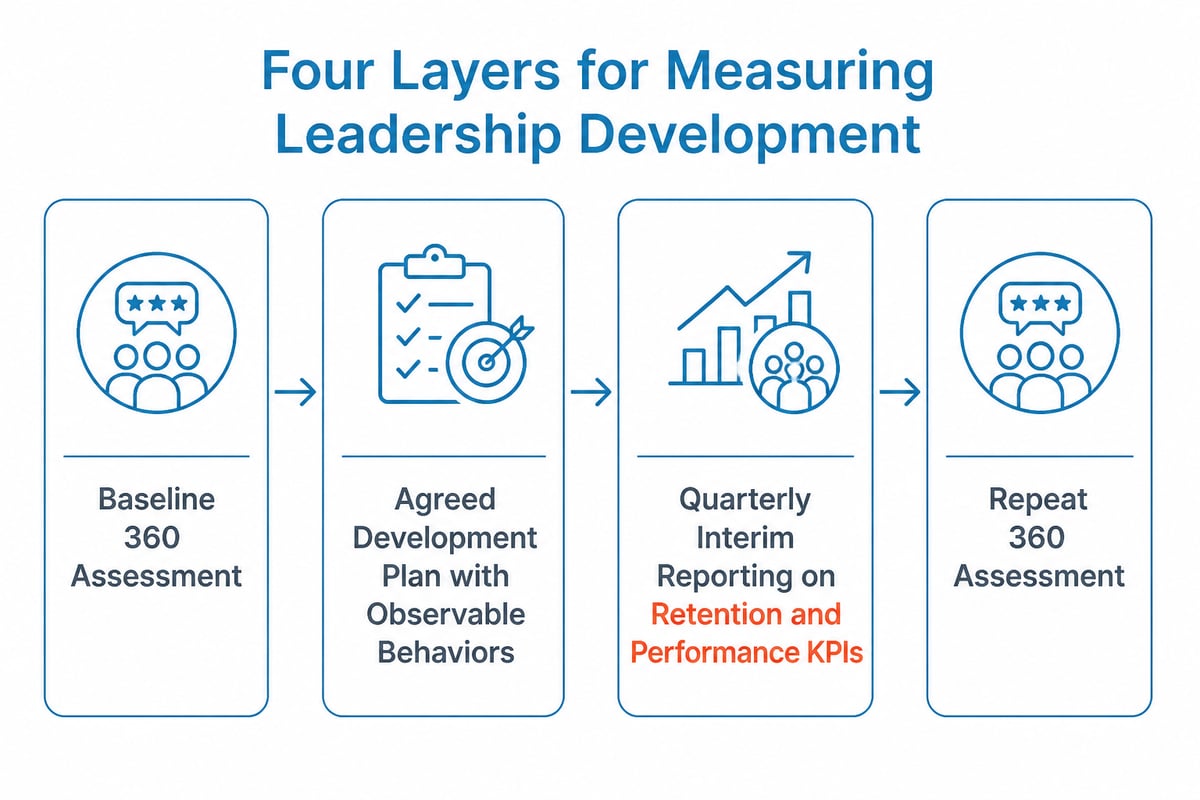
A workable measurement stack has four layers:
- Baseline. A 360 assessment before the engagement starts, so you have something to compare against.
- Goal alignment. A development plan agreed by the leader, their manager and HR, with two or three observable behaviors named.
- Interim evidence. Quarterly reporting tied to retention, performance and leadership KPIs. Noomii provides quarterly ROI reports tied to retention, performance and leadership KPIs.
- Repeat assessment. A follow-up 360 at the end, with the same raters where possible.
The common failure is measuring too late and too vaguely. If the only evidence you collect is an end-of-program survey, you cannot distinguish a good provider from a charming one. For a deeper look at why programs stall, see Noomii's piece on leadership development without behavior change.
One contrarian point: do not default to the most senior sponsor as your program owner. Programs sponsored only by the CEO tend to be protected from honest evaluation. Put the CHRO or head of L&D in charge of the measurement plan, with the CEO as visible sponsor.
Frequently Asked Questions
What are some good training programs for leadership?
Good programs share three features: a diagnostic upfront, a format matched to the leader's level, and measurement tied to behavior. Universities and business schools suit knowledge-building cohorts, while individually matched coaching, such as Noomii's leadership coaching services, suits leaders with specific behavioral goals.
How many providers should we shortlist?
Three to four is enough. Run each through the Five-Gate Provider Screen, then pilot with one or two before committing a full budget.
Should we choose a Thai provider or an international one?
Choose by evidence of fit, not origin. Thai providers bring language and cultural fluency; international providers bring cross-border consistency. Many employers combine both: local training for scale, and coaching for senior leaders operating across several countries.
When is one-to-one coaching better than group training?
Coaching is the stronger choice when the problem is behavioral and specific to a person, such as avoiding difficult feedback or failing to own outcomes. Group training is better for shared foundations such as a common management vocabulary for first-time managers.
How long before we should expect to see results?
Observable behavior change is usually assessed over a defined engagement period, with interim checks at about 90 days. Ask each provider for its reporting cadence, and agree on the KPIs before the work begins.
What should be in the business case for leadership development?
Name the leadership gap, the baseline evidence, the target behaviors, the KPIs affected, the pilot scope and the review dates. Boards respond to specific, testable claims far better than to general statements about culture.
Start this week by pulling your latest 360 or engagement data and writing down the two or three leadership behaviors that most need to change, because every provider conversation goes better with that list in hand. If you want an outside view on those gaps and a coach match you approve before paying, Book a Free Strategy Call with Noomii Leadership Coaching to talk through a program built with your HR team, such as the Leadership Development Programs offering.



Leave a Reply
Want to join the discussion?Feel free to contribute!