
Skills-Based Hiring vs Degrees: A Practical Guide for Employers
In skills-based hiring versus degrees in 2027, skills should win for most roles, but only when employers can actually measure them. Dropping a degree requirement without replacing it with a credible assessment process does not improve hiring. It moves the guesswork from the resume screen to the interview room, and leadership roles are where that guesswork costs the most.
The market has already moved. A ZipRecruiter survey of more than 1,500 talent acquisition professionals and hiring managers, conducted September 8–16, 2025, found that a significant share of recruitment-focused businesses had dropped degree requirements in the prior year. The question for HR, L&D and People leaders is no longer whether to join the shift. It is how to do it without weakening your leadership pipeline.
Why Employers Are Dropping Degree Requirements
Employers are dropping degree requirements because the talent pool is too thin to filter by credential and because a diploma has proven a weak predictor of on-the-job performance.
The pressure is real. In 2025, most employers surveyed said finding talent was more difficult than the year before, according to UNLEASH’s analysis of TestGorilla research. The same research found that many employers struggled to assess soft skills and many struggled to assess technical skills. Read that carefully. Employers are not abandoning degrees because they have a better measurement system. Many are abandoning degrees while still unsure how to evaluate the alternative.
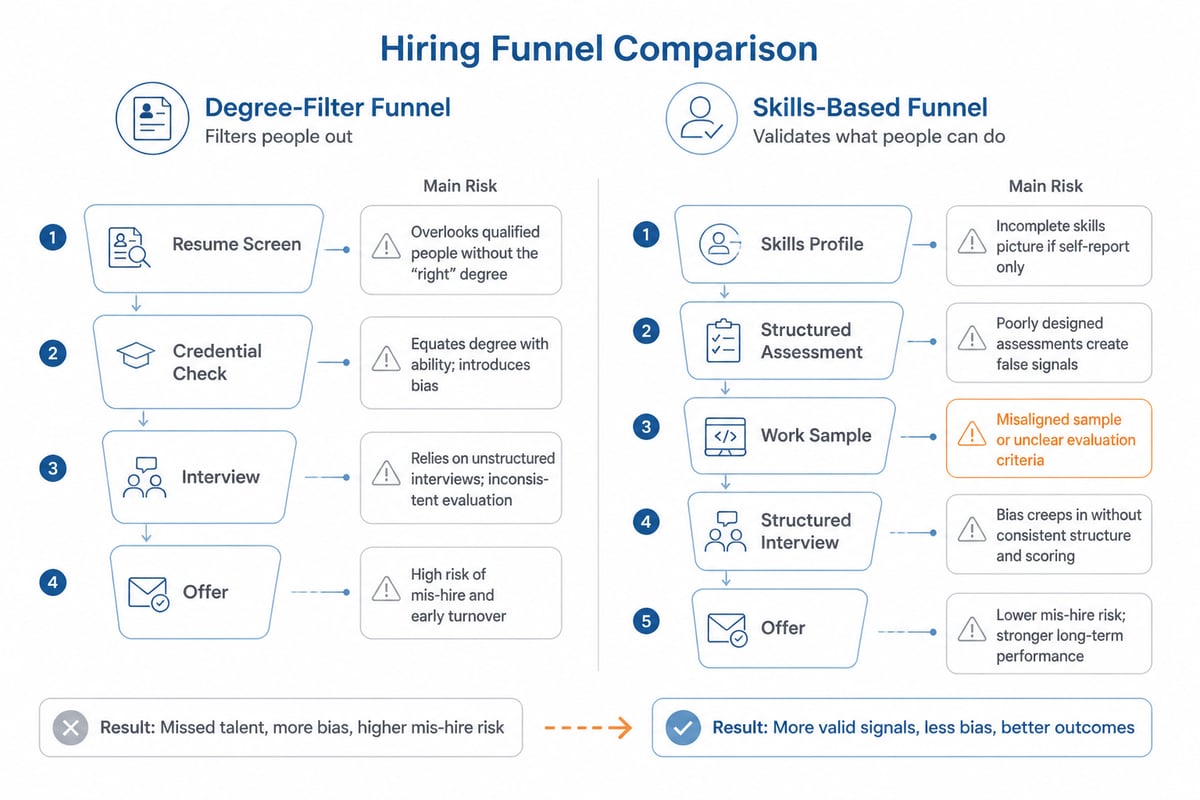
That gap is the central risk of the entire movement. A degree is a crude filter, but it is a cheap one. Removing it without installing something better produces three predictable outcomes:
- Application volume rises, and recruiters drown in unqualified resumes.
- Hiring managers fall back on gut feel, which favors candidates who resemble them.
- Pedigree bias returns through a different door, such as prior employer brand or interview polish.
SHRM’s summary of skills-based hiring research notes that employers report benefits such as increased application volume. More volume is only a benefit if your process can sort it.
What Degrees Still Do Well, and Where They Fail
A degree remains a reasonable proxy for sustained effort, baseline analytical ability and regulated knowledge, but it fails as a proxy for leadership capability.
Be precise about where credentials still carry weight. Licensed professions, clinical roles, engineering sign-off and certain finance functions have legal or safety reasons to require a degree. Pretending otherwise is not skills-based hiring. It is negligence.
Where degrees fail is judgment under pressure. Nobody was ever promoted into a director role because of how they performed in a statistics course. The traits that decide whether a manager succeeds are the ones transcripts do not capture: how they handle a conflict between two direct reports, whether they take ownership of an ambiguous problem, and how they behave when a decision goes badly. Our own view, and the contrarian one, is that the degree debate is a distraction at senior levels. Most organizations promoting internally are already past the degree question. The real failure point is promoting the best individual contributor into a management role with no evidence of people skills.
That distinction matters for leadership succession. A degree tells you almost nothing about who is ready for the next level. Observed behavior does.
Skills-Based Hiring Versus Degrees in 2027: What Changes
Skills-based hiring versus degrees in 2027 is a contest between two measurement systems, and the winner is whichever one produces better evidence about future performance at a cost you can sustain.
Three shifts define the year ahead:
- Assessments move earlier. The ZipRecruiter survey found that a substantial share of businesses were already using candidate assessments to evaluate skills earlier in the hiring process. Expect that share to climb as assessment tools get cheaper.
- AI changes the application itself. When candidates can generate polished resumes and cover letters in seconds, those documents lose signal. Work samples and live exercises gain it. For a deeper look at what machines cannot replicate, see the human skills AI cannot replace.
- Internal mobility becomes the main prize. The largest untapped talent source is your existing workforce, where skills can be observed directly rather than inferred from a credential.
Employers who need to run screening at scale are also pairing skills assessments with conversational tooling. Platforms such as TapTalk handle omnichannel candidate and customer messaging with AI chatbots, which can reduce the administrative load of high-volume applicant communication. Tools like that speed up logistics. They do not replace the judgment about who can lead.
A Framework for Hiring on Skills: The Evidence Ladder
The most reliable way to hire on skills is to rank your evidence by how directly it shows the skill, then require stronger evidence as the role gets more consequential.
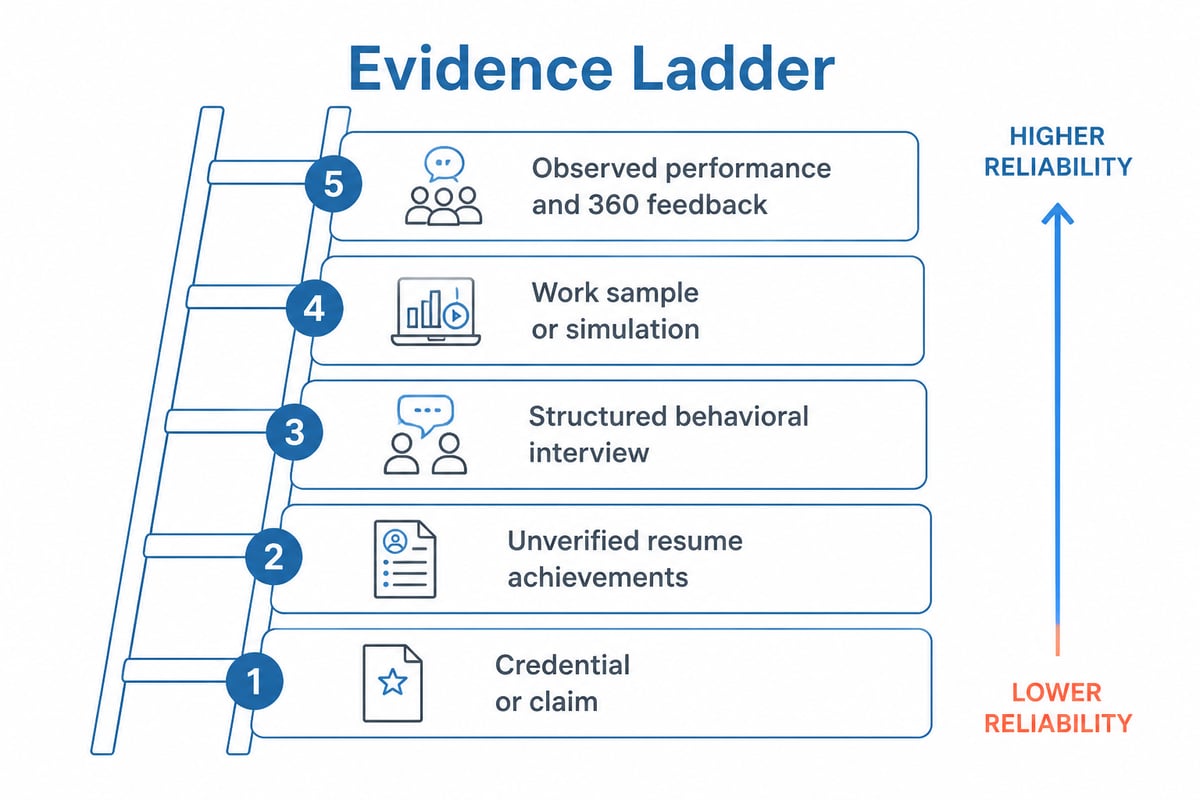
We use a simple five-rung scale, which we call the Evidence Ladder:
| Rung | Evidence type | Reliability for leadership roles |
|---|---|---|
| 1 | Credential or self-reported claim | Low |
| 2 | Resume achievements, unverified | Low to moderate |
| 3 | Structured interview with scored behavioral questions | Moderate |
| 4 | Work sample or simulation | High |
| 5 | Observed performance, including 360 feedback and trial assignments | Highest |
The rule is straightforward. For a frontline individual contributor role, rung 3 may be enough. For a people manager, you want rung 4 at minimum. For succession into senior leadership, insist on rung 5, because by then you have the data.
Most organizations sit at rungs 1 and 2 for leadership hiring and wonder why their new managers underperform. The fix is not a better degree filter. It is climbing the ladder.
Case Study: Rebuilding a Leadership Pipeline on Observed Behavior
The clearest lesson from leadership programs is that behavior can be observed and developed, which makes it a better hiring and promotion signal than a credential.
Problem. A large multinational manufacturer was promoting technically strong engineers into management on the basis of tenure and degrees. New managers stalled at task execution, handling problems themselves instead of owning outcomes across a team.
Diagnosis. A structured 360 assessment showed a consistent pattern. The gap was not technical knowledge. It was problem ownership, delegation and accountability conversations.
Solution. The organization moved from credential-based promotion criteria to a skills profile for each leadership level, then paired new managers with coaches matched by function, level and industry.
Result. In a comparable Noomii engagement with a Fortune 1000 international therapeutics company, leaders moved from task execution to problem ownership. Across Noomii engagements, leaders showed observable behavior change, and a Fortune 500 global electronics manufacturer re-commissioned coaching because of documented impact.
Lesson. Skills you cannot see on a resume can still be measured, developed and tracked. Treat leadership capability as something you build and verify, not something you infer from a diploma.
Five Mistakes That Undermine Skills-Based Hiring
Skills-based hiring fails in predictable ways, and nearly all of them come from treating it as a policy change instead of a process change.
- Removing the degree line from job postings and changing nothing else. If interviewers still score on polish and pedigree, you have changed the posting, not the hiring.
- Assessing technical skills but ignoring leadership behaviors. The UNLEASH data shows that many employers find soft skills hard to assess, so this is the most common blind spot.
- Skipping the job analysis. You cannot test for skills you have not defined. Write the skills profile before you write the posting.
- Applying one standard to every role. Regulated roles keep their requirements. Be explicit about which roles are exempt and why.
- Failing to measure the outcome. If you cannot compare retention, performance ratings and time-to-productivity between degree and non-degree hires, you are running on belief.
That last point deserves emphasis. Track hiring cohorts for at least 18 months. Compare them on manager-rated performance and retention. Without that comparison, a skills-based program is a talking point rather than a strategy. For help with the analytics side, specialist partners such as Stellium Consulting work with enterprises on AI-powered business process improvement, which can include building the reporting layer.
Building Skills-Based Succession for Leaders
The strongest use of skills-based thinking is internal: define the capabilities each leadership level requires, assess your people against them, and develop the gaps deliberately.
Start with the transitions that break most often. The jump from individual contributor to first-time manager is the most fragile, which is why programs aimed at new managers deserve early investment. The jump from manager to executive is the second, and it increasingly calls for executive team coaching versus individual coaching decisions, because senior performance is often a team property rather than a personal one.
A workable internal model looks like this:
- Define three to five observable behaviors per leadership level.
- Baseline each candidate with a 360 survey and a structured manager review.
- Develop the gaps with targeted coaching, stretch assignments and feedback.
- Re-measure at six and twelve months.
- Promote on the trend, not on a single review cycle.
Coaching fits into step three, and the quality of the match matters. Noomii hand-matches coaches by function, level, industry and goals, offers a free 360 leadership survey for every participant, and issues quarterly ROI reports tied to retention, performance and leadership KPIs. Payment does not begin until the coach selection and development plan are approved. If your reporting depends on tying development spend to outcomes, review the coaching budget benchmarks for 2027 before you set targets.
Compliance, Fairness and the Risk of Getting It Wrong
A skills-based process reduces legal and reputational exposure only if it is documented, consistent and validated against the actual job.
Structured criteria applied to every candidate are easier to defend than discretionary judgment. Dropping a degree requirement can widen your candidate pool, but an unvalidated assessment can create its own adverse impact. Three safeguards matter:
- Job-relatedness. Every assessed skill should trace to a documented job requirement.
- Consistency. Use the same scoring rubric, the same questions and the same weighting for every candidate in the pool.
- Audit trail. Keep scoring records so you can show why a decision was made.
Leadership programs face the same standard. Development initiatives should align with organizational, regulatory and ethical requirements, which is why governance belongs in the design phase rather than as a final review.
Frequently Asked Questions
Is skills-based hiring better than requiring a degree?
For most non-regulated roles, yes, provided you have a reliable way to assess skills. The advantage comes from the assessment quality, not from removing the degree. Without credible assessments, the result is often worse than a degree filter.
Which roles should still require a degree?
Roles governed by licensure, safety rules or regulation, such as clinical, legal and certain engineering and finance positions, should keep their requirements. Leadership roles generally should not require a degree as a condition, but they should require demonstrated leadership behaviors.
How do you assess leadership skills without a degree?
Use the Evidence Ladder. Combine structured behavioral interviews, work samples or simulations, and 360 feedback. For internal candidates, observed performance over time is the strongest evidence available.
How long does it take to see results from skills-based hiring?
Plan on at least 18 months of cohort tracking to compare retention and performance between hiring methods. Faster signals, such as time-to-productivity, appear earlier but are less conclusive.
Does skills-based hiring reduce hiring costs?
It can expand the pool and speed up sourcing, but assessments and training carry their own costs. Measure total cost per successful hire, including 12-month retention, rather than cost per posting.

Before your next leadership requisition opens, write a one-page skills profile for the role and decide which rung of the Evidence Ladder you will require before an offer or promotion. If you want help turning that profile into a measured development plan, with a free 360 survey, hand-matched coaches and quarterly ROI reporting, you can book a free strategy call with Noomii Leadership Coaching to map your leadership pipeline against the skills your roles actually demand.


Leave a Reply
Want to join the discussion?Feel free to contribute!