

Virtual Team Management Best Practices for 2027
Virtual team management in 2027 requires more than new tools or policies. It demands fundamental changes in how leaders diagnose dysfunction, build accountability, and measure results across distributed workforces. Most organizations still apply pre-2020 leadership models to post-pandemic realities, wondering why engagement flatlines and performance gaps widen. The answer is simple: generic remote-work advice does not solve the specific leadership failures that destroy virtual team effectiveness. After working with Fortune 500 companies and government agencies navigating complex distributed leadership challenges, clear patterns emerge around what works and what fails spectacularly.
The Diagnostic Gap Most Leaders Miss
Organizations invest heavily in collaboration platforms while ignoring the leadership behaviors that determine whether those platforms create value or chaos. This is the critical mistake.
A 2026 analysis of hybrid work challenges found that technology adoption rates mean nothing without corresponding leadership capability development. Teams with identical tools show wildly different performance based solely on manager competence in virtual contexts. The gap is not in Slack versus Teams. The gap is in whether leaders can diagnose team dysfunction remotely, address it directly, and build accountability without physical presence.
What Effective Diagnosis Looks Like
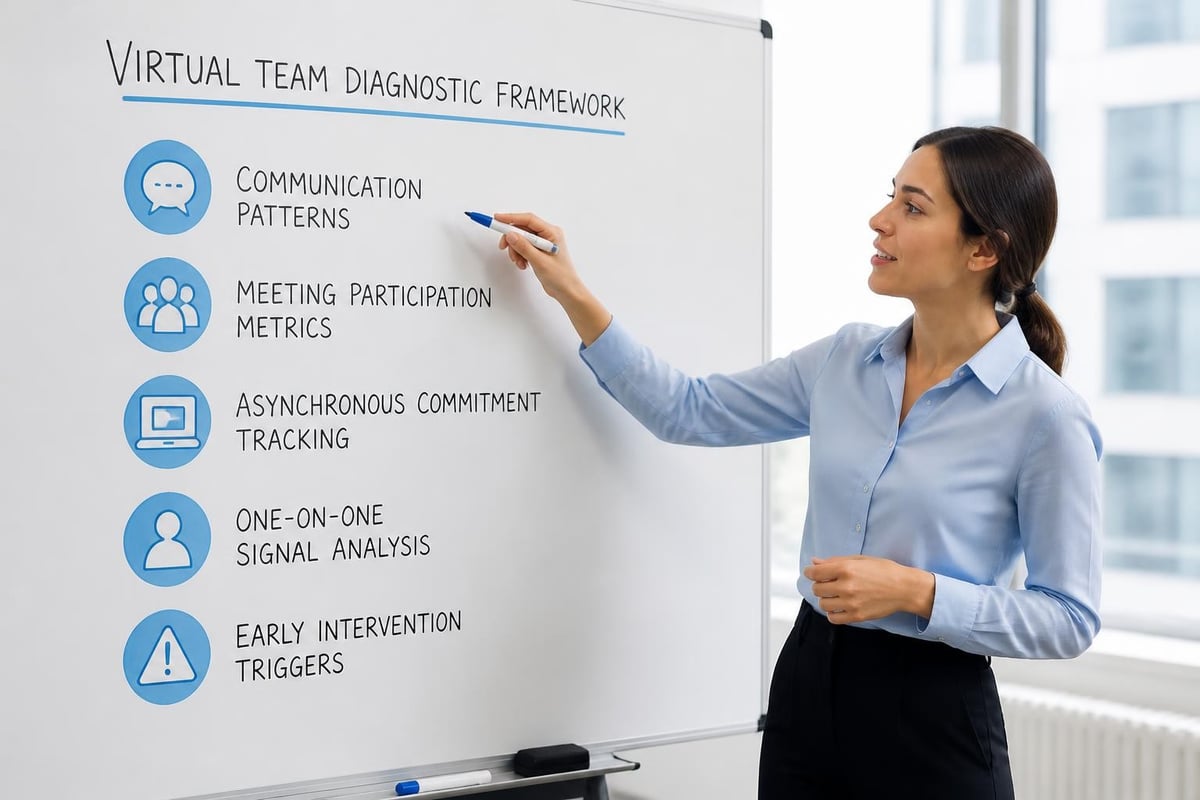
Behavioral pattern recognition beats engagement surveys. Leaders who excel at virtual team management best practices for 2027 track specific indicators:
- Response time patterns across communication channels
- Quality of written communication and decision documentation
- Participation distribution in virtual meetings
- Completion rates on asynchronous work commitments
- Frequency and nature of one-on-one requests
These signals reveal disengagement, confusion, conflict, or capability gaps weeks before traditional metrics catch them. One executive we coached discovered a high-performer was burnt out not through survey scores but by analyzing increasingly terse messages and declining video-on rates during team calls. Early intervention prevented departure.
The Center for Creative Leadership research on virtual teams confirms this approach. Leaders who combine qualitative observation with quantitative tracking outperform those relying on either alone.
The Precision Matching Imperative
Generic leadership development programs fail virtual teams because distributed work amplifies individual leader weaknesses. A micromanager in an office is annoying. A micromanager leading a remote team destroys autonomy, slows decisions, and drives resignations.
This reality demands precision in leadership intervention. Organizations need diagnostic clarity about which leader needs what type of development, then matching them with coaches or mentors who have solved that exact problem in similar contexts.
The Matching Framework That Works
| Leader Challenge | Required Coach Experience | Intervention Focus | Success Metric |
|---|---|---|---|
| Excessive async check-ins | Scaled distributed teams | Trust-building systems | Manager touchpoint reduction |
| Poor written clarity | Cross-cultural communication | Documentation standards | Decision turnaround time |
| Meeting overload | High-performance virtual cultures | Async-first workflows | Calendar density decrease |
| Visibility anxiety | Remote-first organizations | Outcome-based evaluation | Performance confidence scores |
The Noomii Corporate Leadership Program uses this precision matching approach because mismatched coaching wastes time and money. A coach who built virtual teams at a tech startup cannot necessarily help a government agency director navigate compliance requirements while leading distributed staff.
Specificity matters. Our work with organizations like the Department of Energy required coaches who understood both virtual team dynamics and public sector governance constraints.
Building Accountability Without Surveillance
The worst virtual team management practices in 2027 involve surveillance tools that measure activity instead of output. Keystroke monitoring, random screenshot capture, and productivity tracking software signal distrust and infantilize professionals.
Yet the opposite extreme also fails. Pure autonomy without structure creates confusion about priorities, duplicated work, and missed dependencies. The answer is accountability architecture.
The Five-Component Accountability System
Transparent goal cascading ensures every team member connects their work to organizational priorities. This is not OKR theater. It is specific outcome ownership with clear success criteria.
Defined decision rights eliminate the ambiguity that plagues virtual teams. Who makes what decisions? Who needs to be consulted? Who simply gets informed? When these questions lack answers, distributed work grinds to a halt.
Commitment-based calendaring means leaders and teams make explicit promises about deliverable timing, then track completion rates as a team health metric. One global team we advised reduced missed deadlines by 60% in four months using this approach.
Public work documentation creates visibility without meetings. Written updates, decision logs, and project status documentation let teams coordinate asynchronously while building institutional knowledge.
Results retrospectives examine outcomes, not activity. Weekly or biweekly reviews focus on what got done, what blockers emerged, and what the team learned. This builds accountability culture without surveillance.
Research on managing engagement in remote teams supports these practices. Gallup found that clarity of expectations and regular meaningful feedback drive remote worker engagement far more than office presence or monitoring.

The Communication Architecture Decision
Most virtual team management failures stem from poorly designed communication systems. Leaders allow communication chaos, where urgent items hide in email, decisions scatter across Slack threads, and team members waste hours hunting for information.
Effective virtual team management best practices for 2027 require explicit communication architecture:
- Synchronous channels for real-time discussion (video calls, instant messaging)
- Asynchronous channels for considered input (email, documents, project management tools)
- Archive channels for searchable institutional knowledge (wikis, shared drives with clear naming conventions)
- Notification protocols that specify response time expectations by channel and message type
- Escalation paths for when normal channels fail
One Fortune 500 client we worked with reduced meeting time by 35% and improved cross-functional project delivery by implementing clear channel purpose definitions. Previously, every discussion defaulted to meetings because no one trusted async channels for important work.
The Meeting Minimization Framework
Virtual meetings are expensive and exhausting. Leaders who understand virtual team management best practices for 2027 follow these principles:
- Default to async for information sharing, status updates, and one-way communication
- Use synchronous time only for discussion requiring real-time input, relationship building, or conflict resolution
- Keep standing meetings under 30 minutes with clear agendas sent 24 hours ahead
- Record all meetings and provide written summaries within two hours for distributed timezone accommodation
- Measure meeting load as a team health metric, targeting reduction over time
The MIT guidance on remote performance management emphasizes that performance conversations in distributed environments require more structure and documentation than office-based equivalents. This applies equally to team meetings.
Manager Development as Infrastructure Investment
Virtual team effectiveness is manager effectiveness. Period. Organizations that treat remote leadership as an individual capability issue rather than an organizational development priority fail predictably.
The Manager Capability Stack
Level One: Technical Proficiency
Competence with collaboration platforms, async communication, and virtual meeting facilitation. This is table stakes, not differentiation.
Level Two: Diagnostic Capability
Ability to spot disengagement, conflict, capability gaps, and burnout through remote signals. Most managers lack this skill. They notice problems only after they become crises.
Level Three: Intervention Precision
Matching the right developmental intervention to the specific problem. Knowing when to coach, when to clarify expectations, when to restructure work, and when to exit someone who cannot succeed remotely.
Level Four: Culture Building
Creating team norms, psychological safety, and belonging across distance. This separates adequate virtual team managers from exceptional ones.
The SHRM guidance on coaching first-time managers for remote success acknowledges this capability stack. Organizations that invest in structured manager development for distributed leadership see measurable returns in retention and team performance.
Our work with leadership coaching programs consistently shows that manager competence in virtual contexts predicts team outcomes more than any other variable. Invest here or accept mediocre results.

Performance Evaluation in Distributed Contexts
Annual performance reviews were already broken. Virtual work exposes every flaw in traditional evaluation systems. Leaders who rely on office presence observations, hallway conversations, and visibility bias cannot fairly assess distributed team members.
Virtual team management best practices for 2027 demand evaluation system redesign:
Output-Based Assessment Criteria
| Traditional Metric | Virtual Alternative | Why It Matters |
|---|---|---|
| Hours worked | Outcomes delivered | Remote workers operate across timezones; hours are meaningless |
| Office presence | Communication quality | Async environments reward clear writing and documentation |
| Manager visibility | Stakeholder feedback | Direct observation decreases; 360 input increases in importance |
| Activity levels | Impact measurement | Busy does not equal productive in virtual settings |
| Team meeting participation | Contribution across channels | Value creation happens beyond synchronous meetings |
One global organization we advised implemented quarterly impact reviews where team members document their contributions against team goals with supporting evidence. Managers then validate and calibrate ratings across teams. This approach eliminated the visibility bias that previously rewarded those in headquarters timezones.
The key is defining success criteria before evaluation periods, making them transparent, and collecting evidence throughout the period rather than relying on recency bias and manager memory.
The Inclusion and Belonging Challenge
Virtual work can democratize access or amplify existing inequities. The difference is leadership intentionality.
Teams with distributed members often develop proximity bias, where those near headquarters get better assignments, more face time with executives, and faster promotions. This destroys distributed team morale and drives high-performer exits.
Addressing this requires structural intervention:
Rotate meeting times to share timezone inconvenience across the team rather than always disadvantaging remote members in other regions.
Equalize information access by documenting all important discussions and decisions in writing, not just summarizing them for those who could not attend synchronous meetings.
Distribute high-visibility work based on capability and development goals, not office location or manager proximity.
Create dedicated relationship-building time that is explicitly not about work deliverables. Virtual teams need space for the informal connection that happens naturally in offices.
Monitor promotion and opportunity data by location to surface and correct proximity bias before it becomes systematic inequity.
Harvard Business School's perspective on bridging distance in hybrid teams provides practical leader behaviors that reduce proximity bias and build inclusion. The research is clear: these issues do not resolve organically. They require deliberate leadership action.
Building psychological safety in distributed teams is harder than in physical spaces but more important. Team members who fear speaking up in virtual meetings or challenging ideas in written channels withhold the input that prevents mistakes and drives innovation.
The Contrarian View on Hybrid Models
Much of the discourse about virtual team management best practices for 2027 assumes hybrid is inevitable and optimal. This deserves challenge.
For many organizations, hybrid is the worst of both worlds. It creates two classes of employees, forces infrastructure investment in both virtual and physical environments, and generates constant scheduling friction about who needs to be where when.
The data on hybrid work challenges shows persistent execution problems. Organizations implement hybrid policies without addressing the leadership capability gaps, communication architecture decisions, or inclusion challenges that determine hybrid success.
When to Choose Fully Remote
Organizations should seriously consider fully remote when:
- Work is primarily cognitive and asynchronous
- Talent requirements exceed local market availability
- Real estate costs significantly impact profitability
- Employee retention depends on location flexibility
- Leadership team has virtual management competence
When to Choose Fully Office-Based
Office mandates make sense when:
- Work requires hands-on collaboration with physical materials
- Organizational culture depends on spontaneous interaction
- Leadership lacks capability to manage virtually
- Compliance or security requires physical presence
The critical error is choosing hybrid by default without honestly assessing whether the organization can execute it well. Hybrid done poorly is worse than either extreme done competently.
Measuring What Matters in Virtual Teams
Most organizations measure the wrong things in distributed work environments. They track activity, attendance, and satisfaction while ignoring the outcomes that determine business results.
Better metrics for virtual team effectiveness:
- Decision velocity: Time from problem identification to implemented solution
- Cross-functional coordination: Project completion rates and timeline accuracy when multiple teams collaborate
- Knowledge retention: Percentage of critical processes and decisions documented in searchable formats
- Development velocity: Skills acquisition and capability growth rates among team members
- Innovation rate: New ideas proposed, tested, and implemented per quarter
- Voluntary retention: Percentage of high performers who choose to stay beyond two years
These metrics reveal whether virtual team management actually works. Engagement survey scores matter less than whether teams execute effectively, develop talent, and retain the people who drive results.
Organizations serious about virtual team management best practices for 2027 implement quarterly metric reviews that examine trends, diagnose problems, and adjust leadership practices based on data.
Frequently Asked Questions
What is the biggest mistake leaders make managing virtual teams in 2027?
Treating virtual team management as a technology problem rather than a leadership capability problem. Leaders invest in new tools while ignoring the diagnostic skills, communication architecture, and accountability systems that determine distributed team effectiveness. Technology enables remote work; leadership capability determines whether it succeeds.
How can managers build accountability without micromanaging remote teams?
Implement accountability architecture: transparent goal cascading, defined decision rights, commitment-based calendaring, public work documentation, and results retrospectives. This creates structure and visibility without surveillance. Focus on outcomes delivered rather than activity performed.
What performance metrics work best for distributed teams?
Output-based metrics that measure impact rather than activity: decision velocity, cross-functional coordination success, knowledge documentation rates, development velocity, innovation rates, and voluntary retention of high performers. Avoid measuring hours worked, office presence, or manager visibility.
How do you prevent proximity bias in hybrid team environments?
Rotate meeting times across timezones, equalize information access through written documentation, distribute high-visibility work based on capability not location, create dedicated relationship-building time, and actively monitor promotion and opportunity data by location to surface and correct bias.
What communication architecture should virtual teams implement?
Define five distinct channels: synchronous for real-time discussion, asynchronous for considered input, archive for searchable knowledge, notification protocols specifying response expectations, and escalation paths for when normal channels fail. Default to async and use synchronous time only for discussion requiring real-time input or relationship building.
How should organizations develop managers for virtual team leadership?
Build the four-level capability stack: technical proficiency with tools, diagnostic capability to spot dysfunction through remote signals, intervention precision to match solutions to problems, and culture-building skills to create psychological safety and belonging across distance. This requires structured development programs, not ad hoc training.
Virtual team management best practices for 2027 demand diagnostic precision, accountability architecture, and leadership capability development that most organizations have not yet built. Generic advice fails because distributed work amplifies individual leader weaknesses and exposes organizational system gaps. The Noomii Corporate Leadership Program helps organizations solve these complex challenges through evidence-based diagnostics, precision coach matching, and targeted interventions that build measurable virtual team leadership capability aligned with your strategic priorities.


Leave a Reply
Want to join the discussion?Feel free to contribute!