
Executive Coaching Without Measurable Outcomes
Most organizations are pouring resources into executive coaching without knowing what they're getting. Boards approve budgets. HR leaders hire coaches. Executives spend hours in sessions. Yet when asked to quantify the impact, most organizations point to satisfaction surveys and vague testimonials. This is executive coaching without measurable outcomes, and it's costing companies millions while creating a false sense of progress. The uncomfortable truth is that most coaching engagements lack the diagnostic rigor, clear success criteria, and accountability mechanisms that distinguish legitimate leadership development from expensive conversation therapy.
The Real Cost of Unmeasured Coaching Interventions
Executive coaching without measurable outcomes creates liabilities that extend far beyond wasted budget dollars. When a $50,000 coaching engagement produces no documented behavior change, the organization loses the opportunity cost of alternative interventions that might have worked. More critically, unmeasured coaching allows underperforming executives to continue damaging team morale, customer relationships, and strategic initiatives while appearing to address the problem.
One Fortune 500 CHRO shared findings from an internal audit of their coaching spend across 2024-2025. The company invested $2.3 million in executive coaching for 47 senior leaders. When asked to demonstrate measurable improvement, only four engagements could point to specific, documented changes in leadership behavior tied to business outcomes. The remainder offered satisfaction scores and coach testimonials. The audit revealed that organizations often struggle to define impactful leadership development goals from the outset, making downstream measurement nearly impossible.
What Gets Hidden Behind Satisfaction Metrics
Coaching satisfaction scores tell you whether executives enjoyed their sessions. They don't tell you whether the executive stopped micromanaging, improved decision quality under pressure, or built stronger relationships with direct reports. This distinction matters because satisfaction-based evaluation allows coaching to become a comfort mechanism rather than a performance intervention.
Common warning signs that coaching lacks measurable outcomes:
- No pre-engagement behavioral assessment or 360-degree feedback
- Goals stated in abstract terms like "improve leadership presence" or "enhance strategic thinking"
- No defined success criteria agreed upon by the executive, coach, and organization
- Progress measured exclusively through self-reported satisfaction or coach observations
- No mechanism to capture feedback from direct reports, peers, or stakeholders
- Coaching continues indefinitely without clear milestones or completion criteria
The pattern repeats across industries. A government agency invested in coaching for 12 mid-level managers experiencing team performance issues. Six months in, HR asked for evidence of improvement. The coaching firm provided completion certificates and average satisfaction ratings of 4.2 out of 5. When HR examined actual team performance data, eight of the 12 teams showed declining engagement scores and increasing turnover during the coaching period.

Why Traditional Coaching Evaluation Fails
The measurement challenges in coaching research and practice are well-documented in academic literature, but these challenges don't justify abandoning measurement entirely. Instead, they highlight the gap between what most organizations accept as "good enough" and what rigorous evaluation actually requires. The problem isn't that coaching outcomes can't be measured. The problem is that proper measurement requires diagnostic work upfront, clear behavioral targets, and accountability mechanisms that many coaches and organizations avoid.
The Diagnostic Gap
Executive coaching without measurable outcomes typically begins with a fundamental error: skipping the diagnostic phase entirely. An executive or their manager identifies a perceived need. A coach gets hired. Sessions begin. This approach assumes the presenting problem is the actual problem and that coaching is the appropriate intervention.
Effective diagnosis requires:
- Validated behavioral assessments that establish baseline strengths and gaps
- 360-degree feedback from direct reports, peers, and stakeholders
- Performance data review examining team metrics, project outcomes, and operational results
- Cultural context analysis understanding organizational dynamics affecting the leader's effectiveness
- Root cause analysis distinguishing skill gaps from structural, political, or resource constraints
When a technology company approached their leadership development provider about coaching for a VP struggling with "communication issues," proper diagnosis revealed the actual problem: the VP inherited a team with three competing strategic priorities, no decision rights clarity, and a reporting structure that created daily conflicts with two peer VPs. Coaching alone couldn't fix that. The company needed organizational redesign, decision authority clarification, and strategy alignment before coaching would produce value.
Building Measurement Into Coaching Design
Organizations that successfully measure coaching outcomes don't retrofit evaluation at the end. They design measurement into the engagement from the contracting phase. This requires specificity that makes some coaches uncomfortable because it creates accountability for behavior change, not just engagement quality.
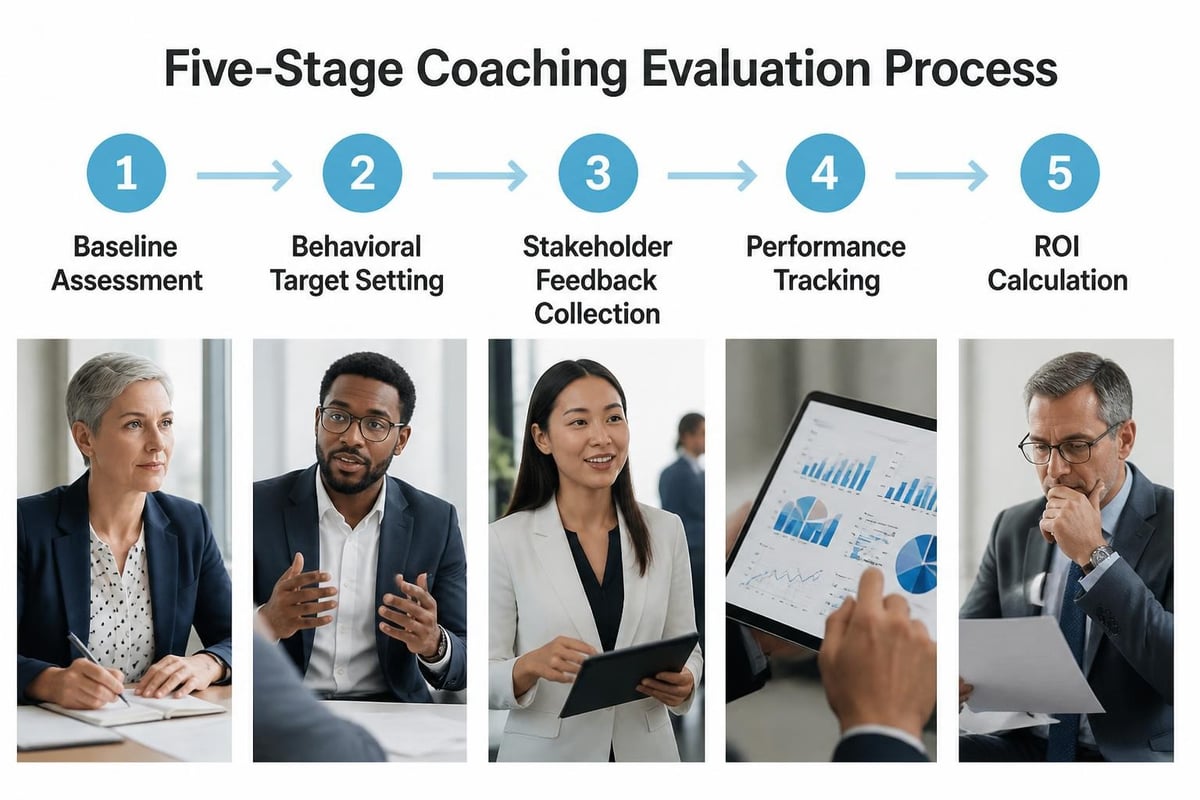
The framework that consistently produces measurable results includes five components:
| Component | What It Measures | How It's Captured |
|---|---|---|
| Baseline Assessment | Current state behavioral patterns, decision quality, relationship effectiveness | 360 feedback, leadership assessments, team engagement data |
| Behavioral Targets | Specific, observable changes in how the leader operates | Clear descriptions of "from X to Y" behavior shifts |
| Stakeholder Feedback | Whether people working with the leader observe actual change | Structured check-ins with direct reports, peers, board members |
| Performance Indicators | Business or operational metrics tied to leadership effectiveness | Team retention, project delivery, engagement scores, decision velocity |
| ROI Calculation | Financial impact of improved leadership performance | Quantified value of retention, faster decisions, reduced conflict costs |
A manufacturing company implemented this framework for their plant leadership coaching program in early 2025. They established clear baseline metrics: average time to resolve safety incidents (7.2 days), supervisor turnover (34% annually), and production variance from plan (18%). Coaching focused on specific behavioral changes: supervisors making safety decisions within 24 hours, conducting weekly one-on-ones using a structured format, and implementing visual management systems for production tracking.
Results after six months:
- Safety incident resolution time dropped to 2.1 days (71% improvement)
- Supervisor turnover decreased to 12% annualized (65% improvement)
- Production variance reduced to 8% (56% improvement)
- Calculated ROI: $2.8M in retained productivity and reduced turnover costs against $340K coaching investment
The difference wasn't coaching quality. The difference was measurement design that created clarity about what needed to change and whether change actually occurred.
The Coach Selection Problem
Executive coaching without measurable outcomes often starts with poor coach selection. Many organizations choose coaches based on credentials, rapport, or availability rather than demonstrated expertise in producing documented behavior change for specific leadership challenges. This selection approach prioritizes inputs over outcomes.
Research on systemic coaching effectiveness demonstrates that coach expertise matters significantly, but expertise must match the specific leadership challenge. A coach with deep experience in conflict resolution may produce excellent results for an executive struggling with peer relationships but deliver minimal value for an executive who needs to improve strategic decision-making under uncertainty.
Matching Methodology Matters
Organizations serious about measurable outcomes implement structured matching processes that consider:
- Leadership challenge specificity: What precise behavior needs to change and under what conditions?
- Industry and context expertise: Has the coach worked with similar challenges in comparable organizational environments?
- Evidence of past results: Can the coach demonstrate documented behavior change and business impact from previous engagements?
- Measurement capability: Does the coach have frameworks and tools to establish baselines and track progress?
- Accountability orientation: Is the coach comfortable being evaluated on client behavior change, not just engagement satisfaction?
The Noomii Corporate Leadership Program addresses this through precision matching algorithms that pair executives with coaches based on validated assessments, specific behavioral targets, and demonstrated coach expertise in producing measurable outcomes for similar challenges. This contrasts sharply with typical selection processes that rely on coach bios and introductory calls.
What Boards and CHROs Are Missing
The tolerance for executive coaching without measurable outcomes reveals a broader governance failure. Boards routinely demand ROI analysis for technology investments, real estate decisions, and M&A activity. Yet many approve six-figure coaching budgets with minimal scrutiny beyond coach credentials and program descriptions. This double standard exists because leadership development often gets categorized as "soft" investment, exempt from the analytical rigor applied to "hard" business decisions.
CHROs face a different problem. Many inherit legacy coaching relationships and vendor contracts that predate their tenure. When these engagements lack measurement infrastructure, unwinding them creates political risk. The executive receiving unmeasured coaching may be satisfied. Their manager may view the coaching relationship positively. Introducing measurement requirements mid-stream can feel like questioning whether the coaching has value, which threatens relationships the CHRO needs to preserve.
The Consequences of Getting It Wrong
Accepting executive coaching without measurable outcomes creates three specific risks that CHROs and boards underestimate:
Opportunity cost: Every dollar and hour spent on unmeasured coaching represents resources unavailable for interventions that might actually work. When a struggling executive spends 18 months in unmeasured coaching while team performance deteriorates, the organization loses the opportunity to try different approaches, redeploy the executive to a better-fit role, or make difficult personnel decisions.
False confidence: Unmeasured coaching creates the appearance of addressing leadership problems without requiring proof that problems are actually being solved. This allows executives, their managers, and HR to feel good about "investing in development" while avoiding accountability for whether development is occurring. According to SHRM analysis on executive coaching value, this dynamic contributes to organizational uncertainty about whether coaching spending produces value.
Cultural precedent: When organizations accept unmeasured coaching for executives, they signal that senior leaders operate under different accountability standards than other employees. This creates resentment and undermines broader performance management credibility. Why should individual contributors face rigorous performance metrics when executives can invest months in unmeasured development with no documented improvement requirements?
Fixing the Measurement Problem
Organizations that successfully transition from unmeasured to measured coaching outcomes don't wait for perfect conditions. They implement changes in contracting, coach selection, and evaluation that immediately increase accountability.
Contracting for Outcomes
The coaching contract determines whether measurement is possible. Vague scope definitions like "executive presence development" or "leadership effectiveness enhancement" guarantee measurement failure because they don't specify what behavior should change or how change will be assessed.
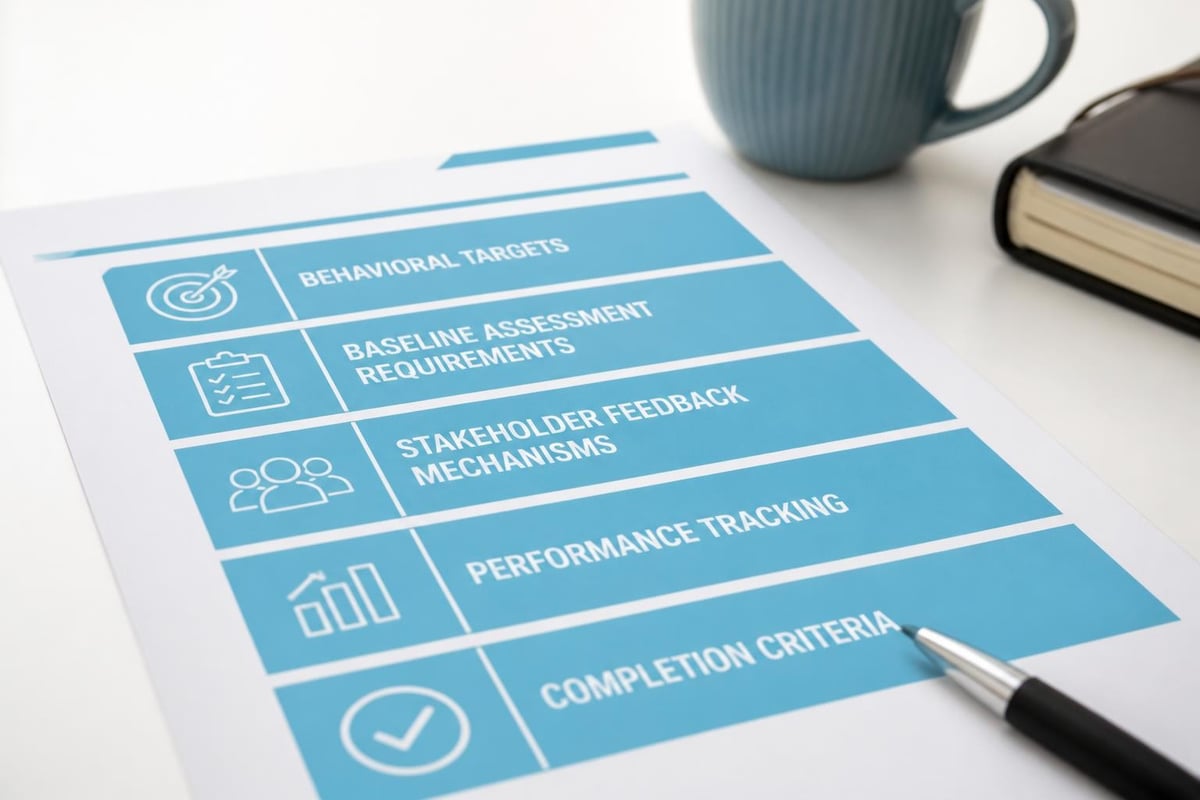
Outcome-focused contracting includes:
- Specific behavioral targets with observable success criteria (example: "Executive will demonstrate improved decision-making under time pressure, measured by stakeholder feedback on decision clarity, timeliness, and follow-through over the next 90 days")
- Baseline assessment requirements completed before coaching begins
- Defined stakeholder feedback mechanisms at 60-day, 90-day, and completion milestones
- Performance data that will be tracked throughout the engagement
- Clear completion criteria or decision points for continuing, adjusting, or ending the engagement
A financial services company revised their standard coaching contract in 2026 to require specific behavioral targets agreed upon by the executive, their manager, and the coach within the first two sessions. Engagements that couldn't articulate clear targets within this timeframe were paused for diagnostic work. This single change reduced their executive coaching spend by 23% while increasing documented behavior change outcomes by 67%.
Building Internal Measurement Capability
Many HR teams lack the frameworks and tools to evaluate coaching effectiveness even when they want to. Building measurement capability requires:
- Baseline assessment tools: Validated instruments that establish starting-point leadership behaviors, team health, and performance metrics
- Progress tracking systems: Structured approaches to collect stakeholder feedback and performance data at defined intervals
- ROI calculation frameworks: Methods to quantify the business value of documented behavior changes (retention value, decision quality improvement, reduced conflict costs)
- Coach accountability processes: Regular reviews where coaches present evidence of progress toward agreed behavioral targets
Organizations don't need to build these capabilities from scratch. The top executive coaching firms focused on measurable outcomes provide assessment tools, tracking frameworks, and reporting systems as part of their engagement model. This shifts measurement burden from internal HR teams to specialized providers with established methodologies.
The Measurement Resistance Pattern
Introducing measurement requirements for executive coaching reveals resistance from predictable sources. Some coaches argue that coaching is inherently qualitative and that measurement reduces complex human development to reductive metrics. Some executives view measurement as surveillance rather than support. Some HR leaders worry that documented coaching failures will reflect poorly on their program design.
These objections deserve examination because they contain partial truth. Poorly designed measurement can become bureaucratic theater that consumes time without generating insight. Metrics without context can create perverse incentives. But resistance to any measurement typically masks deeper concerns about accountability and performance.
When a coach argues that their impact can't be measured, what they often mean is that they're uncomfortable being accountable for whether client behavior actually changes. When an executive resists measurement, they may be protecting their ability to engage in development activity without accountability for development results. When HR avoids measurement, they may be preserving coaching as a relationship management tool rather than a performance intervention.
Distinguishing Legitimate Concerns From Resistance
Valid measurement concerns focus on methodology: Are we measuring the right things? Do our tools capture meaningful change? Are we giving sufficient time for behavior change to stabilize before evaluating? Are we accounting for factors outside the coaching relationship that influence outcomes?
Invalid measurement resistance focuses on principle: Leadership development is too complex to measure. Coaching relationships require trust that measurement would damage. Real change happens gradually and can't be captured in typical business timeframes. These arguments sound sophisticated but they're excuses for avoiding accountability.
The CIPD’s evaluation guidance for organizational coaching acknowledges measurement complexity while maintaining that evaluation is both possible and necessary. Organizations should demand measurement approaches proportionate to investment size and leadership criticality. A $5,000 coaching engagement for a mid-level manager requires less elaborate measurement than a $75,000 engagement for a C-suite executive whose effectiveness affects hundreds of employees.
Moving Beyond Satisfaction Surveys
The default measurement approach for most coaching programs relies heavily on participant satisfaction surveys. These have legitimate uses: they capture whether executives felt the coaching was valuable, whether they'd recommend their coach, and whether they perceived personal growth. But satisfaction data can't answer the question that matters most: Did leadership behavior change in ways that improved organizational performance?
| Measurement Approach | What It Captures | What It Misses | Appropriate Use |
|---|---|---|---|
| Satisfaction surveys | Executive perception of value, coach rapport | Actual behavior change, stakeholder perspective, business impact | Engagement quality check, coach relationship health |
| 360-degree feedback | Multi-stakeholder perception of leadership behaviors | Specific performance outcomes, business results | Behavior change assessment, identifying blind spots |
| Performance metrics | Quantifiable business results | Attribution to coaching vs. other factors | ROI calculation, outcome verification |
| Behavioral observation | Specific instances of target behavior in context | Frequency, sustainability over time | Early progress validation, skill demonstration |
| Stakeholder interviews | Detailed perspective on change impact | Scalability, quantification | Rich context, implementation challenges |
Comprehensive measurement combines multiple approaches. Satisfaction surveys provide engagement health signals. 360-degree feedback captures whether people working with the executive observe behavior change. Performance metrics verify whether behavior change translates to results. Stakeholder interviews provide context that quantitative data can't capture.
A healthcare system implemented this multi-method approach for their clinical leadership coaching program in 2025-2026. They tracked satisfaction scores (averaging 4.3/5), 360-degree feedback showing improved scores on "decision-making under pressure" and "conflict management" for 82% of participants, and clinical team performance metrics showing reduced nurse turnover and improved patient satisfaction scores. The combination provided confidence that coaching produced real change, not just satisfied participants. For organizations looking to implement similar frameworks, understanding how to measure ROI from executive coaching becomes essential.
The Government Agency Challenge
Government agencies face unique measurement obstacles that make executive coaching without measurable outcomes especially common. Budget cycles, personnel regulations, union agreements, and political oversight create constraints that private sector organizations don't face. Yet government agencies also face public accountability standards that should make measurement especially important.
A federal agency spent $840,000 on executive coaching across 2024-2025 for senior executives in a critical operational division. When the Inspector General's office requested evidence of program effectiveness, the agency could provide completion records and average satisfaction scores but no documented behavior change or performance improvement. The IG report questioned whether the coaching expenditure represented appropriate use of taxpayer funds.
The agency's response revealed the core problem: they had treated coaching as a professional development benefit rather than a performance intervention. No baseline assessments. No specific behavioral targets. No stakeholder feedback mechanisms. No performance tracking tied to operational results. The coaching was equivalent to sending executives to a pleasant conference, they felt good about the experience but the organization couldn't demonstrate value.
Government agencies need measurement frameworks that accommodate their unique constraints while maintaining accountability. This includes longer evaluation timelines to account for bureaucratic change cycles, measurement approaches that respect personnel regulations, and ROI calculations that translate behavior change into mission effectiveness rather than pure financial returns. Specialized providers experienced in executive coaching for government agencies understand these requirements and design programs accordingly.
What Actually Works: A Practical Framework
Organizations that successfully eliminate executive coaching without measurable outcomes implement a systematic approach that begins before any coach gets hired and continues through documented outcome achievement.
Phase 1: Diagnostic Clarity (Weeks 1-2)
- Conduct validated leadership assessments to establish behavioral baseline
- Gather 360-degree feedback from direct reports, peers, and stakeholders
- Review performance data for the executive's team or function
- Identify specific behavioral targets with observable success criteria
- Determine whether coaching is the appropriate intervention or whether organizational, structural, or resource issues need addressing first
Phase 2: Strategic Matching (Week 3)
- Match executive with coach based on specific behavioral targets, industry context, and demonstrated coach expertise producing documented results for similar challenges
- Establish three-way agreement between executive, manager, and coach on behavioral targets and success criteria
- Define measurement approach, stakeholder feedback mechanisms, and evaluation timeline
Phase 3: Structured Engagement (Months 1-6)
- Coach conducts sessions focused explicitly on agreed behavioral targets
- Stakeholder feedback collected at defined intervals (typically 60 days, 90 days, completion)
- Performance data tracked monthly
- Progress reviews with executive's manager to assess behavior change and adjust approach as needed
Phase 4: Outcome Verification (Month 6+)
- Final 360-degree feedback compared to baseline
- Stakeholder interviews assessing observed behavior change and impact
- Performance metric analysis showing team or functional improvements
- ROI calculation quantifying business value of documented changes
- Decision to complete, continue, or adjust engagement based on evidence
This framework doesn't guarantee every coaching engagement will succeed, but it guarantees that failure will be identified early rather than after months of expensive sessions that produce no documented value.
Frequently Asked Questions
How long does executive coaching need to run before outcomes can be measured?
Meaningful behavior change typically requires 90-120 days to stabilize enough for stakeholder observation and initial performance impact. However, early progress indicators (stakeholder feedback, specific behavior examples, initial metric movement) should be visible within 60 days. If no progress signals appear by 60 days, the engagement needs diagnostic review to determine whether the intervention is working or needs adjustment.
What if an executive's performance issues are caused by factors outside their control?
Proper diagnosis should identify this before coaching begins. If organizational structure, resource constraints, unclear authority, or misaligned incentives are causing performance problems, coaching the executive won't fix those issues. This is why baseline assessment must include organizational context analysis, not just individual assessment. When diagnostic work reveals systemic problems, the intervention needs to address those first.
Can coaching effectiveness be measured when the executive is performing well but wants to reach the next level?
Yes, but the measurement approach differs. For developmental coaching (versus remedial coaching), behavioral targets focus on capability expansion rather than problem correction. Examples: demonstrating strategic thinking at board level, building enterprise-wide influence, navigating complex political dynamics, leading through major organizational change. Success criteria might include stakeholder feedback on executive presence in high-stakes contexts, successful navigation of specific strategic initiatives, or expanded scope of responsibility.
What's a realistic ROI expectation for measured coaching engagements?
ROI varies by leadership level and challenge addressed, but documented examples show:
- Retention of high-value executive who was flight risk: 100-300% ROI (replacement costs saved)
- Improved team performance (engagement, retention, productivity): 150-400% ROI
- Faster, better strategic decisions: Highly variable but can exceed 500% ROI for critical business choices
- Conflict resolution eliminating dysfunction: 200-600% ROI (lost productivity recovered)
Organizations should establish expected ROI ranges during contracting based on the specific behavioral targets and their estimated business value.
How do you measure coaching outcomes for soft skills like emotional intelligence or executive presence?
These aren't actually unmeasurable, they're measured differently than technical skills. Emotional intelligence shows up in observable behaviors: how the executive handles conflict, responds to stress, reads stakeholder concerns, adapts communication to audience. Executive presence appears in stakeholder perceptions of credibility, influence, and leadership confidence. Both can be measured through 360-degree feedback, stakeholder interviews asking for specific behavior examples, and observation of the executive in high-stakes contexts.
Executive coaching without measurable outcomes represents a governance failure, not a measurement impossibility. When organizations demand the same rigor from coaching investments that they apply to other business decisions, they discover that meaningful measurement is both possible and essential. The Noomii Corporate Leadership Program helps organizations implement evidence-based coaching with precision matching, validated assessments, and measurable outcomes aligned to organizational priorities, ensuring leadership development drives documented business impact rather than expensive good intentions.


Leave a Reply
Want to join the discussion?Feel free to contribute!