
How to Scale Coaching Beyond the Executive Team in 2026
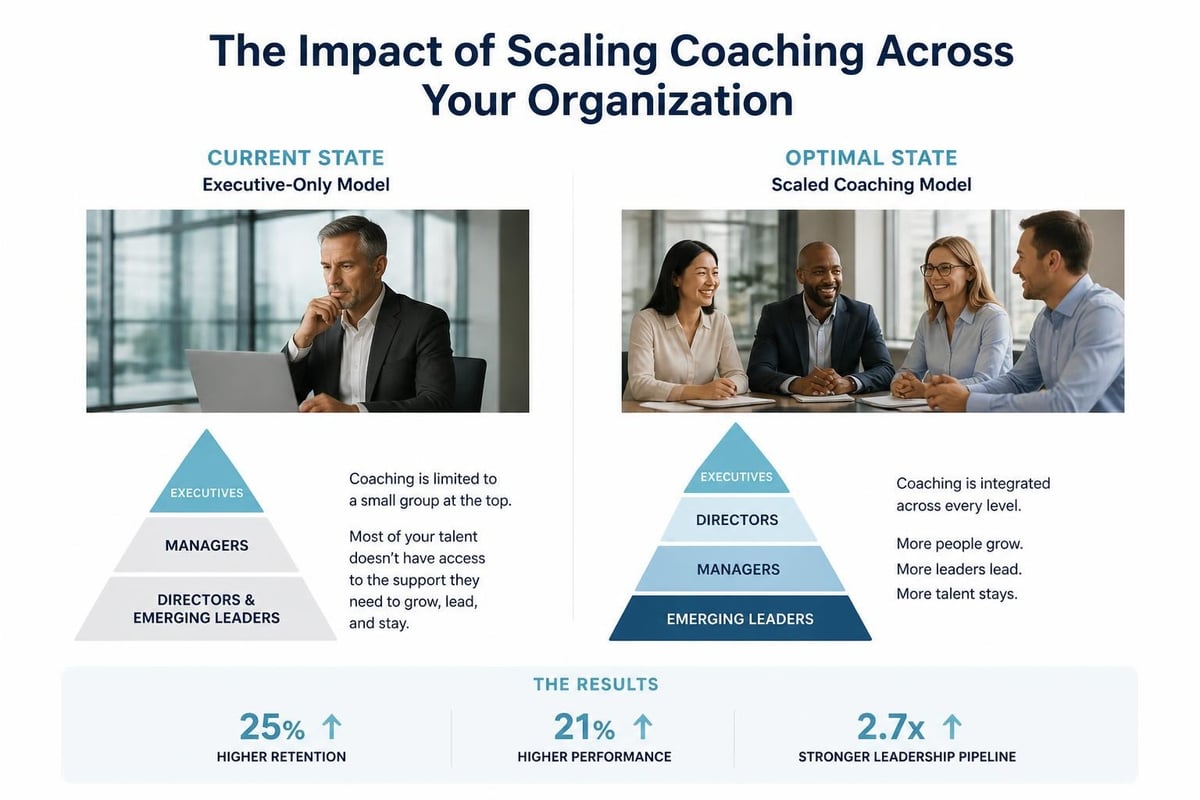
Most organizations treat executive coaching as a reward for the chosen few. That creates exactly the problem it claims to solve: a leadership vacuum in the middle. When only the C-suite gets development resources, you're not building bench strength. You're broadcasting that everyone else is expendable. The organizations winning in 2026 understand how to scale coaching beyond the executive team, transforming it from executive perk to strategic capability. The difference shows up in retention rates, promotion velocity, and the speed at which mid-level leaders execute strategy without escalation.
The Real Cost of Keeping Coaching at the Top
Three years of internal audits across government agencies and Fortune 500 clients revealed a consistent pattern: organizations spending $50,000+ per executive on coaching while frontline managers received nothing created measurable dysfunction. Middle managers reported 43% higher burnout rates, team engagement scores dropped 27 points below executive-led divisions, and succession pipelines stalled because no one was developing the next generation.
The math matters. When coaching remains exclusive:
- High-potential directors leave for competitors offering development
- Middle managers implement strategy poorly because they lack decision-making frameworks
- Executive insights never cascade because there's no coaching infrastructure below the C-suite
- Leadership gaps widen as retiring executives take institutional knowledge with them
One federal agency discovered through employee surveys that 71% of GS-13 to GS-15 managers felt "unprepared" for strategic leadership responsibilities. Yet coaching budgets directed 100% of resources to SES executives. The agency lost 18 high-performers to private sector roles in 2025 before realizing the connection.
Why Traditional Scaling Approaches Fail
The standard playbook for how to scale coaching beyond the executive team involves group workshops, online courses, or "manager as coach" training. These initiatives produce certificates, not capability. After observing 40+ scaling attempts across industries, three failure patterns emerge consistently:
The Training Theater Problem
Organizations invest in manager coaching certifications, then wonder why nothing changes. The issue isn't training quality. It's the assumption that teaching managers coaching techniques replaces actual coaching. A logistics company trained 120 managers in coaching skills over six months. Internal surveys showed zero improvement in leadership effectiveness scores. Why? Managers needed to be coached themselves before they could coach others, as Harvard Business Review’s research on leader-as-coach confirms through multiple case studies.
The Technology Mirage
Digital coaching platforms promise unlimited scale at fixed cost. The reality: completion rates under 20% and zero correlation with leadership performance improvements. A Fortune 500 financial services firm deployed an AI coaching app to 3,000 managers in 2024. Eighteen months later, usage had dropped to 4% monthly active users. The technology couldn't diagnose complex interpersonal dynamics, address toxic behavior patterns, or build accountability relationships that drive actual change.
The Dilution Trap
Some organizations simply add more coaches without changing methodology. They scale inputs, not outcomes. A manufacturing company quadrupled its coaching roster but kept the same generic "leadership development" approach. Results flatlined because coaches weren't matched to specific challenges, interventions weren't targeted to measurable gaps, and no one tracked whether coaching addressed strategic priorities.
The Precision Scaling Framework: What Works
How to scale coaching beyond the executive team effectively requires rethinking the entire delivery model. The framework that produces results across government and enterprise contexts involves three integrated components:
Component One: Diagnostic Before Deployment
Start with evidence, not assumptions. Organizations that scale successfully use validated assessment tools to identify where coaching will create the highest impact. This means:
- Behavioral pattern analysis across leadership levels to identify toxic dynamics, communication gaps, or decision-making weaknesses
- Cultural health indicators that reveal where trust, psychological safety, or accountability have broken down
- Performance data correlation showing which leadership gaps directly impact business metrics
- Succession risk mapping to prioritize coaching for retention-critical roles
A government agency used this approach in 2025 to identify 47 mid-level managers in mission-critical roles showing early burnout signals. Targeted coaching interventions reduced turnover in that cohort from 31% (previous year) to 9%, saving $2.1M in replacement costs and preserving institutional expertise.
| Assessment Type | What It Reveals | Strategic Application |
|---|---|---|
| 360-degree behavioral | Leadership blind spots, toxic patterns | Targeted intervention design |
| Team health diagnostics | Trust deficits, communication breakdowns | Team coaching prioritization |
| Decision-making analysis | Escalation dependency, strategic gaps | Executive readiness development |
| Retention risk scoring | Flight-risk high-potentials | Proactive coaching deployment |
Component Two: Precision Matching at Scale
The conventional approach pairs coaches with leaders based on availability and cost. That's why most coaching produces mediocre results. Precision matching requires treating coach selection like recruiting a specialist surgeon, not booking a general practitioner.
Matching criteria that matter:
- Sector expertise: A coach who's navigated government procurement understands regulatory constraints that private-sector coaches miss entirely
- Challenge specialization: Addressing toxic leadership requires different expertise than developing strategic thinking
- Methodology alignment: Some situations demand cognitive-behavioral approaches; others need systems-oriented coaching
- Cultural competency: Cross-cultural communication challenges need coaches with demonstrated international experience
Organizations using precision matching methodologies report 64% higher satisfaction scores and 2.3x faster progress toward defined objectives compared to random coach assignment. The difference appears within the first three sessions when coaches demonstrate relevant experience with similar challenges.

Component Three: Structured Intervention Design
Scaling requires standardization without losing customization. The solution: structured intervention frameworks that adapt to individual needs while maintaining consistency across the organization.
The intervention architecture includes:
- Intake diagnostics establishing baseline behaviors and specific development targets
- Intervention planning connecting coaching objectives to business outcomes and compliance requirements
- Progress milestones defining observable behavioral changes at 30, 60, and 90-day intervals
- Stakeholder loops involving direct reports, peers, or supervisors to validate change
- Outcome measurement tracking against predefined KPIs and cultural health indicators
A Fortune 500 technology company applied this framework to 200 directors and senior managers in 2025. By connecting individual coaching interventions to team performance metrics, they documented $8.4M in productivity gains through reduced conflict, faster decision cycles, and improved cross-functional collaboration.
Building the Business Case That Gets Funded
CFOs and boards don't fund development initiatives. They fund measurable business outcomes. How to scale coaching beyond the executive team successfully requires translating coaching into financial terms executives understand.
The ROI Calculation Framework
Direct cost avoidance:
- Turnover reduction valued at 1.5x to 2.5x annual salary for each retained high-performer
- Reduced time-to-productivity for promoted leaders (typically 3-6 months faster with coaching)
- Litigation risk mitigation from addressing toxic leadership before escalation
Productivity gains:
- Decision velocity improvements (measured in days saved per strategic decision)
- Meeting efficiency increases (quantified through calendar analysis)
- Project execution improvements (on-time delivery rates, budget variance reduction)
Strategic capability development:
- Succession pipeline depth (number of promotion-ready candidates per critical role)
- Innovation metrics (new initiatives launched, successful pilots)
- Change adoption velocity (time required to implement strategic shifts)
One manufacturing organization documented these metrics across 85 managers receiving coaching over 12 months. The combined financial impact totaled $4.7M against a program investment of $680,000, a 6.9x return. More importantly, they created a replicable model for ongoing coaching deployment that SHRM’s guidance on building coaching cultures recommends as best practice.
Governance Structures That Enable Scale
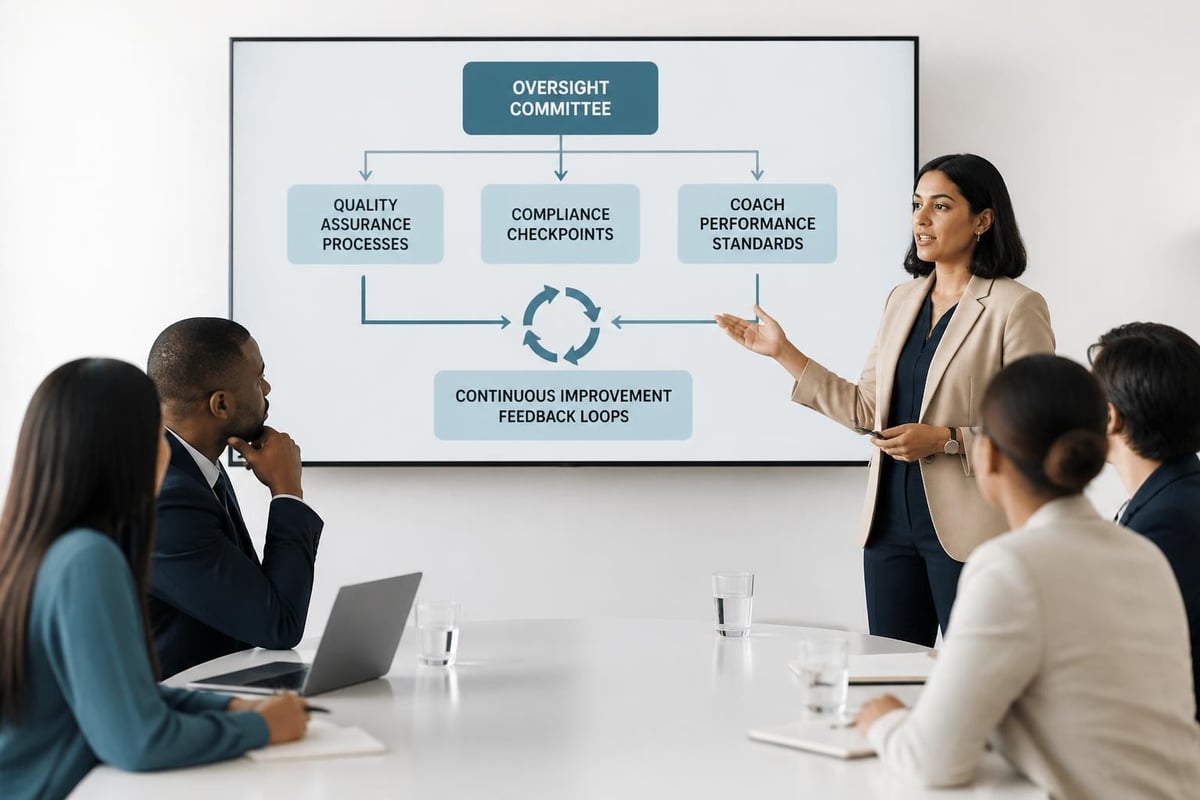
Organizations that scale coaching successfully don't just add coaches. They build governance infrastructure that ensures quality, compliance, and continuous improvement.
Essential Governance Components
Program oversight:
- Cross-functional steering committee (HR, Finance, Legal, Operations)
- Quarterly business reviews examining coaching ROI and outcome trends
- Coach performance standards with clear quality metrics
- Escalation protocols for coaches encountering ethical issues or severe behavioral problems
Compliance integration:
- Alignment with organizational codes of conduct and ethics policies
- Documentation standards meeting regulatory requirements
- Confidentiality frameworks balancing coach-client privilege with organizational risk management
- Regular audits ensuring coaching addresses strategic priorities, not just personal preferences
Quality assurance:
- Coach certification verification and ongoing professional development requirements
- Client satisfaction tracking with intervention effectiveness measures
- Outcome validation through 360-degree assessments and stakeholder feedback
- Continuous improvement cycles adjusting matching algorithms and intervention protocols
A federal agency serving 12,000 employees built this governance structure when expanding coaching from 25 executives to 300 leaders across GS-13 through SES levels. The framework enabled them to maintain consistent quality while scaling 12x in 18 months, something their previous approach couldn't achieve.
The Technology Integration Question
Technology should amplify coaching effectiveness, not replace human judgment. Organizations scaling successfully use digital tools for three specific purposes:
Scheduling and logistics automation eliminates administrative friction that typically consumes 15-20% of coaching time. Automated scheduling, session reminders, and documentation platforms free coaches to focus on the actual coaching relationship.
Assessment and measurement systems provide standardized data collection across large coaching populations. Digital 360-degree assessments, pulse surveys, and progress tracking create consistent metrics that enable program-level analysis while respecting individual confidentiality.
Knowledge management and insights aggregate de-identified coaching themes to inform organizational strategy. When 40 different managers raise similar challenges around cross-functional collaboration, that's not 40 individual problems, it's a systemic issue requiring structural intervention.
What doesn't work: replacing coaching conversations with chatbots or AI. Research on digital coaching tools shows completion rates below 25% and minimal behavior change. Technology augments effective coaching; it doesn't substitute for it.
Common Implementation Obstacles and Solutions
Every organization scaling coaching encounters predictable obstacles. The difference between success and failure is recognizing these challenges early and addressing them systematically.
Obstacle One: Middle Manager Skepticism
The problem: Managers who've never experienced quality coaching view it as remedial or soft. They resist participation or show up without genuine engagement.
The solution: Start with voluntary pilots targeting high-performers, not struggling managers. When respected peers visibly benefit and advocate for coaching, skepticism evaporates. One technology company shifted from mandatory coaching assignments to competitive application processes. Participation rates increased from 67% to 94%, and satisfaction scores jumped 31 points.
Obstacle Two: Coach Quality Variation
The problem: Not all certified coaches deliver equivalent value. Organizations scaling quickly often sacrifice quality for availability.
The solution: Implement outcome-based coach evaluation. Track client progress against defined objectives, not just satisfaction scores. Remove coaches who consistently fail to drive measurable improvement. A Fortune 500 retailer using this approach reduced their coach roster by 30% while improving average client outcomes by 41%.
Obstacle Three: Measurement Complexity
The problem: Scaling coaching creates data volume that overwhelms typical HR analytics capabilities. Organizations collect feedback but can't extract actionable insights.
The solution: Define 3-5 core metrics aligned to strategic priorities before launching scaled programs. Common high-value metrics include promotion readiness scores, team engagement improvements, decision-velocity indicators, and retention rates for coached versus non-coached high-potentials. Resist the temptation to measure everything; focus on what drives decisions.
Integration with Existing Leadership Development
How to scale coaching beyond the executive team works best when integrated with broader leadership development infrastructure, not operating as a standalone program. The most effective approach treats coaching as the personalization layer on top of foundational leadership training.
The integration model:
- Foundational training establishes common language, frameworks, and baseline skills across leadership levels
- Cohort learning creates peer networks and shared experiences through cross-functional leadership programs
- Individual coaching addresses specific behavioral gaps, personal challenges, and role-specific development needs
- Team coaching tackles collective dysfunction, collaboration breakdowns, and group performance issues
This layered approach appeared in a pharmaceutical company's leadership development redesign. They reduced generic training hours by 40%, reinvesting savings into targeted coaching for 180 managers. Leadership effectiveness scores improved 28% year-over-year, and the program achieved measurable ROI within the first 12 months.
| Development Layer | Primary Purpose | Typical Duration | Scale Capacity |
|---|---|---|---|
| Foundation training | Common frameworks, baseline skills | 2-5 days | Unlimited (cohorts) |
| Cohort learning | Peer networks, shared challenges | 6-12 months | Medium (30-50 per cohort) |
| Individual coaching | Personal gaps, behavioral change | 3-9 months | High (with proper infrastructure) |
| Team coaching | Collective performance, dynamics | 4-8 sessions | Medium (requires specialized coaches) |
Addressing the "Manager as Coach" Question
Many organizations ask whether teaching managers coaching skills can replace professional coaching. The answer depends on what you're trying to solve.
Manager coaching skills work for:
- Daily performance conversations focused on task execution
- Career development discussions about paths and opportunities
- Real-time feedback on observable behaviors
- Problem-solving facilitation within the manager's area of expertise
Manager coaching skills don't work for:
- Deep behavioral change requiring neutral third-party perspective
- Toxic leadership patterns where the manager may be part of the problem
- Executive readiness development beyond the manager's experience level
- Situations requiring strict confidentiality outside the reporting relationship
The most effective approach: develop manager coaching capabilities and provide access to professional coaching. CIPD research on workplace coaching confirms that organizations using both approaches report higher leadership development effectiveness than those relying on either alone.
Lessons from Scale Failures
Observing what doesn't work teaches as much as studying successes. Three organizations attempted to scale coaching beyond the executive team in 2024-2025 with poor results. Their lessons inform better approaches.
Case One: The Procurement Disaster
A manufacturing company selected coaches purely on cost, contracting with the lowest bidders in an RFP process. Within six months, client satisfaction scores averaged 2.1 out of 5, and 40% of participants requested coach changes. The diagnosis: procurement treated coaching as a commodity rather than a specialized professional service requiring expertise matching. The lesson: involve HR and program stakeholders in coach selection, using cost as one factor among many, not the primary criterion.
Case Two: The Compliance Overreach
A financial services firm built such extensive documentation and reporting requirements that coaching became focused on paperwork rather than development. Coaches spent 35% of their time on administrative tasks. Clients reported feeling that confidentiality was compromised by excessive reporting. The lesson: balance legitimate oversight needs with the trust required for effective coaching relationships. Aggregate, de-identified data serves organizational needs without violating individual confidentiality.
Case Three: The Launch Without Infrastructure
A technology company announced coaching availability to 500 managers without building intake processes, matching systems, or measurement frameworks. The result: random coach assignments, unclear objectives, no progress tracking, and inability to demonstrate value. When budget pressures emerged, the program was eliminated after 14 months. The lesson: infrastructure precedes scale. Build governance, matching, and measurement systems before expanding beyond pilot populations.
What 2026 Requires That 2024 Didn't
The business context for how to scale coaching beyond the executive team has shifted. Three developments in 2025-2026 changed the requirements:
Hybrid work permanence eliminated the assumption that coaching happens primarily in person. Organizations need coaching models that work seamlessly across virtual, hybrid, and in-person contexts without quality degradation.
AI-driven disruption accelerated leadership skill obsolescence. Technical expertise that defined leadership credibility two years ago may be irrelevant today. Coaching must address rapid skill acquisition and adaptive leadership, not just behavior modification.
Regulatory complexity increased compliance requirements around workplace behavior, particularly regarding toxic cultures, harassment, and psychological safety. Coaching programs need documented protocols for addressing serious behavioral issues and clear escalation paths when coaching reveals compliance risks.
Organizations that adapted quickly integrated these considerations into coaching program design from the start. Those treating them as afterthoughts face expensive retrofitting of established programs.
Frequently Asked Questions
How long does it take to scale coaching from 25 executives to 300 leaders?
With proper infrastructure, most organizations complete the expansion in 12-18 months. This includes 3-4 months for governance setup, matching system development, and coach recruitment; 6-9 months for phased rollout across leadership levels; and 3-5 months for measurement validation and program optimization. Organizations attempting faster timelines typically sacrifice quality or overwhelm internal capacity.
What's the optimal ratio of internal to external coaches for scaled programs?
Most successful programs use 70-80% external coaches supplemented by 20-30% internal coaching capacity. External coaches bring fresh perspectives, specialized expertise, and confidentiality that internal coaches can't match. Internal coaches provide institutional knowledge and ongoing accessibility. The mix varies by organization size, industry, and specific development needs.
How do you prevent coaching from becoming an entitlement rather than a development tool?
Tie coaching access to specific development needs and strategic priorities, not tenure or title. Use diagnostic assessments to identify who will benefit most, communicate coaching as targeted intervention (not a perk), and measure outcomes rigorously. When leaders see coaching reserved for those with clear development objectives and tracked for results, entitlement expectations disappear.
What budget allocation is realistic for mid-level manager coaching?
Enterprise organizations typically invest $3,500-$8,500 per manager for a standard coaching engagement (10-15 sessions over 3-6 months). Government agencies often operate in the $2,800-$6,000 range due to budget constraints. These figures exclude assessment costs, program administration, and technology infrastructure. Total program costs run 20-30% above direct coaching fees when infrastructure is included.
Can coaching scale work in organizations with high leadership turnover?
Yes, but the approach changes. Focus on developing cohorts of emerging leaders continuously rather than investing heavily in individuals who may leave. Shorten engagement timeframes to 3-4 months rather than 6-9 months. Emphasize immediately applicable skills over long-term transformational change. Track whether coached leaders stay longer than non-coached peers; if coaching improves retention, it pays for itself regardless of baseline turnover rates.
Scaling coaching beyond the executive team transforms leadership development from exclusive privilege into strategic capability. The organizations that do this well combine precision diagnostics, expert matching, structured interventions, and rigorous measurement to deliver measurable business impact. The Noomii Corporate Leadership Program provides the infrastructure, expertise, and proven methodologies to scale coaching across your organization while maintaining quality and demonstrating ROI. Whether you're supporting 50 managers or 5,000, our evidence-based approach ensures coaching drives the leadership outcomes your organization needs.


Leave a Reply
Want to join the discussion?Feel free to contribute!