
Certification Inflation Is Hurting Coaches in 2026
The coaching industry has witnessed an unprecedented explosion of certifications, micro-credentials, and digital badges over the past five years. What began as an effort to professionalize the field has morphed into a credential arms race that undermines the very coaches it promised to elevate. Certification inflation is hurting coaches by diluting the signal strength of credentials, raising barriers to entry without improving outcomes, and distracting from the skills that actually matter: diagnosing client challenges, facilitating meaningful change, and delivering measurable results.
The Scale of Credential Proliferation
According to Inside Higher Ed’s coverage of the Credential Engine inventory, the United States now hosts more than 1.8 million distinct credentials, a staggering jump from just a few years ago. Coaching represents a significant slice of this growth, with hundreds of certifying bodies, each offering multiple tiers, specializations, and renewal pathways.
The typical coaching certification landscape in 2026 includes:
- Foundational certifications (ACC, PCC, MCC from ICF; various alternatives)
- Niche specialty certifications (executive, leadership, career, wellness, ADHD, neurodivergence)
- Methodology certifications (ontological coaching, solution-focused, narrative)
- Platform-specific credentials (coaching software, AI co-piloting tools)
- Micro-credentials and digital badges for workshops, masterclasses, or continuing education
Each new credential promises differentiation, but the cumulative effect is noise. Buyers struggle to distinguish between meaningful qualifications and vanity badges. Coaches spend more time and money chasing letters after their name than refining their diagnostic skills or building track records.

When Credentials Actually Help
Not all certifications are created equal. Research from the Brookings Institution analyzing the credential boom shows that credentials tied to specific occupational skills and recognized by employers do improve labor-market outcomes. The problem is that most coaching certifications fail both tests.
The Signal-to-Noise Problem
MIT research on costly signals and hiring demonstrates that credentials only improve matching when they communicate genuine quality differences that employers cannot easily observe. In coaching, the skills that drive results (empathy, pattern recognition, business acumen, facilitation expertise) are poorly proxied by written exams and supervised practice hours.
A coach who has facilitated 200 leadership team meetings, diagnosed dysfunction in real time, and tied interventions to retention or revenue outcomes has developed expertise that no 60-hour certification can replicate. Yet certification inflation is hurting coaches who have built deep experience by forcing them to compete on credential count rather than outcome track records.
| Credential Type | Buyer Recognition | Skill Signal Strength | Cost to Coach |
|---|---|---|---|
| ICF PCC/MCC | High in HR circles | Moderate (process compliance) | $5,000-$15,000 + time |
| Niche specialty (ADHD, executive) | Varies widely | Low to moderate | $2,000-$8,000 |
| Methodology certifications | Low | Low (buyer confusion) | $3,000-$10,000 |
| Digital badges/micro-credentials | Very low | Very low | $200-$1,500 each |
The Diagnosis: Three Ways Inflation Hurts Coaches
1. Credential Collecting Displaces Skill Building
Coaches facing market saturation often respond by accumulating more credentials instead of deepening their expertise in a specific domain. A leadership coach who has worked exclusively with mid-market manufacturing companies for a decade has pattern recognition that no generalist certification can teach. But when buyers default to credential checklists, that expertise becomes invisible.
Case study from firsthand observation:
- Problem: A career coach with 15 years of corporate HR experience struggled to win enterprise clients against competitors with newer ICF credentials.
- Diagnosis: Buyers (HR VPs) used certifications as a lazy filter, missing her deep knowledge of talent systems and succession planning.
- Solution: She reframed her positioning around outcomes (executive retention rates, time-to-promotion metrics) and stopped leading with credentials.
- Result: Won three Fortune 500 engagements in six months by focusing sales conversations on specific business challenges.
- Lesson: Certification inflation forces experienced coaches to market on proof, not proxies.
2. Barrier Inflation Without Quality Improvement
The Georgetown Center on Education and the Workforce report on credential misalignment highlights how credential proliferation often outpaces employer demand and job requirements. In coaching, this manifests as rising costs and time commitments for certifications that buyers don't recognize or value.
New coaches entering the field in 2026 face pressure to invest $10,000-$20,000 and 12-18 months before taking their first paid client. This barrier disproportionately excludes diverse talent, particularly career changers with relevant expertise but limited capital.
3. Employer Confusion and Skepticism
Accredible’s 2025 State of Credentialing report documents a visibility gap: employers want credible skill signals but struggle to evaluate the growing credential zoo. When every coach lists five or six acronyms, none stand out. Buyers either default to the oldest/largest credentialing body (ICF) or abandon credentials entirely and focus on referrals, case studies, and trial engagements.
This skepticism is visible in procurement trends. Leadership coaching buyers increasingly ask for outcome examples, pilot engagements, and aligned incentive structures rather than credential verification.

What Buyers Actually Want in 2026
Mid-market companies hiring executive coaches or building leadership development programs prioritize different criteria:
- Domain expertise: Has the coach worked in similar industries, company stages, or functional roles?
- Outcome track records: Can they share specific results (retention improvement, faster decision cycles, cleaner execution)?
- Diagnostic skill: Can they observe a meeting, spot dysfunction, and propose interventions tied to business KPIs?
- Practical facilitation: Will they coach live in leadership meetings or only in private one-on-ones?
- Risk sharing: Are they willing to offer month-to-month terms or align fees to measurable outcomes?
Certifications rank below all five. This reality is painful for coaches who invested heavily in credentials, but it reflects rational buyer behavior. The J-PAL policy insight on credible skills signals shows that verified certifications only improve employment when they credibly signal job-relevant skills. Most coaching certifications fail this test because the skills they verify (coaching models, ethics, supervised practice) don't align with the skills buyers need (business acumen, pattern recognition, facilitation under pressure).
Alternative Signals That Work
Rather than chasing another credential, coaches can build stronger market signals:
- Public case studies with problem, diagnosis, solution, result, and lesson frameworks
- Outcome portfolios showing engagement ROI, retention lifts, or promotion acceleration
- Niche specialization in an industry, function, or company stage
- Live demonstrations through workshops, free audits, or pilot engagements
- Thought leadership addressing timely challenges (AI adoption, hybrid team dysfunction, manager coaching capability)
Coaches who shifted focus from credentials to outcomes consistently report stronger client acquisition and pricing power. One business coach stopped listing certifications on her website entirely and replaced them with five detailed case studies. Her inbound inquiry rate tripled, and average engagement value increased 40%.
The ADHD Coaching Case Study
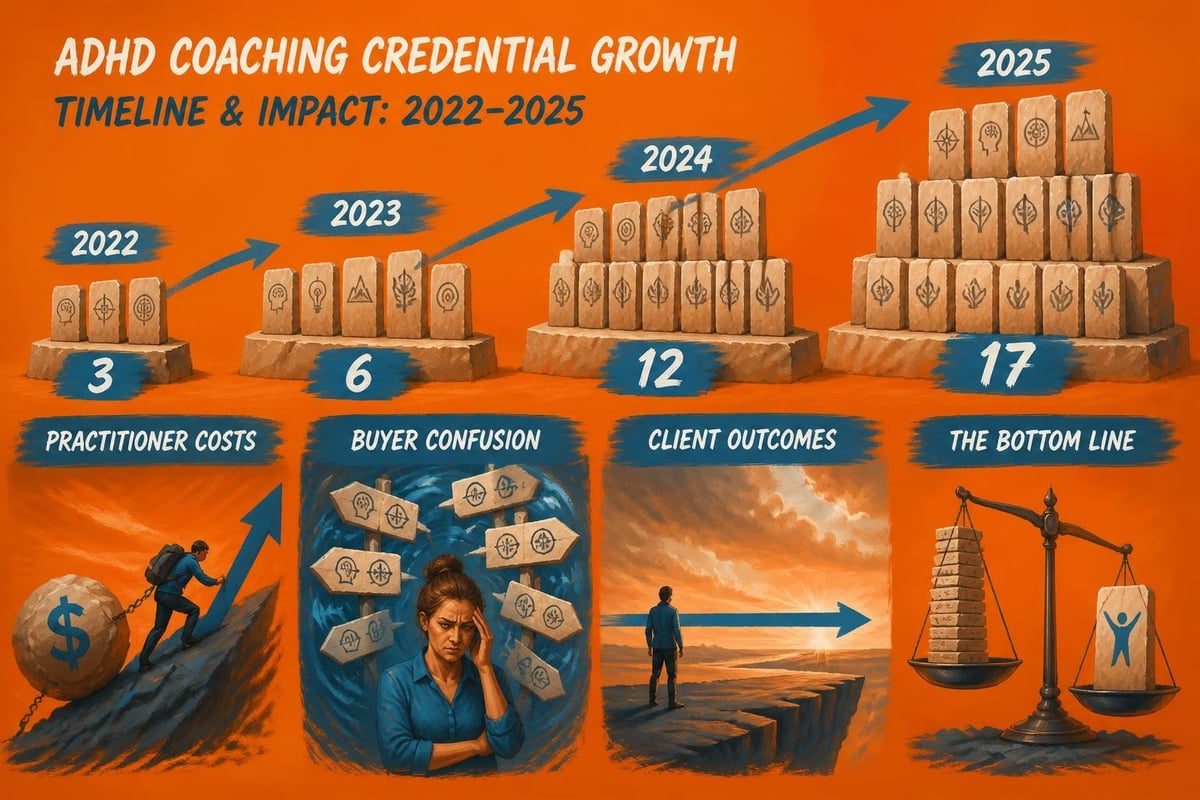
Lightbulb ADHD’s 2025 industry report documents how certification inflation hit the ADHD coaching niche particularly hard. Between 2022 and 2025, the number of ADHD-specific certifications grew from three to seventeen. The report found that newer credentials offered minimal additional training while raising costs and creating scope creep (coaches claiming medical or therapeutic expertise they didn't possess).
Client outcomes did not improve. In fact, buyer confusion increased, and insurance reimbursement remained unchanged despite credential proliferation. The lesson: more certifications don't automatically create more value or trust.
What Coaches Should Do Instead
Stop credential collecting. Invest time and money in skill development that directly improves client outcomes: business literacy, data analysis, meeting facilitation, conflict diagnosis, and change management.
Build proof over proxies. Document every engagement outcome. Track retention, promotion rates, engagement scores, revenue per employee, or decision cycle times. Use that data in marketing and sales conversations.
Specialize deeply. Choose an industry, function, or challenge (manufacturing leadership, SaaS sales managers, post-merger integration) and become the go-to expert through pattern recognition and outcome track records.
Offer risk-sharing terms. Month-to-month engagements, pilot structures, or success-based pricing signal confidence and align incentives with buyers.
Focus on business results. Tie every coaching intervention to clear KPIs. If you can't connect your work to retention, revenue, or operational metrics, you're coaching in a vacuum.
Frequently Asked Questions
1. Do I need an ICF certification to get hired by mid-market companies in 2026?
No. Most mid-market buyers prioritize domain expertise, outcome track records, and practical facilitation skills over certifications. ICF credentials may help in large HR departments with rigid procurement checklists, but they are rarely decisive factors in hiring decisions.
2. What should I invest in if not more certifications?
Invest in domain expertise (industry knowledge, functional depth), outcome documentation (case studies, KPI tracking), business literacy (financial statements, operational metrics), and practical skills (meeting facilitation, conflict diagnosis, change management).
3. How do I compete with coaches who have more credentials than I do?
Compete on outcomes, not credentials. Share specific client results, offer pilot engagements, specialize in a niche where you have deep pattern recognition, and position yourself around business problems rather than coaching methodologies.
4. Are niche specialty certifications (executive, ADHD, career) worth it?
Rarely. Most niche certifications offer minimal training differentiation and low buyer recognition. Build niche expertise through client work, industry immersion, and outcome documentation instead.
5. How has certification inflation changed buyer behavior?
Buyers increasingly ignore credentials or treat them as table stakes. They focus on referrals, case studies, trial engagements, and outcome track records. Credential proliferation has created skepticism, not trust.
6. What signals do mid-market companies actually trust when hiring coaches?
Referrals from peer companies, detailed case studies with measurable results, domain expertise in similar industries or challenges, willingness to offer pilot terms, and demonstrated business acumen.
7. Should I list my certifications on my website or LinkedIn?
List them if required for credibility in your target market, but don't lead with them. Prioritize outcome stories, client testimonials, and specific business problems you solve.
8. How do I know if a certification will actually help my practice?
Ask: Does this credential teach skills my clients care about? Will my target buyers recognize and value it? Can I achieve the same skill development through client work or alternative learning? If the answers are no, no, and yes, skip it.
9. What's the future of coaching credentials given inflation trends?
Expect continued proliferation and declining signal value. The market will increasingly reward coaches who differentiate on outcomes, specialization, and business results rather than credential count. Buyers will rely more on trials, referrals, and proof.
Certification inflation is hurting coaches by replacing skill signals with noise, raising barriers without improving quality, and distracting from the work that actually drives client outcomes. If you're hiring coaches who prioritize measurable business results over credential collecting, Noomii connects mid-market companies with experienced practitioners who coach live in your meetings, tie progress to clear KPIs, and deliver outcomes like faster decisions, stronger retention, and cleaner execution on month-to-month terms.


Leave a Reply
Want to join the discussion?Feel free to contribute!