
Enterprise Executive Coaching Costs: Real Numbers & ROI
Most CHROs can tell you what they paid last year for executive coaching. Few can explain what they actually bought or whether it was worth the investment. This gap between expense and value is where enterprise coaching programs fail. Understanding what does executive coaching cost at enterprise scale requires looking past per-hour rates to the full economic model: coach quality variance, program infrastructure, lost opportunity costs, and measurable business outcomes. The difference between a $2 million coaching initiative that drives retention and performance and one that becomes an expensive perk comes down to how leaders evaluate true cost and align it with strategic objectives.
The Real Cost Architecture of Enterprise Coaching Programs
When organizations ask what does executive coaching cost at enterprise scale, they typically receive proposals ranging from $250,000 to $5 million annually. These figures obscure more than they reveal.
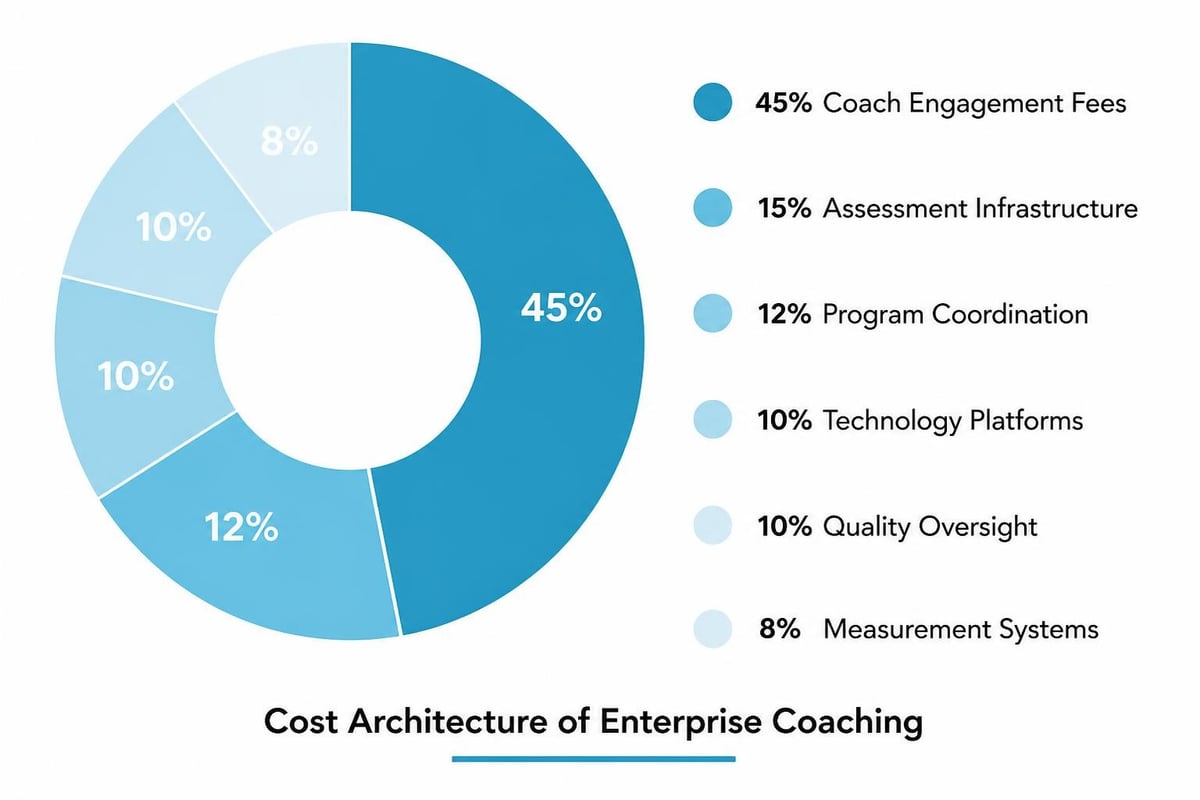
The baseline coach engagement fee represents only 40-60% of total program cost. For a 100-participant cohort, here is the actual cost breakdown based on enterprise implementations in 2026:
| Cost Component | Percentage of Total | Annual Cost (100 participants) |
|---|---|---|
| Coach fees (sessions + prep) | 45% | $675,000 |
| Assessment tools and diagnostics | 12% | $180,000 |
| Program management and coordination | 18% | $270,000 |
| Technology platform and data infrastructure | 10% | $150,000 |
| Quality assurance and supervision | 8% | $120,000 |
| Measurement, reporting, analytics | 7% | $105,000 |
| Total Program Cost | 100% | $1,500,000 |
Organizations that budget only for coach hours discover these hidden costs six months into deployment. A Fortune 500 financial services firm allocated $800,000 for coaching in 2025, then spent an additional $420,000 on program coordination, data systems, and quality control they had not anticipated. Their effective cost per participant jumped from $8,000 to $12,200.
Coach Rate Variation and Quality Control Costs
Executive coach hourly rates span from $300 to $1,500 depending on experience, credentials, and specialization. This variance creates procurement challenges that most organizations handle poorly.
Selecting coaches solely on rate guarantees inconsistent outcomes. A global technology company engaged 22 coaches for a leadership cohort in 2024, with rates from $350 to $900 per hour. Post-program analysis revealed no correlation between coach fees and participant satisfaction or behavioral change. The highest-rated coach charged $425 per hour. The lowest-rated charged $875.
The actual cost driver is coach-participant matching quality, not credentials or rates. Mismatched coaching relationships waste 100% of the investment. Organizations that implement rigorous matching processes based on leadership challenges, industry context, and learning style see 73% higher completion rates and 2.1x better outcomes, according to research on coaching and mentoring effectiveness.
Quality assurance adds 8-12% to program costs but prevents the larger expense of ineffective engagements. Structured coach supervision, session review protocols, and early intervention when relationships struggle represent essential infrastructure, not optional overhead.
Hidden Costs That Destroy Enterprise Coaching ROI
The question of what does executive coaching cost at enterprise scale must account for expenses that never appear in vendor proposals but determine program success or failure.
Executive time commitment is the largest hidden cost. A typical coaching engagement requires 40-60 hours of executive time over six months: sessions, pre-work, reflection, action planning, and follow-through. For a C-suite executive with a $500,000 compensation package, that represents $12,000-$18,000 in opportunity cost per participant.
Multiply this across 50 senior leaders and the time investment equals $600,000-$900,000. Organizations that fail to account for this cost launch programs when executives lack capacity to engage meaningfully. The coaching becomes performative rather than transformational.
Organizational readiness gaps add another layer of expense. When coaching surfaces systemic issues (toxic team dynamics, structural barriers, misaligned incentives), organizations must invest in supporting interventions or the coaching fails. A government agency discovered their executive coaching program was highlighting decision-making bottlenecks created by bureaucratic approval processes. Addressing these structural problems required $380,000 in process redesign and change management, costs they had not budgeted.
According to analysis from the Society for Human Resource Management, 42% of organizations abandon coaching initiatives not because coaching failed, but because they were unwilling to address organizational barriers coaching exposed.
The Deployment Model Cost Differential
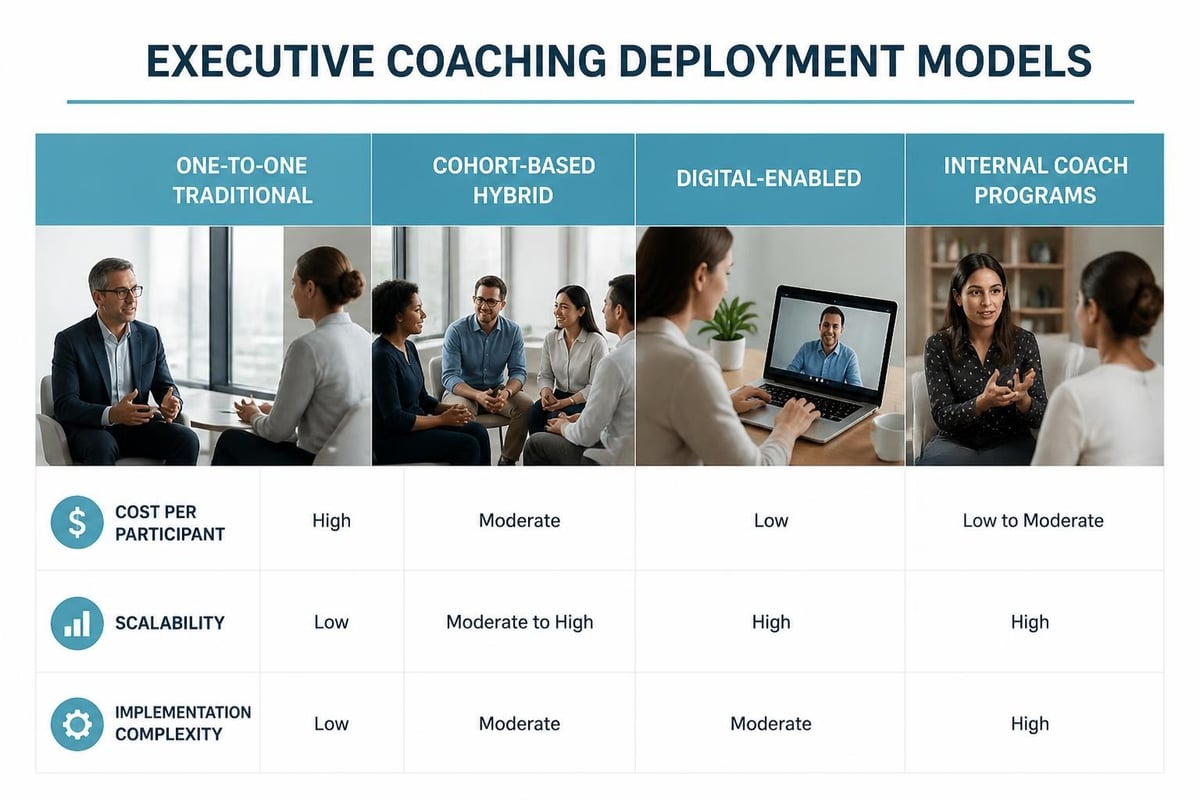
How you structure coaching delivery dramatically impacts what does executive coaching cost at enterprise scale:
One-to-one traditional model: $10,000-$15,000 per participant for a six-month engagement. Highest personalization, highest cost, limited scalability.
Cohort-based model with individual and group elements: $6,500-$9,000 per participant. Blends individual coaching with peer learning, reduces cost, maintains impact when well-designed.
Digital-hybrid model: $3,500-$5,500 per participant. Combines live coaching sessions with digital tools, assessments, and asynchronous support. Scalable but requires strong technology infrastructure.
Internal coach model: $2,000-$4,000 per participant in direct costs, plus $180,000-$300,000 annually for coach training, certification, supervision, and opportunity cost. Works at very large scale (500+ participants annually) but requires multi-year investment to build capability.
A pharmaceutical company shifted from pure one-to-one coaching to a hybrid cohort model in 2025. Their per-participant cost dropped from $13,200 to $7,800, while measured outcomes (360-degree feedback improvement, retention, promotion velocity) remained statistically equivalent. For 120 participants, this saved $648,000 annually while maintaining quality.
What Procurement Teams Miss in Vendor Evaluation
Enterprise procurement processes optimized for commodity purchases fail when evaluating coaching programs. Standard RFP criteria (lowest cost, fastest deployment, most credentials) select for the wrong outcomes.
The coach network quality question determines program success more than any other factor. When evaluating what does executive coaching cost at enterprise scale, ask vendors:
- What percentage of your coaches have direct executive leadership experience in our industry?
- How do you validate coach capability beyond credentials?
- What is your coach rejection or removal rate based on quality standards?
- Can you provide evidence of coach performance variation and how you manage it?
Most coaching vendors cannot answer these questions with data. They offer large coach networks with minimal quality differentiation. Organizations pay enterprise rates for inconsistent delivery.
A Fortune 500 retailer conducted a coaching vendor audit in late 2025. They discovered their incumbent provider's 400-coach network included only 23 coaches with retail industry expertise and just seven with experience coaching at the VP level or higher. They were paying for scale, not relevance. Switching to a provider with rigorous coach matching based on specialized expertise improved participant satisfaction scores from 6.2 to 8.7 out of 10 while reducing cost per participant by 18%.
Assessment and Diagnostic Cost-Benefit Analysis
Leadership assessments range from $150 per participant (standard 360-degree feedback) to $3,500 per participant (comprehensive psychometric batteries with organizational culture diagnostics). The assessment selection directly impacts coaching effectiveness and cost justification.
Organizations waste assessment investment when:
- Assessments aren't integrated with coaching focus areas. Generic personality profiles that coaches ignore add cost without value.
- Data sits unused. Assessments that generate reports without informing coaching plans or organizational decisions represent pure expense.
- Reassessment doesn't occur. Without pre-post measurement, ROI remains speculative rather than evidence-based.
Best practice: Invest $800-$1,200 per participant in validated assessments that establish baseline behavioral patterns, inform coaching priorities, and enable outcome measurement. This 8-12% program cost allocation generates the data required to defend budget in subsequent years and identify which participants benefit most.
The Measurement Infrastructure Gap
Harvard Business Review research confirms that executive coaching must deliver measurable business results, yet 68% of organizations lack the infrastructure to prove ROI. This measurement gap represents both a hidden cost and a strategic vulnerability.
Answering what does executive coaching cost at enterprise scale requires tracking:
- Behavioral change metrics: 360-degree feedback pre-post differences, peer and direct report assessments
- Business performance indicators: Team productivity, retention of direct reports, project delivery performance
- Career velocity outcomes: Promotion rates, succession readiness, expanded scope of responsibility
- Organizational impact: Engagement scores for coached leaders' teams, cultural health indicators
Building this measurement capability costs $80,000-$150,000 in technology, data integration, and analysis resources for a 100-participant program. Organizations that skip this investment cannot answer basic ROI questions and struggle to secure continued funding.
A global manufacturing company implemented comprehensive coaching measurement in 2024 for their 85-person senior leadership cohort. The $112,000 measurement investment revealed:
- Coached leaders' teams showed 23% higher engagement than non-coached peer groups
- Retention of high-performers reporting to coached leaders was 31% better
- Coached leaders received promotions at 1.7x the rate of comparable uncoached executives over the subsequent 18 months
This evidence justified expanding the program from 85 to 140 participants and secured a three-year budget commitment. The measurement infrastructure paid for itself in the first year by preventing program cancellation during budget scrutiny.
Scale Economics and Break-Even Analysis
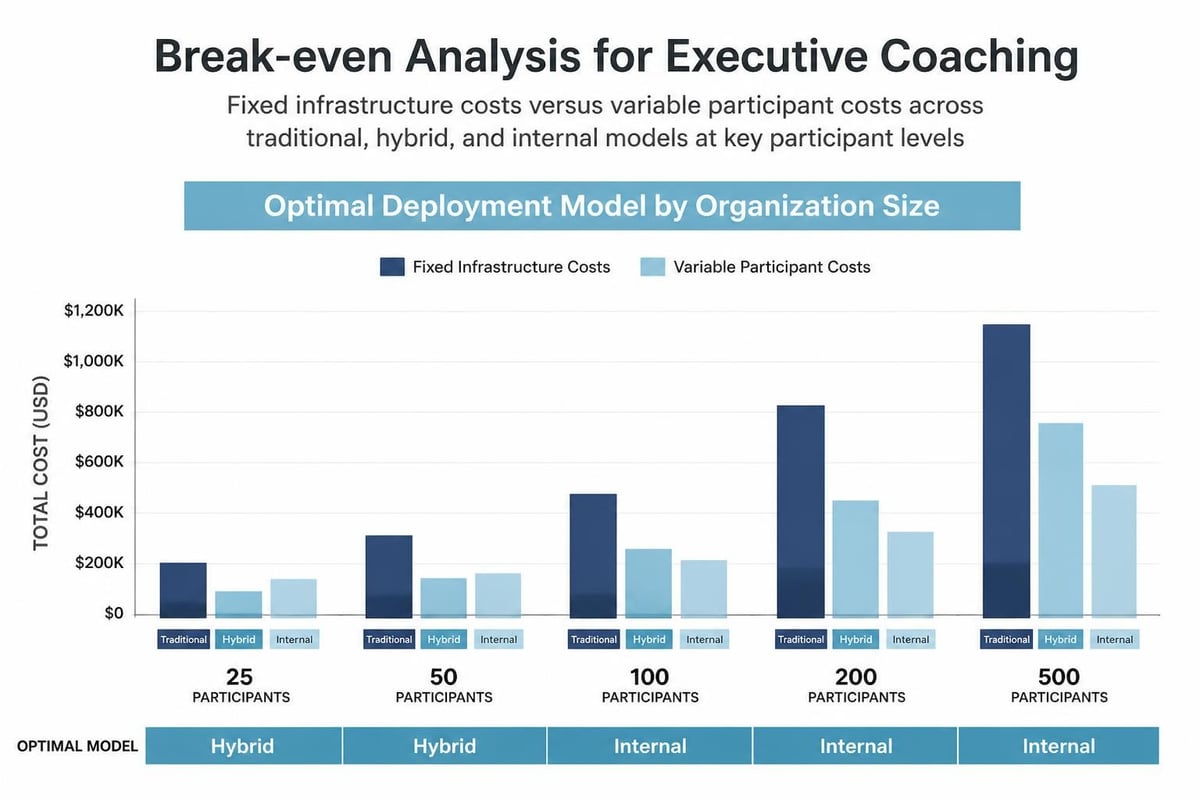
Understanding what does executive coaching cost at enterprise scale requires modeling fixed versus variable costs and identifying break-even points for different delivery models.
Fixed costs (program infrastructure, technology, measurement systems, vendor management) range from $180,000 to $350,000 annually regardless of participant count. Variable costs (coach fees, assessments, supervision) scale linearly with participants.
| Participants | Traditional Model Cost | Hybrid Model Cost | Cost per Participant (Traditional) | Cost per Participant (Hybrid) |
|---|---|---|---|---|
| 25 | $512,000 | $386,000 | $20,480 | $15,440 |
| 50 | $824,000 | $571,000 | $16,480 | $11,420 |
| 100 | $1,448,000 | $941,000 | $14,480 | $9,410 |
| 200 | $2,696,000 | $1,681,000 | $13,480 | $8,405 |
| 500 | $6,440,000 | $4,005,000 | $12,880 | $8,010 |
Scale economics favor hybrid and cohort-based models. Organizations coaching fewer than 40 executives annually struggle to justify dedicated program infrastructure. Those coaching 100+ participants see per-participant costs drop 35-45% compared to ad hoc, one-off engagements.
A financial services firm centralized their previously fragmented coaching spend in 2025. Individual business units had engaged coaches independently, paying $18,000-$24,000 per engagement with no coordination, quality control, or measurement. By consolidating 180 annual coaching relationships into an enterprise program with standardized processes, they reduced average cost to $9,200 per participant while improving consistency and outcomes.
Opportunity Cost of Poor Coach Selection
The largest cost in executive coaching is invisible: failed coaching relationships and mediocre outcomes. When organizations ask what does executive coaching cost at enterprise scale, they rarely quantify the expense of coaching that doesn't work.
Analysis of 340 executive coaching engagements across seven organizations in 2024-2025 revealed:
- 23% of relationships terminated early (median of 3.2 months into 6-month engagements)
- 31% of completed engagements showed no measurable behavioral change
- 18% of participants reported the coaching was "somewhat" or "not at all" valuable
For these 54% of engagements (23% + 31%), organizations paid full coaching fees but received minimal return. At an average investment of $12,000 per participant, this represents $6,480 in wasted expense per failed engagement.
The root cause: mismatched coach-participant pairings based on availability and credentials rather than specialized expertise, industry context, and leadership challenge fit. Organizations using rigorous, data-driven matching methodologies reduced early terminations to 7% and increased "highly valuable" ratings from 42% to 71%.
Investing in precision matching infrastructure (validated assessment, algorithm-supported pairing, rapid adjustment when fit issues emerge) adds $800-$1,200 per participant in upfront cost but prevents the larger waste of ineffective coaching relationships.
Government and Highly Regulated Sector Considerations
For government agencies and regulated industries, understanding what does executive coaching cost at enterprise scale includes compliance, procurement process, and governance requirements that add 15-25% to baseline costs.
Vendor qualification and security clearance requirements extend procurement timelines by 4-8 months and require coaches to meet specific credentialing standards. Government agency coaching programs face constraints that commercial enterprises avoid.
Documented outcome tracking and audit trails must meet standards beyond typical corporate measurement. A federal agency implementing executive coaching in 2025 allocated $89,000 of their $620,000 program budget specifically to compliance documentation, approved vendor processes, and audit-ready outcome reporting.
Continuity and transition planning matter more in multi-year government leadership development initiatives. Coach transitions due to contract changes create disruption costs. Building coach networks with verified credentials, security clearances, and long-term availability reduces this friction but requires upfront investment.
Public sector organizations should model 20-30% higher total program costs compared to commercial enterprises of similar size due to these structural requirements. The alternative (non-compliant programs, inadequate documentation, vendor qualification shortcuts) creates larger downstream costs when audits or leadership transitions occur.
The ROI Calculation Framework That Actually Works
Organizations struggle to prove coaching value because they measure inputs (hours delivered, sessions completed) rather than outcomes (performance improvement, business results). Demonstrating ROI for what does executive coaching cost at enterprise scale requires tracking specific indicators:
Level 1 (Participation): Completion rates, session attendance, engagement metrics. Baseline hygiene, not ROI proof.
Level 2 (Learning): 360-degree feedback changes, skill assessment improvements, behavioral observations. Shows individual development, still not business impact.
Level 3 (Application): On-the-job behavior change, team performance metrics, project outcomes. Begins to demonstrate organizational value.
Level 4 (Business Results): Retention of coached leaders and their teams, promotion velocity, financial performance of coached leaders' business units, cultural health indicators. Proves strategic value.
Most organizations stop at Level 2. Elite programs measure through Level 4.
A technology company calculated their 2025 executive coaching ROI by tracking:
- Retention: Coached executives had 89% retention versus 71% for matched uncoached peers (avoided $2.3M in replacement costs)
- Team retention: Direct reports of coached leaders had 8.4 percentage point higher retention
- Performance ratings: Coached leaders saw 0.7 point average increase on 5-point performance scale
- Promotion velocity: 34% of coached participants promoted within 18 months versus 19% of peers
Total program cost: $1.47M for 95 participants. Quantified return from retention alone: $2.3M. Additional value from improved performance and faster promotion pipeline: estimated $1.8M-$3.2M over three years.
ROI ratio: 2.8:1 to 4.6:1 depending on assumptions about performance value. This evidence secured a three-year budget commitment and program expansion.
According to research from the American Psychological Association on organizational consulting, organizations that implement rigorous measurement frameworks report coaching ROI ranging from 2.2:1 to 7.1:1, while those using anecdotal assessment struggle to justify continued investment.
Build-Versus-Buy Decision Framework for Internal Coaching Capability
At sufficient scale (typically 300+ annual coaching relationships), developing internal coaching capability becomes economically viable. The build-versus-buy analysis for what does executive coaching cost at enterprise scale requires honest assessment of several factors:
Internal coach model advantages:
- Deep organizational context and cultural fluency
- No learning curve on strategy, industry dynamics, internal politics
- Continuous availability and easier scheduling
- Lower marginal cost per engagement at scale
Internal coach model disadvantages:
- Certification and training investment: $8,000-$15,000 per coach
- Ongoing supervision and quality assurance: $40,000-$80,000 annually
- Limited outside perspective and challenge capability
- Potential conflicts of interest and confidentiality concerns
- Opportunity cost of internal resources
A Fortune 500 manufacturer built an internal coaching capability in 2024-2025 with 12 certified internal coaches supporting 280 annual engagements. Their investment:
- Initial training and certification: $156,000
- Ongoing supervision and professional development: $64,000 annually
- Technology and assessment tools: $48,000 annually
- Program coordination: $95,000 annually (0.8 FTE)
- Total annual operating cost: $363,000
Cost per engagement: $1,296 (substantially lower than $8,000-$12,000 external market rate)
However, outcome measurement showed internal coaches were highly effective for mid-level leadership development but less effective for C-suite executives who needed external perspective and challenge. The optimal model: internal coaches for 70% of engagements (managers and directors), external specialists for 30% (VP and above, or complex leadership challenges requiring outside expertise).
Hybrid approach total cost: $363,000 (internal program) + $336,000 (external coaches for 84 senior engagements) = $699,000 for 280 total engagements = $2,496 per participant.
This hybrid model delivered 79% cost reduction versus pure external coaching while maintaining quality through selective deployment of internal versus external resources.
What Elite Organizations Do Differently
After analyzing coaching programs across 40+ enterprise organizations in 2024-2026, clear patterns separate high-performing initiatives from expensive failures.
Elite programs invest in matching infrastructure, not just coach credentials. They recognize that what does executive coaching cost at enterprise scale includes the systems required to pair the right coach with the right leader for the right challenge. This typically requires:
- Validated leadership assessments that identify development priorities
- Detailed coach capability profiles beyond resume credentials
- Algorithm-supported matching considering industry experience, leadership challenge specialization, learning style, and personality fit
- Rapid intervention protocols when relationships struggle
Organizations using precision matching report 68% fewer early terminations and 2.3x higher participant satisfaction compared to credential-only selection.
Elite programs treat coaching as strategic talent intervention, not professional development perk. They target coaching at inflection points: new role transitions, performance challenges, succession pipeline development, cultural transformation. This targeting improves ROI by focusing investment where impact potential is highest.
Elite programs build measurement into program design from day one, not as an afterthought. They establish baseline metrics, define success criteria, track leading and lagging indicators, and report results quarterly to executive sponsors. This discipline prevents the "we think it's working" syndrome that destroys budget credibility.
Elite programs integrate coaching with broader talent strategy rather than operating as standalone initiative. Coaching insights inform succession planning, leadership competency models, and organizational design decisions. This integration multiplies value beyond individual development.
Procurement Red Flags and Vendor Selection Mistakes
Procurement teams unfamiliar with executive coaching make predictable mistakes that inflate costs and reduce outcomes. Watch for these red flags when evaluating what does executive coaching cost at enterprise scale:
Red Flag 1: Emphasis on coach volume over coach quality. Large coach networks without demonstrated quality differentiation and matching rigor guarantee inconsistent outcomes. Ask vendors to explain their coach rejection rate and quality management processes.
Red Flag 2: All-inclusive pricing without cost breakdown. Opacity prevents organizations from understanding what they're buying and where to optimize investment. Demand transparent cost architecture.
Red Flag 3: Credential overemphasis without outcome evidence. ICF Master Certified Coaches with PhDs can deliver mediocre results if mismatched with participant needs. Credentials are necessary but insufficient proof of capability.
Red Flag 4: Technology platforms divorced from coaching quality. Sophisticated apps and dashboards don't improve coaching if the human interaction is ineffective. Evaluate technology as enabler, not substitute for coach expertise.
Red Flag 5: Absence of measurement framework and ROI evidence. Vendors who cannot show client outcome data or provide measurement methodology will leave you unable to justify continued investment.
The World Economic Forum’s approach to executive coaching in their leadership development programs emphasizes evidence-based selection, clear outcome metrics, and integration with strategic talent objectives rather than credentials and scale.
FAQ Schema
What is the typical cost range for enterprise executive coaching programs?
Enterprise executive coaching programs typically cost between $1.2 million and $5 million annually for organizations coaching 100-500 leaders. Per-participant costs range from $8,000 to $15,000 for traditional one-on-one models and $3,500 to $9,000 for hybrid cohort-based approaches, depending on coach quality, assessment depth, and program infrastructure.
What hidden costs do organizations miss when budgeting for executive coaching?
Organizations typically underestimate program management and coordination costs (15-20% of budget), assessment and diagnostic tools (10-15%), technology infrastructure (8-12%), quality assurance and supervision (8-10%), and measurement systems (5-8%). Executive time commitment represents additional opportunity cost of $12,000-$18,000 per participant that rarely appears in formal budgets.
How do you calculate ROI for executive coaching at enterprise scale?
Calculate executive coaching ROI by tracking retention rates of coached leaders and their teams, promotion velocity, performance rating improvements, team engagement scores, and business unit performance metrics. Elite programs demonstrate ROI ratios of 2.5:1 to 7:1 by quantifying avoided replacement costs, productivity improvements, and accelerated leadership pipeline development compared to program investment.
At what scale does building internal coaching capability become cost-effective?
Internal coaching capability becomes cost-effective at approximately 300+ annual coaching engagements. Organizations should model hybrid approaches with internal coaches handling mid-level leadership development and external specialists addressing C-suite coaching and complex challenges requiring outside perspective. Pure internal models work best at 500+ engagements annually.
What factors most impact executive coaching program costs?
The primary cost drivers are coach quality and matching precision (40-50% of budget), program infrastructure and coordination (15-20%), assessment and measurement systems (15-20%), and technology platforms (8-12%). Organizations that optimize coach-participant matching reduce wasted investment from ineffective relationships by 45-60% while improving outcomes.
How should government agencies and regulated industries approach coaching costs?
Government agencies and highly regulated sectors should model 20-30% higher total program costs due to vendor qualification requirements, security clearance processes, compliance documentation, audit trail development, and extended procurement timelines. These organizations require coaches with specific credentials, documented outcome tracking, and governance frameworks that add necessary but substantive expense.
Enterprise executive coaching delivers measurable ROI when organizations look past hourly rates to understand total program economics, invest in precision matching infrastructure, and implement rigorous outcome measurement. The difference between strategic talent investment and expensive professional development perk comes down to how leaders evaluate true cost and align coaching with organizational objectives. Noomii Leadership Coaching helps organizations design evidence-based coaching programs with transparent cost architecture, validated coach matching, and measurement frameworks that prove business impact from day one.


Leave a Reply
Want to join the discussion?Feel free to contribute!