

Executive Coaching ROI Metrics for CFOs (2026 Guide)
Most CFOs don't approve executive coaching budgets because HR can't prove it works. The standard defense? "Leadership development is a long-term investment." That's not an argument. It's a stalling tactic. Finance leaders allocate capital based on measurable returns, isolated impact, and clear accountability. When coaching vendors or internal HR teams can't translate behavioral change into financial outcomes, they lose credibility and budget. The gap isn't philosophical. It's operational. Executive coaching roi metrics for cfos must answer one question: what did we buy, and what did it deliver in terms the income statement and balance sheet recognize?
Why Traditional Coaching Metrics Fail the CFO Test
HR teams routinely present satisfaction scores, completion rates, and participant surveys as proof of coaching effectiveness. These are process metrics, not outcome metrics. A 4.8 satisfaction rating tells you people liked the experience. It doesn't tell you whether the VP of Sales improved pipeline conversion, whether the operations leader reduced cycle time, or whether the toxic executive driving turnover changed behavior.
The disconnect stems from three systemic failures:
- Coaching programs track inputs and activities instead of business outcomes
- Measurement frameworks stop at Kirkpatrick Level 2 (learning) rather than Level 4 (results)
- Attribution models don't isolate coaching impact from other variables
One Fortune 500 client I worked with spent $850,000 annually on leadership coaching with zero financial tracking. When pressed, HR cited "improved leadership capability" as the outcome. The CFO killed the program. The failure wasn't coaching itself but the inability to connect executive behavior change to margin improvement, customer retention, or strategic execution speed.
Finance leaders don't reject development investments. They reject unmeasured claims and vague promises. Harvard Business Review research on executive coaching demonstrates clear impact when organizations define business outcomes upfront and measure them rigorously.

The Five Executive Coaching ROI Metrics That Matter
After analyzing coaching programs across 40+ organizations, five metrics consistently provide CFO-grade evidence of return. These aren't the only relevant measures, but they're the ones that translate leadership behavior into financial impact.
1. Productivity Gain Per Coached Executive
Measure output before and after coaching interventions. For commercial leaders, track revenue per person, deal closure rate, or pipeline velocity. For operational executives, measure throughput, defect rates, or process cycle time. For functional leaders, assess deliverable quality, project completion, or strategic initiative success.
Why it works: Productivity has direct P&L impact. When a coached VP increases their team's output by 12%, you can calculate the revenue or cost implications immediately.
How to isolate coaching impact: Compare coached executives against a control group of similar leaders who didn't receive coaching during the same period. Control for market conditions, organizational changes, and seasonal factors.
One client coaching a regional sales VP saw a 23% increase in team quota attainment within four months. The control group of uncoached regional VPs averaged 4% improvement during the same quarter. The delta (19%) isolated coaching impact. At $8.2M in incremental revenue, the $45,000 coaching investment delivered 182x return.
2. Retention Cost Avoidance
Executive turnover costs between 150% and 400% of annual compensation when you factor in recruiting, onboarding, lost productivity, institutional knowledge loss, and downstream team disruption. Coaching programs that prevent high-performer exits or address toxic leadership before it metastasizes deliver measurable savings.
| Executive Level | Avg. Replacement Cost | Coaching Investment | Cost Avoidance ROI |
|---|---|---|---|
| C-Suite | $1.8M – $2.4M | $75K – $120K | 15x – 32x |
| VP / Senior Director | $425K – $850K | $35K – $60K | 7x – 24x |
| Director / Manager | $180K – $360K | $18K – $30K | 6x – 20x |
The attribution challenge: You must document the exit risk before coaching begins. When HR or the board identifies a flight risk or toxicity pattern, record it formally. If coaching resolves the issue and the executive stays, you've created a defendable ROI calculation.
A government agency I advised was losing high-potential senior leaders to private sector offers at a 40% annual attrition rate. Targeted executive coaching for government agencies addressing career progression concerns and leadership identity reduced that cohort's attrition to 8% over 18 months. The savings in replacement costs alone exceeded the coaching budget by 14x.
3. Time-to-Decision and Strategic Execution Speed
Slow decision-making costs organizations millions in missed market opportunities, delayed product launches, and competitive disadvantage. Executives paralyzed by analysis, conflict avoidance, or organizational politics create bottlenecks that ripple across the business.
Measure decision cycle time before and after coaching. Track days from strategic proposal to approval, time spent in meeting cycles, or speed of critical resource allocation decisions. When coaching helps an executive move faster without sacrificing quality, the financial impact is substantial.
Practical example: A logistics company executive struggled with delegation and control issues, personally reviewing every operational decision. This created a three-week delay in standard approvals. Coaching for logistics executives helped him build trust frameworks and decision authority matrices. Approval cycle time dropped to four days. The resulting operational velocity improvement added $2.1M in annual margin through faster contract execution and reduced demurrage costs.
4. Revenue Impact from Strategic Initiative Completion
Most strategic initiatives fail or stall because executives lack the leadership capability to drive cross-functional alignment, navigate organizational resistance, or maintain accountability through complexity. Coaching that accelerates strategic execution delivers measurable revenue or cost outcomes.
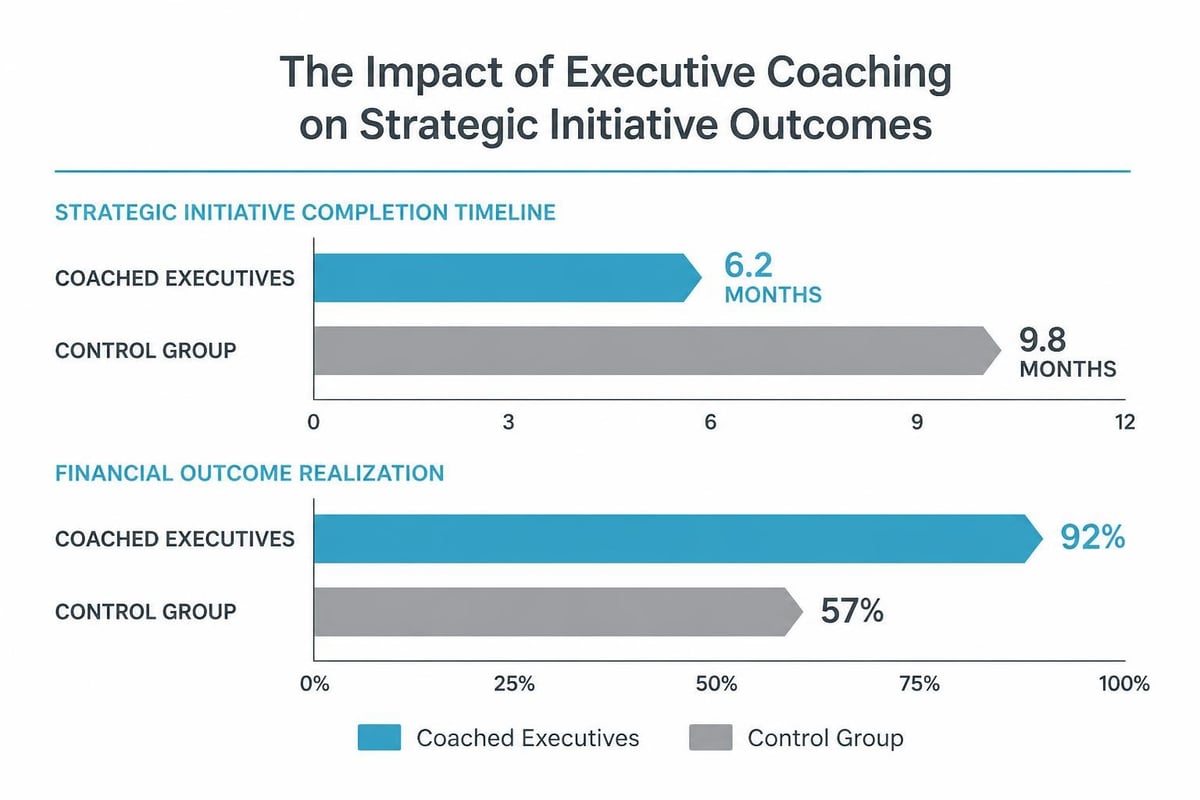
Define the financial target of each strategic initiative upfront. Track coaching recipients' projects against control group initiatives led by uncoached peers. Measure completion rate, timeline adherence, and financial outcome realization.
- Digital transformation: Revenue from new channels, cost reduction from automation
- Market expansion: New customer acquisition, geographic revenue growth
- M&A integration: Synergy realization, retention of acquired talent
- Cultural change: Engagement improvement, innovation pipeline value
A coached CFO leading a digital finance transformation completed implementation four months ahead of schedule, delivering $3.8M in annual cost savings 33% faster than projected. The coaching investment: $62,000. The acceleration value alone (four months of $316K monthly savings) was $1.26M, creating a 20x return before accounting for full-year ongoing savings.
5. Team Performance Multiplier Effect
An executive doesn't just perform individually; they multiply the performance of everyone they lead. Coaching that improves an executive's ability to develop talent, remove obstacles, provide clarity, or drive accountability creates cascade impact across their entire organization.
Measurement approach:
- Track team-level KPIs before and after executive coaching (revenue per employee, quality metrics, engagement scores, voluntary turnover)
- Calculate the team performance delta
- Multiply by team size to determine aggregate impact
- Compare against uncoached executives leading similar teams
One client's VP of Engineering led a 40-person product development team with chronic delivery issues and 28% annual turnover. After six months of coaching focused on delegation, technical mentorship, and psychological safety, team velocity increased 34%, defect rates dropped 41%, and turnover fell to 9%. The aggregate productivity gain across 40 engineers delivered $1.9M in additional capacity value. Recruiting cost avoidance added another $340K. Total impact: $2.24M against a $48K coaching investment.
Building a CFO-Grade Measurement Framework
Finance leaders respect rigor. Your executive coaching roi metrics for cfos need the same discipline you'd apply to capital expenditure decisions, technology investments, or acquisition modeling.
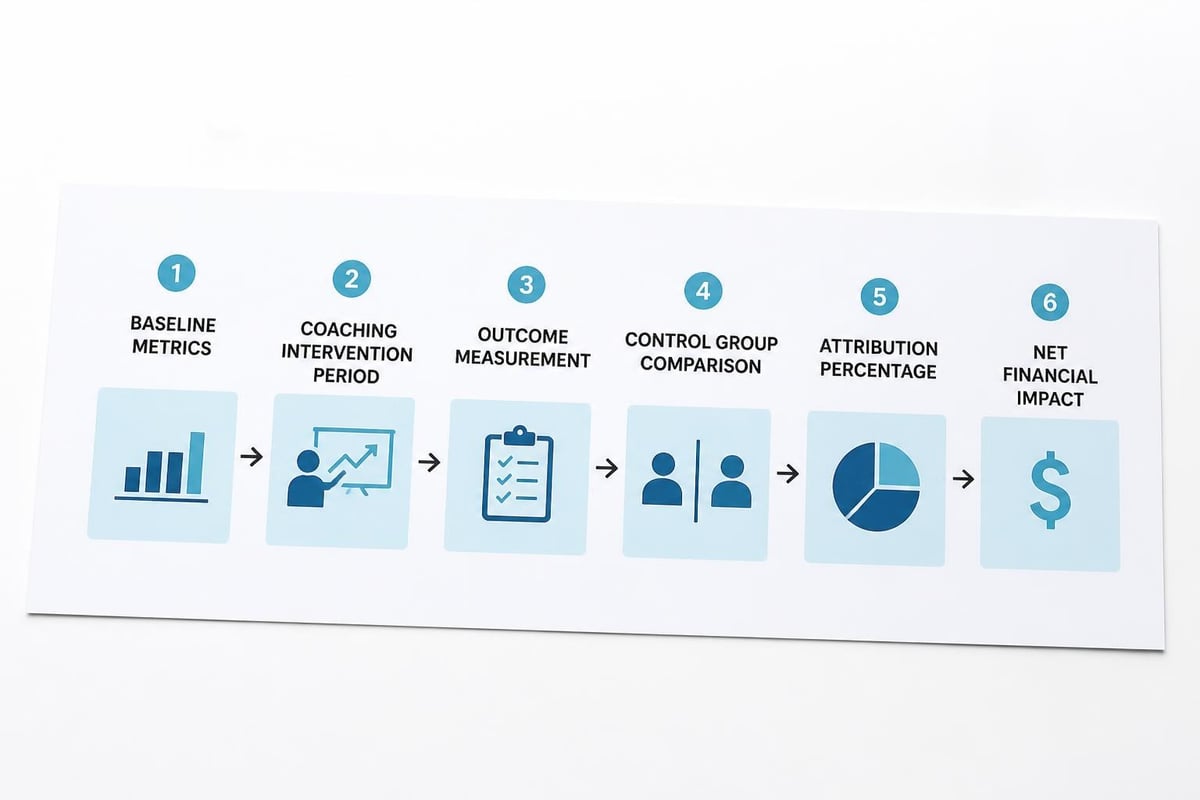
Pre-coaching baseline establishment is non-negotiable. You cannot demonstrate improvement without a documented starting point. Record current performance on your chosen metrics, control for external factors, and establish clear success criteria before coaching begins.
Control group methodology isolates coaching impact from broader organizational, market, or seasonal changes. When you coach three regional VPs, track the performance of uncoached regional VPs during the same period. The performance delta between groups, adjusted for initial baseline differences, represents coaching-specific impact.
Multi-rater feedback integration provides triangulation. Don't rely solely on self-reported improvement. Collect 360-degree input from direct reports, peers, and supervisors at baseline and post-coaching intervals. Look for behavioral change validation from multiple perspectives.
Deloitte’s learning analytics research demonstrates how connecting development interventions to business KPIs creates measurable accountability. The methodology applies directly to executive coaching ROI frameworks.
What Most Organizations Get Wrong About Coaching ROI
Three common mistakes destroy coaching ROI credibility with finance leaders:
Mistake 1: Measuring too early. Behavioral change takes time to manifest as business outcomes. Measuring ROI after 30 or 60 days captures initial reactions, not sustained performance improvement. Most meaningful coaching impact appears between months 4 and 9.
Mistake 2: Conflating activity with outcome. Number of coaching sessions completed, hours invested, or action items created are irrelevant to CFOs. They're process metrics that indicate effort but don't demonstrate value creation.
Mistake 3: Attribution inflation. When coaching happens simultaneously with new strategy rollout, organizational restructuring, or market expansion, you cannot claim 100% of subsequent performance improvement as coaching impact. Conservative attribution builds credibility. Aggressive attribution destroys it.
I've reviewed coaching ROI claims from major providers showing 600% returns based on participant estimates of personal productivity improvement. These calculations rarely survive CFO scrutiny because they're based on self-serving assessments without control groups or objective validation.
The Data Architecture Required for Coaching ROI
You need three connected data systems to track executive coaching roi metrics for cfos effectively:
- HR information system: Performance ratings, 360 feedback, engagement survey results, turnover data, promotion velocity
- Financial system: Revenue, margin, cost center performance, budget variance, project ROI
- Coaching platform: Session attendance, goal progress, assessment scores, behavioral milestones
Most organizations maintain these systems in silos. HR tracks satisfaction. Finance tracks P&L. Coaching vendors track completion. Nobody connects the dots. SHRM’s guidance on measuring leadership development ROI emphasizes this integration challenge as the primary barrier to credible ROI measurement.
When you build integration, you can trace the path from coaching intervention to behavioral change to team performance to financial outcome. Without integration, you're left with correlation arguments that finance leaders reject.
Proprietary Frameworks That Improve ROI Measurement
Generic coaching programs produce generic results. Precision matching, targeted interventions, and evidence-based diagnostics create measurable differentiation.
Behavioral diagnostics before coach assignment ensure you're addressing the actual performance gap, not a generalized "executive presence" or "strategic thinking" development goal. Validated assessments identify whether the core issue is conflict avoidance, analysis paralysis, micromanagement, or inadequate delegation.
Coach specialization matching pairs executives with practitioners who have domain expertise in their specific challenge. A supply chain executive struggling with cross-functional influence needs different coaching than a finance executive managing board relationships. Generic "leadership coaches" without sector experience deliver weaker outcomes because they lack contextual fluency.
Compliance-aligned coaching protocols matter for regulated industries, government agencies, and public companies. When coaching addresses ethical boundaries, fiduciary responsibility, or governance requirements, measurement frameworks must track regulatory risk reduction and compliance incident prevention.
The Noomii Corporate Leadership Program combines validated leadership assessments, proprietary coach-matching algorithms, and outcome-focused measurement frameworks designed specifically for CFO-grade accountability. This precision approach consistently outperforms generic coaching platforms in head-to-head ROI comparisons.
When Coaching ROI Fails (And Why It's Usually Not the Coach)
Not every coaching engagement delivers positive ROI. Understanding failure modes helps you avoid them.
Wrong executive selection: Coaching cannot fix fundamental competence gaps, value misalignment, or unwillingness to change. When organizations use coaching as a "last chance" intervention for executives already on performance improvement plans, success rates plummet. Coaching works best for high-potential leaders facing specific behavioral or capability challenges, not marginal performers who should be exited.
Undefined success criteria: "Improve leadership effectiveness" isn't measurable. "Increase team retention from 71% to 88% and reduce decision cycle time from 19 days to 7 days" is measurable. Vague goals produce vague outcomes.
Organizational interference: When coached executives receive conflicting messages from their CEO, board, or peers, behavioral change becomes impossible. If coaching emphasizes delegation while the CEO publicly rewards heroic individual contribution, the executive faces contradictory incentives. Coaching ROI requires organizational alignment.
Competitive Vendor Analysis for CFO Evaluation
When evaluating coaching providers, CFOs should demand evidence on five dimensions:
| Evaluation Criterion | Red Flag | Green Flag |
|---|---|---|
| Measurement methodology | Satisfaction surveys only | Pre/post metrics with control groups |
| Coach qualifications | Generic leadership background | Sector-specific expertise and outcomes |
| Attribution rigor | Claims credit for all improvements | Conservative attribution with controls |
| Data integration | Standalone coaching platform | Connects to HRIS and financial systems |
| Pricing transparency | Per-session fees with unlimited scope creep | Fixed-price with defined outcomes |
Most coaching platforms emphasize coach credentials, technology features, or brand recognition. These matter less than measurement rigor and outcome accountability. A credentialed coach who doesn't move business metrics creates zero value. An unbranded specialist who doubles team productivity creates substantial value.
Top executive coaching firms differentiate themselves through proprietary matching methodologies, validated assessment tools, and contractual ROI commitments. Demand proof of past performance, not testimonials.
The 2026 Shift: AI, Regulation, and Coaching Economics
Three forces are changing executive coaching roi metrics for cfos in 2026:
AI-augmented coaching reduces delivery costs while maintaining outcome quality. Automated session notes, AI-generated development plans, and algorithm-driven behavioral tracking lower coaching program costs by 30-40%. CFOs should demand these efficiency gains translate to better ROI, not just vendor margin expansion.
Regulatory scrutiny of leadership behavior increases coaching value in compliance-sensitive industries. Banking, healthcare, government, and public companies face heightened expectations for executive conduct, ethical decision-making, and governance accountability. Coaching that prevents regulatory violations, reputational damage, or board crises delivers unmeasured but substantial risk mitigation value.
Labor market volatility makes retention economics more favorable for coaching investments. When replacement costs rise and talent scarcity intensifies, the cost-avoidance value of coaching that prevents executive exits increases proportionally.
Research from the Center for Creative Leadership demonstrates how coaching cultures create sustainable competitive advantage through leadership capability that competitors cannot easily replicate.
Frequently Asked Questions
What's a realistic ROI range for executive coaching?
Conservative studies show 3x to 7x ROI when properly measured with control groups and isolated attribution. Exceptional programs with precision targeting and rigorous measurement achieve 15x to 25x returns. Claims above 30x typically reflect attribution inflation or short measurement windows that capture temporary performance spikes rather than sustained improvement.
How long does it take to see measurable coaching ROI?
Behavioral indicators appear within 6-8 weeks. Business outcome impact typically emerges between months 4 and 9. Financial ROI measurement should occur at 9-12 months to capture sustained performance change. Earlier measurement risks false positives from initial enthusiasm that doesn't translate to long-term results.
Should we measure coaching ROI at the individual or program level?
Both. Individual executive ROI validates the intervention model and informs future coach selection. Program-level ROI (aggregate impact across all coached executives) provides the CFO-grade investment justification. Most organizations measure only program satisfaction, missing the individual variation that reveals which coaching approaches work and which don't.
What if coaching delivers behavioral change but no measurable financial impact?
This indicates a targeting failure, not a coaching failure. You either coached the wrong executive, addressed the wrong behavior, or selected a metric unconnected to that executive's actual business leverage. Successful coaching changes behavior. Successful ROI measurement ensures you're changing behaviors that matter financially.
How do we compare coaching ROI against other leadership development options?
Calculate cost per percentage point of improvement in your target metric. If coaching costs $50K and improves team productivity 18%, the cost per point is $2,778. If a leadership workshop costs $15K and improves productivity 3%, the cost per point is $5,000. Coaching wins on efficiency. The same methodology applies across training, rotational assignments, or internal development programs.
Executive coaching roi metrics for cfos come down to a simple principle: measure what matters, isolate what you're buying, and demand the same rigor you'd apply to any capital allocation decision. When you connect leadership behavior change to financial outcomes through validated measurement frameworks, coaching becomes one of the highest-return investments in your organization. The Noomii Corporate Leadership Program builds CFO-grade measurement into every engagement, providing the evidence-based accountability that turns leadership development from an expense into a strategic asset.


Leave a Reply
Want to join the discussion?Feel free to contribute!