
Coaching for Executives with a Poor 360 Result
A poor 360 result is not a coaching opportunity. It's a diagnostic signal that something fundamental broke down in how an executive leads, communicates, or builds trust. Most organizations treat it as a development moment and assign a coach. That's only half right. The real work begins with understanding why the feedback diverged so sharply from the executive's self-perception, what organizational factors contributed to the gap, and whether the individual has the capacity and commitment to change. Without that foundation, coaching becomes expensive theater.
What a Poor 360 Result Actually Tells You
360-degree feedback reveals perception gaps, not performance deficits. When an executive scores poorly, you're seeing a breakdown in how their behavior lands with direct reports, peers, or managers. The data shows where trust eroded, where communication failed, or where leadership style clashed with team expectations.
Three diagnostic patterns appear consistently:
- Self-awareness gap: The executive rates themselves significantly higher than others rate them, often by 1.5 to 2 points on a 5-point scale
- Consistency problem: Scores vary wildly across rater groups (peers rate high, direct reports rate low), indicating selective behavior or favoritism
- Isolation signal: Written comments reveal the executive operates in a silo, resists input, or creates fear that suppresses candid feedback
Research published in the National Center for Biotechnology Information demonstrates that multisource feedback improves performance when paired with structured intervention, but only 30% of participants sustain behavior change beyond six months without ongoing support.
The mistake most HR leaders make is treating all poor results the same. A new executive struggling with culture fit needs different intervention than a 20-year veteran who stopped listening to their team. Diagnosis determines the coaching approach.

The First 72 Hours After Results Arrive
The window between receiving results and starting coaching determines whether the executive engages or deflects. Most wait weeks to schedule the first session. That's a mistake.
Within 24 hours, the executive should review results with their manager or CHRO, not the coach. This conversation establishes organizational expectations and confirms whether the company views this as a development opportunity or a performance issue. Clarity matters. Executives need to know if their role is at risk or if the organization is investing in their growth.
Day one priorities:
- Manager delivers results in person, confirms organizational support, sets clear expectations for engagement
- Executive receives full report, written comments, and comparative data (if available)
- HR schedules coach intake within 48-72 hours, not two weeks out
By hour 48, the executive should complete a structured reflection process that captures initial reactions, identifies themes they recognize, and lists behaviors they're willing to examine. This prep work separates executives who want to improve from those who want to explain the results away.
The CIPD's evidence-based guidance on improving feedback confirms that feedback uptake depends heavily on how quickly leaders move from defensiveness to curiosity. Waiting creates rumination and rationalization.
Why Speed Matters More Than Comfort
Delayed coaching allows executives to construct narratives that protect their ego. They cherry-pick favorable comments, dismiss critical feedback as outliers, or blame raters for misunderstanding their intentions. The longer they sit with results alone, the harder it becomes to shift their interpretation.
Fast engagement doesn't mean rushing to solutions. It means getting a coach in the room while the executive is still processing, still uncertain, and potentially more open to alternative explanations for what went wrong.
Building the Coaching Plan: Framework Over Feelings
Coaching for executives with a poor 360 result requires a structured diagnostic framework, not empathy sessions. The coach's job is to help the executive see what they can't see, test whether their behavior matches their intent, and design experiments that generate new data.
The intervention architecture has four components:
| Component | Purpose | Timeline | Success Indicator |
|---|---|---|---|
| Root cause analysis | Identify behavioral drivers behind low scores | Weeks 1-2 | Executive articulates specific behaviors they will test or stop |
| Stakeholder interviews | Gather unfiltered context from raters | Weeks 2-4 | Coach identifies 2-3 high-impact behavior changes |
| Pilot interventions | Test new behaviors in low-risk settings | Weeks 4-8 | Direct reports notice changes without prompting |
| Reinforcement structure | Build accountability and track progress | Weeks 8-16 | Improved scores in pulse surveys or informal check-ins |
The Culture Amp coach’s guide for taking action on 360 surveys provides a practical session structure that moves from interpretation to experimentation quickly, which matters when executives are paying $300-500 per hour for coaching.
Root Cause Analysis: What Most Coaches Skip
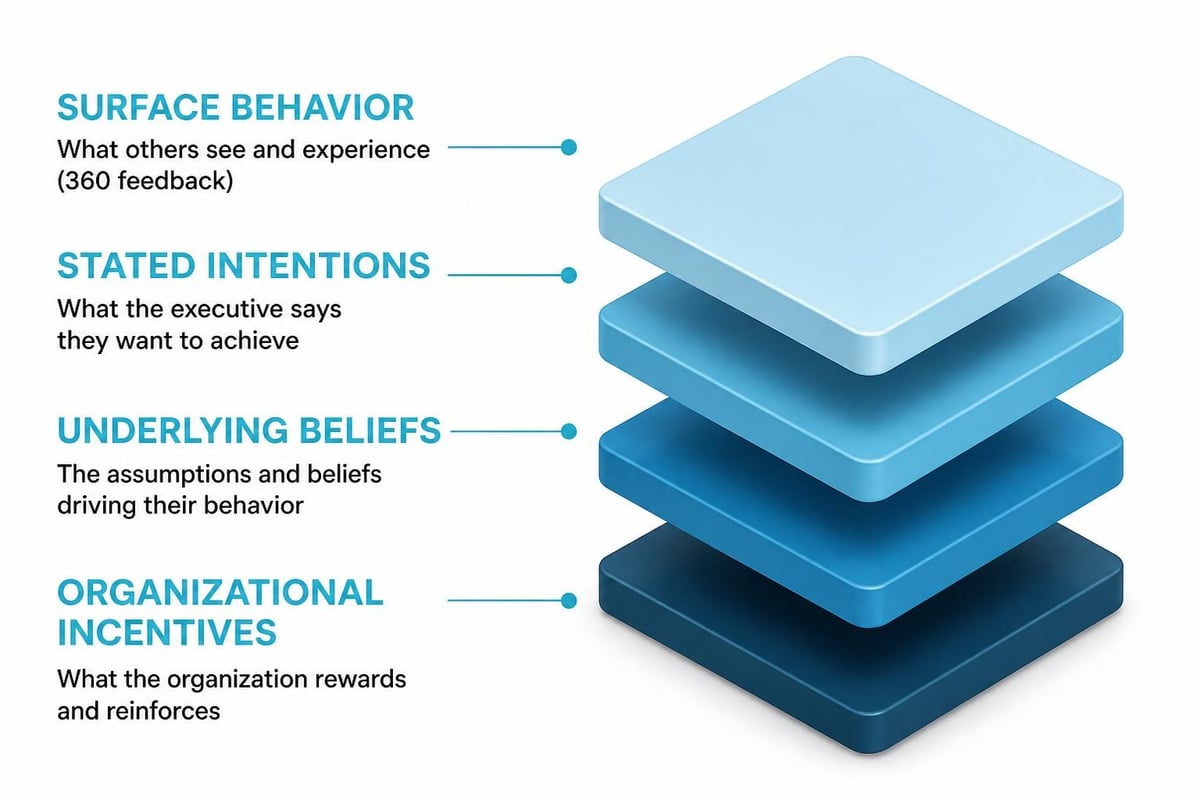
Surface-level coaching focuses on communication skills or emotional intelligence. Effective coaching for executives with a poor 360 result digs into why the executive's leadership model broke down.
In a 2024 engagement with a financial services VP, the 360 revealed consistent feedback: "doesn't listen" and "dismisses concerns." The executive believed he was decisive and action-oriented. The root cause wasn't listening skills. It was his belief that pausing to process input would be perceived as weakness. His behavior was logical given his mental model. Coaching addressed the model, not the symptom.
Key questions that surface root causes:
- What trade-off were you making when you chose this behavior?
- What do you believe would happen if you did the opposite?
- What does this behavior protect you from?
- Who taught you this approach, and where has it worked well before?
These questions reveal whether the executive operates from fear, outdated success patterns, or misaligned incentives. Behavior change happens when the executive sees the cost of staying the same.
When Coaching Isn't the Right Intervention
Some poor 360 results signal incompatibility, not development needs. Coaching can't fix every leadership problem, and trying wastes organizational resources.
Three situations where coaching fails:
- The executive fundamentally disagrees with the feedback and views it as politically motivated or unfair after multiple coaching sessions
- Behavioral patterns involve ethics violations, harassment, or conduct that creates legal exposure for the organization
- The executive's leadership philosophy conflicts with organizational values (e.g., command-and-control leader in a culture transitioning to distributed decision-making)
A Fortune 500 client spent $40,000 on executive coaching in 2025 for a division president whose 360 revealed concerns about retaliation and favoritism. After six months, behavior hadn't changed. The issue wasn't skill. It was judgment and values. The organization separated from the executive three months later. Coaching became an expensive delay.
Executive coaching for government agencies often surfaces this challenge because public sector leaders operate under different accountability structures and may resist feedback that questions their authority or decision-making approach.
The Readiness Test
Before investing in coaching, assess three factors:
- Insight: Does the executive recognize at least some themes in the feedback as valid?
- Ownership: Do they acknowledge their behavior contributed to the results, even if context matters?
- Agency: Do they believe they can influence how others perceive them through behavior change?
If the answer to any question is no, coaching won't work until those foundational beliefs shift.
Stakeholder Interviews: The Missing Diagnostic Step
Most coaching engagements rely solely on 360 data. That's incomplete. Coaches should interview 4-6 raters to understand context the survey can't capture.
Stakeholder interviews reveal:
- Situational triggers: The executive's behavior deteriorates under specific conditions (deadline pressure, budget constraints, senior leadership scrutiny)
- Relationship patterns: The executive has strong relationships with certain personality types and breaks down with others
- Organizational dynamics: Poor scores reflect broader team dysfunction or restructuring trauma, not just individual behavior
A technology executive I worked with in early 2026 received harsh feedback about micromanagement. Interviews revealed the team had experienced three leadership changes in 18 months and interpreted any oversight as distrust. The executive's behavior wasn't the sole problem. The team's trauma response amplified every action. Coaching addressed both the executive's need to rebuild trust and the team's need for stability signals.
Harvard Business Review's guidance on turning 360-degree feedback into dialogue emphasizes that feedback becomes actionable when coaches facilitate conversations between executives and raters, moving beyond survey data to collaborative problem-solving.
Interview Protocol That Works
Coaches should ask raters:
- What does this executive do that helps you succeed?
- What one behavior change would make the biggest difference in how you work together?
- If the executive asked you directly what to start, stop, or continue, what would you say?
- What context should they understand about how the team is experiencing the current environment?
These questions generate usable insight, not venting sessions. Frame interviews as input for the executive's development plan, not a second round of criticism.
Designing Pilot Interventions: Small Bets, Fast Feedback
Coaching for executives with a poor 360 result fails when it tries to fix everything simultaneously. Effective plans identify 2-3 high-impact behaviors and run experiments that generate observable change quickly.
Example pilot interventions by feedback theme:
| Feedback Theme | Pilot Intervention | Observable Change | Timeline |
|---|---|---|---|
| "Doesn't listen" | Ask one clarifying question before responding in meetings | Team members contribute more ideas unprompted | 2 weeks |
| "Creates fear" | Acknowledge mistakes openly in team setting | Direct reports raise concerns earlier | 3 weeks |
| "Plays favorites" | Rotate who presents work in leadership reviews | Team perceives fairer opportunity distribution | 4 weeks |
| "Unclear expectations" | Send Friday summary of priorities for coming week | Fewer missed deadlines or misaligned deliverables | 2 weeks |
Pilots work because they're testable. The executive tries a new behavior, observes what happens, and adjusts. This approach treats leadership development as hypothesis testing, not personality renovation.

Measuring What Matters
Track progress through informal pulse checks, not another full 360. Ask 3-4 direct reports: "What's different? What's better? What still needs work?" Quick feedback accelerates learning.
SHRM’s explanation of the difference between feedback and coaching in performance management clarifies that coaching uses ongoing feedback loops to build capability, while formal feedback evaluates outcomes. Poor 360 results demand both.
The Organizational Half of the Equation
Poor 360 results rarely exist in isolation. Organizational culture, incentive structures, and leadership norms shape how executives behave.
If an executive gets promoted for aggressive decision-making and then receives poor scores for "not listening," the organization sent mixed signals. Coaching won't overcome misaligned incentives.
Questions HR should ask before deploying coaching:
- Do our promotion criteria reward the behaviors the 360 measures?
- Are we asking this executive to lead differently than the executives who promoted them led?
- What organizational practices make this behavior more likely? (unrealistic timelines, under-resourced teams, unclear authority)
- If this executive changes and performance doesn't improve, what does that tell us?
A manufacturing client in 2025 sent five executives to coaching after poor 360 results. All five led teams experiencing major restructuring. Scores improved modestly, but engagement stayed low. The problem wasn't the executives. It was decision-making opacity from senior leadership and chronic resource constraints. Coaching became a convenient way to avoid addressing systemic issues.
Organizations serious about leadership development pair executive coaching with evidence-based leadership diagnostics that assess team health, decision-making effectiveness, and cultural alignment alongside individual capability.
What Success Looks Like Six Months In
Improved scores matter, but behavioral sustainability matters more. Coaching for executives with a poor 360 result succeeds when the executive builds new habits that stick after coaching ends.
Success indicators by stage:
- Month 1-2: Executive demonstrates insight and commits to 2-3 specific behavior changes
- Month 3-4: Direct reports and peers notice changes without prompting
- Month 5-6: New behaviors become default, not effortful; executive self-corrects when old patterns emerge
- Month 7-12: Follow-up 360 or pulse survey shows measurable improvement in target areas
A healthcare executive I coached in 2025 received brutal feedback about "abrasive communication." After four months, her team reported she was "asking more questions" and "less reactive in meetings." By month six, she had developed a pre-meeting routine where she identified two people she wanted to hear from and made space for their input. The behavior became automatic. Her next 360, nine months later, showed a 1.3-point improvement in communication effectiveness.
Coaching doesn't make executives perfect. It makes them capable of recognizing their impact and adjusting their approach based on data, not ego.
When to Escalate Beyond Coaching
Some situations require intervention beyond one-on-one coaching. If an executive shows minimal progress after three months of committed work, or if new concerning behaviors surface, escalate to HR or senior leadership.
Escalation triggers:
- Written feedback in a follow-up pulse survey reveals the executive's behavior is getting worse, not better
- The executive engages in coaching but doesn't apply lessons in real work situations
- Team attrition accelerates during the coaching period
- The executive blames the team, raters, or organization for lack of progress
Escalation isn't failure. It's recognition that the problem exceeds what coaching can address. Some executives need reassignment to roles better suited to their strengths. Others need formal performance management. A few need to leave the organization.
Coaching is a powerful tool for executives committed to growth. It's not a substitute for accountability when fundamental fitness for role is the issue.
Poor 360 results demand diagnostic precision, structured intervention, and organizational honesty about whether coaching is the right tool. When executives possess insight, ownership, and agency, coaching converts critical feedback into measurable behavior change. Noomii Leadership Coaching pairs executives with certified coaches who specialize in translating 360 data into development plans that stick, using evidence-based frameworks and accountability structures that ensure results outlast the coaching engagement.
FAQ
What should an executive do immediately after receiving a poor 360 result?
Review the results within 24 hours with your direct manager to understand organizational expectations and confirm whether this is a development opportunity or a performance issue. Complete a structured reflection identifying themes you recognize and behaviors you're willing to examine before your first coaching session, which should happen within 72 hours.
How long does coaching typically take to address poor 360 feedback?
Effective coaching engagements run 4-6 months with measurable behavior changes visible within 6-8 weeks. Initial sessions focus on root cause analysis and stakeholder interviews, followed by 2-3 pilot interventions tested in low-risk settings. Sustainable change requires 6-12 months to become default behavior.
Can coaching fix all poor 360 results?
No. Coaching works when executives demonstrate insight (recognize feedback as valid), ownership (acknowledge their behavior contributed), and agency (believe they can change how others perceive them). If feedback involves ethics violations, values misalignment, or the executive fundamentally rejects the feedback after multiple sessions, coaching isn't the right intervention.
Should the executive meet with people who gave negative feedback?
Not directly about their ratings. The coach should conduct confidential stakeholder interviews with 4-6 raters to gather context the survey can't capture. Once the executive has a development plan, they can share changes they're working on and ask for ongoing feedback, but avoid making it about defending past behavior or identifying who said what.
How do you measure if coaching is working before the next 360?
Use informal pulse checks at 6-8 weeks asking 3-4 direct reports what's different, what's better, and what still needs work. Observable indicators include team members contributing more in meetings, raising concerns earlier, or commenting unprompted on specific behavior changes.
What's the difference between a development opportunity and a performance issue?
Development opportunities assume the executive has the capacity and commitment to change with support and time. Performance issues indicate fundamental fitness for role questions, values misalignment, or conduct creating organizational risk. The first coaching conversation should clarify which situation applies and what's at stake if behavior doesn't improve.


Leave a Reply
Want to join the discussion?Feel free to contribute!