

C Suite Coaching for a Newly Appointed Executive
Most newly appointed C-suite executives fail not because they lack competence, but because they misread the system they've entered. They bring strong credentials, proven track records, and board confidence, yet within six months, 40% are already struggling with credibility, team dynamics, or strategic misalignment. The difference between executives who thrive and those who derail often comes down to one variable: whether they engaged in c suite coaching for a newly appointed executive during the critical transition window.
The Hidden Complexity of Executive Transitions
Executive transitions look deceptively simple from the outside. A leader gets promoted or hired, receives congratulations, and starts work. What's invisible is the complexity beneath that surface.
New C-suite members face what IMD researchers call "transition-specific challenges" that differ fundamentally from ongoing development needs. They must simultaneously decode political dynamics, build credibility with skeptical peers, inherit teams with existing loyalties, and deliver results under compressed timelines. These aren't sequential tasks. They happen concurrently, often with conflicting demands.
In our work with Fortune 500 companies and government agencies, we've observed a consistent pattern: executives who enter transitions without structured support make predictable errors. They over-rely on what worked in previous roles. They move too fast on structural changes before understanding cultural undercurrents. They underestimate the coalition-building required at the C-suite level.
The First 90 Days: Where Coaching Delivers Maximum ROI
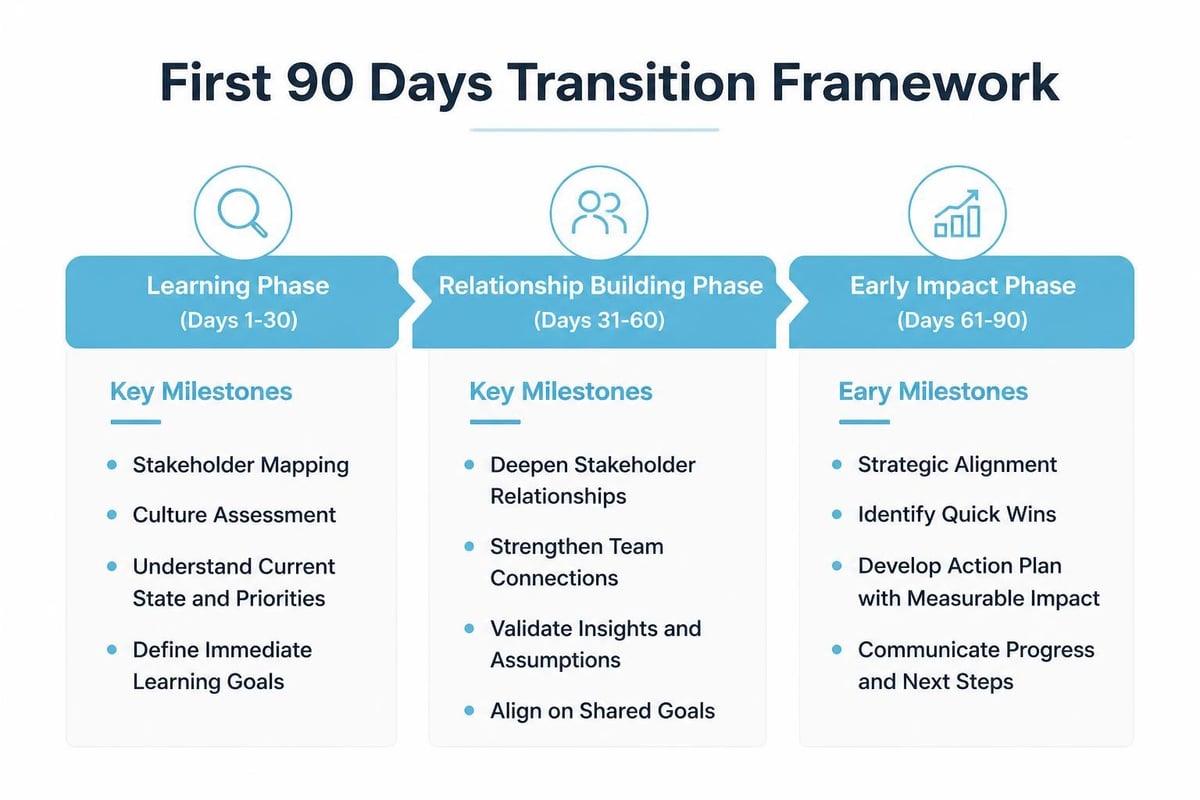
The window for c suite coaching for a newly appointed executive isn't open indefinitely. Research and practice both point to the first 90 days as the critical intervention period.
Why this timeframe matters:
- Stakeholder impressions form rapidly. Within 45 days, peers and direct reports have formed judgments about a new executive's competence, style, and trustworthiness.
- Early decisions create path dependencies. Initial choices about team composition, priorities, and working norms establish patterns that become increasingly difficult to change.
- Learning curves are steepest. New executives absorb more information about culture, politics, and hidden dynamics in the first quarter than in the subsequent year.
A Harvard Business Review executive playbook emphasizes that onboarding is a team sport, not an individual exercise. The most effective c suite coaching for a newly appointed executive treats the leader's integration as a system-level intervention, not just personal development.
What Newly Appointed Executives Get Wrong
Over 200 executive transitions we've supported reveal recurring blind spots. These aren't failures of intelligence or effort. They're structural misreadings that even accomplished leaders make under transition pressure.
Misreading the Mandate
Boards and CEOs often communicate incomplete or contradictory expectations. A new CFO hears "transform finance operations" but misses the unspoken constraint: don't threaten the controller who has 25 years of institutional knowledge and CEO trust. A new COO receives a mandate for "operational excellence" without clarity on whether that means cost reduction, quality improvement, or speed to market.
Effective coaches surface these ambiguities early. They push executives to test assumptions, seek clarifying conversations, and identify whose definition of success actually matters. The World Economic Forum’s discussion with transition coaches highlights that newly appointed CEOs consistently underestimate the importance of explicit alignment conversations in the first 30 days.
Overvaluing Technical Expertise, Undervaluing Political Intelligence
New executives typically earned their roles through functional excellence. They were exceptional at operations, finance, technology, or sales. That expertise becomes a trap when they default to solving problems through technical prowess rather than organizational influence.
We worked with a newly appointed Chief Information Officer at a government agency who spent her first 60 days designing a modernization roadmap. The analysis was brilliant. The execution failed because she hadn't invested time understanding agency politics, competing budget priorities, or the informal power structure. By the time she recognized the oversight, key stakeholders had already formed coalitions to resist her initiatives.
C suite coaching for a newly appointed executive addresses this directly by shifting focus from what to do to how to build the organizational capacity to execute. Coaches guide leaders through stakeholder mapping, influence strategies, and coalition-building before they commit to major initiatives.
Inheriting Teams Without Diagnosing Team Health
Most new executives inherit existing teams. The temptation is to either keep everyone (risk aversion) or make immediate changes (decisive action). Both approaches miss the diagnostic step.
High-performing coaches help new leaders conduct systematic team assessments within the first 45 days:
| Assessment Dimension | Key Questions | Why It Matters |
|---|---|---|
| Capability Gaps | Does the team have the skills needed for future strategy? | Determines development vs. hiring needs |
| Trust & Collaboration | Do team members support each other or operate in silos? | Predicts execution effectiveness |
| Alignment on Priorities | Is there shared understanding of what matters most? | Reveals hidden conflicts and confusion |
| Engagement & Morale | Are top performers energized or looking for exits? | Flags retention risks early |
This diagnostic discipline prevents two costly errors: keeping underperformers too long out of caution, or losing strong performers through premature restructuring.
The Evidence Base for Transition Coaching
Executive coaching isn't a soft intervention. A meta-analysis of randomized controlled trials demonstrates measurable effects on executive behaviors, decision-making quality, and team outcomes. Workplace coaching interventions show particularly strong effects when targeted at specific transitions rather than general development.
The evidence matters because c suite coaching for a newly appointed executive requires investment. Organizations need to know what they're buying.
What Works: Transition-Specific Coaching Design
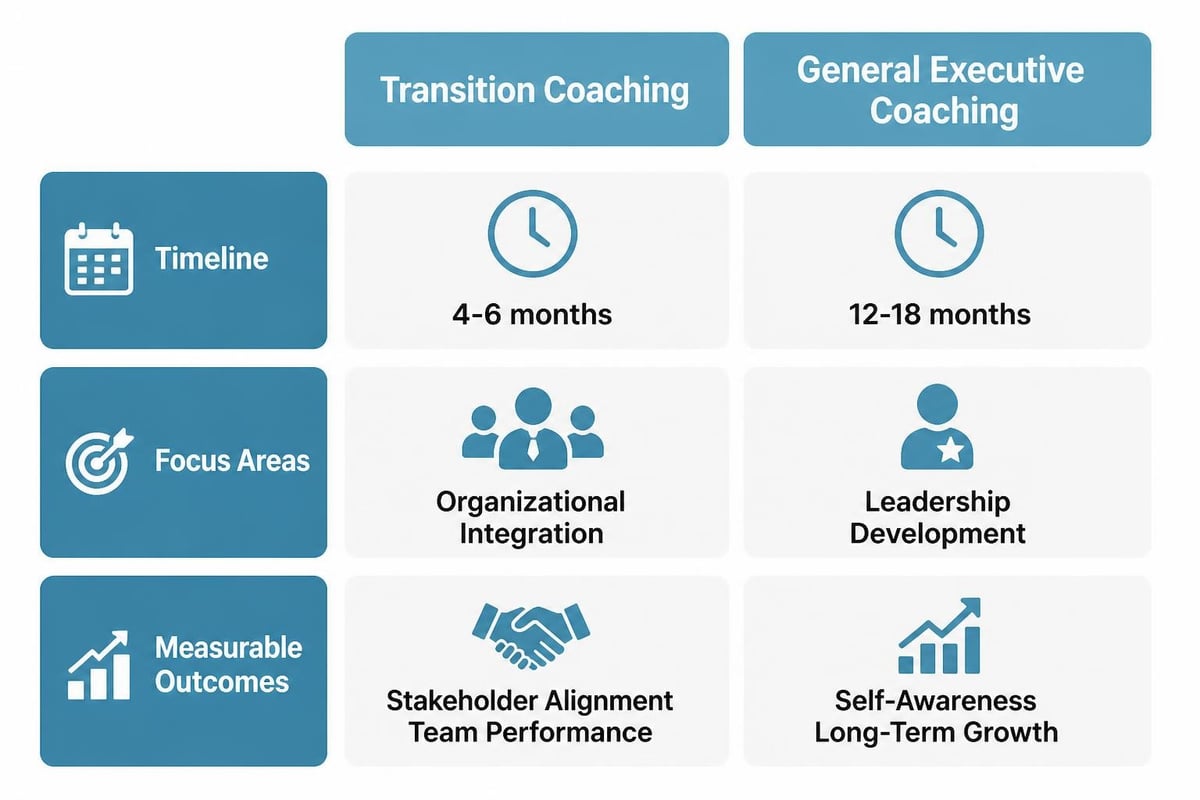
Generic executive coaching focuses on long-term leadership development. Transition coaching operates differently, with distinct characteristics:
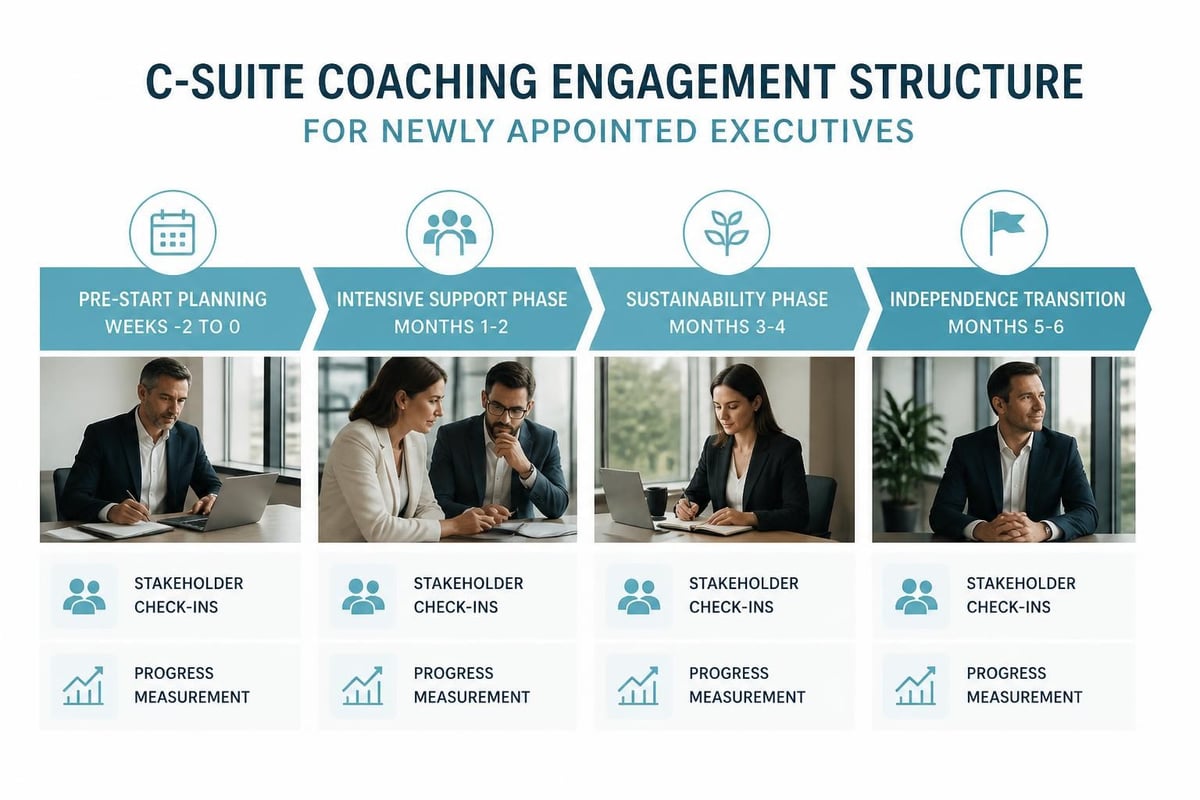
Shorter time horizons. Most effective transition coaching runs 4-6 months, with intensive support in months 1-2 and decreasing frequency thereafter.
Situational diagnosis first. Before addressing the leader's development needs, transition coaches map the organizational context: culture, power dynamics, inherited challenges, and stakeholder expectations.
Action-oriented. Each coaching session should produce specific next steps: conversations to have, decisions to make, stakeholders to engage.
Team integration focus. Unlike individual development coaching, transition coaching often includes team sessions, peer feedback, and stakeholder interviews to accelerate organizational integration.
A broader meta-analysis on workplace coaching reinforces that coaching effectiveness increases when tied to specific organizational outcomes rather than abstract leadership competencies.
The Coach Match Problem
Not every executive coach can effectively support c suite coaching for a newly appointed executive. The skill set differs from coaches who excel at long-term development, team facilitation, or functional expertise.
What Separates Effective Transition Coaches
Through our network of certified executive coaches supporting government agencies and Fortune 500 companies, we've identified the capabilities that predict transition coaching success:
-
Executive-level experience. Coaches who've operated at C-suite or equivalent levels understand the political complexity, board dynamics, and pressure that new executives face.
-
Sector fluency. A coach supporting a new hospital system COO needs healthcare industry knowledge. A coach working with a newly appointed agency director needs public sector experience. Generic business coaching doesn't translate.
-
Diagnostic precision. Strong transition coaches conduct stakeholder interviews, review organizational data, and assess team dynamics before designing coaching interventions. They diagnose the system, not just the individual.
-
Practical orientation. The best transition coaches balance insight with pragmatism. They help executives navigate real dilemmas with incomplete information rather than waiting for perfect clarity.
The matching challenge is significant. Many organizations default to brand-name coaching firms or coaches with strong credentials but no transition specialization. The mismatch wastes time and money during the window when coaching delivers maximum value.
Precision coach matching that accounts for transition expertise, sector knowledge, and situational fit significantly improves outcomes. Organizations that treat coach selection as a strategic decision rather than a vendor procurement see measurably better results.
Common Transition Scenarios and Coaching Applications
C suite coaching for a newly appointed executive isn't one-size-fits-all. Different transition types create different challenges and coaching needs.
Internal Promotion to C-Suite
An internal promotion brings the advantage of organizational knowledge and existing relationships. It also creates distinct challenges.
The peer-to-boss dynamic. Yesterday's colleagues are today's direct reports. Former peers at the leadership table now expect deference. Navigating these relationship shifts while maintaining authenticity is complex.
Proving you've evolved beyond your functional expertise. Internal promotions often struggle with perception: "She's a great CFO but can she think like a CEO?" Coaching helps leaders demonstrate strategic breadth without abandoning the functional credibility that earned them the role.
Managing inherited expectations and loyalties. Internal leaders carry history. Teams have pre-existing opinions, the organization knows their weaknesses, and stakeholders may resist change because "we've always done it this way."
We supported a newly promoted Chief Operating Officer at a manufacturing company who'd spent 15 years in operations. His peers questioned whether he could think beyond operational efficiency to broader business strategy. Coaching focused on reframing his narrative, building cross-functional partnerships, and making early strategic contributions that shifted perception. Within 90 days, board feedback reflected increased confidence in his enterprise leadership capability.
External Hire to C-Suite
External hires face the opposite challenge: they bring fresh perspective but lack organizational context and relationships.
Accelerated cultural learning. External executives must decode culture, understand informal power structures, and identify sacred cows without the benefit of years of accumulated knowledge.
Building trust from zero. Internal candidates start with some baseline credibility. External hires must earn it, often while facing skepticism: "Why did we need to hire from outside?"
Avoiding the savior trap. Boards often hire external executives to drive change. The temptation is to arrive with solutions before understanding problems. This alienates stakeholders and leads to failed initiatives.
A newly appointed Chief Technology Officer we coached came from a high-growth technology company to a traditional financial services firm. Her instinct was to immediately modernize technology stacks and processes. Coaching helped her slow down, invest in stakeholder listening, and sequence changes to build coalition support. The delayed start created faster long-term execution because she built organizational buy-in before pushing major initiatives.
First-Time C-Suite Role
Leaders entering the C-suite for the first time face an additional layer of complexity: they're learning both a new role and a new organizational level simultaneously.
Understanding C-suite dynamics. The leadership team operates differently than any other team in an organization. Decision-making is more political, accountability is more visible, and mistakes have broader consequences.
Navigating CEO expectations. First-time C-suite executives often underestimate how different the relationship with the CEO is compared to any previous boss relationship.
Managing expanded scope and ambiguity. C-suite roles come with broader mandates, less structure, and more ambiguous success metrics than functional leadership roles.
The table below outlines coaching focus areas by transition type:
| Transition Type | Primary Challenges | Coaching Focus Areas |
|---|---|---|
| Internal Promotion | Relationship resets, proving strategic capability, managing history | Reframing narrative, strategic visibility, peer relationship navigation |
| External Hire | Cultural learning, building trust, avoiding premature solutions | Stakeholder listening, coalition building, sequencing change |
| First-Time C-Suite | Understanding executive dynamics, CEO relationship, managing ambiguity | Executive team integration, decision-making frameworks, executive presence |
Building the Coaching Engagement
Organizations that implement c suite coaching for a newly appointed executive most effectively treat it as a strategic initiative, not an HR benefit.
Pre-Start Engagement
The coaching relationship should begin before the executive's first day. Pre-start coaching focuses on entry strategy: who to meet first, what to learn, how to structure the first 30 days.
This isn't about teaching job skills. It's about strategic planning for the transition. Coaches work with executives to:
- Identify key stakeholders and plan early conversations
- Develop hypotheses about organizational challenges to test
- Design a learning agenda for the first 90 days
- Anticipate political dynamics and plan navigation strategies
Organizations that wait until week three or four to introduce coaching miss the highest-leverage intervention window.
Structured Stakeholder Input
Effective transition coaching incorporates 360-degree stakeholder perspectives early. Within the first 30 days, coaches should conduct confidential interviews with:
- The hiring manager (CEO, board chair)
- C-suite peers
- Key direct reports
- Critical cross-functional partners
- Selected external stakeholders (board members, key customers, regulators)
These interviews serve dual purposes: they provide the coach with organizational intelligence to inform coaching, and they signal to stakeholders that the new executive values their input and is committed to integration.
Ongoing Measurement and Adjustment
The best coaching engagements establish clear success metrics upfront and track progress systematically.
Sample metrics for c suite coaching for a newly appointed executive:
- Stakeholder confidence scores (measured at 30, 60, 90 days)
- Team engagement and alignment indicators
- Strategic initiative launch timeline and quality
- Peer relationship health assessments
- Early business outcome markers relevant to the role
This measurement discipline keeps coaching focused on organizational impact rather than executive comfort. It also provides data-driven insights that HR and learning leaders can use to demonstrate coaching ROI.
The Organizational Context That Coaching Can't Fix
C suite coaching for a newly appointed executive isn't a substitute for organizational dysfunction. Coaching works when the system is fundamentally healthy but needs help integrating a new leader. It fails when underlying organizational problems sabotage even strong executives.
When Coaching Isn't Enough
We've declined coaching engagements when diagnostic work revealed systemic issues that coaching can't address:
Misaligned mandates. When the board, CEO, and stakeholders have fundamentally different expectations for a new executive's role, coaching can't bridge that gap. The organization needs executive alignment first.
Toxic team dynamics. If a new leader inherits a team with deep dysfunction, unaddressed misconduct, or complete lack of trust, individual coaching won't solve the problem. The organization needs broader leadership intervention.
Resource constraints that make success impossible. Coaching can't compensate for inadequate budgets, insufficient staffing, or structural barriers that prevent execution.
Organizations should conduct honest assessments before investing in coaching. Is the organization ready to support a new executive's success, or are we asking coaching to solve problems that require systemic change?
Integrating Coaching with Broader Onboarding
The IMD annual report on executive education trends shows increasing recognition that coaching works best as part of comprehensive onboarding, not as a standalone intervention.
Effective integration includes:
- Executive team facilitation to accelerate peer relationships
- Structured onboarding programs that provide organizational context
- Clear performance expectations and success metrics
- Regular check-ins with the hiring manager beyond coaching sessions
- Access to organizational resources, networks, and information
Organizations treating coaching as the entire onboarding strategy set new executives up for unnecessary struggle.
Frequently Asked Questions
How long should c suite coaching for a newly appointed executive last?
Most effective transition coaching engagements run 4-6 months, with intensive support in the first 60 days (often weekly or bi-weekly sessions) tapering to monthly check-ins in months 3-6. This timeline aligns with the critical transition period while avoiding dependency. Some executives extend to 12 months for ongoing development, but the transition-specific coaching should be time-bound.
What's the typical investment for executive transition coaching?
C-suite transition coaching typically ranges from $15,000 to $50,000 for a 6-month engagement, depending on coach credentials, engagement intensity, and included components (stakeholder interviews, team sessions, assessments). Given that executive hiring and onboarding costs often exceed $1 million when factoring in search fees, salary, relocation, and opportunity costs, coaching represents 1.5-5% of total investment while significantly reducing derailment risk.
Should coaching be confidential or should the organization receive updates?
The best practice is structured transparency: coaching conversations remain confidential, but the engagement includes periodic three-way check-ins (executive, coach, and hiring manager or CHRO) to review progress against objectives. This balances psychological safety with organizational accountability. Stakeholder interviews conducted by the coach should be confidential to encourage candor.
How do you measure whether transition coaching is working?
Effective measurement combines leading and lagging indicators. Leading indicators include stakeholder confidence scores, team engagement metrics, and peer relationship quality assessed at 30, 60, and 90 days. Lagging indicators include business outcomes tied to the executive's mandate, retention of key team members, and successful launch of strategic initiatives. The strongest evidence comes from multi-source feedback showing improved perception and effectiveness over the transition period.
Can transition coaching work virtually or does it need to be in-person?
Both formats can work, but hybrid approaches often prove most effective. Initial sessions should include in-person time if possible to build coach-executive rapport and allow the coach to observe organizational dynamics firsthand. Subsequent sessions can be virtual for efficiency. For geographically distributed organizations or remote executives, fully virtual coaching can succeed when supplemented with stakeholder video interviews and digital collaboration tools that provide organizational context.
The first 90 days of a C-suite appointment determine whether a leader builds momentum or fights credibility battles for years. Evidence-based c suite coaching for a newly appointed executive accelerates integration, prevents predictable derailment, and transforms individual transitions into organizational opportunities. Noomii Leadership Coaching combines precision coach matching with transition-specific expertise to help newly appointed executives and their organizations navigate these critical windows with confidence and measurable results.


Leave a Reply
Want to join the discussion?Feel free to contribute!