

AI Coaching Sounded Brilliant But Wasn’t: What Happened
Between 2023 and mid-2026, hundreds of mid-market companies bought into AI coaching platforms. The pitch was compelling: instant feedback, 24/7 availability, personalized development at scale, and costs well below traditional coaching. For HR leaders managing 50 to 300 employees, the numbers worked beautifully on paper. Then reality arrived. Most found that AI coaching sounded brilliant but wasn't what their managers actually needed when facing real leadership challenges.
The Promise Looked Perfect on Every Slide
Vendors demonstrated slick interfaces. AI bots asked thoughtful-sounding questions. Dashboards tracked engagement metrics. The technology appeared to solve three persistent problems at once:
- Scale – Every manager gets coaching without hiring a team of humans
- Cost – Monthly per-seat fees versus $300-plus hourly rates
- Consistency – Same methodology applied across the organization
Sales presentations included charts showing adoption rates, session frequency, and user satisfaction scores. What rarely appeared? Evidence that managers made better decisions, held tougher conversations, or drove measurable business outcomes after six months of AI coaching.

Pattern Matching Is Not Judgment
The core limitation became obvious once managers faced actual leadership dilemmas. AI systems excel at pattern recognition. They've ingested thousands of coaching transcripts, leadership books, and management frameworks. When a mid-level manager describes a team conflict in generic terms, the AI delivers reasonable questions and suggests common frameworks like GROW or CLEAR models.
Here's where AI coaching sounded brilliant but wasn't sufficient: Real leadership moments require context-specific judgment that current systems cannot provide.
A manufacturing VP needed to restructure a department while retaining key technical talent during a product pivot. The AI chatbot offered change management frameworks and stakeholder mapping exercises. What the VP actually needed? Someone who understood manufacturing org charts, competitive retention packages, and how to sequence tough conversations when two senior engineers hate each other.
A SaaS director faced a situation where her best performer was undermining team cohesion. The AI suggested feedback templates and conflict resolution scripts. The real issue required diagnosing whether this was a culture fit problem, a compensation equity issue, or a signal that her own leadership style was creating the dynamic.
Recent evaluation of mental health chatbots highlighted performance gaps when systems faced scenarios outside their training distribution. Leadership coaching hits the same wall.
The Feedback Loop Breaks Down
AI systems struggle with what they cannot observe. They work with what users type. Most managers, especially under pressure, describe situations incompletely or with significant bias.
| Human Coach Capability | AI Limitation |
|---|---|
| Reads body language and tone during live meetings | Text-only input limits diagnostic accuracy |
| Asks follow-up questions based on micro-expressions | Cannot detect what the manager is avoiding |
| Observes actual team dynamics firsthand | Relies entirely on self-reported narratives |
| Challenges rationalizations in real time | Tends to validate input rather than confront |
The American Psychological Association’s health advisory on generative-AI chatbots cautions that these systems can provide misleading reassurance. The same applies to leadership coaching: An AI tool can make a manager feel coached without improving their actual performance.
What Buyers Missed During Evaluation
Three critical gaps appeared during vendor selection that most companies only recognized six months into deployment:
- Demo scenarios were softball questions – Vendors showcased the AI handling common challenges with polished responses, not the messy, politically charged situations that derail real managers
- Engagement metrics replaced outcome metrics – Companies measured logins and session completion instead of whether managers' direct reports reported improved leadership
- No accountability for business results – AI vendors sold software licenses, not coaching outcomes tied to retention, revenue, or execution improvements
Harvard Business Review’s discussion on building AI assistants noted that confidentiality concerns and the tendency for AI to give false reassurance are particularly problematic in coaching contexts. Mid-market companies discovered this when managers stopped bringing their hardest problems to AI tools because the responses felt generic.
The Hidden Cost: Opportunity Loss
The real damage wasn't the subscription fee. It was the six to twelve months spent deploying AI coaching while actual leadership problems compounded.
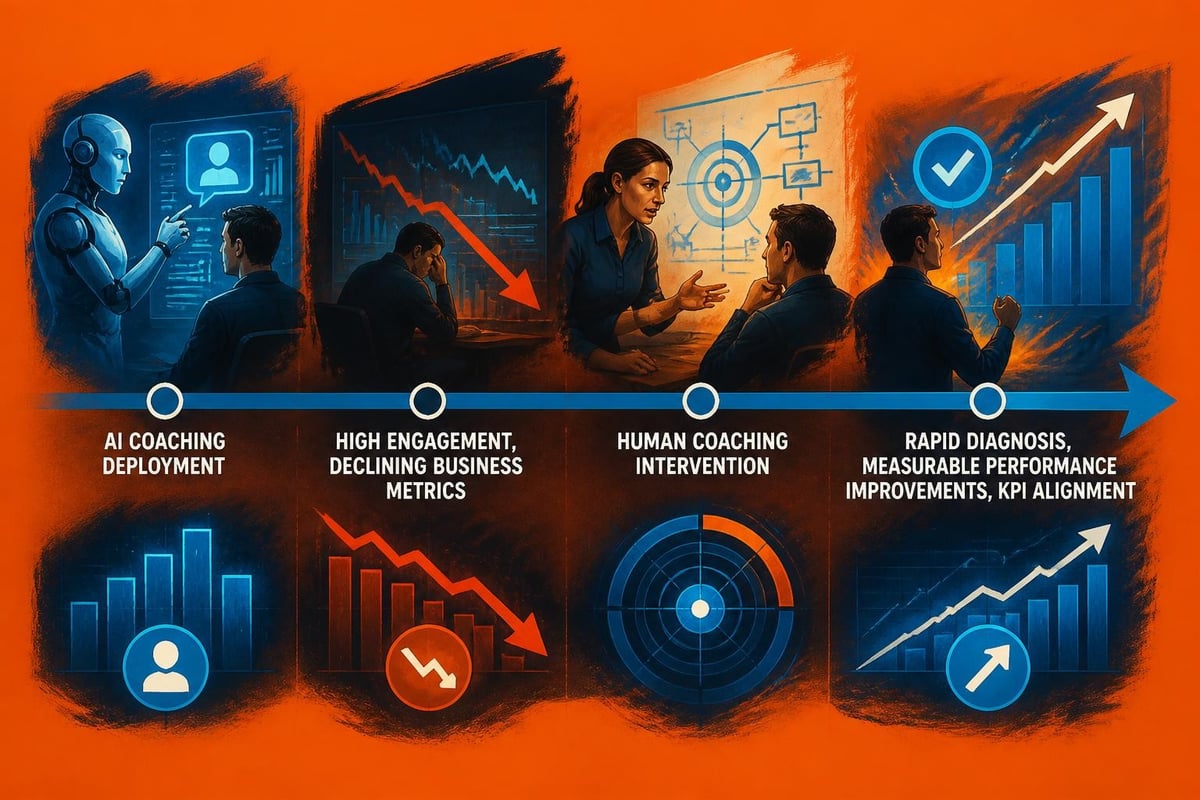
Example from a 280-employee logistics company: They invested in an AI coaching platform for 35 managers in Q1 2025. Usage looked strong through Q2. By Q3, turnover among high performers had increased, cross-functional projects were stalling, and three managers left citing lack of real development support. The AI platform showed 78% engagement. The business showed deteriorating team performance.
When they switched to executive coaching focused on operating cadence and KPI scorecards, problems that had festered for months got diagnosed and addressed within weeks.
The Certification Parallel
The AI coaching disappointment mirrors another industry pattern: credential worship. Many companies believed ICF-certified coaches automatically delivered better results, only to find certification said nothing about business acumen or outcome focus. Certified coaches still struggle to get clients for good reason – credentials don't equal effectiveness.
Similarly, AI coaching sounded brilliant but wasn't a substitute for expertise. The technology impressed, the frameworks looked solid, but results remained elusive because pattern matching cannot replace judgment honed through hundreds of live coaching engagements.
What Actually Works: Hybrid Reality
By late 2025, smarter buyers stopped treating AI as replacement coaching and started positioning it appropriately:
- Skill practice and reinforcement between human coaching sessions
- On-demand access to frameworks and templates during low-stakes situations
- Prep work before live coaching calls to help managers articulate challenges more clearly
- Micro-learning delivery for tactical management skills
The companies seeing ROI from leadership development in 2026 combine technology with human expertise. AI handles repetition and information delivery. Experienced coaches handle diagnosis, accountability, and real-time intervention in critical moments.
Microsoft Research’s RUBICON framework for evaluating domain-specific human-AI conversations revealed exactly why AI coaching sounded brilliant but wasn't delivering: The systems performed well on surface metrics while missing the deeper patterns that determine coaching effectiveness.
Evidence Gaps and Regulatory Concerns
Peer-reviewed analysis of using large language models in psychotherapy identified computational and ethical challenges that apply equally to leadership coaching contexts. Current AI systems lack:
- Ability to assess when a manager needs escalation to mental health support
- Understanding of organizational politics and power dynamics
- Capability to recognize when a leader's self-description contradicts observed behavior
- Mechanisms to ensure advice aligns with company culture and strategic priorities
WHO guidance on ethics and governance of large models in health emphasizes that deployment should follow evidence of benefit, not just technological capability. Most AI coaching platforms launched without controlled studies showing they improved leadership effectiveness or business outcomes.

What Mid-Market Leaders Should Demand
Based on three years of watching companies deploy and then abandon AI coaching tools, here's what actually predicts success:
For AI tools – Demand proof of business outcomes, not engagement metrics. Ask for case studies showing improved retention, faster decision-making, or better team performance tied to the technology.
For human coaching – Require coaches who work inside your operations, attend key meetings, and tie development to specific KPIs. Month-to-month terms signal confidence in results.
For hybrid approaches – Insist on clear role definition. What does AI handle, what requires human judgment, and how do you measure whether the combination drives business improvement?
The pattern is clear: AI coaching sounded brilliant but wasn't a replacement for experienced coaching tied to business outcomes. Companies that accepted this reality and deployed technology appropriately saw benefits. Those that tried to substitute algorithms for judgment lost months of opportunity while leadership problems compounded.
AI coaching platforms promised transformation but mostly delivered engagement metrics while real leadership challenges went unaddressed. Mid-market companies need development approaches tied to measurable business results, not impressive technology demos. Noomii connects organizations with experienced coaches who work live in your meetings, focus on clear KPIs and ROI, and operate month-to-month so you stay because results are visible, not because you're locked into multi-year contracts.


Leave a Reply
Want to join the discussion?Feel free to contribute!