

How Coaching Pays for Itself: ROI and Real Results
Most executives buy coaching like they buy consulting: upfront cost, vague outcomes, fingers crossed. That approach fails because it treats coaching as an expense rather than an investment with measurable returns. The question isn't whether coaching costs money, it's whether the business outcomes justify the spend. When structured correctly, how coaching pays for itself becomes visible within 90 to 180 days through retention savings, faster execution, and revenue protection.
The Retention Math That Changes Everything
A single departure at the manager level costs 100% to 300% of annual salary when you factor in recruiting fees, onboarding time, lost productivity, and tribal knowledge walking out the door. If you're paying a manager $120,000, that departure just cost you $120,000 to $360,000.
Coaching changes this equation dramatically:
- Reduced turnover risk: Managers who receive coaching report 40% to 60% higher engagement scores
- Faster conflict resolution: Teams with coached leaders resolve disputes in days, not weeks
- Clearer succession paths: High performers see growth opportunities and stay longer
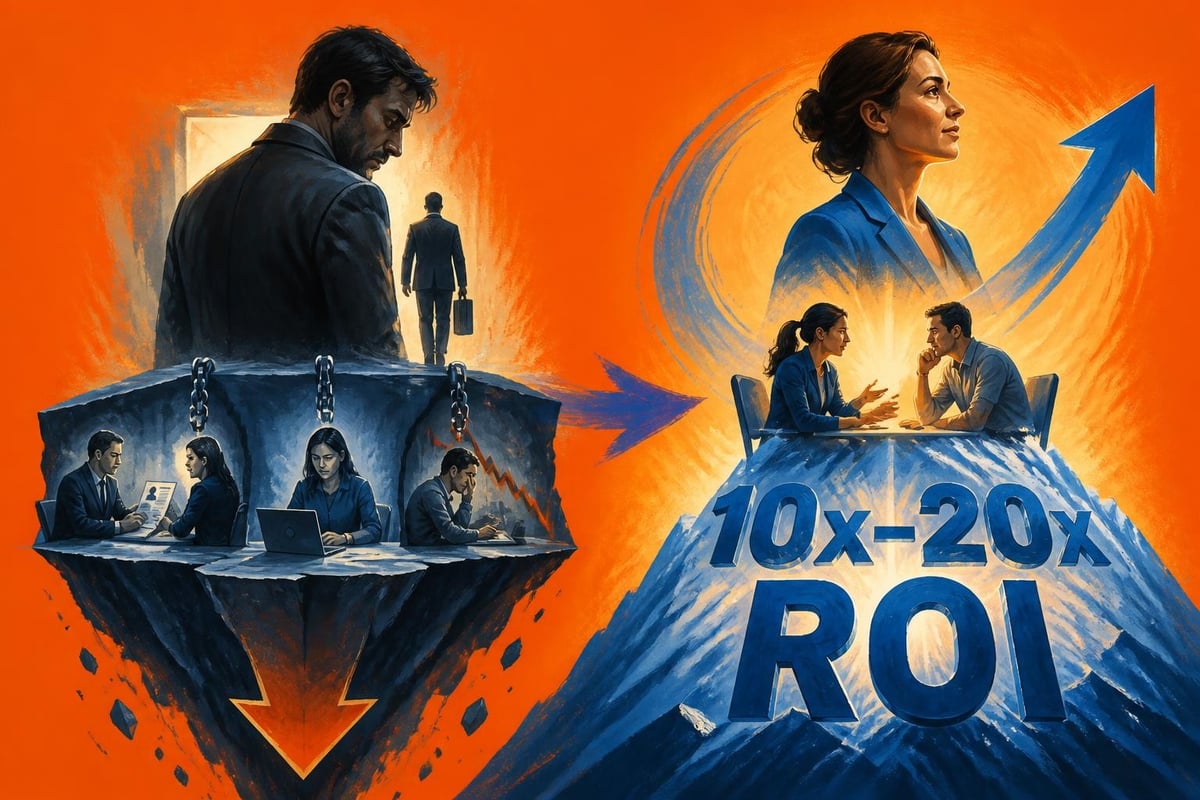
One mid-market technology client faced three key departures in Q1 2025. After deploying team coaching with direct accountability for engagement scores, they retained all three leaders through year-end. Replacement cost avoided: $780,000. Coaching investment: $48,000. That's a 16x return before counting productivity gains.
The Deloitte Model for Calculating People Investment Returns
Deloitte’s human capital research provides a straightforward framework: measure baseline performance metrics, deploy the intervention (coaching), track the same metrics quarterly, and calculate the dollar value of improvement. This approach cuts through the certification theater and credential worship that plagues the industry.
Problem: A 150-person SaaS company struggled with decision paralysis. Product launches slipped by 60 to 90 days, costing $200,000 per month in delayed revenue.
Diagnosis: Leadership team lacked operating cadence, clear KPIs, and accountability mechanisms. Meetings ran long with no decisions.
Solution: Executive coaching focused on decision frameworks, KPI scorecards, and live facilitation during leadership meetings. No theory sessions, just in-meeting coaching on real decisions.
Result: Product launch cycle dropped from 180 days to 105 days. First product shipped on new timeline generated $1.2M in incremental revenue in six months.
Lesson: How coaching pays for itself becomes obvious when you tie it directly to revenue-impacting workflows, not abstract leadership competencies.
Measurement Frameworks That Prove Value
Too many coaching engagements rely on subjective satisfaction surveys and vague "development" language. That's how coaching earned its reputation as expensive and unaccountable. Real ROI requires three measurement layers:
| Metric Type | Example KPIs | Measurement Frequency |
|---|---|---|
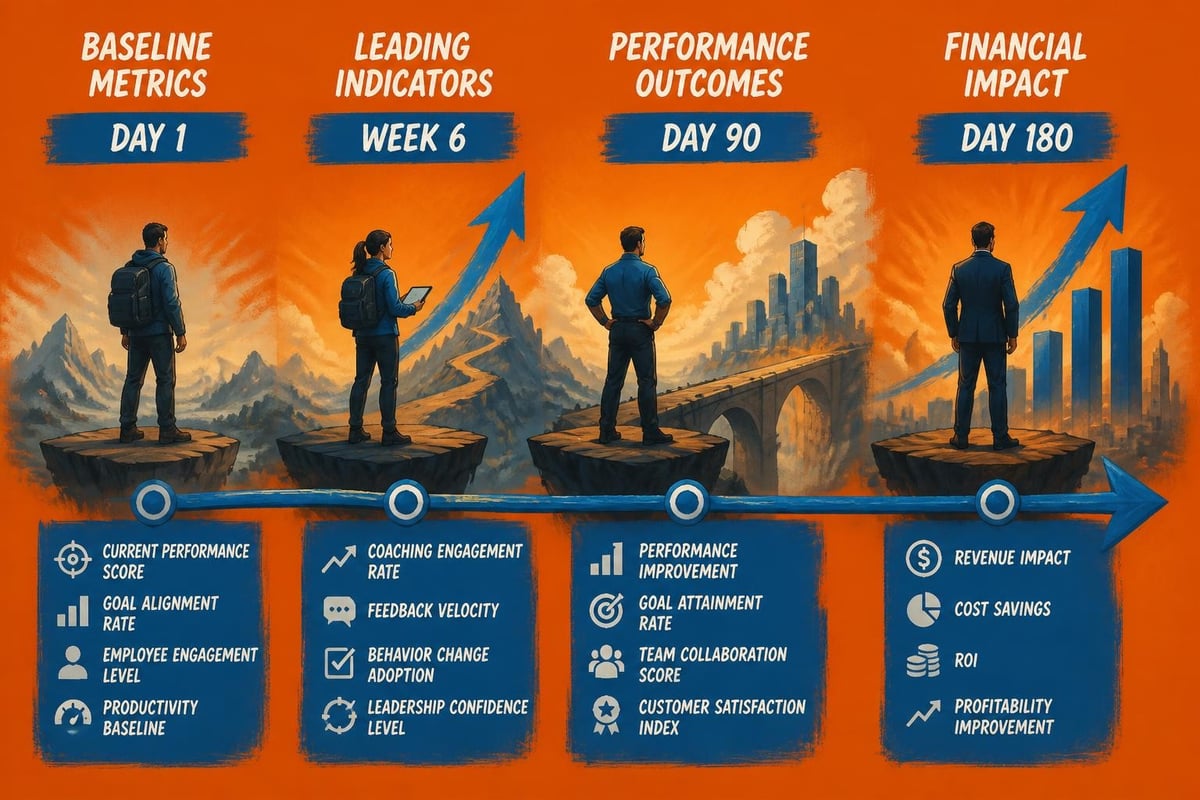
| Leading indicators | Meeting efficiency, decision velocity, 1-on-1 consistency | Weekly |
| Performance outcomes | Sales conversion, retention rate, project delivery | Monthly |
| Financial impact | Revenue per employee, cost of turnover, margin improvement | Quarterly |
The Coaching Impact Study documents median ROI of 7x across 100+ engagements, but only when coaching includes clear success metrics from day one. Certification level and coach pedigree showed zero correlation with outcomes. Expertise in the client's industry and willingness to measure results showed strong correlation.
The 90-Day Visibility Window
Month 1: Establish baseline metrics (current decision speed, retention risk scores, team communication quality)
Month 2: Deploy coaching with live observation, real-time feedback in actual work contexts, not conference rooms
Month 3: Measure changes in leading indicators and identify early outcome improvements
By day 90, you should see movement in decision velocity, meeting quality, or manager coaching skills. If you don't, the engagement is already failing. This contradicts the industry myth that coaching takes 12 to 18 months to show results. That timeline exists to protect bad coaching, not to serve clients.
Revenue Protection and Growth Acceleration
The Center for Creative Leadership research shows that coached sales leaders improve team quota attainment by 12% to 18% within two quarters. For a $10M revenue team, that's $1.2M to $1.8M in additional revenue annually.
Real example: A manufacturing client struggled with account retention. Top five accounts represented 60% of revenue, and two were at flight risk due to service issues. Leadership coaching focused on client communication protocols, escalation frameworks, and account manager skill development.
Outcome: Both at-risk accounts renewed. Revenue protected: $3.6M annually. Coaching cost: $36,000 for six months. ROI: 100x if you count only the revenue saved, plus ongoing relationship improvements.
This is how coaching pays for itself in customer-facing roles. You're not coaching communication skills in the abstract; you're preventing revenue loss through better client relationships.
The Marginal Gains Model
British Cycling famously applied 1% improvements across dozens of variables to dominate international competition. The same model works in business coaching when you focus on execution, not transformation.
- Reduce weekly meeting time by 15%: Gives managers three additional hours for coaching direct reports
- Improve decision documentation by 20%: Cuts rework and confusion downstream
- Increase 1-on-1 consistency from 60% to 95%: Catches performance and retention issues earlier
None of these changes is dramatic. Stacked together across a 50-person leadership team, they add up to hundreds of recovered hours and faster execution on strategic priorities.
KPI Scorecards That Drive Accountability
Traditional coaching lacks teeth because there's no scoreboard. You can't manage what you don't measure, and you can't prove ROI without numbers.
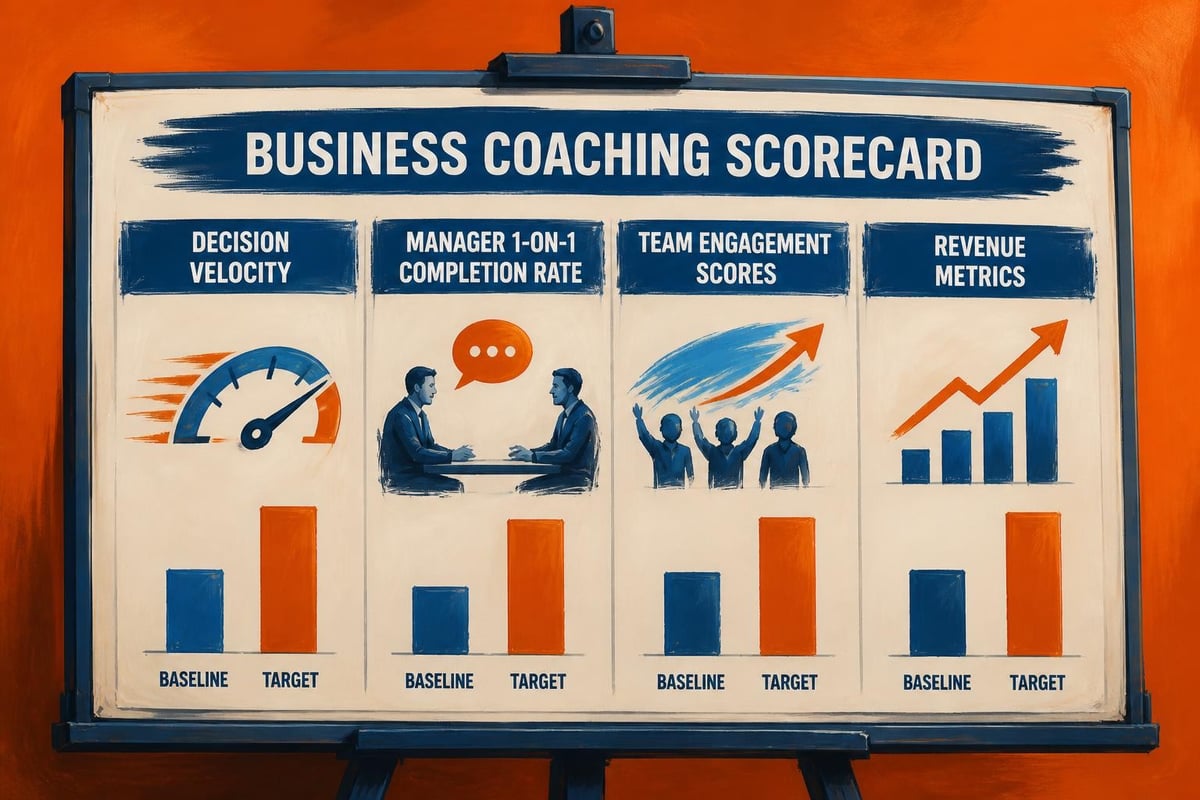
Effective coaching scorecards include:
- Decision velocity (days from issue identification to decision)
- Manager coaching frequency (1-on-1s completed / total scheduled)
- Employee engagement scores (measured quarterly)
- Revenue or margin metrics tied to coached behaviors
- Retention rate for coached leaders and their teams
When executive coaching includes shared risk and visible KPIs, both parties stay focused on outcomes, not activities. Month-to-month terms force continuous value delivery, unlike the 12-month contracts that insulate poor performance.
The Certification Myth and What Actually Predicts Results
The coaching industry suffers from credential inflation. ICF certification, psychology degrees, and expensive training programs dominate marketing, yet World Economic Forum research on leadership development shows minimal correlation between coach credentials and business outcomes.
What does predict results:
- Industry experience in the client's sector
- Willingness to coach live in real work contexts
- Focus on measurable KPIs from engagement start
- Track record of documented outcomes with previous clients
- Ability to challenge leadership dysfunction, not just support it
A coach with 20 years in SaaS understands product-market fit, sales cycles, and technical team dynamics. That expertise delivers faster insights than someone with three certifications but zero business context. Choose practitioners over credential collectors when ROI matters.
Shared Risk Models That Align Incentives
Most coaching operates on billable hours or fixed retainers, creating perverse incentives. The coach wins whether results materialize or not. How coaching pays for itself shifts dramatically when compensation ties to outcomes.
Aligned incentive structures:
- Base fee plus performance bonus tied to agreed KPIs
- Success fees for hitting retention or revenue targets
- Month-to-month terms with visible quarterly results reviews
- Partial refunds if agreed metrics don't improve
These models remain rare because many coaches can't deliver measurable results. But for clients, shared risk separates serious practitioners from those selling expensive hope. If a coach won't tie any compensation to outcomes, that tells you everything about their confidence.
How coaching pays for itself depends entirely on measurement, accountability, and tying engagements to real business KPIs from day one. Retention savings, faster decisions, and revenue protection deliver 7x to 20x returns when coaching focuses on execution rather than theory. If you want practical corporate coaching that delivers measurable business results tied to clear outcomes, Noomii offers month-to-month engagements with aligned incentives and no long contracts, so you stay because results are visible.
FAQ
Q: How long does it take for coaching to show measurable ROI?
A: Leading indicators like decision velocity and meeting efficiency should improve within 60 to 90 days. Financial outcomes like retention savings and revenue protection typically become visible within 180 days when coaching includes clear KPIs and accountability.
Q: What's a realistic ROI multiple for executive coaching?
A: Documented studies show median ROI between 7x and 20x when engagements include baseline metrics, outcome measurement, and focus on business performance rather than abstract development. Single retention saves or revenue protections can deliver 10x to 100x returns.
Q: Should I prioritize coach certifications or industry experience?
A: Industry experience and track record of measurable results predict outcomes far better than certifications. A coach with deep expertise in your sector delivers faster insights and more relevant guidance than credential collectors without business context.
Q: How do I measure the dollar value of coaching outcomes?
A: Track turnover costs avoided (100% to 300% of salary), revenue protected or accelerated (client retention, faster launches), productivity gains (meeting time saved, decision velocity), and engagement improvements (measured quarterly). Convert each to dollar impact.
Q: What KPIs should I track during a coaching engagement?
A: Combine leading indicators (decision speed, 1-on-1 consistency, meeting efficiency), performance outcomes (sales conversion, project delivery, retention rate), and financial metrics (revenue per employee, margin, turnover cost). Measure monthly or quarterly.
Q: Why do most coaching engagements fail to prove ROI?
A: They lack baseline metrics, clear success criteria, and accountability mechanisms. Vague development goals and satisfaction surveys can't demonstrate business value. Without measurement, coaching becomes an unaccountable expense.
Q: Should coaching contracts be long-term or month-to-month?
A: Month-to-month terms force continuous value delivery and visible results. Long contracts insulate poor performance and reduce coach accountability. Shared risk models with aligned incentives work best when ROI matters.
Q: How does team coaching ROI differ from individual executive coaching?
A: Team coaching often shows faster ROI through improved collaboration, decision velocity, and execution across multiple people simultaneously. Individual executive coaching delivers deeper leadership transformation but takes longer to scale impact across the organization.
Q: What's the biggest mistake companies make when buying coaching?
A: Treating coaching as a development perk rather than a performance investment with clear business outcomes. Without agreed KPIs, measurement frameworks, and accountability, coaching becomes expensive hope instead of measurable value.


Leave a Reply
Want to join the discussion?Feel free to contribute!