Corporate Coaching for Mining Operations in 2026
Mining operations face leadership challenges unlike any other industry. When a shift supervisor makes a poor call 800 meters underground, people die. When site leadership fails to address toxic behavior patterns, high performers leave for competitors. When executive teams miss early signals of operational drift, entire sites shut down. The stakes are existential, yet most mining companies still treat leadership development as a compliance checkbox rather than an operational imperative. Corporate coaching for mining operations addresses this gap by delivering targeted interventions that directly impact safety performance, retention, and operational continuity.
Why Mining Leadership Failures Create Operational Crises
The industry's leadership challenges stem from structural realities that generic corporate development programs ignore. Mining operations run 24/7 across dispersed locations with workforce demographics spanning five generations, multiple languages, and cultures ranging from fly-in-fly-out contractors to multi-generational local families. Site leaders manage crews who operate autonomous haul trucks, process plants with millisecond tolerances, and explosive materials under regulatory scrutiny.
Leadership failures cascade differently in mining than in other sectors.
A toxic mine manager doesn't just hurt engagement scores. They trigger safety incidents, regulatory investigations, and community relations crises. Deloitte’s Tracking the Trends 2025 report identifies the leadership capability gap as a central barrier to digital transformation and workforce retention across the mining sector.
Traditional corporate training programs fail because they don't account for:
- Critical control management protocols that require instant decision-making under pressure
- Multi-site coordination where leaders rarely see their direct reports face-to-face
- Unionized workforce dynamics that complicate performance management
- Commodity price volatility that creates constant budget uncertainty
- Social license requirements where one leadership misstep can cost community approval
The Evidence Base for Targeted Coaching Interventions
Industry data reveals where coaching interventions deliver measurable impact. Research published in Mining, Metallurgy & Exploration examined safety culture initiatives across multiple mining organizations and found that structured leadership coaching programs reduced high-potential incident rates by 23-41% when focused on frontline supervisor decision-making under uncertainty.
The International Council on Mining and Metals guidance on critical control management explicitly links leadership capability, cultural factors, and frontline engagement to fatality prevention. Their framework identifies five leadership competencies that correlate with safety performance: situational awareness, risk perception calibration, crew communication clarity, authority gradient management, and post-incident learning agility.
Corporate coaching for mining operations works when it targets these specific competencies rather than generic emotional intelligence or strategic thinking. The best programs combine behavioral diagnostics with operational observation to identify exactly where a leader's decision-making breaks down under production pressure.
What Precision Coach Matching Actually Means in Mining Contexts
Most mining companies hire coaches based on credentials and availability. This approach fails because mining leadership challenges require sector-specific pattern recognition that general business coaches don't possess. A coach who excels at helping tech executives navigate board dynamics will struggle to diagnose why a mine superintendent can't retain millwrights or why safety stand-downs keep happening on night shift.
Effective coach matching for mining operations requires three filters:
- Operational experience or deep sector immersion so the coach understands production constraints, equipment limitations, and geological realities
- Regulatory and compliance fluency including workplace safety legislation, environmental permits, and Indigenous consultation requirements
- Psychological safety expertise to address the power dynamics that prevent frontline workers from speaking up about hazards
The Noomii approach applies these filters through validated assessment data rather than self-reported coaching preferences. We've observed that mining leaders consistently underestimate their blind spots around authority gradients and risk normalization. Understanding psychological safety frameworks becomes critical when coaching supervisors who manage teams where speaking truth to power can prevent fatalities.
| Challenge Area | Generic Coach Response | Mining-Specific Coach Response |
|---|---|---|
| Production vs. safety conflict | Work-life balance discussion | Critical control decision tree analysis |
| Crew retention issues | Employee engagement survey | Roster pattern and compensation structure review |
| Cross-cultural team friction | Diversity training recommendation | Site-specific cultural dynamics and community relations alignment |
| Incident investigation participation | Stress management techniques | Human factors analysis and just culture principles |
How Leading Mining Companies Structure Coaching Programs
Anglo American’s 2025 sustainability disclosure details their Living Leader program, which combines CliftonStrengths assessments with targeted coaching interventions for site and corporate leaders. Their approach includes quarterly coaching sessions, peer learning cohorts, and operational shadowing where coaches observe leaders in production meetings, safety walkarounds, and shift handovers.
Similarly, IAMGOLD’s 2024 Sustainability Report describes coaching programs integrated with mentorship frameworks and structured career conversations. They track coaching ROI through retention rates, internal promotion velocity, and safety performance metrics rather than participant satisfaction scores.
The pattern across successful programs involves:
- Multi-rater feedback from supervisors, peers, and direct reports collected before coaching begins
- Operational observation periods where coaches shadow leaders during actual work rather than relying only on interview data
- Specific behavioral targets tied to measurable outcomes like incident rates, production variance, or turnover
- Integration with existing systems including performance management, succession planning, and competency frameworks
The Cost-Benefit Reality of Executive Coaching in Mining
Mining companies question executive coaching costs until they calculate the expense of replacing a site general manager mid-construction or dealing with a work refusal that shuts down production. A typical senior mining executive coaching engagement runs $18,000-35,000 annually. A single safety incident investigation costs $200,000-500,000 in direct expenses before considering production delays, regulatory fines, or reputational damage.
The business case becomes clearer when organizations track leading indicators:
- Reduction in high-potential incident rates within coached leaders' areas of responsibility
- Improved employee engagement scores specifically for psychological safety and speak-up culture questions
- Decreased turnover among critical technical roles and high-potential leaders
- Faster incident investigation completion with higher-quality corrective action effectiveness
- Stronger community relations outcomes measured through consultation effectiveness and social license metrics
Organizations that treat corporate coaching for mining operations as a strategic intervention rather than professional development perk see measurably different results. The difference lies in how they select participants, match coaches, set objectives, and measure outcomes.
Addressing the Skills Gap Through Structured Leadership Development
The Minerals Council of Australia’s workforce and skills resources highlight growing concerns about leadership pipeline strength as experienced mine managers retire and digital transformation accelerates. Professional development trends tracked by Edumine show increasing adoption of blended learning models that combine technical training with leadership coaching.
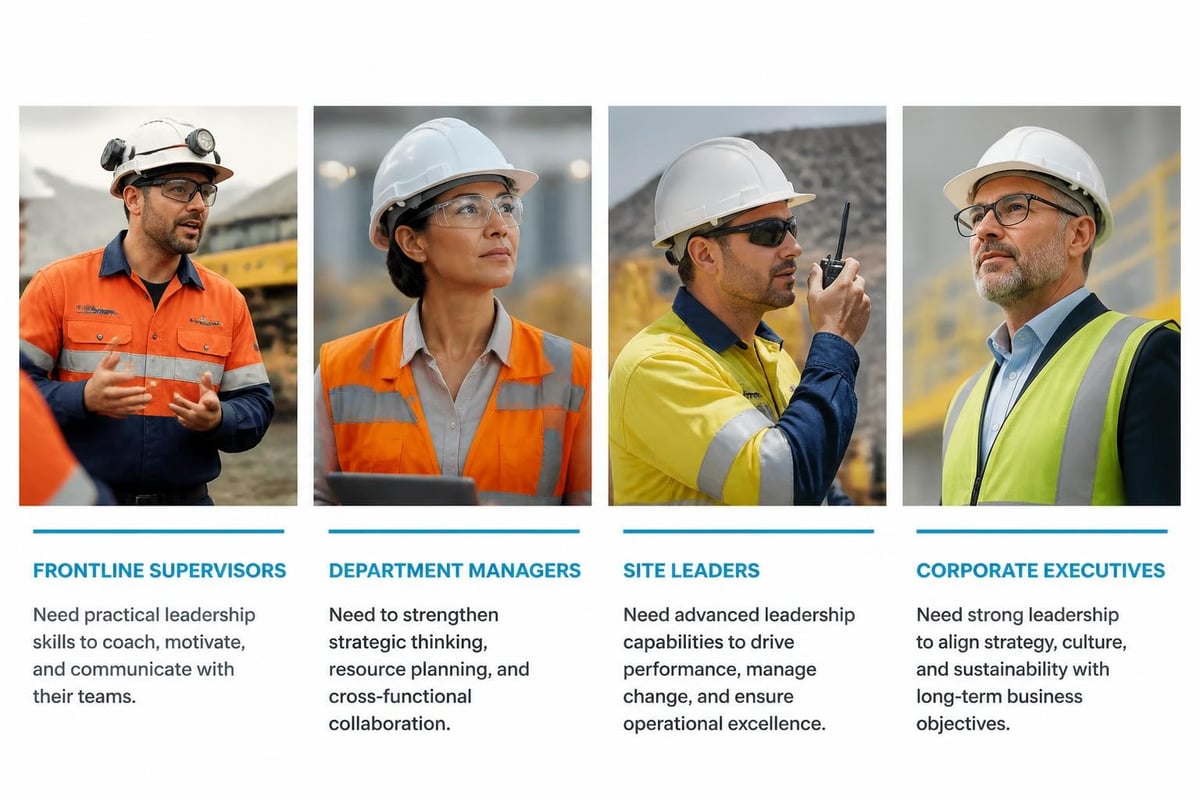
The skills gap manifests differently at each leadership level:
Frontline Supervisors
These leaders need coaching on transitioning from technical expert to team leader, managing former peers, applying progressive discipline fairly, and making rapid risk decisions under production pressure. Many receive promotions based on technical competence without any leadership preparation. Coaching interventions focus on situational leadership, crucial conversations, and risk perception calibration.
Site Department Managers
Middle management in mining operations struggles with resource allocation conflicts, cross-functional coordination, and managing up to site leadership while supporting frontline teams. Effective coaching addresses political navigation, strategic influence without formal authority, and resilience during commodity downturns or ownership changes.
Site General Managers and Mine Managers
Senior site leaders need coaching on stakeholder management complexity, balancing short-term production demands with long-term strategic investments, leading through major incidents, and managing their own stress and decision-making quality during crises. The best coaching programs include scenario planning, decision rehearsal, and executive presence development specific to mining contexts.
Corporate Mining Executives
C-suite leaders in mining companies face unique challenges around portfolio optimization, social license at scale, board governance during volatile commodity cycles, and leading digital transformation in traditionally conservative organizations. Corporate coaching for mining operations at this level focuses on strategic judgment, board effectiveness, and organizational culture change.
What Effective Coaching Actually Changes in Mining Operations
The best evidence of coaching effectiveness comes from observable behavioral change and measurable operational impact. We've tracked coaching interventions across multiple mining clients and identified consistent patterns in what changes and what doesn't.
Behaviors that improve with targeted coaching:
- Pre-job brief quality and crew engagement during safety conversations
- Response time and decision quality during unplanned equipment failures
- Conflict resolution effectiveness in multi-cultural team settings
- Willingness to stop work when conditions change unexpectedly
- Quality of incident investigations and corrective action implementation
- Retention conversations and career development discussions with high performers
Behaviors resistant to coaching alone:
- Deep technical skill gaps that require formal training
- Personality disorders or clinical mental health conditions requiring professional treatment
- Organizational culture problems that coaching one leader cannot overcome
- Compensation structure issues driving retention problems
- Inadequate systems, tools, or resources that prevent good execution
Organizations waste coaching resources when they expect individual development to solve systemic problems. Corporate coaching for mining operations delivers results when leadership gaps represent the actual constraint, not when coaching becomes a substitute for fixing broken processes, inadequate resources, or toxic organizational cultures.
Measuring What Matters in Mining Leadership Development
Traditional coaching programs measure participant satisfaction and self-reported behavior change. Mining operations require harder evidence. The measurement framework should track:
| Metric Category | Specific Indicators | Data Source |
|---|---|---|
| Safety Performance | High-potential incidents, safety observation participation, near-miss reporting rates | Safety management system |
| Operational Excellence | Production plan achievement, equipment availability, cost per ton | Production reporting system |
| Workforce Stability | Voluntary turnover, internal promotion rates, critical role time-to-fill | HRIS and talent management system |
| Cultural Health | Psychological safety scores, speak-up culture indicators, trust index | Employee surveys and focus groups |
| Leadership Pipeline | Succession plan strength, development plan completion, career conversation frequency | Talent review and succession planning data |
Organizations that connect coaching investments to these operational metrics make better decisions about program design, coach selection, and participant prioritization. The measurement discipline also builds executive sponsorship because mining leaders respect what they can quantify.
Contrarian Insight: Why Most Mining Leadership Programs Fail
The conventional wisdom says mining companies should develop comprehensive leadership competency models, cascade training programs across all levels, and create consistent global standards for leadership excellence. This approach consistently underperforms because it ignores how mining operations actually work.
Mining leadership operates in a high-context, relationship-based environment where formal authority matters less than operational credibility. A supervisor with 15 years underground experience commands more influence than a general manager with an MBA and no operational background, regardless of what the organization chart says. Leadership development programs that ignore these power dynamics waste resources on initiatives that crews dismiss as "head office nonsense."
The better approach targets specific leaders whose behavior change will shift team norms and operational outcomes. Instead of rolling out enterprise-wide programs, focus coaching resources on:
- Site leaders at operations with deteriorating safety performance or production challenges
- High-potential leaders being prepared for larger operational responsibility
- New site general managers during their first 180 days in role
- Technical specialists transitioning into people leadership roles
- Leaders managing significant operational changes like automation implementation or mine life extensions
This targeted approach delivers measurably better ROI than broad-based programs because it concentrates resources where behavior change creates operational leverage. Corporate coaching for mining operations works best as precision intervention, not universal employee benefit.
Implementation Framework: Getting Coaching Right in Mining Contexts
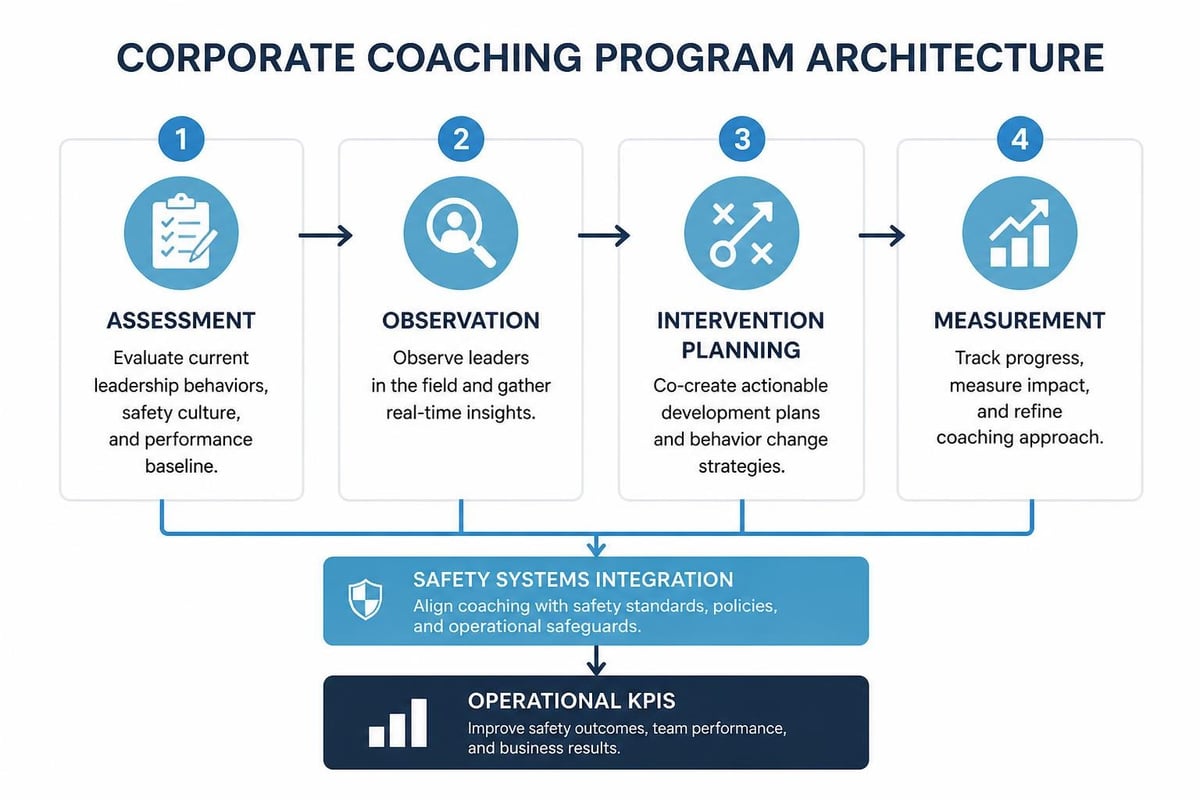
Organizations that successfully implement coaching programs in mining operations follow a disciplined process:
- Diagnostic phase: Conduct multi-rater feedback, review incident data, analyze turnover patterns, and observe leaders in operational settings to identify specific behavioral gaps
- Coach selection: Match leaders with coaches who have mining sector experience, relevant technical backgrounds, and proven capability in the target development area
- Goal alignment: Set specific behavioral objectives tied to operational metrics, not generic leadership aspirations
- Integration planning: Connect coaching interventions to performance management, succession planning, and operational improvement initiatives
- Progress tracking: Monitor leading indicators monthly and adjust coaching focus based on operational feedback and data trends
- Outcome measurement: Evaluate coaching effectiveness through safety performance, retention metrics, and operational results, not satisfaction surveys
The implementation discipline matters more than program design elegance. Mining operations respect what works, not what sounds sophisticated. Noomii Leadership Coaching applies this implementation framework through evidence-based diagnostics and precision coach matching that accounts for industry-specific requirements.
Organizations should budget 6-12 months for meaningful behavior change and operational impact. Quick wins happen, but sustainable leadership transformation requires time for new behaviors to become habitual and team dynamics to shift.
Regulatory Compliance and Governance Considerations
Mining operations face increasing regulatory scrutiny around leadership capability and organizational culture. Workplace safety legislation in multiple jurisdictions now includes explicit requirements for leadership competence, safety culture management, and worker consultation effectiveness. Corporate coaching for mining operations helps organizations demonstrate due diligence and compliance with these evolving standards.
Key compliance intersections include:
- Workplace health and safety acts requiring demonstrated leadership competence in risk management and critical control oversight
- Environmental protection regulations where leadership decisions directly impact permit compliance and environmental performance
- Indigenous consultation requirements where site leadership capability affects social license and regulatory approval
- Modern slavery and human rights due diligence requiring ethical leadership throughout supply chains and contractor management
- Corporate governance standards for board oversight of organizational culture and leadership effectiveness
Smart mining companies integrate coaching interventions with compliance management systems to create documentation trails showing systematic leadership development aligned with regulatory requirements. This approach transforms coaching from discretionary professional development into documented risk management.
Corporate coaching for mining operations delivers measurable impact when organizations treat it as operational intervention rather than professional development perk. The evidence shows that targeted coaching focused on safety leadership, crew dynamics, and operational decision-making reduces incidents, improves retention, and strengthens cultural health. Noomii Leadership Coaching helps mining companies implement precision coaching programs that align with operational priorities, regulatory requirements, and measurable business outcomes through evidence-based diagnostics and specialized coach matching.


Leave a Reply
Want to join the discussion?Feel free to contribute!