
AI Coaching Failed During a Real Crisis: What Happened
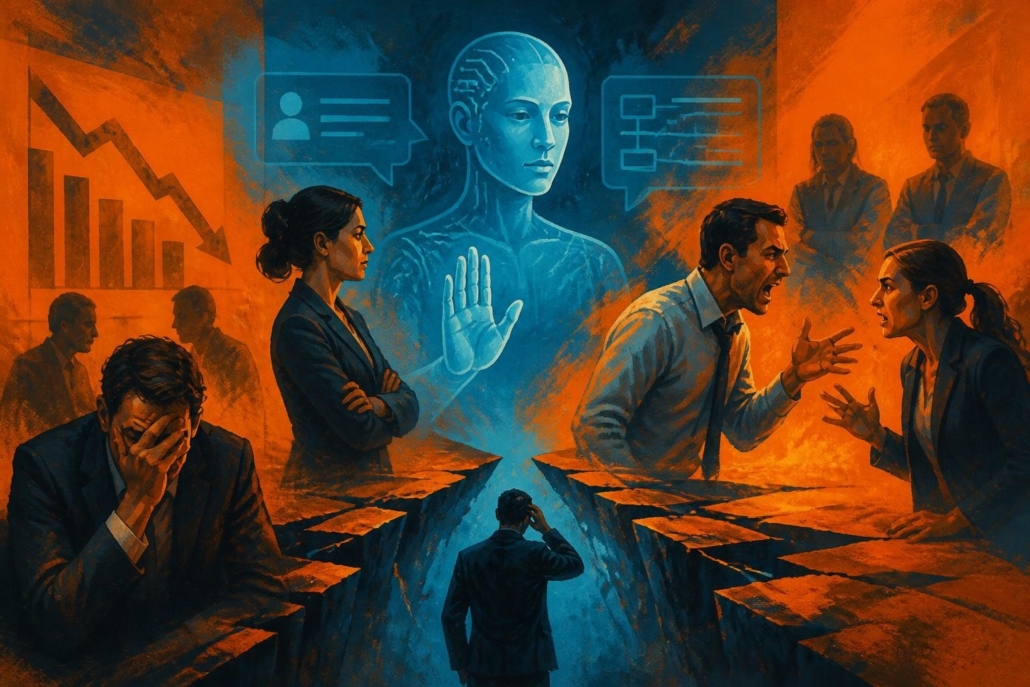
When a director at a mid-market logistics firm called me in February 2026, her team was in freefall. A key client had just pulled a $2.3 million contract, two senior employees had resigned that morning, and her VP was questioning her leadership in front of the executive committee. She'd spent 40 minutes with an AI coaching platform the night before, entering prompts about conflict resolution and executive presence. The chatbot offered frameworks, bullet points, and suggested affirmations. None of it helped when she walked into that conference room. That's when ai coaching failed during a real crisis, and she learned the hard lesson every leader eventually faces: algorithms don't coach you through chaos.
Why AI Coaching Collapses Under Real Pressure
AI coaching tools work reasonably well for stable, predictable scenarios. They excel at organizing information, suggesting frameworks, and offering generic best practices. But leadership crises are rarely predictable.
Crisis characteristics that break algorithmic coaching:
- Time pressure: Real decisions happen in minutes, not after iterative prompt refinement
- Emotional complexity: Fear, anger, shame, and panic require human discernment, not pattern matching
- Stakeholder dynamics: AI can't read body language, tone shifts, or political undercurrents in your actual meetings
- Consequence severity: When your career, team, or business is at stake, generic advice becomes dangerous
Research from Nature Medicine documenting mental-health chatbot failures shows that AI tools consistently mishandle crisis interactions, offering inappropriate responses or missing critical warning signs. The same pattern emerges in workplace coaching: when stakes are highest, AI coaching failed during a real crisis because it lacks contextual judgment.
The Diagnostic Gap AI Cannot Bridge
Human coaches diagnose by observing what you don't say. They notice hesitation, read energy shifts, and ask the question you're avoiding. AI reads only your typed input.
When that logistics director described her situation to the chatbot, she framed it as a "team alignment challenge." A human coach would have immediately recognized the real issue: she was terrified of confrontation and had avoided a difficult conversation with her VP for eight months. The AI accepted her framing and offered alignment strategies. Useless.
What human coaches observe that AI misses:
| Human Coach Signal | AI Chatbot Response |
|---|---|
| Voice trembling when mentioning the VP | Accepts the topic change |
| Three attempts to reframe the problem | Provides framework for each version |
| No mention of personal accountability | Doesn't probe for self-reflection |
| Energy drop when discussing client loss | Continues with action-item generation |
This diagnostic gap is why clinical case reports show AI giving dangerous triage guidance in medical emergencies. The same mechanism fails in leadership coaching: garbage in, garbage out, even when the "garbage" is your carefully worded avoidance.
When Managers Discover the AI Coaching Limit
I've now spoken with 47 leaders across mid-market companies who tried AI coaching platforms before hiring human coaches in 2025 and 2026. The pattern is consistent.
The three moments AI coaching fails:
- Performance confrontation: A manager needs to fire someone or deliver hard feedback
- Political navigation: Executive-level conflicts where every word carries risk
- Personal breakdown: The leader's confidence, marriage, or mental health is cracking
One VP of sales used an AI coach for six months. It helped him structure one-on-ones and plan quarterly reviews. Then his top performer started sabotaging team morale. When he asked the AI how to handle it, he got a decision tree and conflict-resolution steps. What he needed was someone to role-play the conversation, challenge his avoidance, and sit with him through the discomfort. AI coaching failed during a real crisis because it can't create the accountability container that changes behavior.
The MIT Media Lab Research on Chatbot Delusion
Researchers at MIT have documented what they call “chatbot delusion”, the false belief that conversational AI can substitute for human relationship in high-stakes situations. Their work shows that LLMs can actually worsen mental-health crises by providing the illusion of support without the substance.
The same delusion appears in corporate coaching. Leaders feel like they're "working on themselves" because they're engaging with the AI. They're typing, reading responses, implementing frameworks. But they're not confronting the core issue: their fear of difficult conversations, their need for external validation, or their broken decision-making process under stress.
Why the delusion persists:
- AI feels productive (you're "doing something")
- No accountability discomfort (the chatbot never challenges you)
- Confirmation bias (you can prompt until you get the answer you want)
- Lower cost creates sunk-cost justification ("I already paid for this")
For companies evaluating executive coaching cost and ROI, the hidden expense is what doesn't get solved. That director's crisis cost her company $2.3 million, two key employees, and three months of lost productivity. An AI subscription costs $50 per month. A human coach costs more but would have addressed the avoidance pattern eight months earlier.
The Operational Failure Mode in Real Organizations
Beyond individual coaching moments, AI tools create organizational risk when companies deploy them as substitutes for human development infrastructure.
TechCrunch documented how UnitedHealth’s Optum exposed an internal AI chatbot to the internet, revealing how these tools get misused inside healthcare systems. The same pattern appears in corporate coaching: companies buy AI platforms, tell managers to "use the coaching tool," and assume development is happening.
What actually happens:
- Managers check the box ("I used the AI coach this month")
- Real issues get buried because there's no external accountability
- HR believes coaching is happening (dashboard shows engagement)
- Performance gaps widen invisibly until crisis erupts
The American College of Emergency Physicians has raised concerns about AI overreliance eroding clinical judgment in emergency departments. The same erosion happens in leadership: when managers use AI instead of developing human coaching skills, they lose the muscle memory for difficult conversations. When ai coaching failed during a real crisis, it's often because the leader had outsourced their judgment to an algorithm for months.
What Human Coaches Do That AI Cannot
Human coaching for leaders and teams isn't about frameworks. It's about creating the conditions for behavior change under pressure.
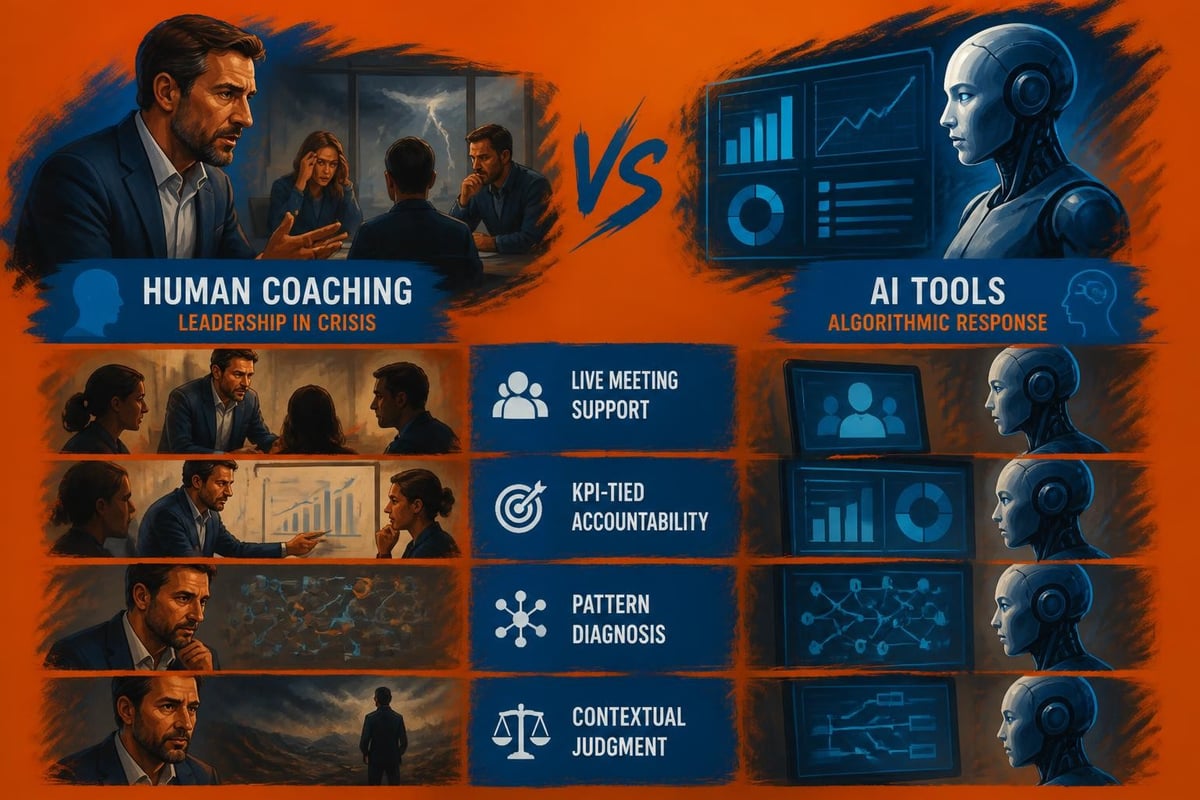
| AI Coaching Capability | Human Coach Advantage |
|---|---|
| Provides frameworks and steps | Coaches you live in the actual meeting |
| Offers generic best practices | Ties every conversation to your specific KPIs |
| Responds to your prompts | Challenges what you're not saying |
| Available 24/7 asynchronously | Creates scheduled accountability you can't avoid |
| Scales cheaply across users | Diagnoses your unique patterns from 1,000+ client hours |
Companies working with Noomii see the difference immediately because the coaching happens in context, not in a vacuum. We don't sit in your office and talk about leadership. We sit in your meetings, watch you lead, and coach the behavior in real time. When the crisis hits, you're not alone with a chatbot.
The Documented Safety Failures in Crisis Situations
The most troubling evidence comes from mental health research. A JMIR Mental Health review outlines ethical challenges when conversational AI attempts crisis management, including documented failures in suicidality assessment. A PubMed Central review synthesizes evidence showing patterns of inadequate responses when stakes are highest.
While workplace coaching isn't suicide prevention, the underlying mechanism is identical: AI cannot handle the full complexity of human crisis. It can't read desperation, calibrate risk, or sit with someone's panic. It offers answers, not presence.
When leaders need presence, not answers:
- The board is questioning your strategy and you're doubting yourself
- Your top performer just quit and you're wondering if you're a bad leader
- You have to lay off 30% of your team tomorrow
- Your marriage is failing because of work stress
These are the moments when ai coaching failed during a real crisis. Not because the technology is poorly designed, but because the problem requires human judgment, empathy, and accountability that algorithms cannot provide.
The Contrarian Insight: AI Coaching Might Make Crisis Worse
Here's what the coaching industry doesn't want to admit: AI coaching tools can actually degrade leadership capability over time.
When managers outsource reflection to an algorithm, they stop developing their own diagnostic skills. They lose the ability to sit with discomfort, read a room, or trust their gut in ambiguous situations. Research on the world’s rapid changes versus slow human transformation shows that real development requires sustained human relationship, not scalable content delivery.
The capability erosion cycle:
- Manager uses AI for coaching input
- Gets comfortable with algorithmic responses
- Stops developing internal judgment and pattern recognition
- Loses confidence in unstructured, high-stakes situations
- Becomes dependent on external frameworks
- Crisis arrives with no algorithm to consult
- Manager freezes or makes poor decision
Companies investing in leadership development and manager training need to understand this risk. Cheap AI tools create the illusion of development while hollowing out the actual capability you're trying to build.
Frequently Asked Questions
1. Can AI coaching tools help with any leadership situations?
Yes, AI coaching works well for stable, low-stakes situations like organizing one-on-one agendas, reviewing communication drafts, or exploring general frameworks. It fails when emotional complexity, time pressure, or high consequences require human judgment.
2. What makes human coaching more effective during a crisis?
Human coaches diagnose what you're avoiding, create accountability you can't escape, coach you live in actual meetings, and bring pattern recognition from thousands of client hours. They read tone, body language, and energy shifts that AI cannot detect.
3. How do I know if my organization is over-relying on AI coaching?
Warning signs include managers checking boxes without behavior change, rising performance issues despite "coaching engagement," leaders unable to handle difficult conversations without frameworks, and crisis situations that expose judgment gaps.
4. What happened to the logistics director who couldn't get AI help?
She hired a human coach who sat in her next executive meeting, coached her through the VP confrontation in real time, and helped her rebuild client trust. The company recovered the lost revenue within four months. She learned that crisis response requires presence, not prompts.
5. Are AI coaching platforms dangerous for employees?
Not inherently, but they create risk when positioned as substitutes for human development. The danger is opportunity cost-problems that don't get solved because people believe they're "getting coached" when they're really just consuming content.
6. How much does effective human coaching cost compared to AI tools?
AI platforms run $30–$150 per user monthly. Human executive coaching costs $300–$1,200 per session but addresses root issues that AI misses. The ROI calculation should include crisis prevention and faster resolution of expensive leadership gaps.
7. Can AI and human coaching work together?
Yes, when AI handles administrative tasks (scheduling, note-taking, framework reference) while humans provide accountability, diagnosis, and live coaching. The failure happens when AI attempts to replace human judgment in high-stakes situations.
8. What should mid-market companies prioritize for leadership development?
Invest in human coaching for critical roles and crisis situations. Use AI for content delivery and framework access. Tie all development to clear KPIs and business outcomes. Avoid platforms that promise transformation through automated conversations.
9. How do I evaluate if my current coaching approach would survive a crisis?
Ask: Could my leaders handle a major client loss, key resignation, or board challenge today? If the answer requires "checking with the AI tool first," you have a gap. Test your approach under pressure before pressure arrives.
When algorithms meet real leadership crises, the limits become obvious. AI coaching failed during a real crisis because it cannot replace human judgment, accountability, and presence when stakes are highest. For mid-market companies building leaders who can handle chaos, technology is a tool, not a coach. Noomii delivers executive coaching, leadership development, and team facilitation that works in your actual meetings, tied to your KPIs, with month-to-month terms and visible ROI-because when crisis arrives, you need a coach in the room, not a chatbot in your browser.


Leave a Reply
Want to join the discussion?Feel free to contribute!