

Corporate Coaching Programs in Egypt: 2026 Landscape
Egyptian organizations are replacing ineffective classroom training with targeted leadership interventions. The shift is measurable: Egyptian companies are rethinking corporate learning by moving away from generic programs toward coaching engagements that address specific performance gaps, cultural resistance, and retention challenges. The evidence suggests most firms still lack the diagnostic rigor to match leaders with the right coach or measure ROI beyond satisfaction surveys. Corporate coaching programs in Egypt now represent a strategic imperative, not an HR checkbox, particularly for organizations competing for talent in Cairo's financial sector, Alexandria's manufacturing clusters, and the expanding logistics hubs serving North Africa and the Gulf.
Why Most Leadership Development Fails in Egyptian Organizations
The conventional model delivers predictable failure. Organizations invest in standardized programs that ignore context, culture, and individual readiness. The result: high completion rates, minimal behavior change, and leadership teams that revert to old patterns within weeks.
Three diagnostic gaps expose the problem:
- Misaligned intervention design: Programs address generic "leadership competencies" rather than specific obstacles (decision paralysis, poor delegation, toxic team dynamics).
- No precision matching: Leaders receive coaches based on availability, not sector expertise, cultural fluency, or proven success with similar challenges.
- Compliance theater: Firms check boxes for governance or regulatory requirements without embedding leadership development into performance management, succession planning, or strategic execution.
The corporate training market in Egypt continues growing, but volume masks inefficiency. Organizations spend on programs that fail to solve the underlying issues: weak middle management pipelines, inconsistent decision-making at the executive level, and cultural resistance to feedback.

What Actually Drives Results
Evidence from firms that transformed leadership effectiveness reveals a pattern. Success correlates with three factors: precise diagnosis of leadership gaps, coach-leader matching based on sector expertise and challenge type, and integration with existing performance systems.
One Cairo-based financial services firm faced a retention crisis in 2025. Exit interviews identified poor middle management as the primary driver. The firm deployed targeted coaching for 23 managers, matching each with coaches experienced in financial sector leadership transitions. Six months later, turnover dropped 34% and promotion-ready candidates increased by 41%. The difference: coaching addressed specific behaviors (micromanagement, unclear expectations, avoidance of difficult conversations) rather than abstract competencies.
| Traditional Approach | Evidence-Based Approach | Business Impact |
|---|---|---|
| Generic leadership program | Diagnostic assessment identifying specific gaps | 3x higher behavior change |
| Random coach assignment | Precision matching by challenge and sector | 2.4x faster results |
| One-size curriculum | Customized intervention plan | 58% better retention outcomes |
The Egyptian Market Context Leaders Miss
Local dynamics shape what works. Corporate coaching programs in Egypt must navigate hierarchical cultures, generational transitions, and the reality that many executives learned leadership in environments that rewarded control over collaboration.
Generational Transition Creates Urgency
Family-owned enterprises and established corporates face succession pressure. Founders in their 60s built businesses through personal relationships and centralized decision-making. The next generation inherited different market conditions: digital transformation requirements, talent wars with multinationals, and employees who expect developmental feedback.
The gap manifests in predictable ways:
- Decision bottlenecks: Executives struggle to delegate, creating organizational paralysis.
- Cultural clashes: Younger leaders implement participative approaches that conflict with established hierarchies.
- Retention failures: High-potential managers leave for organizations with clearer growth paths.
Coaching interventions that acknowledge this context deliver results. Programs that ignore it waste time debating theoretical frameworks while the real issues compound.
Regulatory and Governance Standards Demand Structure
Government agencies and regulated sectors require documented leadership development aligned with compliance standards. The ILO’s work on productivity and decent work in Egypt emphasizes workplace learning standards and capacity building for organizational trainers.
This creates opportunity for firms offering corporate coaching programs in Egypt with proper governance frameworks, measurement systems, and alignment with institutional priorities. It also exposes vendors who lack the infrastructure to support government contracts or Fortune 500 compliance requirements.

Building Effective Corporate Coaching Programs: A Practical Framework
Organizations that achieve measurable results follow a consistent pattern. The framework below reflects lessons from implementations across financial services, manufacturing, and government sectors in Egypt.
Phase 1: Evidence-Based Diagnostics
Start with validated assessments that identify specific leadership gaps, behavioral patterns, and team dynamics. Generic 360 surveys produce data; targeted diagnostics produce actionable insights.
Critical assessment areas include:
- Decision-making patterns under pressure
- Delegation effectiveness and trust indicators
- Conflict resolution approaches and avoidance behaviors
- Communication clarity and feedback delivery
- Strategic thinking versus operational firefighting
The assessment phase should take 2-3 weeks and involve multiple data sources: direct reports, peers, objective performance metrics, and self-evaluation. Organizations that rush this phase or rely solely on self-reported competencies build programs on faulty foundations.
Phase 2: Precision Coach Matching
This separates effective programs from expensive failures. Matching requires three dimensions of fit:
Challenge-specific expertise: A leader struggling with toxic team dynamics needs a coach experienced in organizational behavior and conflict resolution, not generic executive development.
Sector knowledge: Financial services executives face different pressures than manufacturing leaders. Coaches must understand regulatory constraints, market dynamics, and industry-specific leadership challenges.
Cultural fluency: Effective coaching in Egyptian organizations requires understanding hierarchical dynamics, communication norms, and how to navigate generational differences without creating defensive resistance.
The AUC Executive Education analysis of Egypt’s L&D landscape documents the rise of mentoring and coaching, but highlights the shortage of coaches with combined business acumen, psychological expertise, and local market knowledge.
Organizations should evaluate coach credentials across three dimensions:
| Evaluation Criteria | What to Verify | Red Flags |
|---|---|---|
| Sector Experience | Minimum 10 years in relevant industry | Generic "executive coach" positioning |
| Coaching Methodology | Evidence-based approach with measurement framework | Vague descriptions of "transformational" work |
| Cultural Competence | Demonstrated success in Egyptian or MENA organizations | Western-only client base with no regional adaptation |
Phase 3: Customized Intervention Plans
Generic coaching conversations produce generic results. Effective plans target specific behaviors with clear success metrics.
A manufacturing executive facing low team engagement needs different interventions than a CFO struggling with strategic communication to the board. The intervention plan should specify:
- Target behaviors: Exactly what will change (weekly one-on-ones, delegation of specific decision types, conflict addressed within 48 hours).
- Measurement approach: How progress gets tracked (direct report feedback, decision speed metrics, team engagement scores).
- Timeline and milestones: 90-day checkpoints with specific outcomes expected.
- Escalation protocols: When and how to adjust if progress stalls.
Plans that lack this specificity become therapy sessions disconnected from business results.
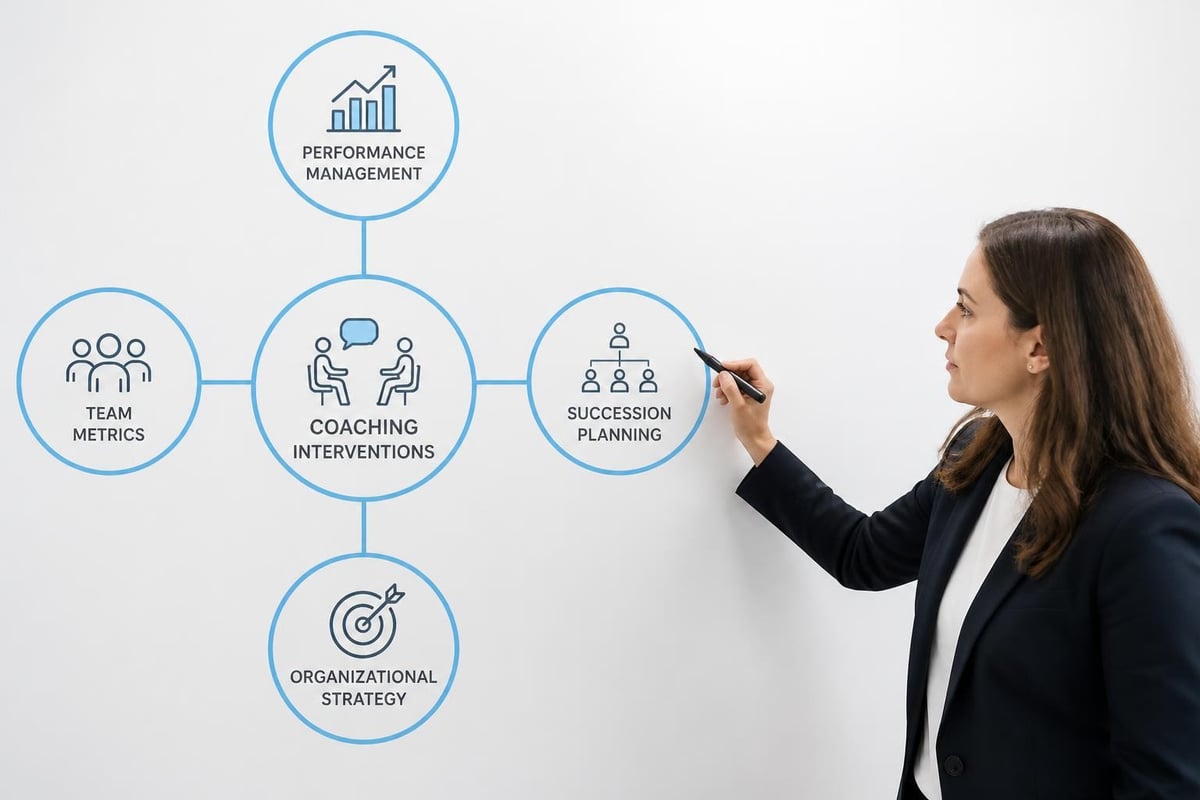
Phase 4: Integration with Performance Systems
Coaching fails when it operates in isolation. Effective programs connect to:
- Performance reviews that evaluate the targeted behaviors
- Succession planning that identifies coaching as development path
- Team metrics that reflect leadership effectiveness
- Compensation decisions that reward demonstrated growth
The ILO policy brief on quality apprenticeships in Egypt emphasizes linking workplace learning to employer needs and establishing standards for in-company trainer development. The same principle applies to leadership coaching: disconnect from organizational systems guarantees marginal impact.
Measuring What Matters: Beyond Satisfaction Surveys
Most organizations measure coaching effectiveness through participant satisfaction. This captures whether leaders enjoyed the experience, not whether their behavior changed or business outcomes improved.
ROI-Focused Measurement Framework
Effective measurement tracks three levels:
Individual behavior change: Specific, observable shifts in how leaders make decisions, communicate, delegate, and address conflict. Measure through direct report feedback, peer observation, and behavioral frequency tracking (how often does the leader conduct one-on-ones, how quickly do they address performance issues).
Team-level impact: Changes in engagement scores, voluntary turnover, speed of decision execution, and cross-functional collaboration effectiveness. These indicators connect individual leadership improvement to team performance.
Organizational outcomes: Revenue per employee, time-to-market for new initiatives, succession bench strength, and retention of high-potential talent. These metrics demonstrate business value, not just leadership development activity.
One Alexandria-based logistics company implemented corporate coaching programs in Egypt for 15 senior managers in early 2025. They tracked three metrics: employee engagement (starting point: 62%), average time to fill senior roles (127 days), and operational efficiency scores. After nine months, engagement reached 78%, time-to-fill dropped to 89 days, and efficiency improved 23%. The coaching investment returned 4.2x through reduced recruiting costs and productivity gains alone.
Common Implementation Failures and How to Avoid Them
Three patterns predict failure. Organizations repeat these mistakes because they prioritize convenience over effectiveness.
Failure Pattern 1: Volume Over Precision
Firms deploy coaching to dozens or hundreds of leaders without diagnostic rigor. Everyone receives the same program duration and approach regardless of readiness, challenge severity, or strategic importance.
The fix: Tier interventions based on diagnostic results. High-potential leaders facing critical gaps receive intensive coaching (12-18 months, bi-weekly sessions). Solid performers with specific skill gaps receive focused interventions (3-6 months, monthly sessions). This concentrates resources where they generate maximum return.
Failure Pattern 2: Outsourcing Accountability
HR selects a vendor, launches the program, and waits for transformation. When results disappoint, they blame coach quality or participant commitment.
The reality: Effective programs require active executive sponsorship, clear success criteria, and integration with existing performance systems. The CHRO or CEO must own outcomes, not delegate responsibility to a vendor or HR business partner.
Understanding executive coaching costs helps organizations budget appropriately, but price sensitivity without quality criteria produces poor vendor selection and wasted investment.
Failure Pattern 3: Cultural Tone-Deafness
Programs designed for Western contexts fail when imported unchanged. Coaching that works in Silicon Valley or London requires adaptation for hierarchical cultures, different communication norms, and varying comfort with direct feedback.
The adaptation: Coach matching must account for cultural fluency. Intervention plans should acknowledge hierarchy while building new behaviors. Measurement frameworks need to recognize that culture change happens gradually, with visible executive modeling required before broader adoption.
Vendor Selection Criteria That Actually Predict Success
Most RFP processes evaluate the wrong factors. Vendor reputation, client lists, and marketing sophistication correlate poorly with program effectiveness.
Evaluate vendors on these dimensions:
- Diagnostic rigor: Do they begin with validated assessments or jump straight to coaching assignments?
- Matching methodology: How do they ensure coach-leader fit beyond resume matching?
- Measurement infrastructure: What specific metrics do they track and how do they connect coaching to business outcomes?
- Sector expertise: Have they delivered measurable results in your industry within Egyptian or MENA markets?
- Scalability without quality loss: Can they maintain coach quality and matching precision as programs expand?
Organizations should request case studies with specific metrics: behavior change indicators, team performance improvements, and organizational outcomes. Vendors who provide only testimonials or satisfaction scores lack the evidence base for serious enterprise work.
Firms exploring options across regions can review top leadership coaches in China or corporate coaching vendors in Canada to understand how sophisticated organizations evaluate providers globally.
The Government and Public Sector Opportunity
Government agencies face unique leadership challenges: mission complexity, bureaucratic constraints, limited compensation flexibility, and intense public scrutiny. Traditional training programs fail because they ignore these realities.
Corporate coaching programs in Egypt designed for public sector needs must address:
- Mission alignment: Coaching that connects individual leadership growth to public service objectives and constituent impact.
- Regulatory compliance: Programs that meet government procurement standards and documentation requirements.
- Team morale in resource-constrained environments: Developing leaders who motivate teams despite compensation limitations and bureaucratic friction.
- Succession planning for institutional knowledge: Preparing next-generation leaders before critical expertise retires.
Agencies that implement evidence-based coaching see measurable improvements in employee engagement, policy execution speed, and public service delivery. The challenge: procurement processes optimized for cost rather than outcome quality, and cultural resistance to external interventions perceived as criticism.
What Egyptian Organizations Should Demand from Coaching Programs in 2026
The market is maturing. Organizations no longer need to accept generic programs or unproven vendors. Demand these standards:
Validated diagnostic tools that identify specific leadership gaps rather than producing generic competency reports.
Transparent matching methodology that explains exactly how coaches get assigned based on challenge type, sector expertise, and proven results.
Clear ROI framework established upfront, with specific metrics, measurement frequency, and accountability for outcomes.
Sector-specific experience demonstrated through case studies with named clients (where confidentiality permits) or detailed examples showing business context understanding.
Scalable quality systems that maintain coaching effectiveness whether serving 10 leaders or 200, with consistent matching rigor and measurement discipline.
Exploring leadership coaching options should include evaluating provider infrastructure, not just individual coach credentials. The best individual coach cannot compensate for poor matching, weak diagnostics, or absence of measurement systems.
Frequently Asked Questions
What is the typical duration for corporate coaching programs in Egypt?
Effective programs run 6-12 months depending on challenge complexity and leader readiness. Shorter engagements (3-4 months) work for focused skill development. Complex behavioral changes or cultural transformation require 12-18 months with ongoing reinforcement. Programs shorter than three months rarely produce sustained behavior change.
How do organizations measure ROI for leadership coaching investments?
Track three levels: individual behavior change through direct report feedback and behavioral frequency, team impact through engagement and retention metrics, and organizational outcomes including productivity per employee and succession bench strength. Organizations seeing positive ROI typically measure across all three levels rather than relying on satisfaction surveys alone.
What qualifications should coaches have for Egyptian corporate contexts?
Look for coaches with minimum 10 years sector experience, validated coaching methodology, and demonstrated success in Egyptian or MENA organizations. Cultural fluency matters more than international certifications alone. Coaches should understand hierarchical dynamics, generational transitions, and how to navigate organizational politics without creating defensive resistance.
How many coaching sessions are needed to see measurable results?
Most leaders show initial progress after 4-6 sessions over 8-12 weeks. Sustained behavior change typically requires 12-16 sessions over 6-9 months with ongoing accountability mechanisms. Session frequency should match challenge intensity: bi-weekly for intensive interventions, monthly for skill development.
What's the difference between coaching for executives versus mid-level managers?
Executive coaching typically addresses strategic decision-making, board communication, organizational culture shaping, and enterprise-wide impact. Mid-level coaching focuses on team leadership, delegation, conflict resolution, and tactical execution. Both require different coach expertise and measurement approaches. Matching methodology should account for leadership level and corresponding business impact.
Egyptian organizations investing in leadership development face a choice: continue funding programs that produce certificates instead of capability, or implement evidence-based corporate coaching programs that solve specific challenges with measurable results. The firms gaining competitive advantage in 2026 are those that treat leadership development as strategic infrastructure, not an HR initiative. Noomii Leadership Coaching provides the diagnostic rigor, precision matching methodology, and measurement frameworks that transform leadership effectiveness across government agencies, multinational enterprises, and growth-stage companies operating in Egypt and throughout the MENA region.



Leave a Reply
Want to join the discussion?Feel free to contribute!