

Certification Does Not Create Coaching Clients
Every month, hundreds of newly certified coaches complete their training, post celebratory announcements on LinkedIn, and wait for clients to arrive. Most wait a long time. The uncomfortable truth is that certification does not create coaching clients. It creates certified professionals who still need to learn how to run a business, position their services, demonstrate value, and earn trust in a crowded market. In 2026, with coaching saturation at historic levels and AI tools challenging traditional delivery models, credentials matter less to buyers than coaches assume.
Why Certification Programs Skip Client Acquisition
Most certification programs focus on methodology, ethics, and competency frameworks. They teach models, practice conversations, and evaluate adherence to process standards. What they rarely teach is how to attract paying clients.
The gap is structural. Certification is not a substitute for a business strategy, yet many programs sell the credential as if it automatically unlocks demand. New coaches graduate with clean notes, strong technique, and zero understanding of positioning, pricing, or lead generation.
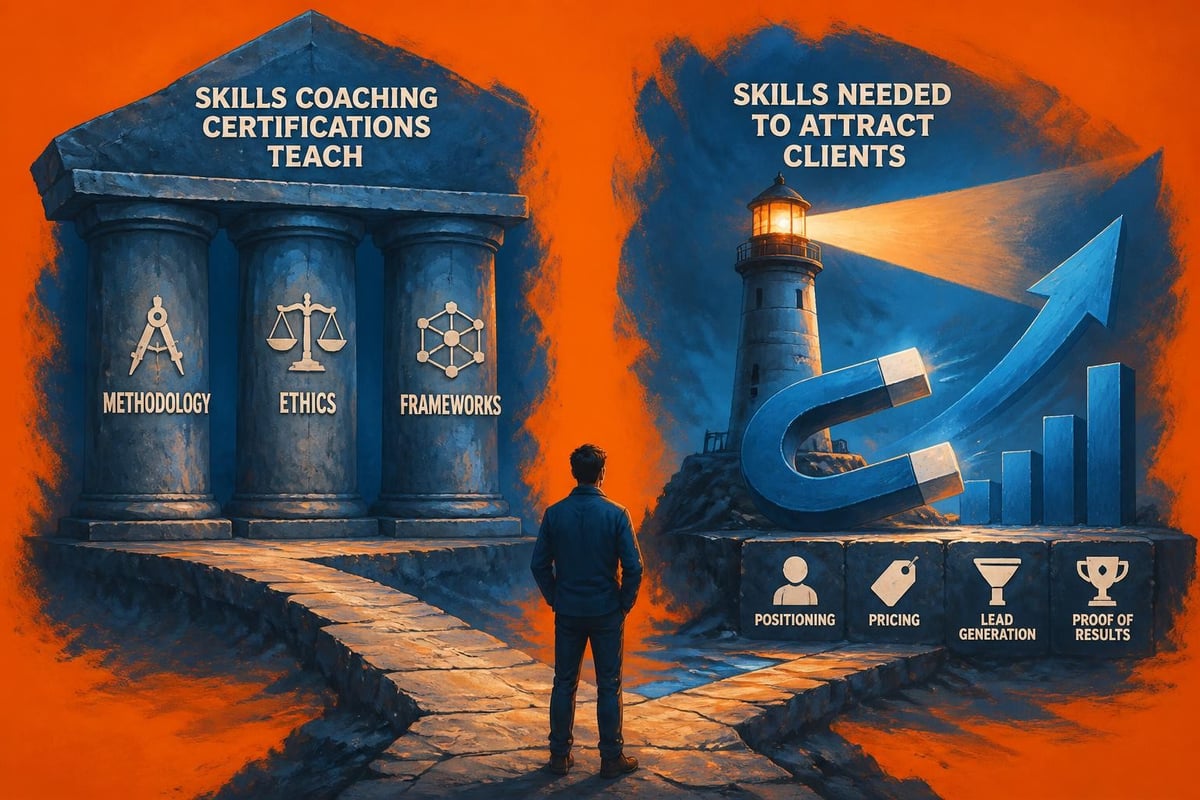
The Skills Gap That Keeps Coaches Broke
- Positioning: Certification doesn't teach you how to differentiate in a saturated market or define a compelling niche.
- Pricing: Many programs avoid commercial topics entirely, leaving coaches to guess at rates or undercharge out of fear.
- Lead generation: Few coaches learn paid acquisition, content marketing, referral systems, or partnership strategies.
- Proof: Credentials signal training, but buyers want case studies, outcomes, and results tied to their specific problems.
Research shows that about half of coaching clients do not consider certification important when hiring a coach. They evaluate expertise, fit, track record, and value alignment instead.
What Buyers Actually Evaluate in 2026
Corporate buyers and individual clients approach coaching decisions differently than certification programs assume. They care less about hours logged in training and more about outcomes relevant to their context.
When a mid-market company evaluates executive coaching options, they ask:
- Can this coach help our managers make faster, better decisions?
- Will engagement and retention improve?
- How do we measure ROI?
- What's the track record in our industry or with our challenges?
Certification appears nowhere in that evaluation. Domain expertise, facilitation skill, measurable results, and commercial alignment dominate. A certified coach with no business experience loses to an uncertified executive with 20 years of operating knowledge and proven frameworks.
| Buyer Priority | Certification Signals | What Actually Matters |
|---|---|---|
| Measurable outcomes | Trained in methodology | Case studies, KPIs, ROI proof |
| Industry relevance | Generic competencies | Domain expertise, contextual insight |
| Business value | Hours of practice coaching | Results tied to client goals |
| Trust and fit | Third-party credential | Referrals, testimonials, direct experience |
Authority Signals That Replace Credentials
The coaches who build sustainable practices in 2026 lead with authority, not accreditation. They build trust through proof.
Firsthand Experience and Results
A leadership development coach who has managed teams, hit revenue targets, and navigated organizational conflict brings credibility no certification can replicate. Buyers want coaches who have done the work, not just studied it.
Proprietary Frameworks and Methods
Coaches who create named processes, diagnostic tools, or scorecards differentiate themselves. A custom framework signals original thinking and positions the coach as an authority, not a commodity.
At Noomii Corporate Coaching, we use operating cadence audits and KPI scorecards to tie coaching directly to business metrics. That approach attracts mid-market companies more effectively than any credential.
Case Studies with Measurable Outcomes
One detailed case study showing problem, diagnosis, solution, result, and lesson outweighs a dozen certifications. Buyers want to see themselves in your past work.
Example case study structure:
- Problem: Sales team missing quarterly targets, low morale, unclear pipeline process
- Diagnosis: Weak accountability systems, inconsistent manager coaching, no shared KPIs
- Solution: Implemented weekly scorecards, coached managers live in pipeline reviews, aligned incentives to measurable outcomes
- Result: 23% revenue increase in six months, 40% improvement in manager engagement scores
- Lesson: Accountability without daily coaching fails; coaching without measurement wastes time
Why Certification Does Not Create Coaching Clients
The phrase deserves emphasis because the myth persists. Certification does not create coaching clients because it solves the wrong problem. It validates your training. It does not validate your ability to attract, convert, or retain buyers.
Credentials don’t bring clients because clients hire coaches to solve problems, not to admire diplomas. They want faster decisions, stronger teams, clearer execution, and measurable growth. Certification signals readiness to coach, but readiness to coach is not the same as readiness to run a business.
Many coaching certifications fail coaches by evaluating process over outcomes, competency over results, and adherence to models over client impact. Coaches pass exams, hang credentials, and struggle to fill their calendars because the market doesn't reward training hours. It rewards value delivery.

When Certification Does Add Value
Certification isn't worthless. It serves specific purposes when aligned with market reality.
- Structure for new coaches: A good program accelerates skill development and provides supervised practice.
- Institutional credibility: Some corporate buyers, government contracts, or healthcare settings require accredited credentials.
- Community and network: Programs connect you with peers, mentors, and potential referral sources.
- Confidence and legitimacy: For coaches transitioning from other fields, certification can provide internal validation.
The decision framework for coaching certification should weigh these benefits against cost, time, and opportunity cost. If you're coaching business leaders without formal HR requirements, investing in proof of results and client acquisition often delivers better ROI than another credential.
Building a Practice Without Credential Worship
Many successful coaches operate without certification, relying instead on expertise, positioning, and reputation. They focus on:
- Niche selection: Choosing a specific audience, problem, or industry where their experience creates unfair advantage
- Outcome articulation: Describing results in business terms (revenue, retention, speed, clarity) rather than coaching jargon
- Proof development: Building case studies, testimonials, and referral systems before scaling marketing
- Commercial fluency: Understanding pricing, packaging, contracting, and ROI measurement
- Continuous learning: Investing in skills that matter to buyers (facilitation, diagnostics, business strategy) over credential collection
Contrarian Insight: Certification Can Delay Success
Here's what the industry rarely admits: pursuing certification often postpones the hard work of building a business. It feels productive because you're learning, submitting assignments, and earning a credential. But it's a comfortable detour from the uncomfortable work of positioning, pricing, pitching, and proving value.
Coaches who delay launching until they're "certified enough" miss market feedback, client insights, and revenue that funds better training. The market teaches faster than any classroom.
FAQ: Certification and Client Acquisition
Q: Do I need a coaching certification to get clients?
A: No. Many successful coaches operate without formal certification, especially in business, executive, and niche coaching. Buyers prioritize expertise, results, and fit over credentials.
Q: Why doesn't certification guarantee clients?
A: Certification validates your training, not your business skills. Client acquisition requires positioning, marketing, proof of results, and sales capability, which most programs don't teach.
Q: What do corporate buyers care about when hiring coaches?
A: Mid-market and Fortune 500 buyers evaluate domain expertise, measurable outcomes, ROI proof, facilitation skill, and cultural fit. Certification is rarely a top-five decision factor.
Q: Should I skip certification entirely?
A: Not necessarily. If you're new to coaching, a strong program accelerates skill development. But don't treat certification as a substitute for business strategy or client acquisition skills.
Q: How do I attract clients without a big-name credential?
A: Lead with case studies, niche expertise, proprietary frameworks, and results tied to business outcomes. Build referral networks and demonstrate value through content, workshops, or pilot engagements.
Q: What skills matter more than certification?
A: Positioning, pricing, lead generation, diagnostic capability, facilitation, business fluency, and the ability to tie coaching to measurable KPIs and ROI.
Q: Can certification hurt my coaching business?
A: Yes, if it delays launching, consumes capital needed for marketing, or creates dependency on credential collection instead of client-facing work.
Q: Do clients ask about my certification?
A: Some do, but research shows about half don't consider it important. More often, they ask about your experience, approach, results, and how you'll measure success.
Q: What's the best investment for new coaches?
A: Building proof (case studies, testimonials), clarifying your niche and positioning, learning client acquisition, and developing proprietary methods that differentiate you from certified generalists.
Certification does not create coaching clients because buyers hire results, not resumes. In 2026, the coaching market rewards proof over pedigree, outcomes over credentials, and business acumen over training hours. If you want to build accountable leaders, drive measurable growth, and tie coaching to real business outcomes, Noomii delivers practical corporate coaching with month-to-month terms, no long contracts, and a focus on KPIs and ROI that keeps clients engaged because results are visible.



Leave a Reply
Want to join the discussion?Feel free to contribute!