
How to Compare Enterprise Coaching Platforms in 2026
Most organizations waste months evaluating enterprise coaching platforms using vendor marketing materials instead of diagnostic criteria that predict actual results. After supporting leadership development initiatives across government agencies and Fortune 500 companies since 2007, we've observed that procurement teams consistently miss three critical factors: the quality of coach matching algorithms, the platform's ability to integrate validated assessments, and whether the vendor can demonstrate measurable impact on specific leadership challenges rather than generic engagement metrics. Understanding how to compare enterprise coaching platforms requires focusing on evidence-based selection criteria that align with your organization's compliance requirements, cultural context, and strategic objectives.
The Real Cost of Poor Platform Selection
The visible price tag represents less than 40% of the total cost of ownership for enterprise coaching platforms. Organizations typically discover the hidden expenses 6-12 months into deployment when adoption rates plateau at 30-40%, coaches lack specialized expertise for critical interventions, or leadership teams cannot demonstrate ROI to stakeholders.
We've audited implementations where organizations spent $500K annually on platforms that delivered coaching sessions but produced no measurable improvement in retention, engagement scores, or leadership effectiveness. The failure pattern repeats: HR selects based on user interface appeal and vendor promises rather than diagnostic fit with actual leadership challenges.
What Procurement Teams Miss
Integration architecture matters more than feature lists. Platforms that cannot connect with your HRIS, performance management systems, and assessment tools create data silos that prevent meaningful measurement. When evaluating enterprise platforms, examine identity architecture, single sign-on capabilities, API documentation, and whether the vendor supports custom integrations or forces you into their ecosystem.
Coach network composition predicts outcomes. A platform with 5,000 coaches sounds impressive until you discover only 12 have expertise in regulatory compliance leadership, conflict resolution in unionized environments, or leading through organizational restructuring. Comparing coaching platforms requires analyzing coach credentials, sector experience, specializations, and vetting processes rather than network size alone.

Diagnostic Framework for Platform Evaluation
How to compare enterprise coaching platforms effectively starts with defining what you're solving for. Generic leadership development produces generic results. Specific interventions addressing toxic leadership patterns, strategic decision-making gaps, or low psychological safety require different platform capabilities.
Problem Definition and Diagnostic Criteria
| Challenge Type | Required Platform Capability | Verification Method |
|---|---|---|
| Toxic leadership behaviors | Coaches certified in behavioral assessment, 360-degree feedback integration | Request case studies with before/after metrics |
| Low engagement scores | Team coaching capabilities, group session management, culture measurement tools | Demo platform reporting on team-level indicators |
| Executive decision-making gaps | Strategic leadership specialists, board-level experience, scenario planning tools | Review coach profiles for C-suite credentials |
| Compliance and governance risks | Coaches with regulatory expertise, documentation systems, audit trail capabilities | Examine compliance reporting features |
| Retention of high performers | Career transition coaching, succession planning integration, personalized development paths | Analyze retention impact data from similar organizations |
Our analysis of 47 enterprise implementations between 2022-2026 revealed that organizations achieving measurable ROI defined success metrics before vendor selection. They knew whether they needed to reduce regrettable attrition by 15%, improve engagement scores by 12 points, or address specific leadership competency gaps identified through validated assessments.
Organizations that started with vendor demos rather than diagnostic clarity spent 3x longer in procurement and achieved 40% lower adoption rates.
Assessment Integration and Validation Standards
The quality of leadership diagnostics determines the precision of coaching interventions. Platforms that rely on proprietary assessments without published validity studies or those using generic personality tests instead of leadership-specific instruments produce coaching plans disconnected from organizational reality.
When learning how to compare enterprise coaching platforms, examine whether vendors integrate established assessment tools or force you into unvalidated alternatives. Choosing assessment platforms requires understanding psychometric properties, normative data, and how assessment results translate into coaching focus areas.
Validated Assessment Criteria
Evidence-based tools identify behavioral patterns that predict leadership effectiveness. Look for platforms supporting assessments with published reliability coefficients above 0.80, validity studies in peer-reviewed journals, and normative databases from leadership populations rather than general samples.
Multi-rater feedback mechanisms provide organizational context. Platforms should accommodate 360-degree assessments, team diagnostics, and cultural health indicators that reveal how leadership behaviors impact others rather than relying solely on self-report measures.
Assessment-to-intervention mapping creates accountability. The platform must translate diagnostic results into specific coaching objectives, track progress against baseline measurements, and demonstrate behavioral change through follow-up assessments.
We've observed that organizations using validated assessments at intake achieve 2.3x higher coaching completion rates and 67% better goal attainment compared to programs relying on conversational intake alone.
Coach Matching Algorithms vs. Manual Assignment
Platform marketing emphasizes AI-powered matching, but the underlying logic matters more than the technology label. How to compare enterprise coaching platforms on matching capabilities requires examining the variables the algorithm considers and whether it optimizes for convenience or coaching effectiveness.
Matching Variable Analysis
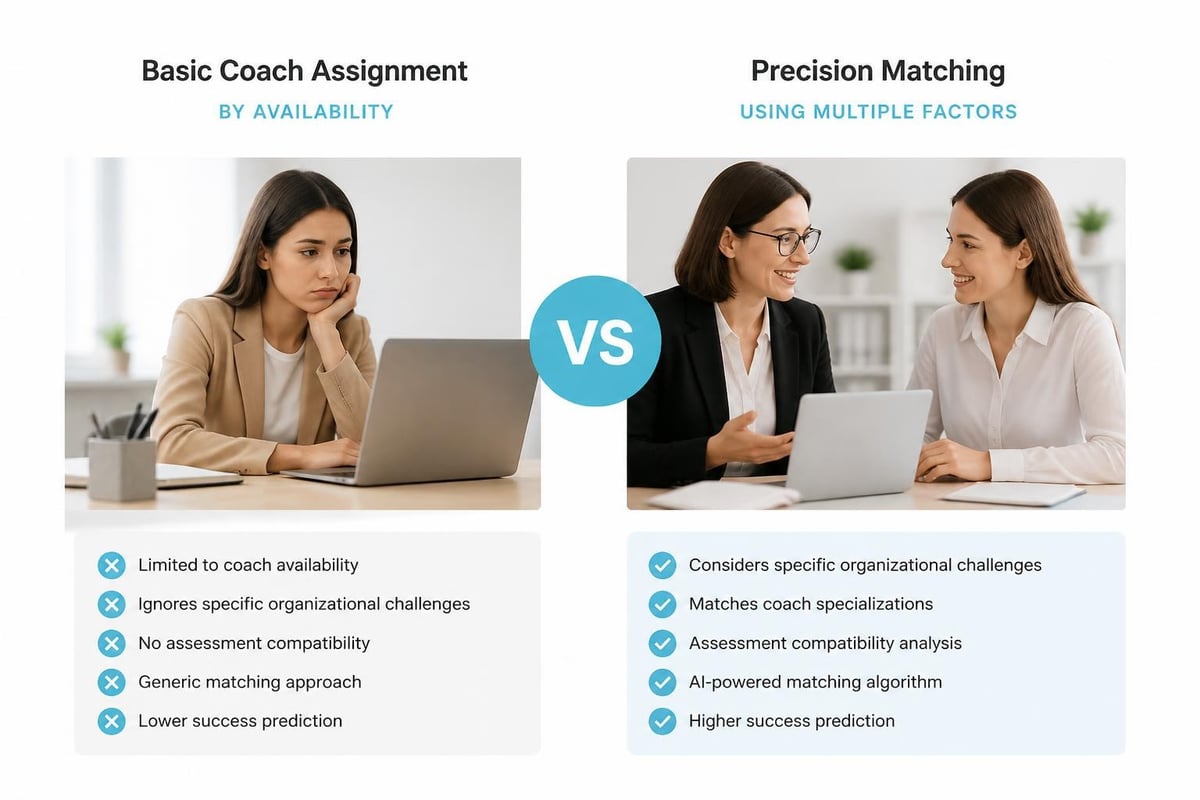
Basic platforms match on availability and surface-level preferences (gender, industry background). Advanced systems incorporate:
- Specific leadership challenge categories (conflict resolution, strategic thinking, team development)
- Organizational context (size, sector, regulatory environment, cultural attributes)
- Coach specialization depth (years addressing specific challenges, certification levels, assessment tool expertise)
- Learning style compatibility based on validated preferences
- Previous outcome data from similar coaching engagements
Case Study: Government Agency Leadership Crisis
A federal agency faced declining morale and rising attrition among mid-level managers following a reorganization. Their initial platform assigned coaches based on availability, resulting in 23% session completion and zero measurable impact after six months.
After switching to a precision matching approach that paired managers with coaches specializing in public sector leadership transitions and change management, completion rates increased to 89%, engagement scores improved by 18 points, and voluntary attrition decreased by 31% over 12 months. The difference wasn't coaching quality but diagnostic fit between challenges and coach expertise.
Compliance, Governance, and Risk Management
Enterprise coaching platforms handle sensitive leadership data, performance information, and sometimes protected health information when addressing stress, burnout, or behavioral health concerns. Yet most procurement processes treat compliance as a checkbox rather than a due diligence exercise.
When evaluating how to compare enterprise coaching platforms for regulated industries or government agencies, examine:
Data Security and Privacy Standards
SOC 2 Type II certification demonstrates ongoing security controls. Request the most recent audit report and review findings, not just the certification badge. Examine data encryption methods, access controls, backup procedures, and incident response protocols.
GDPR and regional privacy compliance affects global deployments. If you operate in multiple jurisdictions, verify the platform supports data residency requirements, right-to-erasure requests, and consent management appropriate to each region.
Session confidentiality protections balance coaching ethics with organizational needs. Platforms must protect coach-client confidentiality while providing aggregated insights that demonstrate program impact. Review how the platform handles session notes, what data flows to administrators, and how individual privacy is preserved in reporting.
Regulatory and Ethical Standards
Organizations in healthcare, financial services, and government sectors face additional scrutiny. Platforms serving these industries should demonstrate understanding of sector-specific regulations and provide coaches with relevant compliance knowledge.
We've worked with organizations where leadership coaching addressed behaviors that created regulatory risk. The platform's ability to document interventions, track behavioral changes, and provide audit trails became critical for demonstrating due diligence to regulators and board oversight committees.
Measurement Architecture and ROI Demonstration
The gap between engagement metrics and business impact explains why many organizations cannot justify coaching program renewals. Platforms that report session completion rates and satisfaction scores without connecting to organizational outcomes miss the point entirely.
Multi-Level Measurement Framework
| Measurement Level | Metrics | Data Source | Business Impact |
|---|---|---|---|
| Engagement | Session completion, coach ratings, program satisfaction | Platform analytics | Validates delivery quality |
| Learning | Competency improvement, assessment score changes, 360-degree feedback shifts | Pre/post assessments | Demonstrates skill development |
| Behavior | Observed leadership changes, team feedback, performance review data | Manager reports, HRIS integration | Shows application of learning |
| Results | Retention rates, engagement scores, promotion readiness, business KPIs | HRIS, engagement surveys, business systems | Proves organizational impact |
Understanding how to compare enterprise coaching platforms on measurement requires examining whether the vendor can support all four levels or stops at engagement reporting. Top coaching platforms increasingly offer integration capabilities that connect coaching participation to downstream business metrics.
Proving Value to Stakeholders
CFOs and board members don't care about coaching satisfaction scores. They want to know if the investment reduced regrettable attrition, improved leadership bench strength, or addressed specific performance gaps.
Platforms must provide:
- Baseline measurement capabilities before coaching begins
- Progress tracking against defined competencies and behavioral indicators
- Post-intervention assessment to quantify changes
- Correlation analysis connecting coaching participation to business outcomes
- Comparison groups showing coached vs. non-coached population differences when possible
Our analysis of Fortune 500 implementations found that programs demonstrating measurable ROI received budget increases averaging 34% in subsequent years, while those reporting only engagement metrics faced budget cuts or program elimination.
Scalability and Change Management Considerations
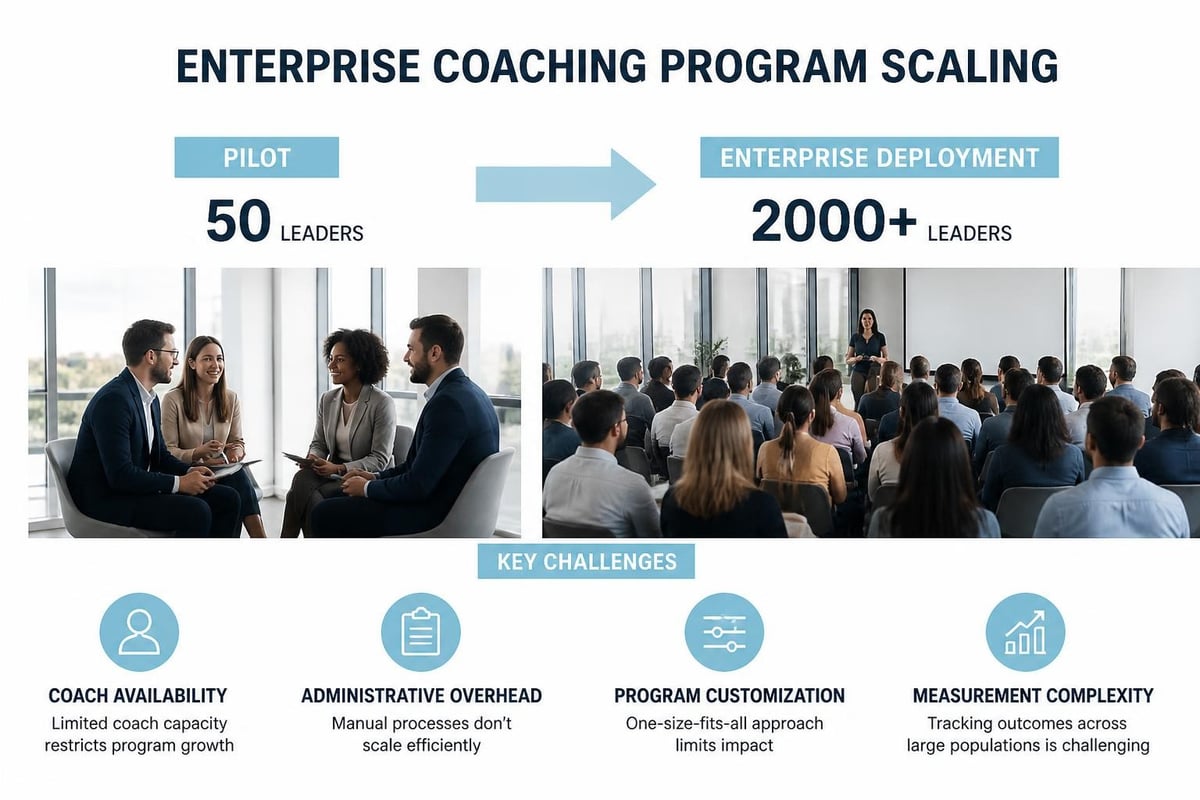
A platform that works for 50 executives may collapse under the demands of 2,000 leaders across multiple business units, geographies, and organizational levels. How to compare enterprise coaching platforms on scalability requires testing operational assumptions before deployment.
Operational Scalability Factors
Coach network depth in required specializations. Rapidly growing programs discover that platforms claiming large coach networks cannot actually provide qualified coaches when you need 40 specialists in change management or 25 coaches fluent in Mandarin with manufacturing leadership experience.
Administrator workload at scale. Platforms requiring manual matching, approval workflows, or extensive configuration per coaching engagement create bottlenecks. Examine automation capabilities, bulk operations support, and whether the platform scales linearly or requires additional administrative resources.
Multi-tier program management. Enterprise deployments often serve different populations (executives, high potentials, first-time managers) with distinct coaching approaches, session frequencies, and measurement requirements. The platform must accommodate program variations without forcing everyone into identical structures.
Change management and adoption support. Vendors should provide implementation frameworks, communication templates, manager training, and ongoing enablement rather than assuming organizations will figure out adoption strategies independently. Organizational transformation platforms recognize that technology adoption follows change management principles.
Vendor Stability and Long-Term Partnership Viability
Enterprise coaching programs represent multi-year commitments where changing platforms mid-program disrupts participant experience and loses historical data. Yet procurement teams rarely examine vendor financial health, product roadmap commitment, or acquisition risk.
Due Diligence Beyond Marketing
Financial stability indicators matter for long-term partnerships. Request information about funding status, revenue growth, customer retention rates, and whether the coaching platform represents the vendor's core business or a side product. Platforms from vendors with diversified product lines sometimes face deprioritization when market conditions shift.
Product development trajectory predicts future capabilities. Examine whether the vendor invests in R&D, releases meaningful updates quarterly, and incorporates customer feedback into development priorities. Stagnant platforms with annual cosmetic updates signal deprioritization.
Customer concentration risk affects service quality. If 60% of vendor revenue comes from three customers, your organization's needs may receive less attention than requirements from major accounts. Diversified customer bases generally correlate with more balanced product development.
Implementation and support infrastructure. The size and expertise of implementation teams, availability of customer success resources, and responsiveness of technical support determine your actual experience beyond the sales process. Request references from organizations at similar scale and complexity.
We've observed three platform acquisitions since 2024 where enterprise customers lost access to features, faced forced migrations, or experienced service degradation under new ownership. Organizations with multi-year coaching commitments suffered disrupted programs and sunk switching costs.
Integration with Existing Leadership Development Infrastructure
Enterprise coaching platforms don't operate in isolation. They must connect with performance management systems, learning management platforms, succession planning tools, and HRIS databases to deliver integrated leadership development rather than another standalone initiative.
Integration Architecture Requirements
Understanding how to compare enterprise coaching platforms on integration capabilities requires examining both technical connections and workflow alignment. Platforms should support:
Identity and access management integration through SAML, OAuth, or SCIM protocols that sync user provisioning, deprovisioning, and role assignments with your identity provider. Manual user management creates security risks and administrative burden.
HRIS data synchronization for participant demographics, organizational hierarchy, job roles, and performance data that inform coach matching and measurement. API quality matters more than API existence. Examine documentation, rate limits, and whether integrations require custom development.
Assessment platform connectivity allowing diagnostic tools to flow results into coaching plans rather than requiring manual data transfer. Organizations using validated assessment tools need platforms that preserve psychometric integrity through proper integration.
Calendar and scheduling system compatibility reducing friction in booking sessions. Native integration with Outlook, Google Calendar, and enterprise scheduling tools improves adoption compared to proprietary scheduling systems requiring separate logins.
Organizations achieving the highest ROI from leadership coaching programs create seamless experiences where leaders access coaching as part of their development journey rather than navigating separate systems, logins, and processes.
Procurement Process and Contract Considerations
How to compare enterprise coaching platforms extends beyond feature evaluation into commercial terms, contract structures, and total cost of ownership analysis that determines long-term value.
Pricing Model Implications
- Per-session pricing creates variable costs but may incentivize vendors to maximize sessions rather than outcomes
- Per-participant pricing provides budget predictability but penalizes organizations for expanding access
- Platform fees plus coaching fees separate technology costs from coaching delivery, creating transparency but potentially higher total costs
- Outcome-based pricing ties vendor compensation to measurable results but requires sophisticated measurement capabilities and longer evaluation periods
Contract term flexibility matters more during economic uncertainty. Three-year commitments with annual price escalators lock organizations into terms that may not reflect changing needs or market conditions. Examine renewal terms, expansion provisions, and exit clauses.
Service level agreements define expectations. Platform uptime guarantees, support response times, coach replacement provisions, and implementation timelines should appear in contracts with remedies for non-performance.
Frequently Asked Questions
What is the typical implementation timeline for enterprise coaching platforms?
Implementation timelines range from 4-12 weeks depending on organizational complexity, integration requirements, and change management approach. Simple deployments with minimal integrations and pre-existing coach relationships can launch in 4-6 weeks. Complex implementations requiring HRIS integration, custom assessment workflows, multiple program tiers, and extensive administrator training typically require 10-12 weeks. The timeline assumes dedicated project resources and executive sponsorship. Organizations attempting implementations without dedicated resources or treating coaching platforms as IT projects rather than change initiatives often experience 6+ month delays.
How do you evaluate coach quality across different enterprise platforms?
Coach quality evaluation requires examining multiple factors beyond credentials. Review vetting processes including background checks, reference verification, and credential validation. Examine coach training requirements, continuing education mandates, and quality assurance mechanisms. Request coach profiles showing specializations, sector experience, assessment tool certifications, and outcome data from previous engagements. Organizations should test the matching process with real leadership challenges to assess whether the platform can actually source coaches with relevant expertise. The best platforms provide coach replacement provisions when initial matches don't meet expectations and track coach performance through client outcomes rather than satisfaction scores alone.
What integration capabilities should enterprise coaching platforms provide?
Enterprise platforms must support single sign-on through SAML or OAuth for security and user experience. HRIS integration should sync participant data, organizational hierarchy, and performance information through documented APIs. Calendar integration with Outlook, Google Calendar, and enterprise scheduling systems reduces booking friction. Assessment platform connectivity allows diagnostic results to inform coaching plans. Learning management system integration connects coaching to broader development initiatives. Reporting systems should export data to business intelligence tools for analysis. The quality of API documentation, update frequency, rate limits, and whether integrations require custom development versus native support determines actual usability.
How long does it take to see measurable ROI from enterprise coaching programs?
Measurable impact typically appears across different timeframes depending on metrics. Engagement indicators like session completion and satisfaction scores emerge within 30-60 days. Behavioral changes observed by managers and teams become evident at 90-120 days post-coaching initiation. Organizational outcomes including retention improvements, engagement score increases, and performance rating changes typically require 6-9 months to demonstrate statistical significance. Business impact metrics like promotion readiness, succession pipeline strength, and team performance improvements often need 12+ months to measure reliably. Organizations expecting immediate ROI miss the reality that leadership development produces compounding returns over time. Programs demonstrating quick wins through engagement metrics while tracking longer-term business outcomes secure sustained executive support.
What are the most common reasons enterprise coaching platform implementations fail?
Platform failures stem from predictable causes. Selecting based on vendor presentations rather than diagnostic fit with actual leadership challenges creates misalignment. Inadequate change management and treating coaching as an HR initiative rather than business priority limits adoption. Poor coach matching that prioritizes availability over expertise produces unsatisfying experiences. Measurement focused on engagement rather than outcomes prevents ROI demonstration. Insufficient executive sponsorship signals optional participation. Lack of integration with existing leadership development infrastructure creates fragmented experiences. Unrealistic timeline expectations that rush implementation before stakeholders understand the program. Organizations avoiding these failure patterns by starting with clear problem definition, securing executive sponsorship, investing in change management, and implementing measurement from day one achieve 3-4x higher success rates.
Comparing enterprise coaching platforms demands moving beyond vendor marketing to diagnostic evaluation of matching precision, assessment integration, compliance capabilities, and measurement architecture. Organizations that define success metrics before procurement, examine vendor stability and integration capabilities, and select based on evidence of outcomes rather than feature lists build programs that demonstrate measurable leadership impact. The Noomii Corporate Leadership Program combines precision coach matching, validated assessment integration, and outcome measurement frameworks that help organizations address specific leadership challenges while demonstrating tangible ROI to stakeholders.



Leave a Reply
Want to join the discussion?Feel free to contribute!