

ICF Does Not Improve Coaching Outcomes (2026 Data)
The coaching industry has built a mythology around credentials, with the International Coaching Federation (ICF) sitting at the center of this narrative. Organizations write job descriptions demanding ICF certification. Coaches pay thousands for training programs just to append three letters after their names. Yet when you examine the evidence, a pattern emerges that challenges this credential worship: ICF does not improve coaching outcomes in ways that matter to businesses paying for results.
This isn't about discrediting good coaches who happen to hold ICF credentials. It's about exposing the gap between certification and performance, between process compliance and client transformation. After observing hundreds of coaching engagements across mid-market companies, the pattern is clear: credentials predict adherence to methodology, not business impact.
The Evidence Gap Between Certification and Results
Multiple research efforts have attempted to establish the link between ICF certification and superior coaching outcomes. The results are underwhelming.
Research on coaching effectiveness identifies several factors that predict successful outcomes, but certification status consistently shows weak correlation with client-reported transformation. The variables that actually matter include coach experience, client readiness, relationship quality, and contextual understanding of the client's business environment.
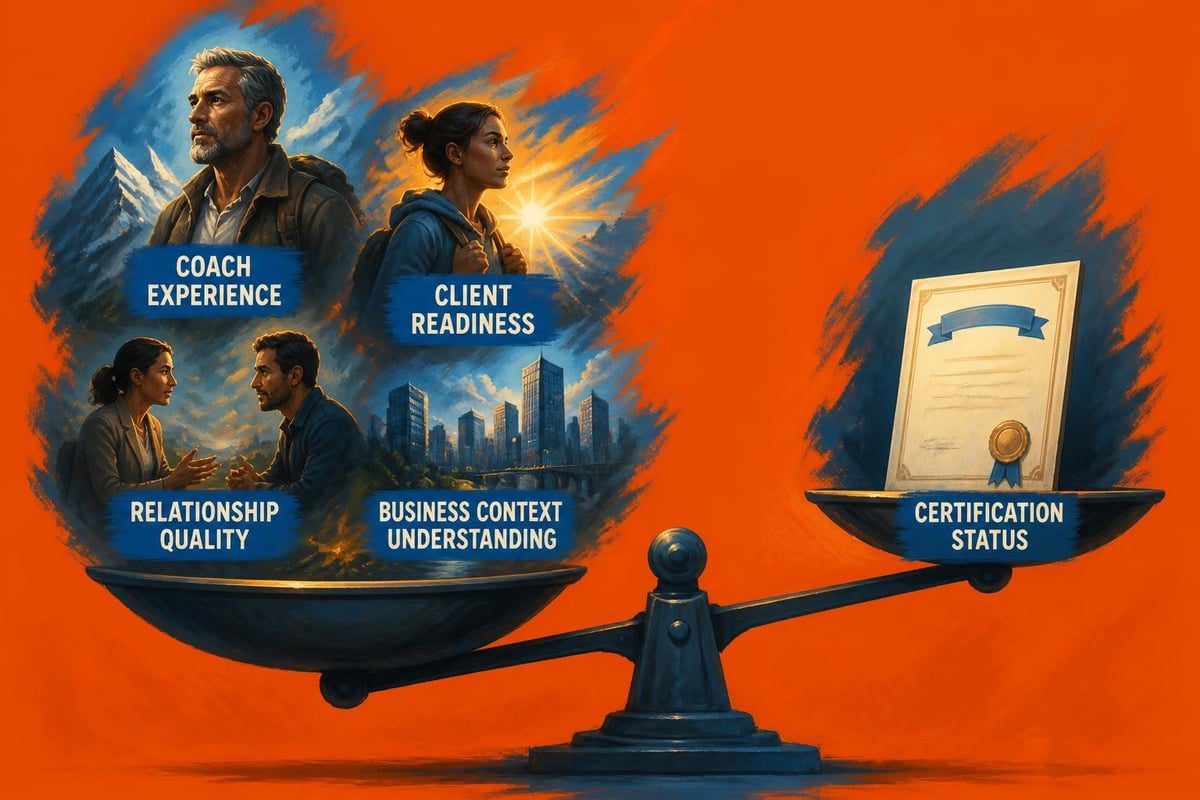
A study examining solution-focused coaching behaviors found that specific coaching approaches and client perceptions of the coaching relationship mattered far more than credential status. Coaches using effective techniques without ICF certification outperformed credentialed coaches using rigid frameworks poorly matched to client needs.
What Certification Actually Measures
ICF certification primarily validates three things:
- Training hours completed (often in classroom settings disconnected from real client challenges)
- Adherence to ICF core competencies (a process framework, not an outcome framework)
- Ability to pass assessments (demonstrating knowledge of methodology, not business impact)
None of these directly measure whether a coach can help a VP of Sales fix a broken forecast process, enable a leadership team to make faster decisions, or build psychological safety in dysfunctional teams.
When companies hire coaches focused on ICF competency demonstrations rather than business problem-solving, they get coaching sessions that feel like coaching but lack commercial punch. The coach asks powerful questions, reflects carefully, and maintains professional boundaries, yet the client's KPIs remain stuck.
Why Organizations Keep Hiring Certified Coaches
If ICF does not improve coaching outcomes meaningfully, why do HR departments and procurement teams keep requiring it?
The answer lies in risk mitigation theater. When a coaching engagement fails, pointing to ICF credentials provides cover. "We hired a certified coach" becomes the defense, even when certification had nothing to do with the failure or success of the engagement.
| Reason for Requiring ICF | Actual Impact on Outcomes | Risk Mitigated |
|---|---|---|
| Professional standards compliance | Low correlation | Legal/HR exposure |
| Quality assurance | Weak predictor | Procurement approval |
| Vendor differentiation | Creates artificial scarcity | Decision fatigue |
| Industry best practice perception | Minimal outcome variance | Executive judgment criticism |
This creates a self-reinforcing cycle. Organizations require credentials, coaches pursue credentials to access opportunities, and the industry perpetuates the myth that credentials equal effectiveness.
The Cost of Credential Obsession
Mid-market companies typically pay 20-40% more for ICF-credentialed coaches compared to equally experienced coaches without certification. Understanding coaching costs reveals this premium rarely translates to measurably better results.
That premium funds:
- Coach training program fees ($3,000-$15,000)
- Ongoing ICF membership and credential renewal
- Mentor coaching hours
- Assessment fees and continuing education credits
None of these expenses directly improve a coach's ability to diagnose why a leadership team can't execute strategy or why a manager avoids difficult conversations.
What Actually Drives Coaching Outcomes
Observing engagements that produce measurable business impact reveals a different set of success factors.
Deep contextual expertise matters enormously. A coach who understands SaaS sales cycles, recurring revenue models, and forecast accuracy can add immediate value to a VP of Sales. Generic "leadership coaching" without industry context often misses the nuances that unlock performance.
Live application beats theory. Coaches who work inside client meetings, observe actual team dynamics, and provide real-time feedback create faster behavior change than those conducting isolated one-on-one sessions disconnected from daily work.
Outcome alignment and measurement separate impactful coaching from expensive conversations. When coaching ties directly to KPIs (faster decision cycles, improved retention rates, increased pipeline conversion), both coach and client maintain focus on results rather than process compliance.

The Experience Paradox
Here's what the certification model misses: the best coaches often developed their expertise outside formal coaching programs. They were operators, executives, consultants, and functional experts who learned to facilitate transformation through repeated exposure to business problems.
Research on wellness coaching demonstrates that coaches with deep subject matter expertise in the domain they're coaching (health, business, finance) achieve better client outcomes than generalist coaches with superior credentials but less contextual knowledge.
A former CFO coaching financial leaders brings pattern recognition from dozens of similar challenges. A sales leader coaching account executives understands pipeline reality versus forecast fiction. These coaches may or may not pursue ICF certification, but their value stems from experience, not credentials.
The AI Disruption Nobody's Discussing
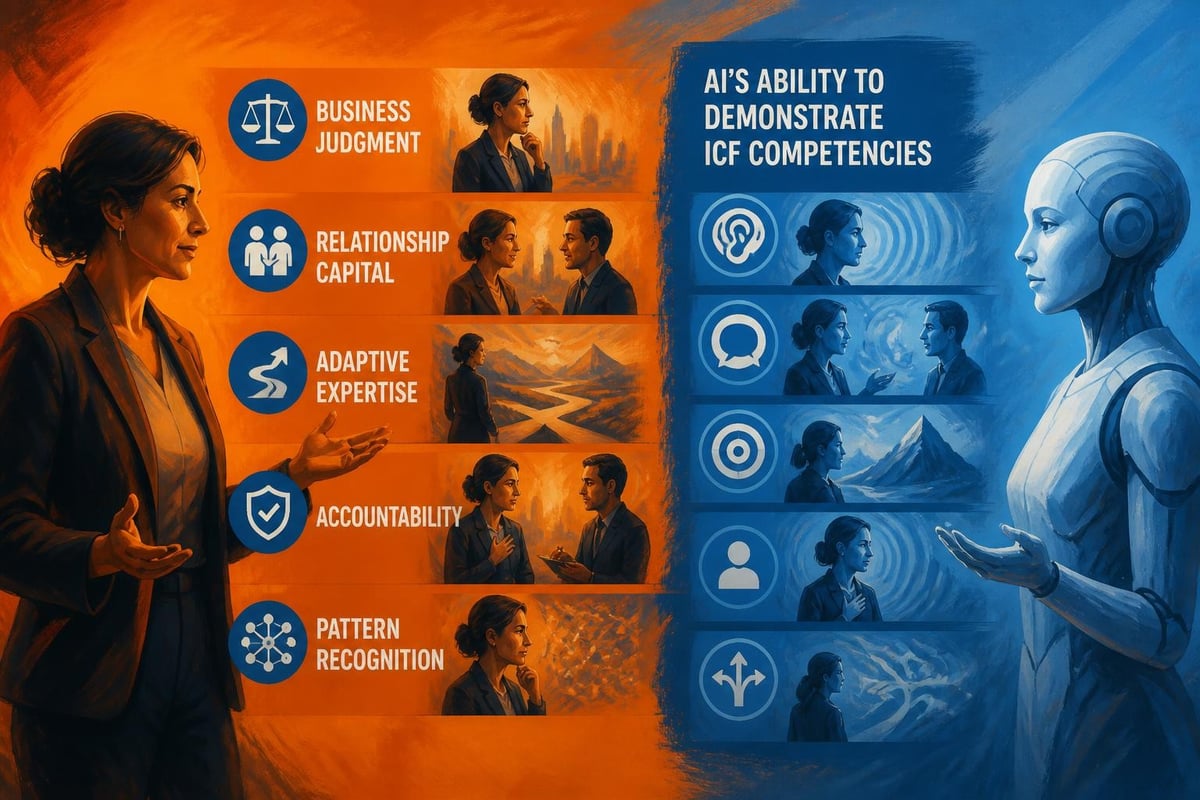
By 2026, the credential conversation has become even more absurd. AI tools for coaching can now demonstrate ICF core competencies with startling accuracy. An analysis of AI performance on ICF-style assessments shows large language models can mimic credentialed coaching conversations effectively.
If AI can pass ICF assessments without producing meaningful coaching outcomes, what does that reveal about what certification actually measures?
The value gap is widening. Human coaches who add value do so through:
- Business judgment developed from operating experience
- Relationship capital and trust building over time
- Adaptive expertise that reads context and adjusts approach
- Accountability partnership that sustains commitment when motivation fades
- Pattern recognition from seeing similar challenges across multiple organizations
None of these appear on ICF competency rubrics. All of them drive results.
Choosing Coaches for Impact, Not Credentials
Organizations serious about coaching ROI should revise their selection criteria.
Start with outcomes, not credentials. Define the business problem clearly. Is it execution speed? Leadership pipeline? Sales performance? Then find coaches who have solved that specific problem repeatedly, regardless of letters after their name.
Demand proof of results. Ask for case studies showing problem, diagnosis, solution, result, and lesson learned. Generic testimonials about "transformative experiences" signal coaching without business impact.
Evaluate contextual fit. A coach who understands your industry, business model, and operational challenges will add value faster than a credentialed generalist learning your world on your dime.
Test before committing. Month-to-month arrangements let you assess impact without long-term risk. If results aren't visible within 90 days, certification won't save the engagement.
Measure what matters. Track business metrics, not coaching session attendance. Decision speed, retention rates, pipeline growth, and team engagement scores reveal impact. Hours logged and competencies demonstrated do not.
Smart buyers recognize that ICF does not improve coaching outcomes enough to justify the credential premium or restricted talent pool. They hire for expertise, experience, and evidence of results instead.
Frequently Asked Questions
Does ICF certification mean a coach is qualified?
ICF certification confirms training hour completion and methodology knowledge, not business expertise or proven results. Many highly effective coaches lack certification, while some certified coaches deliver minimal business impact.
Should I only hire ICF-certified coaches?
No. Evaluate coaches based on relevant experience, industry expertise, proven outcomes, and contextual fit for your specific challenges. Certification is one data point, not the primary qualifier.
What predicts successful coaching outcomes?
Research shows coach experience in your domain, client readiness, relationship quality, clear outcome definition, and contextual business understanding predict success better than certification status.
Why do companies require ICF credentials?
Organizations often require credentials for risk mitigation, procurement compliance, and perceived quality assurance rather than evidence of superior outcomes. It simplifies vendor selection but may exclude highly effective coaches.
Are uncertified coaches less ethical?
Ethics depend on individual character and professional standards, not certification. Many uncertified coaches maintain high ethical standards, while certification doesn't prevent all ethical failures.
How much more do ICF coaches cost?
ICF-credentialed coaches typically charge 20-40% premiums over equally experienced uncertified coaches, with costs passed to clients despite weak correlation between certification and measurably better results.
Can AI replace ICF-certified coaches?
AI can already demonstrate ICF core competencies convincingly, revealing that certification measures methodology adherence more than human coaching value like judgment, trust, and adaptive expertise.
What should I ask when hiring a coach?
Request specific case studies with measurable outcomes, ask about experience with your industry and challenge type, and clarify how they'll measure progress and tie coaching to business KPIs.
How quickly should coaching show results?
Business coaching should show measurable progress within 90 days. If behavioral change, decision improvement, or relevant KPI movement isn't visible by then, certification won't rescue the engagement.
The evidence is clear: ICF certification correlates weakly with coaching outcomes that drive business performance. Organizations get better results when they hire for expertise, experience, and proven impact rather than credentials alone. If you need practical corporate coaching that delivers measurable business results tied to clear KPIs, Noomii connects you with coaches focused on outcomes, not credential worship, with month-to-month terms that align risk with visible results.



Leave a Reply
Want to join the discussion?Feel free to contribute!