

AI Adoption and Executive Accountability in 2026
The conversation around ai adoption and executive accountability has shifted from theoretical to existential. In 2026, boards are asking harder questions, regulators are tightening enforcement, and the gap between who deploys AI and who owns the outcomes has become untenable. Most organizations have moved past the "should we adopt AI" phase. They're now confronting a more dangerous reality: their executives are accountable for systems they don't fully understand, can't properly govern, and haven't integrated into core workflows. The result isn't just inefficiency. It's exposure.
The Accountability Gap Is Now a Governance Crisis
Recent findings reveal a troubling pattern. Many CIOs are held accountable for AI systems they don’t fully control, creating a structural disconnect between responsibility and authority. This isn't a technology problem. It's an organizational design failure that leadership teams have ignored for too long.
When executives deploy AI without clear ownership structures, three predictable failures emerge:
- Diffused responsibility across departments that creates accountability vacuums
- Fragmented governance that leaves risk management reactive instead of proactive
- Misaligned incentives where innovation teams optimize for speed while compliance teams manage fallout
The consequences aren't abstract. In one Fortune 500 manufacturing company we worked with in 2025, an AI-powered supply chain optimization tool deployed by operations generated $4.2 million in cost overruns before anyone questioned who was accountable for validating its recommendations. The CIO was held responsible despite having no input on vendor selection or implementation oversight.

What Boards Are Actually Measuring
Boards have stopped accepting vague AI strategy presentations. They're now demanding specific accountability metrics:
| Accountability Measure | What Boards Ask | What It Reveals |
|---|---|---|
| Decision Rights Mapping | Who approves AI deployments? | Whether accountability is defined or diffused |
| Risk Ownership | Who's personally liable for AI failures? | If consequences are real or theoretical |
| Governance Integration | How does AI fit existing compliance? | Whether controls are bolted on or built in |
| Outcome Tracking | What KPIs measure AI impact? | If executives manage or just monitor |
This shift reflects a broader reality. AI adoption problems are usually organizational problems in disguise, and boards now recognize that technology issues mask leadership failures.
Why Speed Without Structure Creates Liability
The execution gap in ai adoption and executive accountability stems from a dangerous assumption: that moving fast justifies bypassing governance. Organizations that prioritized deployment speed over accountability structures are now facing the consequences.
A 2026 study found that unauthorized AI usage has created what researchers call an "AI execution gap." Shadow AI deployments, where teams adopt tools without IT oversight, have proliferated across enterprises. The problem isn't the technology itself. It's that executives lack visibility into what systems are deployed, what data they access, and what decisions they influence.
One global financial services firm discovered 37 separate AI tools in use across their organization during a compliance audit. None had gone through formal approval processes. All processed customer data. The Chief Risk Officer learned about them when regulators asked for documentation.
The Three Governance Failures Leaders Miss
Executives consistently underestimate three critical governance gaps:
-
The Trust Deficit: Building transparent, human-centered AI systems requires intentional design, not just technical capability. When leadership teams skip stakeholder engagement, they create AI systems employees resist or circumvent.
-
The Investment Illusion: Businesses struggle with ensuring AI investments translate into long-term value because they focus on acquisition costs while ignoring lifecycle management, training requirements, and integration complexity.
-
The Ownership Vacuum: Without explicit assignment of accountability, AI initiatives default to collective responsibility, which in practice means no one is responsible. This creates the conditions for preventable failures.
These aren't edge cases. They're the dominant pattern in organizations that treat ai adoption and executive accountability as separate workstreams instead of integrated imperatives.
What Effective AI Accountability Actually Requires
The organizations getting this right in 2026 share common practices that distinguish accountability theater from genuine governance. They've moved beyond committees and policies to embed ownership into executive roles and performance expectations.
Direct Executive Ownership Models
Leading organizations assign specific executives personal accountability for AI outcomes, not just oversight. This means:
- The CMO who deploys AI-powered customer segmentation owns accuracy metrics and bias audits
- The COO implementing predictive maintenance systems is accountable for both efficiency gains and safety validations
- The CHRO using AI screening tools must demonstrate fairness standards and adverse impact monitoring
This approach eliminates the diffusion problem. When executives know their compensation and reputation depend on AI system performance, governance stops being someone else's problem.
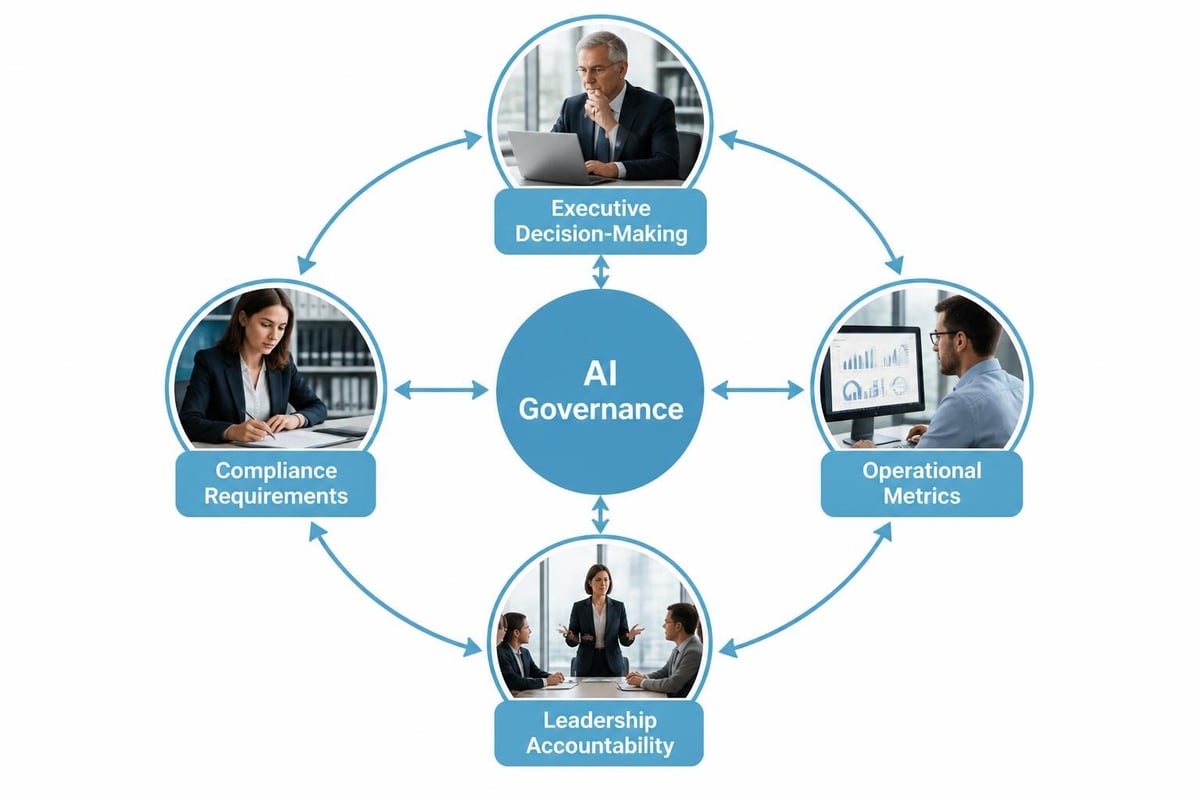
Frameworks That Close the Gap
Proprietary frameworks we've developed through leadership and executive coaching interventions focus on three integration points:
The AI Accountability Audit
Before deployment, executives must answer:
- What specific business outcome am I accountable for delivering?
- What failure modes could this system create, and who manages each?
- How will I know if this system is performing as intended?
- What happens if performance degrades or creates unintended harm?
The Governance Integration Map
This tool connects AI initiatives to existing compliance frameworks, risk committees, and decision rights structures. It reveals where AI governance overlaps with financial controls, data privacy requirements, and operational risk management. Organizations that skip this step discover gaps during incidents, not before them.
The Executive Readiness Assessment
Most executives aren't equipped to govern AI systems effectively. They lack technical fluency, underestimate organizational change requirements, and don't recognize when vendor claims exceed reality. This assessment identifies specific capability gaps and creates targeted development plans. In practice, this often means pairing executives with specialized coaches who have sector expertise in technology governance and organizational transformation.
The Leadership Capabilities AI Governance Demands
The shift to effective ai adoption and executive accountability requires different leadership capabilities than most executives currently possess. This isn't about learning to code. It's about developing judgment in unfamiliar domains.
Executives who successfully govern AI systems demonstrate three distinct capabilities:
Technical Translation Competence
They don't need deep technical expertise, but they must understand enough to ask the right questions. When a vendor claims 95% accuracy, they ask: "Accuracy measured against what baseline, using which validation methodology, on data that looks like ours or different?" They recognize the difference between correlation and causation. They understand that model performance in lab conditions differs from production environments.
This capability develops through structured exposure, not osmosis. The most effective approach we've observed pairs executives with technical advisors who can explain implications without dumbing down complexity.
Organizational Design Thinking
AI adoption fails when executives treat it as a technology insertion rather than an organizational redesign challenge. Systems that cross departmental boundaries require new coordination mechanisms. Processes that shift from human to algorithmic decision-making need different quality controls. Roles that change from executing tasks to validating AI outputs demand new competencies.
Leaders who recognize these second-order effects design implementation plans that address them proactively. Those who don't discover organizational antibodies rejecting the technology regardless of its technical merit.
Risk Imagination and Scenario Planning
The most dangerous AI failures aren't the ones you plan for. They're the edge cases no one anticipated. Effective executives develop what we call "risk imagination" through systematic scenario planning. They ask: "What could go wrong that we haven't considered? What happens if this system performs exactly as designed but in a context we didn't anticipate?"
One manufacturing executive we coached in early 2026 ran scenario exercises around their predictive maintenance AI. The team identified 12 failure modes related to sensor accuracy, model drift, and maintenance scheduling conflicts. What they missed: how the system would behave during a supply chain disruption when replacement parts weren't available according to the optimized schedule. That scenario emerged three months post-deployment and required manual overrides that the system wasn't designed to accommodate.
| Leadership Capability | Development Approach | Time to Competence |
|---|---|---|
| Technical Translation | Structured pairing with technical advisors | 3-6 months |
| Organizational Design | Cross-functional redesign workshops | 4-8 months |
| Risk Imagination | Scenario planning and failure mode analysis | 6-12 months |
The Compliance Dimension Leaders Underestimate
Regulatory expectations around ai adoption and executive accountability are tightening faster than most organizations recognize. The era of self-regulation is ending. What replaces it will make executives personally liable in ways that should change how they approach AI governance today.

In 2026, we're seeing three regulatory trends that demand executive attention:
Personal Liability Expansion
Regulators are moving toward models where executives can be held personally liable for AI system failures that cause harm, similar to financial controls under Sarbanes-Oxley. This means certifying AI systems meet safety and fairness standards, maintaining audit trails, and demonstrating due diligence in governance.
Algorithmic Transparency Requirements
New regulations require organizations to explain how AI systems make decisions that affect individuals. This goes beyond technical documentation to include impact assessments, bias testing results, and human oversight mechanisms. Executives who can't produce this documentation face enforcement actions.
Continuous Monitoring Mandates
Unlike traditional systems where compliance is point-in-time, AI systems require ongoing monitoring because their behavior can change as they learn from new data. Regulations now expect executives to demonstrate continuous oversight, not just deployment approval.
What This Means for HR and L&D Leaders
The compliance dimension creates an imperative for HR and learning leaders that many haven't recognized. Executives need development programs that address AI governance specifically, not general digital literacy training. This requires:
- Targeted coaching that builds AI governance capabilities in context of specific business challenges
- Cross-functional learning that brings together legal, compliance, IT, and business leaders to develop shared frameworks
- Scenario-based development that tests executive judgment in realistic AI governance situations
Organizations that view this as optional discover the gap when regulators or boards demand evidence of executive competence. By then, remediation is expensive and credibility is damaged.
The most effective programs we've designed through the Noomii Corporate Leadership Program pair executives with coaches who have specific expertise in technology governance and organizational transformation, not general leadership development.
Building Sustainable AI Governance Structures
The transition from ad hoc AI adoption to sustainable governance requires structural changes that most organizations haven't implemented. This isn't about adding another committee. It's about redesigning how decisions get made, how risks get managed, and how accountability gets enforced.
The Cross-Functional AI Council Model
Organizations achieving sustainable ai adoption and executive accountability typically establish cross-functional councils with real decision authority. These differ from advisory committees in three ways:
- Binding decisions: The council can block AI deployments that don't meet governance standards
- Executive membership: C-suite leaders participate directly, not through delegates
- Outcome accountability: Council members are collectively accountable for AI risk management
One healthcare system we worked with in late 2025 created an AI Governance Council with the CEO, CFO, CMO, CIO, General Counsel, and Chief Medical Officer. They meet monthly to review all AI initiatives, approve deployments, and track performance metrics. In the first six months, they blocked four projects that couldn't demonstrate adequate risk controls and redesigned governance for three others. The result: zero AI-related compliance incidents compared to five in the prior year.
Integration With Existing Governance
The mistake many organizations make is treating AI governance as separate from existing risk management, compliance, and audit structures. This creates parallel systems that compete for attention and resources.
Effective integration connects AI governance to:
- Risk committees that already oversee operational, financial, and reputational risks
- Audit functions that verify controls and validate performance claims
- Compliance programs that ensure regulatory requirements are met
- Ethics frameworks that guide decision-making when technical capabilities exceed societal consensus
This integration requires deliberate design. It doesn't happen automatically. Executives must map where AI governance intersects existing structures and create explicit linkages.
Metrics That Actually Matter
Most AI governance metrics measure activity rather than outcomes. Executives track how many AI projects are deployed, how much is spent, or how many people are trained. These numbers don't indicate whether AI is governed effectively.
The metrics that reveal genuine accountability focus on:
- Decision quality: Are AI-informed decisions producing better outcomes than previous methods?
- Risk incidents: How many AI-related failures occur, and what's the trend over time?
- Governance compliance: What percentage of AI systems meet defined governance standards?
- Executive fluency: Can leaders explain how their AI systems work and what could go wrong?
Organizations serious about ai adoption and executive accountability put these metrics in executive scorecards and board reports. They make governance performance visible and consequential.
The Talent Implications No One Is Discussing
The shift to genuine AI accountability creates talent challenges that most HR leaders haven't anticipated. Organizations need executives who can govern AI systems effectively, but the pipeline for these capabilities doesn't exist.
Traditional executive development programs don't address AI governance. Technical training focuses on practitioners, not leaders. The result is a capability gap at the exact moment boards are demanding greater accountability.
Building Internal Capability Versus Buying It
Organizations face a build-versus-buy decision: develop AI governance capabilities in current executives or recruit leaders who already possess them. Each approach has implications:
Internal Development Advantages:
- Preserves institutional knowledge and relationships
- Aligns with existing culture and decision-making norms
- Demonstrates commitment to current leadership team
- Typically more cost-effective than external recruitment
Internal Development Challenges:
- Requires 6-12 months to build meaningful competence
- Success depends on executive willingness to learn
- May not achieve the depth of expertise needed for complex environments
External Recruitment Advantages:
- Brings proven AI governance experience immediately
- Can accelerate organizational capability development
- Signals seriousness about transformation to stakeholders
External Recruitment Challenges:
- Competition for AI-literate executives is intense
- Cultural fit remains uncertain until leader is embedded
- Can demoralize internal candidates passed over for roles
Most successful organizations pursue a hybrid approach: develop core executives through intensive coaching while selectively recruiting external talent for specialized roles.
Why Traditional Leadership Development Falls Short
Standard leadership programs don't prepare executives for ai adoption and executive accountability challenges. They focus on timeless principles like communication, strategic thinking, and team building. These matter, but they don't address the specific judgments AI governance requires.
Executives need development that is:
Context-Specific: Generic AI training doesn't help a CFO understand how to govern algorithmic trading systems or a CHRO evaluate AI-powered talent analytics. Development must address the specific AI applications leaders are accountable for governing.
Action-Oriented: Learning happens through application, not just exposure. Executives build governance capabilities by working through real scenarios with expert guidance, not by attending seminars.
Performance-Linked: Development must connect to business outcomes and executive performance expectations. When AI governance competence affects compensation and advancement, executives prioritize building it.
The organizations achieving measurable progress use precision matching between executives and specialized coaches who understand both leadership development and AI governance. This approach, which mirrors what companies have learned from lessons on modern leadership, creates accountability for both the executive and the development provider.
Frequently Asked Questions
What makes an executive personally accountable for AI outcomes?
Personal accountability means the executive faces real consequences, positive and negative, based on AI system performance. This includes tying compensation to governance metrics, making the executive the named decision-maker for AI approvals, requiring personal certification of compliance, and establishing clear expectations that failure to govern effectively affects career progression. It moves beyond collective responsibility to individual ownership.
How long does it take to build AI governance capabilities in executives?
Most executives require 6-12 months of structured development to build meaningful AI governance competence. This assumes targeted coaching, exposure to real scenarios, and application to actual business challenges. Pure classroom training takes longer and produces weaker results. The timeline varies based on technical starting point, learning commitment, and organizational support for application.
What's the difference between AI oversight and AI accountability?
Oversight means monitoring and advising on AI initiatives but not owning outcomes. Accountability means being personally responsible for whether AI systems deliver intended value, comply with requirements, and avoid creating harm. Many executives have oversight roles but lack genuine accountability, which is why governance gaps persist.
Should companies require AI literacy for all C-suite roles?
Yes. Every C-suite executive will either deploy AI in their function or govern its use by their teams. Claiming AI is "not my area" is no longer acceptable. The level of technical depth varies by role, but every executive needs sufficient literacy to ask informed questions, recognize risks, and ensure appropriate governance.
How do you measure if AI governance is working?
Effective measurement combines leading and lagging indicators. Leading indicators include governance compliance rates, executive assessment scores, and risk identification metrics. Lagging indicators include AI-related incident frequency, regulatory findings, and business outcome quality. Organizations should track both, with increasing emphasis on leading indicators that prevent problems rather than just measuring them after they occur.
The gap between ai adoption and executive accountability represents one of the most significant leadership challenges of 2026, and organizations that close it gain competitive advantage while those that don't accumulate risk. Executives need specialized development that builds governance capabilities in context, connects to real business outcomes, and creates genuine accountability for AI system performance. The Noomii Corporate Leadership Program delivers precision-matched coaching that addresses these specific challenges, pairing executives with coaches who have sector expertise in technology governance and organizational transformation to build sustainable AI accountability structures.



Leave a Reply
Want to join the discussion?Feel free to contribute!